The Intersection of Art and Constitution: A Republic Day Symposium at Kala Sankul

New Delhi, January 26: A special monthly symposium was organized at Sanskar Bharati’s central office, ‘Kala Sankul,’ on the eve of Republic Day. The theme of the symposium was “The Artist’s Vision of the Soul of the Indian Constitution,” with Shri Lakshmi Narayan Bhala Ji, a senior pracharak of the Rashtriya Swayamsevak Sangh and an expert on the Indian Constitution, as the keynote speaker.

The event began with floral tributes to the portrait of Bharat Mata and a ceremonial worship. During the session, Shri Bhala Ji shed light on the historical and cultural significance of the illustrations created by Nandalal Bose in the original manuscript of the Indian Constitution. He emphasized that these illustrations are not merely decorative but serve as a vivid reflection of Indian civilization, culture, and the soul of the Constitution. Through these artworks, the traditions, glorious history, and values of India’s freedom struggle have been effectively conveyed.

Shri Bhala Ji elaborated on the role of these illustrations in each chapter of the Constitution. He highlighted that great artist like Nandalal Bose dedicated their artistic expertise to give each page of the Constitution a unique identity. These illustrations incorporate significant elements from the Mahabharata, Ramayana, Buddhism, and key events of India’s freedom struggle, portraying the Indian Constitution as a living and inspiring document.

The symposium witnessed participation from a large number of art enthusiasts and thinkers, who regarded it as an inspiring opportunity to understand Indian art traditions. The officials of Sanskar Bharati expressed gratitude to everyone involved and resolved to continue organizing such motivational events in the future.

All India Organization Minister Shri Abhijit Gokhale and Area Organization Minister Shri Vijay Kumar were specially present on the occasion. The symposium was skillfully conducted by Garima Rani, while the vote of thanks was delivered by Shri Kuldeep Sharma, the convenor of the drama symposium. The success of the event was supported by significant contributions from Shri Vishwadeep, Pradeep Pathak, Ms. Anchal, Sushank, Shivam Mrityunjay, Saurabh, Harshit, Raman, and Kala Sankul’s administration head, Shri Digvijay Pandey.

This symposium was a commendable effort to unveil the depth of the Indian Constitution, and the unique aspects of Indian culture embedded within it. The illustrations by Nandalal Bose not only enhance the aesthetic appeal of the Constitution but also symbolize India’s soul and its rich historical heritage. Such events provide an opportunity to connect with Indian traditions and culture while deepening respect for the Constitution.


“Kavi Saptak: A Celebration of Poetry and Creativity at Vanmali Srujan Kendra, Bhopal”

Bhopal. Vanmali Srujan Kendra, Bhopal unit organized a special poetry recitation series called ‘Kavi Saptak’ in the Muktdhara Auditorium of Rabindranath Tagore University on 23 December 2024. In which talented poets of Rabindranath Tagore University and Scope Global Skill University mesmerized the audience with their creations.

In this program, Shashwat Verma, Ashi Dixit, Vikrant Bhatt, Vishakha Rajurkar Raj, Mudit Srivastava and Mausami Parihar recited their poems, which immersed the auditorium in literary essence. Shashwat was seen communicating with his inner self in his poems, while the freshness of language was seen in Ashi’s poems. Vikrant presented his curiosities in poetry. Vishakha scattered the rainbow colors of love in her poems. Mudit worked to bind the events of life and the fine lines of nature in language. Mausami expressed her tender restlessness through poems.
The program was presided over by Dr. Veena Sinha ji, President of Vanmali Srujan Kendra, Bhopal unit. Who congratulated the poets and shared her views on their poems. Shri Vinay Upadhyay ji also praised the poets and the new experiments done in their creations. At the end of the program, Dr. Savitri Singh Parihar, Coordinator of Sanskrit Oriental Language and Indian Knowledge Tradition Center, expressed her gratitude to everyone. Student Pushpendra, Chairman of Virasat Samiti, conducted the program efficiently, and on this occasion teachers of the Faculty of Humanities and Liberal Arts and students of Natya Vidyalaya were also present as spectators. Due to which the program got a wide and enthusiastic audience. ‘Kavi Saptak’ not only provided a platform to poetry lovers but also promoted literary dialogue and creativity.


Identity and Design & Identity in Design

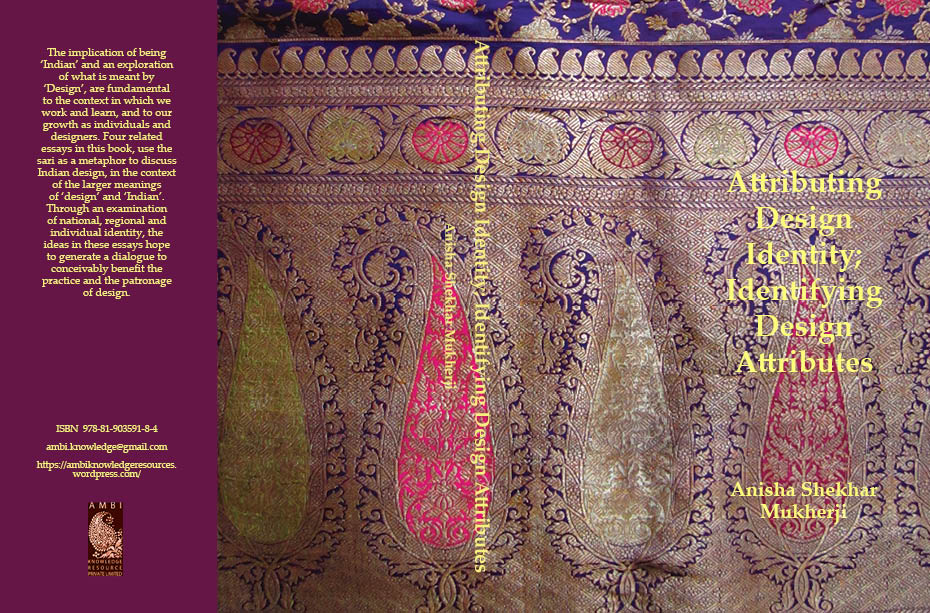
Attributing Design Identity

Taking off from the previous talk on Design Thinking and Attributes of Identity (see Design Thinking – and the Idea of India) this talk is a continuation of the exploration of the relationship between design and identity.

Through a comparative analysis of the meanings of ‘modern’ and ‘Indian’, as seen in contemporary and earlier pieces of architecture and design in India, we see how culture, society and philosophy affect aesthetics and ethics – and thus, the appreciation or articulation of design.

Both these talks were prepared and recorded as part of an online set of public lectures for the students of the School of Architecture, World University of Design in February 2021. For more information on the rest of the talks in the series, please see http://anishashekhar.blogspot.com/p/talks-and-videos.html

https://youtu.be/u3i0y_QnZe0


Folk Arts of India: Madhubani

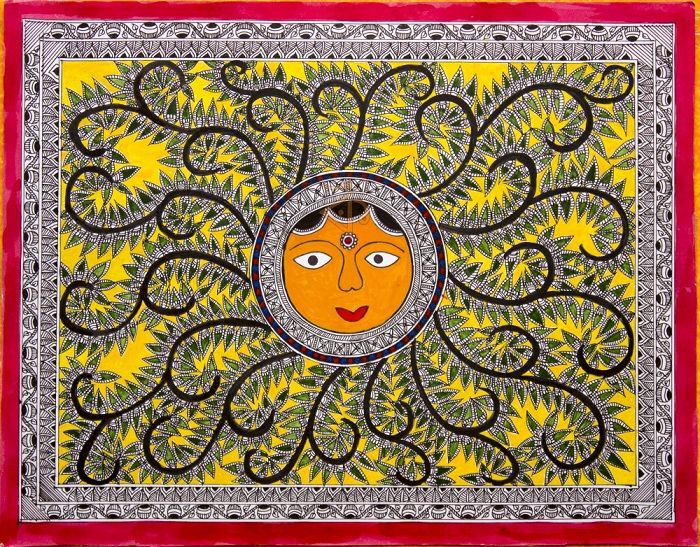
Image Credit : https://www.artzolo.com/traditional-art/sun-madhubani-painting?id=71024

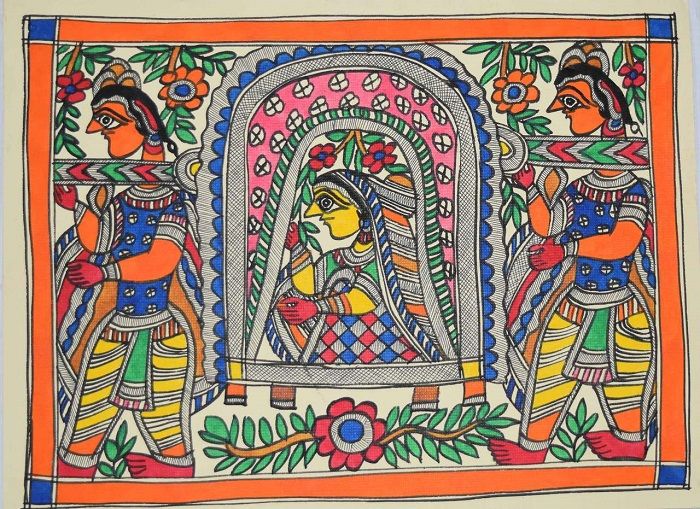
Madhubani Art form, also referred to as the Mithila art form is a style of Indian paintings that finds its roots in the northern Bihar region of India and the lower regions of Nepal. The Madhubani art form is remarked and characterized by the complex geometrical patterns that these paintings employ to represent ritualistic content of occasions such as festivals etc.

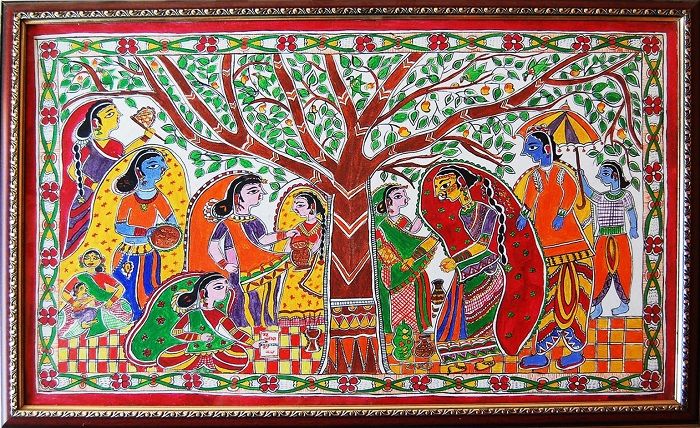
Madhubani paintings find their origin in the Mithila region of Bihar. The tale of Madhubani paintings goes back to the times of Ramayana where it is said that when King Janaka, the father of Sita, had asked the painters of his kingdom to create paintings for his daughter’s wedding, the art form came into existence. From there the knowledge has been passed down to generations and the paintings have beautified the homes of people illustrating thoughts, hopes and dreams.

Image Credit : http://mpcrafts.com/product/madhubani-painting-king-queen-perform-worship-big/

In its initial phases, the Madhubani art form was practised by different strata or sects of peoples which led to the categorization of the art form into five categories viz. Tantrik, Bharni, Godna, Katchni, Khobar. However, with the dissolution of sect and caste-based lines in contemporary times, these styles of Madhubani art form too have fused together. The theme of the Madhubani paintings is heavily focused on the Hindu deities like Krishna, Rama, Durga etc along with heavenly bodies like the sun and the moon. The paintings also illustrated the scenes of the royal courts and social events like weddings and festivals.

Image Credit :https://www.fizdi.com/madhubani-painting-art024-dulhan-in-doli-art_2168_24963-handpainted-art-painting-15in-x-11in/

The Madhubani paintings are the most famous for their use of complex geometrical figures complemented with the simplicity and the use of brush and the colours often sourced from natural resources. The paintings are predominantly made using powdered rice, along with colours that were extracted from pollen, pigments, turmeric, and leaves and flowers from an array of trees. The empty spaces in the paintings are often filled in with motifs of the flowers, animals and geometrical patterns.

The Madhubani art form is surviving and thriving due to the efforts of the artist who work day in day out to make the world aware of the Madhubani art form. Some notable artists in the domain are Sita Devi, Ganga Devi, Mahasundari Devi and Bharati Dyal. The Madhubani art form is kept alive by institutions such as Kalakriti in Darbhanga, Benipatti in the Madhubani district.

The Madhubani art form is the storehouse of aspiration of the common people illustrating everything from their beliefs to hopes and thoughts.

Independent Project by Abhinav Sharma
Guide ⇒ Prof. Manohar Khushalani

References :

  1. Madhubani Paintings – Cultural India
  2. Madhubani Paintings: People’s Living Cultural Heritage


Folk Arts of India: Gond

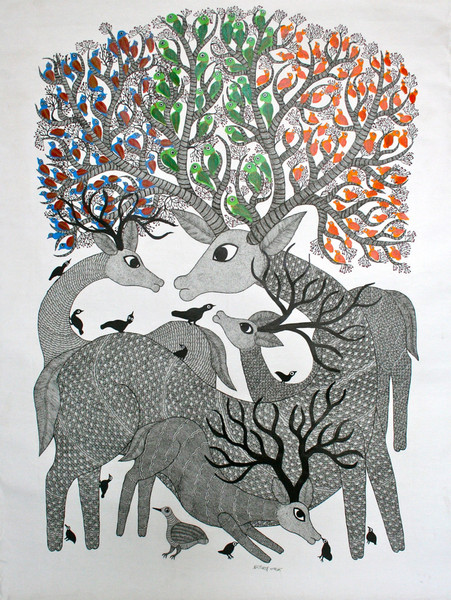
Painting By Jangarh Singh Shyam – Jean-Pierre Dalbéra via Flickr

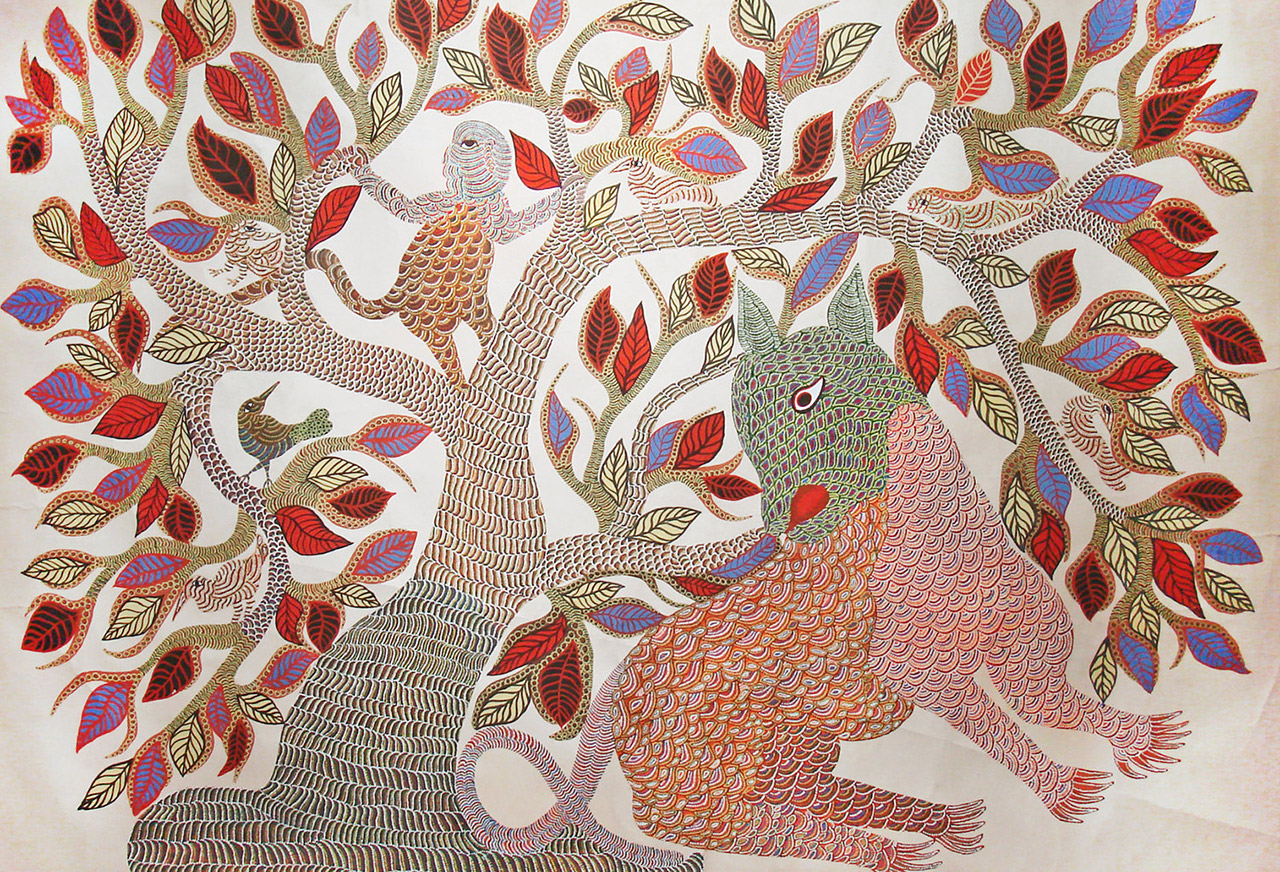
Gond art form, as the name suggests is the art form that is practised by the largest one of the largest tribe in India, i.e. the Gond tribe which is housed in central India in the states of Madhya Pradesh, Chattisgarh etc. The word Gond derives its roots from the Dravidian expression, Kond which implies ‘the green mountain’. In the recent times, the importance and the value of the Gond art form has gained such zeinth that the Indian government has stepped in to preserve and profess the art form.

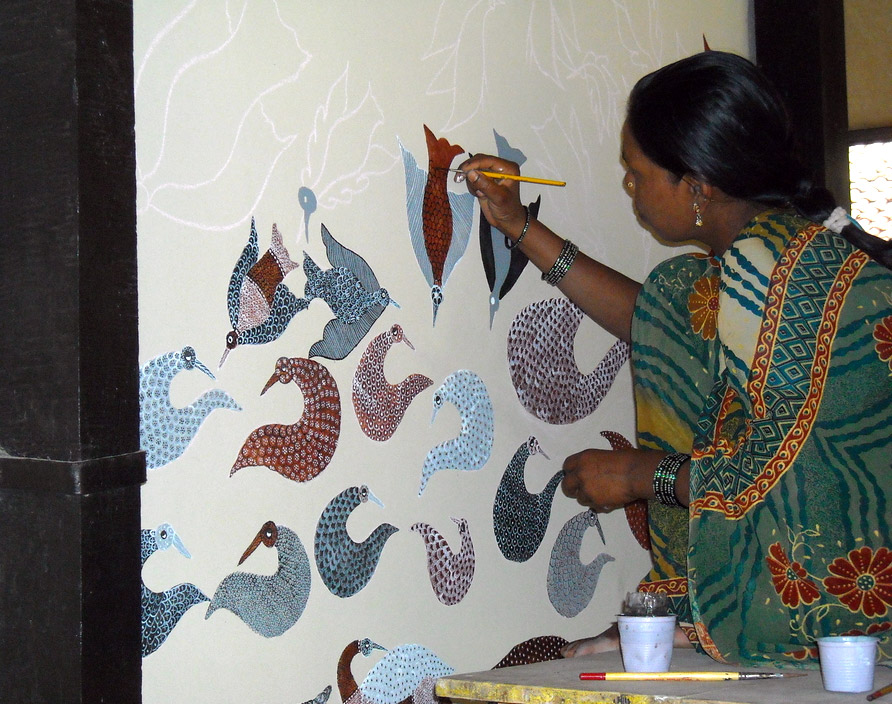
In the central regions of India, paintings have been flourishing since the 1400s. Paintings are an integral part of the Gond traditional practices. The Gonds were of the opinion that viewing images and paintings brought in good luck for them and helped them gain prosperity. The tribe also used the art form to pass on the knowledge of history down the generations. It is due to this very reason that the Gonds traditionally have been creating motifs, tattoos etc. on the floors, walls of their homes.

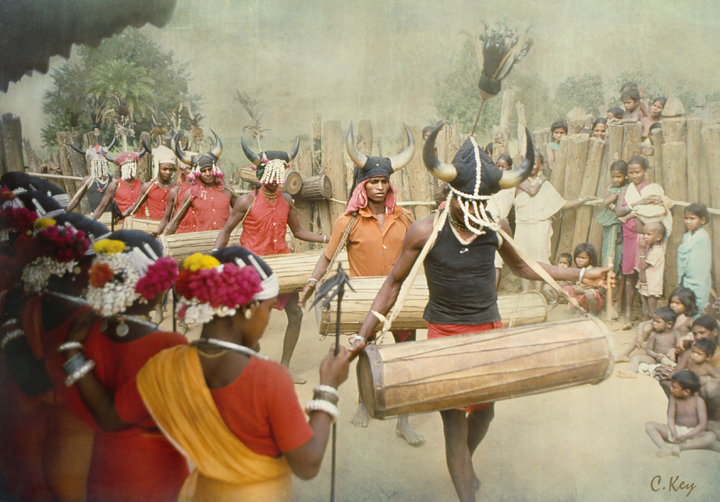
Muria people a part of Gondi Tribe – Collin Key via Flickr

For the Gonds, the art form is a means to illustrate the close connection the people share with the spirit of nature. The Gonds were of the strong faith that every natural element be it the mountains, the sun, the rivers had a spirit in them. For the people, recreating these acts in art was an act of worship and reverence to that spirit. The mighty Indian mythologies are some other sources of inspiration for the Gond art form.

The Gond art form has striking features in the way the lines are drawn in them in such way that pique the curiosity of the viewer into the subject instantly. A sense of movement and flow was established by the use of waving lines and curvy strokes. The spread of the dots and the dashes in the Gond paintings complement the geometric shapes and patterns employed. The art form regularly employed the shapes like that of fish, water droplets to etch out an expressive value and weight to the painting.

The Gond art form employed sharp, defined colours in the paintings with the canvas being dominated by bright hues of red, yellow and white background to highlight the contrast. The sources of the colours were all natural ranging from plant sap, coloured soil to charcoal.

The Gond art form in contemporary times has reached the global scale with the efforts of modern artists and the steps of the government to preserve the art form.

Independent Project by Abhinav Sharma

Guide ⇒ Prof. Manohar Khushalani

References :

  1. Gond Art : A Folk Art Form with Beautiful Tribal Colours, Themes, and Shapes
  2. Gond Paintings – Capturing the Life and Essence of One of India’s Largest Tribes


The General having crossed a Torii boundary – Drawing with a Torii and a figure

The trajectory of my art practice takes on a zigzag path sometimes; and at other times a circuitous one or a U-turn that I didn’t expect to take.
The work “The General” is one such. I started off with figure sculptures and then went on to study life drawing at Boston University.


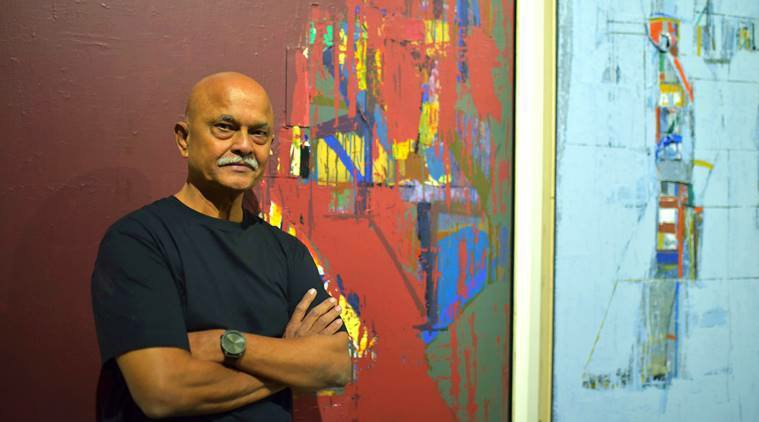
Abstractionist Prabhakar Kolte’s Exhibition,’The Mind’s Eye’ opens 9th Oct

Prabhakar Kolte

Prabhakar Kolte was born in 1946 and received his Diploma from the Sir J.J. School of Art, Mumbai in 1968. He also taught there between 1972 and 1974. His early works show a strong influence of Paul Klee, the Swiss artist and teacher whose child like figures belie the sophistication of his richly textured surfaces.

Treasure Art Gallery
cordially invites you to the Preview of this

Veteran Abstractionist, Prabhakar Kolte’s
the seminal exhibition The Mind’s Eye

Curated by Uma Nair
Inauguration by Ritu Beri

The other dignitaries who will be a part of the exhibition opening and inauguration are Shri. Adwaita Gadanayak, Director General, NGMA; Shri. Dinesh K Patnaik, Director General, ICCR; Diplomats; Eminent Artists; Prominent Gallerists & Art Collectors.

The Mind’s Eye by Prabhakar Kolte
Treasure Art Gallery
9th October, 2021, 6pm onwards
D/24, Defence Colony, New Delhi – 110024

The Preview will be followed by wine and cheese
The exhibition will be on view until 10th December, 2021. Monday-Saturday, 11am-7pm

R.S.V.P.
Anuj Kumar Boruah/ Shakti Raj Vidyarthi
Conversations Unbound
+91 9958372662 / 9711118189
anuj@conversationsunbound.com


Folk Theatre Forms of India: Tamasha

Tamasha is considered a major traditional dance form of the Marathi theatre, which includes celebration filled with dancing and singing and is performed mainly by nomadic theatre groups throughout the Maharashtra region. The word “Tamasha” is loaned from Persian, which in turn loaned it from Arabic, meaning a show or theatrical entertainment.​1​ In the Armenian language, “To do a Tamasha” means to follow an exciting and fun process or entertainment. Unofficially, this word has come to represent commotion or display full of excitement.​1​ The traditional form of Tamasha was inspired by a lot of other art forms like Kathakali, Kaveli, ghazals etc.

The region of Maharashtra had a long theatrical tradition, with early references to the cave inscriptions at Nashik by Gautami Balashri, the mother of the 1st-century Satavahana ruler, Gautamiputras Satakarni. The inscription mentions him organizing Utsava’s a form of theatrical entertainment for his subjects.​1​ Tamasha acquired a distinct form in the late Peshwa period of the Maratha Empire and incorporated elements from older traditional forms like Dasavatar, Gondhal, Kirtan etc. Traditional Tamasha format consisted of dancing boys known as Nachya, who also played women’s roles, a poet-composer known as Shahir, who played the traditional role of Sutradhar, who compered the show. However, with time, women started taking part in Tamasha.​2​

Marathi theatre marked its journey at the beginning of 1843.​3​ In the following years, Tamasha primarily consisted of singing and dancing, expanded its range and added small dramatic skits known as Vag Natya.​3​ These included long narrative poems performed by the Shahir and his chorus, with actors improvising their lines. There are two types of Tamasha dance forms: dholki bhaari and the older form known as sangeet baari, which contains more music and dance than drama.​4​

The government of Maharashtra has instituted annual awards in the memory of the late Vithabai Narayangavkar Lifetime Achievement Award for those who had extensively contributed to the preservation of the Tamasha Art form throughout the world.​1​

_________________________________
Independent Project by Sezal Chug
Guide: Prof. Manohar Khushalani
__________________________________

  1. 1.
    encyclopedia wikipedia. wikipedia. Tamasha. https://en.wikipedia.org/wiki/Tamasha

  2. 2.
    encyclopedia britannica. tamasha. tamasha. https://www.britannica.com/art/tamasha

  3. 3.
    tourism maharashtra. tamasha. maharashtratourism. https://www.maharashtratourism.net/culture-lifestyle/dances/tamasha.html

  4. 4.


Social Distancing or Physical Distancing? / Archana Hebbar Colquhoun

                                                   a sculptural representation

Seated Man
Seated Man

Covid-19 and Social Distancing

The current global coronavirus pandemic leading to COVID-19 shows no signs of dying a natural death; far from it, we are nowhere near finding a solution to arresting the spread of the virus.  The virus appeared mysteriously and suddenly, infected some, multiplied rapidly, hitch-hiked by various means and entered all parts of the world – sparing no region. It underwent numerous mutations during its journey around Planet Earth and half a year later still stays firmly away from the grasp of human comprehension.

This uncontrolled, worldwide pandemic has completely transformed our lives and we have come up with one rather simple behavioral method and the only known effective one so far to cope with this situation. The world’s lingua franca has given it the name “Social Distancing.” The English language is highly adaptive. But the language is also very adept at coining specious terms. These terms are then taken up unquestioningly by anyone speaking any language, anywhere in the world.

I would like to discuss, using one of my sculptural works, the connotative meanings of the term “Social Distancing.” As a more suitable term to use in the COVID-19 context, I would suggest the term “Physical Distancing.

A Sculptural representation

The subject of this article is a sculpture of a seated man. It is the third in the series of five sculptures that I made in Tokyo, in the late 80s. These sculptures are based on specific people I saw on the streets of “Calcutta,” in the early to mid-80s. I did not and could not strike up a conversation with any of them. Perhaps I did not have the strength of spirit to connect with them through verbal communication. I had my own problems and I felt just as helpless as they did or perhaps they did not even feel the same sort of disempowerment I felt. They were, for all I know, stronger in spirit than most and had the mental strength to accept their condition and live a functional life with a reasonable level of happiness and fulfillment.

The reason for the absence of an interaction with any of the individuals I saw and passed by on the streets of Calcutta that year in the early to mid-80s was revealed to me gradually, over the years. This happened through certain specific experiences I had with people, belonging to different groups, in various countries. These experiences were, what I would call, mundane and of little import when taken from the point of view of a day to day existence. To me, however, they were eye openers. These experiences signified to me the true meaning of the currently much bandied about term “Social Distancing.”

I posted a write-up about my second sculpture in the series, crawling man, titled “The World on its Hands and Knees,” since the person the sculpture was modeled on represented to me the condition that all of us are in now – our lives ruthlessly controlled by a global pandemic caused by a bio-chemical entity, the coronavirus, that exists in that nebulous state between living and nonliving.

The fear of COVID-19 is real, palpable, and terrifying because we have no understanding of the workings of the coronavirus. A term with a very specific meaning has been coined to describe the physical distance each of us needs to maintain with everyone except for the few people with whom we share a living space, excluding even your blood relatives if they happen to live in separate accommodation.

This physical distancing is termed “Social Distancing.”

Social Distancing vs Physical Distancing

“Social Distancing” is entirely erroneous as a term to describe the sort of distancing we need to maintain between each other during this pandemic. The ‘distancing’ is necessary so as to not catch the virus from people with whom interaction is unavoidable, termed essential workers, and spreading the virus to other individuals.

Social Distancing as a practice is nothing new; it has always existed in all societies, in one form or another. It is implemented and controlled by a small minority of agents of power, be they the ruling elite, the strong amongst the weak etc.  Using the term “Social Distancing” in the present situation to describe a prescriptive behavioral form of maintaining physical distance to avoid spreading of COVID-19 that applies to all, irrespective of their social standing, performs the task of validating, insidiously, the deep social divide, wide-spread all over the world. The term gives credence to the institutionally managed segregation of communities that disempowers large groups of people based on their color, ethnicity, economic standing, gender, etc., and people with physical disabilities. These groups of people live a socially distanced life. I have not included other groups or even people with disabilities that are not to do with the visible physical body, in this discussion.

Persons with physical disabilities

Among the many disempowered groups of people, such as those listed above and others, it is the group of people with physical disabilities that are uniquely placed as the ones whose lives are more severely affected by social isolation and the resulting social distancing.  A person with physical disabilities is a single individual, often experiencing a sense of separation even within their own family. Although living a socially distanced life like many other groups of people, a person with a physical disability is alone in their disability as each form of disability is different from another. The extent and nature of the disability depends on individual factors and the person with a disability does not belong to a clearly identifiable collective.

Examples of a ‘collective’ would be an ethno-racial social group or a community of economically deprived families, living in ghettoized, marginalized conditions. Accordingly, a person with disabilities lacks the emotional support system that individuals belonging to other disempowered groups with shared problems and a common identity have.

 The social and emotional isolation of people with a physical disability may be the result of congenital factors, of deliberate acts of cruelty, accidents, and even more shockingly and tragically due to poorly understood medical treatments. These treatments are administered hastily, not having been properly verified but widely hailed as effective, and any side-effects resulting from the treatment, which may be severe and irreversible are identified only when the damage is already done.

As mentioned earlier, physical disabilities can include a whole range of conditions, including ones that are not readily visible to others or those that entirely escape the notice of people who are strangers to the person with a disability.

A physical disability of a particular kind and why it became the subject of my sculptures

The form of physical disability I chose to highlight through the set of five sculptures belong to the one category of people (four of the sculptures referring to actual individuals I saw), who are either born with or developed later in life anomalies (in medical terms a “deformity”) in their bodily structure. Their limbs, extremities, and craniofacial features affect how they are viewed by others and the bodily movement and functionalities of the people in this category are restricted to various degrees. Often, the stark visual nature of their physical characteristics, entirely unique to each individual and the disabilities being specifically their own, marks them apart from others. They are denied a sense of belonging to a community. Inarguably, the social and emotional isolation that the people in this group experience compounds their day to day difficulties and increases their dependency on others. The subject was compelling and I was and still am deeply affected by the life situation of people with disabilities who have readily visible “malformations” of the body.

Before I talk about my sculpture, seated man, and the form and content of the work, I would like to make clear my rationale and impetus behind selecting, as subjects of my artwork, people with physical characteristics that restrict their mobility and whose body structure does not conform to expected norms. If the motivation for doing the set of sculptures is not already evident from the foregoing discussion, I would like to stress that by doing these works I want to bring to light the pain and suffering of these individuals, which is singularly their own.

These set of sculptures may be deemed voyeuristic, distasteful, and even lacking in basic human sensitivity and compassion on the part of the artist.  This is one reading of the work, and from the point of view of the artist, that is me, the reading reflects the reader’s/viewer’s own point of view, which does not allow them to extend their understanding of what an art work stands for, the compelling motivations of the artist for doing works of this kind, and the complex web of meanings the artwork holds. These meanings of the artworks constantly change and come to light depending on the context in which they are presented and the nature of the audience. There may be no specific target audience in the mind of the artist when a work is created, unless the work is commissioned by a specific patron with clear-cut requirements. My set of works are entirely self-motivated and created with no specific audience in mind.

It is my conjecture that the seated man, who in all probability was homeless, had a congenital condition that caused the shortening of his arms but evidently with strong musculature in the upper and forearms, both structurally relocated and joined in such a way as to provide for an elbow function. The formation of the arms had a certain degree of symmetry, in that the arms had the same proportion and structurally related to the rest of the body in a similar manner.

The Sculpture of a seated man

Middle Image

A seated man, homeless perhaps, his posture is almost that of a yogi. His torso is upright and handsome. He sits with his legs folded under in the yoga pose of Vajrasana, holding a stick in one hand for support. His arms are strong, although shortened. They are connected securely to his shoulders in a “standard” anatomical position. His head is turned sideways to view something that he caught sight of from the corner of his eyes. He used his very own form of transport, a little trolley, which I edited out from the sculpture. This I did so as to give prominence to the figure of the man who bore himself with dignity to the extent he could, given his circumstances. The trolley would have been a distraction and would have drawn attention to his disability.

Whatever innate dignity his physical demeanor may have presented, he was still an outcast – homeless, living on the streets, and displaying those physical features that the vast majority of people could not relate to and from whom they maintained a clear social distance.

The social distancing of people such as the seated man has no relation to the “Social Distancing” prescribed by the governments of all countries for tackling COVID-19. What is needed in the present circumstances is “Physical Distancing.”

If the indignity of a subtle form of social distancing was not enough, the seated man spending most of his time on the pavement had people walking past him, occasionally tossing a few coins in his bowl, who practiced a more blatant form of “physical distancing;” whereby, when they passed him on the street, they kept a distance that was more than necessary. This they did to make certain that they avoided contact with him. They walked past him by making a wide arc of a semi-circular curve using a quick motion to go past him, in the shortest possible time.

Practicing social distancing in relation to people isolated from the mainstream of society existed way before COVID-19 gripped our lives.

Displaying the work in an art gallery

Last Image

In order to express the combined qualities of dignity and social isolation of the seated man, the figure was placed directly on the floor of the gallery on the first day of the show, and from the second day of the show until the closing of the show the figure was placed on a pedestal, which not only isolated him but also provided him with an elevating platform, giving him the dignity he deserves.


Dharti Arts Residency 2018 | Public Talks – Pallavi Paul | 13 June

Serendipity Arts Foundation

http://www.serendipityartsfoundation.org/

Dharti Arts Residency 2018
————————————————————

As part of its programming, Dharti Arts Residency 2018 is hosting a series of public talks by artists, performers, and cultural practitioners. Invited speakers will give an illustrated lecture about their practice, which will be followed by a conversation with the audience.

13-06-18 | 6pm – 7.30pm
Find Out More (http://www.serendipityartsfoundation.org/)

============================================================