Kala Sankul Brings Art, Reflection and Devotion Together through “Yugpurush”
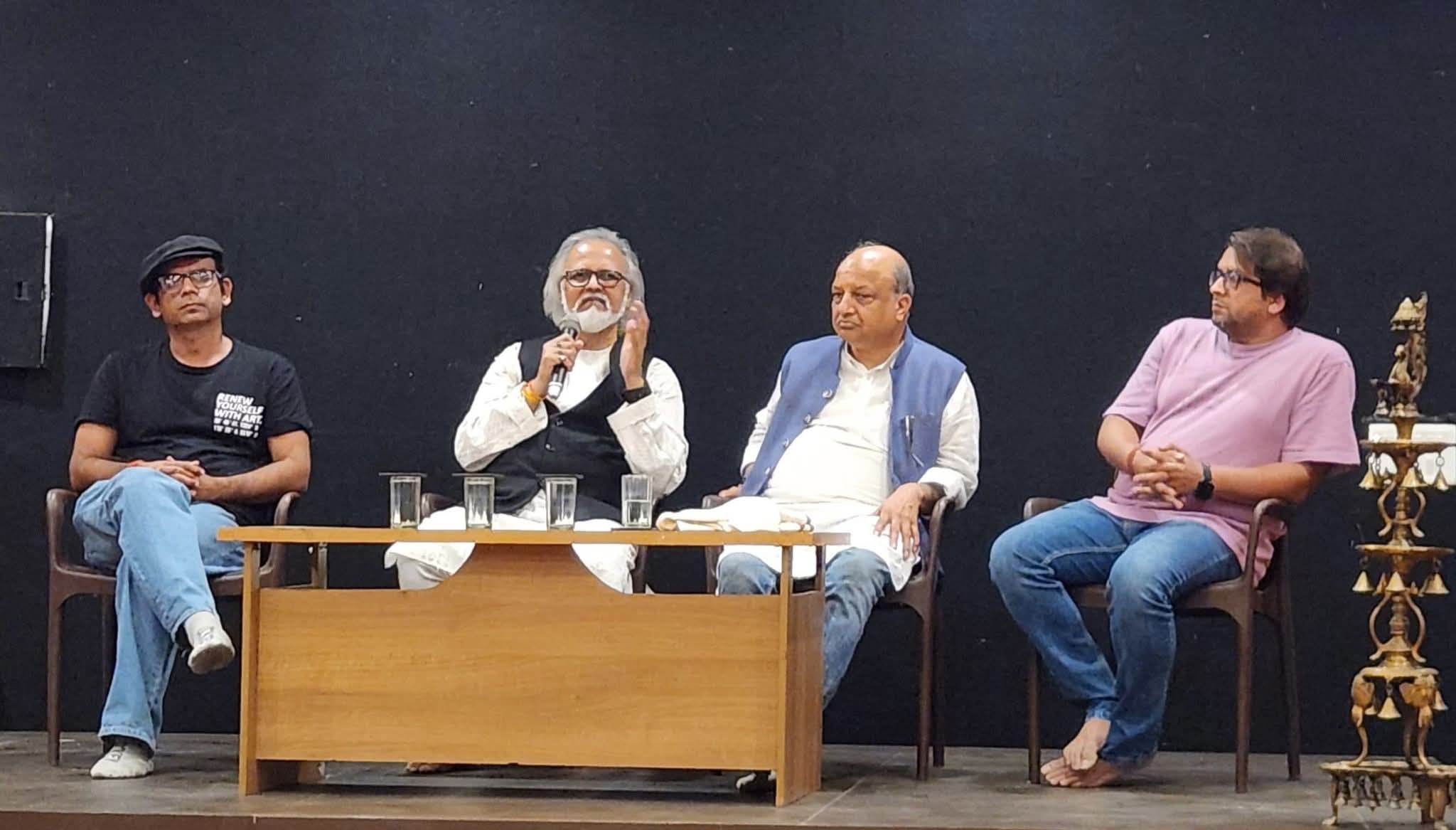
New Delhi, October 26, 2025 — A thought-provoking Theatrical Review Symposium was organized at Kala Sankul, the cultural hub of Sanskar Bharati, on Sunday. The event commenced with the traditional lighting of the lamp, symbolizing the illumination of knowledge and creativity. Present on the occasion were Mr. Ashok Tiwari, Convenor of Kala Sankul; Mr. Rajesh Jain “Chetan”, Chief Guest; Mr. J.P. Singh, playwright and director of the featured play; and veteran theatre artist Mr. Avtar Sahni and Mr. Raj Uadhyay.

Kala Sankul, a vital initiative of Sanskar Bharati, aims to bring together the diverse dimensions of Indian art and culture on a shared platform. It is not only a space for artists to engage in dialogue, critical reflection, and self-exploration, but also a medium for the promotion of Indian life values and creative traditions.

As part of this ongoing initiative, a theatrical review session was held on “Yugpurush”, a play presented by Rangbhoomi Delhi. The play is based on the lives of Sri Ramakrishna Paramhansa and Swami Vivekananda, portraying the era when young Narendra had not yet become Vivekananda but was progressing toward self-realization and spiritual awakening.

Before the discussion, select impactful scenes from the play were screened for the audience. This was followed by an engaging interaction with the play’s director Mr. J.P. Singh, along with Mr. Vipin Kumar (as Ramakrishna Paramhansa), Mr. Sudhir Rikhari (as Swami Vivekananda), and Chief Guest Mr. Rajesh Jain “Chetan”.

During the session, Mr. Rajesh Jain recited one of his beautiful poems, which resonated deeply with the spiritual essence of “Yugpurush.” The discussion explored how the actors internalized such profound and spiritual roles—how portraying these revered personalities influenced their own perspectives and inner journeys.

Playwright Mr. Jayvardhan (J.P. Singh) shared insights into the creative process, explaining that “Yugpurush” is rooted in the sacred guru-disciple relationship, where both teacher and student act as reflections and complements of one another—together forming a spiritual unity that continues to inspire generations.

Following the review, Mr. Sudhir Rikhari rendered a soulful bhajan that filled the hall with emotional and devotional serenity, perfectly complementing the theme of the play. The musical moment brought an air of peace and reverence, leaving the audience deeply moved.

The play also featured notable performances by Arun Sode, Tripti Johri, Shuddho Banerjee, Gaurav Verma, Jitendra Chauhan, Ravi Parcha, Kaustubh Pandey, Anurag Malik, Sangeeta Suyal, Shreya Agarwal, and Hari Singh Kholiya. All the artists were felicitated by the Kala Sankul family with traditional angavastras and potted plants as a mark of respect.

The success of the event was made possible through the dedication of many committed contributors, especially Ms. Bharti Dang, who served as the Convenor and gracefully anchored the entire evening. Special appreciation was also extended to Shruti Sinha, Garima Rani, Sneha Mukherjee, Raj Upadhyay, Shraboni Saha, and Harshit Goyal, whose efforts and enthusiasm ensured the program’s memorable success.

With every monthly symposium, Kala Sankul strengthens its resolve to celebrate India’s artistic heritage and inspire new generations of creative thinkers. It stands as a living testament to the belief that art, when rooted in cultural values, becomes a guiding force for individual and social transformation.


Yugpurush: The Soul of the Guru–Disciple Tradition and the Splendour of the Stage

On 18th August, the historic Kamani Auditorium in New Delhi witnessed a theatrical evening that transcended performance and turned into a soulful experience. “Yugpurush”, written and directed by Jayvardhan (J.P. Singh), offered precisely such a rare journey. Through this play, the director dared to bring to the stage the confluence of the guru–disciple tradition, spirituality, and human inquiry—and this daring vision succeeded on every level.

The performance began with the grand worship of Goddess Kali. The resounding beats of the dhak, the echo of conch shells, and the chanting of priests transformed the stage into a sacred temple. This was not just a religious tableau, but a conscious theatrical choice, transporting the audience to the spiritual ground where the journeys of Vivekananda and Ramakrishna began. Here, the culture of Bengal does not remain a mere backdrop but emerges as an inseparable part of the narrative. Costumes, music, and dance brought the stage alive—red-bordered saris, traditional dhotis, the melodic flow of kirtans, and classical gestures combined to transcend time and space, carrying the audience to nineteenth-century Calcutta.

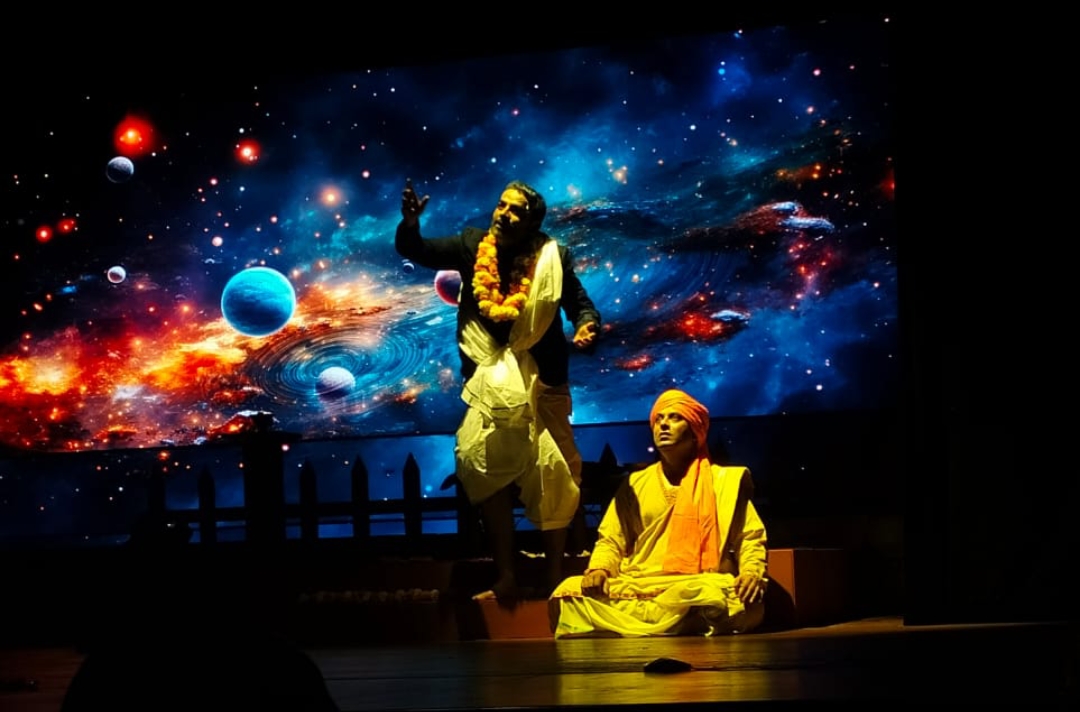
One of J.P. Singh’s greatest strengths lies in his ability to balance tradition with modern theatrical technique. Stage design and lighting were not confined to creating atmosphere; they actively deepened the play’s philosophical resonance. Whether it was the steps of the Dakshineswar temple or the historic moment of the Chicago Parliament of Religions, projections and scene transitions provided not only dramatic flair but also symbolic depth. Light at times expressed Vivekananda’s inner turbulence, and at other times lingered on the compassionate smile of Ramakrishna.

The soul of the production was carried by its performances. Vipin Kumar, as Ramakrishna Paramhansa, infused the role with simplicity and spiritual radiance, making the presence of divinity palpable on stage. His compassionate gaze and subtle smile did not merely represent the character—they embodied it. Sudheer Rikhari, as Swami Vivekananda, brought to life the disciple’s inquisitive, logical, and energetic spirit. His voice and body language rekindled the memory of that historic moment when Vivekananda introduced Indian philosophy and spirituality to the world in Chicago. Together, their performances created the heartbeat of the play—the tender assurance of the guru alongside the restless questioning of the disciple, ultimately merging into a profound philosophy of life.

The greatest strength of Yugpurush is that it is not a simple dramatic recreation of historical or mythological figures. It is, at its core, a philosophical journey. Vivekananda’s scientific rationality and Ramakrishna’s devotional fervor converge to remind us that even today the true path of life lies in balancing these two poles.

A special note must be made of Jayvardhan (J.P. Singh). As both playwright and director, he proves that theatre for him is not merely an art form but a medium to bring life-philosophy to society. His writing lends depth to the dialogues, while his direction renders them alive both visually and aurally. For him, theatre is not simply “entertainment” but a path to “self-realization”—and this is the play’s greatest achievement.

In the end, “Yugpurush” is not just a stage production; it is a call of the soul. It demonstrates that the union of devotion and reason is the true essence of life. Even after the curtain falls, the experience resonates within the mind for long—and that is the hallmark of truly great theatre.