A home is without any doubt a safe space, an extant that has the infinite capacities to being ourselves; where our clothes need not be washed or ironed and made to be presentable all the time; our unkempt unshaven looks draws no contempt from the gazing mirrors; cutlery can be limited to eating straight out of the pizza box with greasy tissues thrown carelessly all over the floor; and leisure is our pass time and idyllic conversations the only competing games. The debate arises then, if we choose to keep this space out of bounds for others, however familial or close. It is the truth that only when we get this free entitlement to closing these doors of our room, shutting out those as being totally non transgerressable, barring these latitudes out of anyone’s reach, do we get a veracious sense of belonging. The arguments arise loud and the cacophony grows louder only when we keep these augmented heavens exclusive for our winged flights, leaving others alone and far behind in what they see as their black earth.
Adoring such realities, one, is discerned to be “ unconventional” or can I say “ odd” to the normal public eye. However, if we all sieve through the thoughts running in our minds, we come to this realization, that all of us wish for an exclusive home, that only belongs to us and only to us. This hearth does not see the privilege only of the “single status” fancy holding few, but to all, men, women or children. All, I see as wanting to create an expanse of an unparalleled area that echoes our only headrooms. We then come to conclude that we are faithfully heard. Our tete-a tete might be limited to the capacity of recording random intramural thoughts, however, inner, however wordless, or however out of tune for others, it forever plays as a beautiful melody for our ears.
We, unfortunately, are created as social byproducts and often have to assume suggestive capacity giving roles, inundated with responsibility and risk. The risk that we can carve out then, for our own employment seems much easier and much more responsible. If created exclusively for us, they are results of accurate victories as being free of failure in the eyes of others. As the endeavours seeked are for our own purview; and we are un-mockingly forgiving towards ourselves, we sense a literal liberty. Thus being unrestrained from scorn, and disdain, we seek everlasting joy in solitude, and despite being born into a home, I see the human mind seeking and wandering eternally in the search of this unerring habitat. If our birth homes can define and allow such unconfined liberties, uncontested un-contemptuous ways, will only then, this never ending sojourns of seeking of ours to belong, cease and stop to identify the true borders of a hinterland. Let’s become companions to the exodus of the few and return thus to our realistic homes.
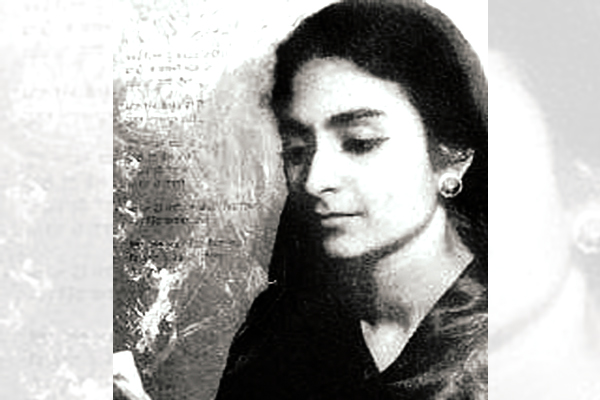
About Amrita Pritam / Kanika Aurora
If you truly wish
To write the story of your life
All you must do
Is to bleed
On the blank pages…
These are the words of Amrita Kaur; born a hundred and two years ago, sparkling with uncommon fire in Gujranwala, Pakistan who afforded us a glimpse of her promise shortly after her mother had passed away despite her furious and fervent prayers to the Almighty. Questioning her grandmother about the perplexing tradition at home of keeping her father’s Muslim friends’ utensils in a segregated corner in the kitchen, an activist at eleven, refusing to drink in any other glass until all glasses belonged to one religion. Her first ‘baghavat(rebellion)’, as she called it.
Constantly unafraid, she wrote with much fervour and managed to churn out her first collection of poems published in 1936, at the age of sixteen entitled ‘ Amrit Lehrein (Immortal Waves)’.Getting married off soon after to Pritam Singh did not rob her of her resolve or gift and write she did; finding solace in her inner world and words as Amrita Pritam.
Her first distinguishable progressive streak in writing became rather apparent when she wrote of the anguish and the socio-economic concerns of the hour in ‘Lok Peed’ (People’s pain), in 1944. Here, she criticized the state of the economy after the Second World War and the terrible agony suffered by all during the Bengal famine in 1943. It was however in 1948, post the Indian Partition in 1947 and its innumerable and unspeakable horrors, that Amrita wrote her now iconic poem ‘Ajj aakhan Waris Shah nu’ ( Today, I invoke Waris Shah)which made her a household name in India and Pakistan alike.
Ajj Akkhan Waris Shah nu/ Today I invoke Waris Shah
Speak from the depths of the grave
To Waris Shah I say
And add a new page to your saga of love
Today.
Once wept a daughter of Punjab
Your pen unleashed a million cries
A million daughters weep today
To you Waris Shah
They turn their eyes.
Awake, decry your Punjab
O sufferer with those suffering!
Corpses entomb the fields today.
The Chenab is flowing with blood,
Mingled with poison by some
And the waters of five rivers
And this torrent of pollution
Unceasingly covers our earth.
And heavy with venom were the winds,
That blew through forests
Transmuting into a snake
The reed of each musical branch
With sting after sting did the serpents
Suppress the voice of people….
Where can we seek another like Waris Shah today?
Only you can speak from the grave
To Waris Shah I say
Add another page to your epic of love today. (Translated by Amrita Pritam)
In 1950, her novella Pinjar(Skeleton); arguably one of the finest and foremost depiction of the Partition from a woman’s perspective was published and gained much acclaim. It was adapted and made into a Hindustani movie in 2002 produced in Bollywood(Mumbai). In this story, Amrita wrote passionately about the plight of scores of Hindu, Muslim and Sikh ‘nowhere women’ who were abducted, raped or killed as well as those who somehow managed to return but were never accepted back into their families for being ’tainted’. It was a strong comment on the hypocrisy of the societal norms of the day and fiercely feminist and critical in tenor and managed to make quite an impact on the conservative collective consciousness at the time. Some of her later work, notably ‘Kaal Chetna’(Consciousness of Time), Aksharon ke saaye(The shadow of words) and Kaala Gulab(Black Rose) all had a serious rebellious flavour.
The trauma of partition and the shackles of patriarchal society which relegated Punjabi women to the kitchen, behind the veil forever lamenting their unspeakable grief in hushed tones to each other or in innumerable pathos laden Sufi folk songs; Amrita Pritam emerged as a fearless voice from amongst them and made a name for herself despite being criticized, condemned and even threatened braving the odds.
Speaking of socially relevant purposeful literature and the Progressive Writers Movement (from1930s till after Independence) which sought to inspire people through the written word championing the cause of equality and condemning social injustice; one tends to recall Munshi Premchand, Faiz Ahmed Faiz, Kaifi Azmi, Sajjad Zaheer , Majaz, Manto, Ismat Chugtai, Krishan Chander and Bhishm Sahni to name a few; Amrita Pritam who initially indulged in romantic poetry had joined the movement and went on to create and express her own brand of revolutionary ideas in an original voice strongly and soldiering on.
Post Partition, she began working at the Punjabi service of All India Radio in Delhi, where she had moved from Lahore and continued serving there till 1961.
Mera Pata/My Address
Today I erased the number from my house
and got rid of the street name from the top of the road
Wiped off the names from all the street posts
But if you are really keen on finding me
Then go knock on the door of each house
Of every street, of every town in every country
This is a curse
This is a blessing
For wherever you come across a liberated soul
Think of it as my home
As an alternative view of history luminously shines through her poems and stories that cut deep, laying bare raw grief and palpable despair which find little solace but for her words; her refuge; her “Akkhar’(Words).
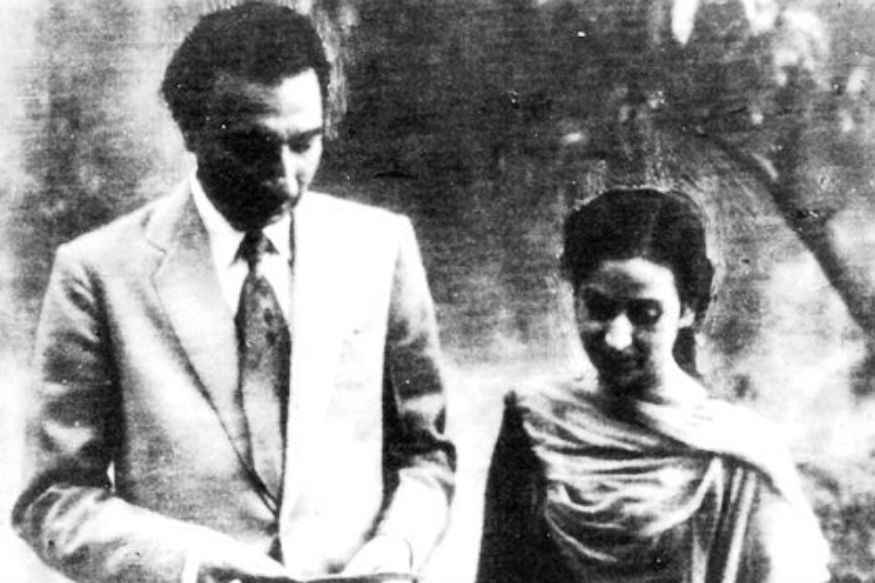
In her personal life, love came to her outside her marriage in the form of Sahir Ludhianvi, the celebrated poet who became her muse of sorts and fiercest lifelong attachment… She was enamoured by his charm and did not keep her feelings under wraps and wrote him ‘Sunehey’(Messages) which won her the Sahitya Academy award in 1957. Interestingly, at the time her intense involvement with him which she describes in great detail in her autobiography “Raseedi Ticket(Revenue Stamp) recounts moments of prolonged silence between them with him smoking cigarettes and her saving the stubs and reigniting them in private. Another famous anecdote has her recalling a time when she was being photographed by a press reporter posing with a pen and paper on her table; she would scribble his name “Sahir”, filling up the age in a trance like state. That she would get turned on by languidly applying Vicks on his throat when he was a little under the weather and describe it in minute detail was considered extremely sensuous and not at all appropriate at the time. Her first meeting with him has been recorded for posterity in “Aakhri Khat” (The last Letter) and his dalliance with Sudha Malhotra, a singer in Mumbai resulted in Amrita suffering a clinical emotional breakdown. Her poems obviously took on a different hue speaking volumes of her unfulfilled longings, all rather semi erotic in nature and completely frowned upon in public yet devoured with relish in private fomenting some of the most original, paradigm shifting poetry of its time…
You do not come
Spring awakens and stretches its arms
Flowers weave their silk threads
For the festival of colour
You do not come.
Afternoons grow long
Red has touched the grapes
Sickles are kissing their wheat
You do not come.
Clouds gather
Earth opens its hands to drink
The bounty of the sky
Yet, you do not come…she laments.
Her desire for him is almost tangible and she openly professes to the poems being dedicated to him and admitting that her marriage was a loveless burden which she finally freed herself of in 1960.
Sahir and Amrita
In an interview to Carl Copolla she articulates, “The bonds and conventions of society are certainly reflected in my poetry, negatively, of course. But I think every intelligent person has to suffer…Suffering is the price the intelligent person has to pay. As for women, I feel that women in literature are different from women in other fields…Basically; there is a prejudice against women in literature. Men take women’s writing lightly; they doubt a women’s sincerity. For example, when I got this Sahitya Akademi Award, and with it fame, the leading English daily in Delhi wrote that I got my popularity in Punjabi literature because of my youth and beauty. I felt very sorry to read that. Why not talent? They can admire a beautiful woman, but not a talented one.”
In spite of innumerable constraints, she continued writing in her native tongue and started the publication of a Punjabi literary journal, ‘Naagmani’ (Serpent’s jewel) in 1964.
Translating poems of Edgar Allan Poe and Robert Frost n Punjabi as well as highlighting the work of emerging Punjabi poets and women writers; she worked relentlessly to create a healthy, aesthetic platform showcasing marginalized thought and voice.
It was an uphill task but she had a companion and a lover extraordinaire called Imroz who spent the last 45 years of her life dedicating his own to her cause.
Imroz allowed her to be.
Living with Imroz in an unconventional, uninhibited way, without formally marrying him at the time was again Amrita’s way of following her inner truth and at the time considered a remarkable revolutionary life choice.
In another instance, when she insisted, he roam around the world before taking any final decisions about them; he apparently got up and circumambulated around her seven times and said; “That’s done”.
Amrita and Imroz
“Father, Brother, Friend and Husband…the labels mean nothing.
When I set my eyes upon you, all these words became meaningful at once…she said of Imroz.
That was our tryst, yours and mine
We slept on a bed of stones
And our eyes, lips and fingertips,
Became the world of our bodies; yours and mine
They then made translations of this first book
The Rig Veda was compiled much later.
(An excerpt from her poem ‘Kufr’ )
Her book ‘Aurat(Woman)’deserves a special mention which carries interviews of scores of women activists and writers , translations of feminist writings from other languages and her own essays on issues such as prostitution, bride burning, women’s rights and the quest for liberation.
Her strength lay in her knowledge that her vision was shared by many others in other times and places.
She would often implore all who vociferously criticized her to give her a fair chance.
“I wish to ask all those who condemn me and my writings, do you wish to allow the fire of Punjabi writing to spread light all over or do you forcibly wish to bury it, silence it forever?
In her self- portrait poem, ‘Amrita Pritam’, she attempts to mirror her innermost core in very sparse, simple words.
“There was a pain
I inhaled it silently
Like a cigarette
There are a few songs
I have flicked off
Like ashes from the cigarette…
In a career that spanned over six decades, Amrita Pritam penned over a hundred works including poetry, essays, stories novels and biographies. Her works have been translated into several Indian and foreign languages.
Apart from the Sahitya Academy award for Sunehede in 1956, one of the highest awards for literature, Bhartiya Jnanpith Award was conferred upon her in 1982 for Kagaj Te Canvas (Paper and Canvas).
She also received the Padma Vibushan, India’s second highest Civilian Award in 2004.
“An award is not the ultimate goal for any writer. The only goal is to reach people, touch their souls. If an award aids that process, then it actually means something, becomes important.”; she said.
But apart from her very passion laden emotional poems, her influences were of multiple nature which lead her to produce an alternative, exceedingly intelligent, often explosive, unique, inspirational body of work.
So she wrote on as a progressive-romantic writer who promises her lover that she shall return to him and live on.
Her most quoted poem which is also a promise to Imroz reads
Maiyn tenu phir milangi (I shall meet you again)
I shall meet you yet again
Where and how
I know not
Perhaps I shall become a
figment of your imagination
or maybe splaying myself
as a mysterious line
on your canvas
I shall keep gazing at you.
Perhaps I shall become a ray
of sunshine and
dissolve in your colours
or embraced by your colours
I will paint myself on your canvas
How and where
I do not know –
But I shall meet you for sure.
It’s possible that I shall transform into a spring
and rub foaming
droplets of water on your body
and like a tender coolness I shall
rub your chest
I do not know enough
But that whatever time might do
this birth shall run along with me.
When the body perishes
All perishes
but the strings of memory
are woven with cosmic atoms
I will pick these particles
Re-weave the strings
and I shall meet you yet again.
And live on she shall, for all those who are concerned with the truth of life.
Constantly challenging the status quo, her legacy is her philosophy which still inspires;
“My life shall be my answer.”
(All translations are done by the author unless mentioned otherwise).
The Forbidden Fruit of today: CLOSURE / Ojaswini Trivedi
The eternal jigsaw.
There’s nothing in this world even remotely close to what most may call – closure.
We spend years and years trying to find answers to the half spoken sentences and mid-air collapsed promises. The night teases us to insomnia, trying to replay the tape of those incidents, moments, gestures. What could have been, what should have been. Were we real then? or are we real now? We rage and grill ourselves. We hate and condemn ourselves. Toss and turn with that withering anxiety of the unknown . What did I do? What had I done? The uncertainty of the consequences we, at this point are not ready to either accept or let go of. The actions, that are followed by the tell-tale signs of how bleak or bright the future may be. And this struggle gets more and more aggressive with time, when one incident after the other forces you to believe that the problem lies with you.
When after each altercation with yourself, you find yourself bleeding and pleading for comfort. For faith, for acceptance.
Seeking that solace in the pauses, the unsent messages, the U-turns, the walk-aways, whiskeys and cigarettes, drugs and women, people and their optimism.
You nurture that thought. Save it. Protect it. Grow it. Embellish it. WORSHIP IT.
Till it consumes you to the very core and leaves you anticipating the sinful life you’ve led consisting of “clueless grievances” you’ve given to people. The open ended commitments you made, the forsaken narratives you played to ease your broken heart that is out there to seek vengeance and thrive on hate and is desperate for blood.
My darling.
For how long, do you intend to walk barefoot, with cracked heels and lips. Your aching eyes, tired, seamless, need to close. You need to rest. You need to breathe.
Breathe.
That road will never end. Like a mirage that follows, it’s an abyss staring into the sky.
Closure is a myth. You keep running and running only to find that you’ve been chasing a balloon at the edge of a cliff.
The anxiety stems from the thrill of damage you’ve caused to yourself in the process and the reckless continuation of the same in the yearning for solid, concrete answers. There aren’t any answers. Since there were no questions asked.
Since our hearts never lied.
We always knew.
You. Always. Knew. There is no confrontation, as we stood against each other.
We think we deserve to know the truth.
We’ll never know it. And that truth is clenching the thread of the balloon in your fingers and standing at a safe pedestal. That, my dear. Is the time to forgive yourself. To truthfully hold yourself together and forgive yourself.
We’re not running anyone’s races. Not living anybody else’s life. People aren’t answerable to us. We aren’t entitled to them. Closure is not a peaceful abomination of your relationship with them. It’s the last gravel thrown in the grave..by YOU. YOU are your closure. All this while we’ve been chasing the invisible, trying to conquer the unknown, measuring the abyss, justifying the inexistent.
Stop.
Please stop.
It’s just you. It’s always been you.
Find yourself, trust yourself.
We’ll get through this, together.
Staring in the Subway
A Chilling Short Story from London
Staring in the Subway by Manasvi Gautam
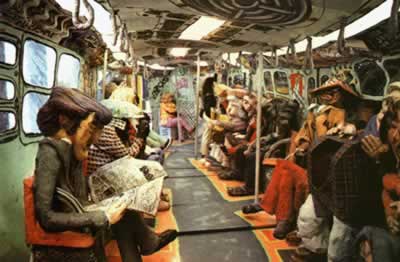
“Subway” (from Ruckus Manhattan), 1976– Red Grooms
A woman had been through a long and hard day at the office and was coming back home in the late evening. The day had seemed to drag on; she was exhausted and looking forward to getting back home where she would hit the hay. She went into a metro station where she got on a train and made herself comfortable on a seat. She noticed a woman sitting opposite her who was staring at her intently. She tried to ignore it but each time she looked over, the woman was there with her eyes wide open and the woman had not blinked or moved in any way at all. That strange woman carried on staring at her.
At one of the stops a passenger got onto the train and sat next to her. He quietly advised her to get off at the next stop; she decided to take the advice because she was apprehensive about what the woman wanted. The next stop was a busy one and she thought if that woman tried to follow her, she would be able to lose herself in the crowd.
When the train came to the next stop, she hurried off the train and the man followed her. The man was relieved and said to her “I’m going to contact the police. That was really frightening. I didn’t want to alarm you on the train but the woman sitting opposite you was dead and there were two men sitting either side of her, keeping her upright.”