The Forbidden Fruit of today: CLOSURE / Ojaswini Trivedi

Mirage
The eternal jigsaw.

There’s nothing in this world even remotely close to what most may call – closure.

We spend years and years trying to find answers to the half spoken sentences and mid-air collapsed promises. The night teases us to insomnia, trying to replay the tape of those incidents, moments, gestures. What could have been, what should have been. Were we real then? or are we real now?
We rage and grill ourselves. We hate and condemn ourselves.
Toss and turn with that withering anxiety of the unknown . What did I do? What had I done? The uncertainty of the consequences we, at this point are not ready to either accept or let go of.
The actions, that are followed by the tell-tale signs of how bleak or bright the future may be.
And this struggle gets more and more aggressive with time, when one incident after the other forces you to believe that the problem lies with you.

When after each altercation with yourself, you find yourself bleeding and pleading for comfort. For faith, for acceptance.

Seeking that solace in the pauses, the unsent messages, the U-turns, the walk-aways, whiskeys and cigarettes, drugs and women, people and their optimism.

You nurture that thought. Save it. Protect it. Grow it. Embellish it. WORSHIP IT.

Till it consumes you to the very core and leaves you anticipating the sinful life you’ve led consisting of “clueless grievances” you’ve given to people. The open ended commitments you made, the forsaken narratives you played to ease your broken heart that is out there to seek vengeance and thrive on hate and is desperate for blood.

My darling.

For how long, do you intend to walk barefoot, with cracked heels and lips. Your aching eyes, tired, seamless, need to close. You need to rest. You need to breathe.

Breathe.

That road will never end. Like a mirage that follows, it’s an abyss staring into the sky.

Closure is a myth.
You keep running and running only to find that you’ve been chasing a balloon at the edge of a cliff.

The anxiety stems from the thrill of damage you’ve caused to yourself in the process and the reckless continuation of the same in the yearning for solid, concrete answers. There aren’t any answers.
Since there were no questions asked.

Since our hearts never lied.

We always knew.

You. Always. Knew.
There is no confrontation, as we stood against each other.

We think we deserve to know the truth.

We’ll never know it. And that truth is clenching the thread of the balloon in your fingers and standing at a safe pedestal.
That, my dear. Is the time to forgive yourself.
To truthfully hold yourself together and forgive yourself.

We’re not running anyone’s races. Not living anybody else’s life.
People aren’t answerable to us. We aren’t entitled to them.
Closure is not a peaceful abomination of your relationship with them.
It’s the last gravel thrown in the grave..by YOU.
YOU are your closure.
All this while we’ve been chasing the invisible, trying to conquer the unknown, measuring the abyss, justifying the inexistent.

Stop.

Please stop.

It’s just you. It’s always been you.

Find yourself, trust yourself.

We’ll get through this, together.


The mask with the black hair / a poem by Sushmita Mukherjee


Take the first step,
Become your own bestie,
Your online friend, begins and ends with You in the main role, not a cameo,
in the online film forwards of others.
I spied a homely grey haired hag,
You guessed right..in the mirror,
She smiled Mona Lisa ish,
And gestured to the dressing table.
Ah! I don’t have one here in the village, just some stuff haphazardly pitched together in my hurried exit from Mumbai, fleeing the Virus, like a Partition victim of yore.
The deodorant smiled at me, luring me to let her cozy under my armpits.
Sorry girl, I said,
you know, here in nature, I don’t smell at all.
The toothpaste squeezed soft and sparingly,
Wants to be pushed and handled hard.
But I decline… You have more to stay in todays’ day..
So with wipes and tissues,
No ‘khachak khachak’ like our film helpers do, liberally plucking out 5, when 1 would suffice.
Trees, wood, plants heave a tentative collective sigh…
My shampoo stares seductively at me…
I hadn’t noticed the sexy gaze all these years…
No no, not today..I tease her back,
I can wait
I will use you bit by bit,
till you foam at the mouth.
And then the hair colour dibba,
Painfully reserved for the last day of the lockdown,
The colour which will provide the mask to meet the masks that I will meet,
When lockdown opens,
I will meet another woman,
The mask with the black hair!

Susmita Mukherjee
3-4-2020
Lockdowned in paradise.


I KEEP YOU AS A POEM / Sangeeta Gupta

I keep you as a poem
in the core of my  existence
I sing all day
You my song
You often shine as the evening star
in my lonesome dreams
You hold my hand
When I am lost in the wilderness
You, the lifeline of a poet
I keep you as a poem
in the core of my  existence


Barun Chanda’s Murder in the Monastery: A Mini Review / Raj Ayyar

Barun Chanda’s ‘Murder in the Monastery’: A Mini Review

‘It rained unseasonably in the afternoon–a sudden shower that came without warning. High winds moaned through the glass panes of windows. People ran indoors.
Blue streaks of lightning zigzagged through dark clouds, freezing the raindrops mid-air. Then came the hailstorm.
In no time at all, the courtyard turned snow white.
Gusts of wind made the prayer flags flap loudly in protest.’
–Barun Chanda: Murder in the Monastery.
Unfortunately, the sun comes out a little too soon, just after the Gothic build up!
I have mixed feelings about this murder mystery set in a Tibetan Buddhist monastery high up in Sikkim, with splendid Himalayan views, and a cast of eccentric characters some murderous.
I’d say–one thumb up, and one thumb down for Barun Chanda’s second thriller translated from Bengali to English.
I don’t know why Chanda, a maverick actor (even had a role in Satyajit Ray’s ‘Seemabaddha’), cum executive cum author is considered the daddy of the Bengali adult thriller. Though Satyajit Ray wrote his Feluda mysteries for kids, I suspect more adults than kids read them these days. Ditto for Saradindu Bandyopadhyay’s Byomkesh Bakshi.
The text situates itself initially within the whodunit genre, with detective Avinash Roy and his sidekick Pradyot, surrounded by a host of suspects, many of them European expats of dubious credentials. However, it flip flops over to a Dan Brown style thriller, complete with a missing secret manuscript about Jesus spending time not during the missing years, but after his alleged death, at a Buddhist monastery in Kashmir.
The manuscript zealously guarded in a basement vault by the good Buddhist monks at Chanda’s Dengziang monastery in Sikkim. Yet it vanishes leaving a distraught abbot, tense monks running around, and two murders linked to the missing manuscript.
Chanda, unlike Dan Brown, manages a credible, minimalist diplomatic secularism–though the murderer is s hired goon of some Christian sect or other, Chanda does not point fingers at the Catholic church or Opus Dei, a la Brown in ‘The Da Vinci Code’.
I liked the erotic undercurrents in the novel overall–the steamy one-night stand between Miriam the fair-skinned Coorgi Catholic nun novice and Tenzing, the fully grown adolescent Buddhist monk novice, is deliberately understated and leaves the reader’s pornographic imagination to fill in the details.
However, Chanda is resolutely heterocentric, and his detective marginalizes suggestions of monkish gay sex with a disapproving homophobic sniff, that is implied, not expressed.
Well worth a read at an airport, or on a long airplane ride.
—Raj Ayyar


Siesta at Charles De Gaulle Airport by Shanita Vichare

Siesta at Charles De Gaulle Airport !
Down The Memory Lane…..

( my flight was delayed )
No hurried spaces, to foot fall
I sat;
Raising my hopes, for the next flight
On Time…”Qui “………
Feeling for my dimes; I finally had a fancy……
At Cafetie’re
Had some quickbites Chargrill & Cappuccinos…..
Croissants & puffs…not forgotten my penchant
For
Caramel ! …Irresistible…..!!!!
Such ‘Delicacies’ on my palate…..!!! ( I think, every thing had gone well then on the contarary)
Meal….was a Deal !

….What next ?….
I skirted on the ‘Vogue’ stands…..
Now; nothing more would I have ever wanted,
Out of The Blue ! I had Missed The Flight….( next was after 7 hours)
Now It was Calling……
Perfect ! Timing……
I made rounds at ….. ‘Christen Doir ‘ N ‘Gucci ‘Perfumes
Bought A Freaking ‘Poison’….a Duffel Bag !
Those Were The Days! My Friend….. ( when you have no worries )
Sheer ! Delight …
To smoothen my ruffled feathers , I bet !!
…..The Lounge ! Was the best place…..now…. I perched On the seats,
By Jove ! I saw a beauty….
Jolie Belle femme ! …from Cypress ….
A Royal Persona…..
Picture Perfect ! Well,
We soon got …talking ….and of lands far, across the seven seas !
It was a day….Out of The Blue !
“Qui “
Princess; Treated me ……
…..Wafted scents and aroma…..Spread over
The Tableau
For a Lavish Dinner;
Holding The Long Trimmed Goblets…..
Of Chardonnay N Champagne !
Vintage And
Signature Dishes ! Well Famished .
Well,
Long after, the days have set I still …
Carry The Memories …of the day !
Some Days are Blessed !
But The Journeys are Destined !

(Scribbled at Paris Airport when I was stranded for more than 10 Hours – Shanita Vichare)


Dharti Arts Residency 2018 | Public Talks – Pallavi Paul | 13 June

Serendipity Arts Foundation

http://www.serendipityartsfoundation.org/

Dharti Arts Residency 2018
————————————————————

As part of its programming, Dharti Arts Residency 2018 is hosting a series of public talks by artists, performers, and cultural practitioners. Invited speakers will give an illustrated lecture about their practice, which will be followed by a conversation with the audience.

13-06-18 | 6pm – 7.30pm
Find Out More (http://www.serendipityartsfoundation.org/)

============================================================


Neeraj Gupta Wins Silver in Florence Biennale

Sculptor Neeraj  Gupta became the first Indian artist to get the  Lorenzo il Magnifico SILVER  medal in sculpture in XIth Florence Biennale,  the second highest award of  an important art event of Europe.  The award is significant because it comes from the Birth Place and work place of the most important  artist of the history Michelangelo.

Michelangelo not only established the role of an artist in the society but also took the art to a new high. He proved that the best in the art is yet to come and demolished the myth that best art was created in Roman Era.

So this important award to an Indian sculptor improves the Image of India in terms of artistic capability on the international scene  but also proves that Indian are second to none intellectual and art areha also.

The award was also significant because there was a staff completion from more than 1000 participating artist from around 73 major nations. Their award will help put the contemporary Indian  art in international  focus.


The Poetry Page – LS Bajpai / Antonio Blunda

The Poetry Page

Laxmi Shanker Bajpai

Those_People

Those People

Those were the people who
with tiny boxes filled with fine sugar
would go in search of anthills

They would scatter seeds on terraces
for birds to feed on.

They would get troughs of water
made outside their houses for
thirsty animals passing by.

and before eating their own meal
They would set aside a portion for cows and
other creatures.

They wouldn’t let anyone pluck a single leaf from the trees
after sunset
lest the resting trees be disturbed.

They would start conversations on their own
and ask strangers for introductions
They would heartily help those in need

and if someone asked them for directions
they would gladly
escort the person to his destination.

and if at some odd hour a lost traveler
happened to come to their
door they would provide him with
food and a place to rest

maybe such a species does still exist
in some remote village or hamlet
I wish it were possible to create a museum for them
So that generations to come would learn that
This too was a way of living.

Quelle persone
Italian Translation of L.S. Bajpai’s poem by an Italian Poet: Antonio Blunda

Quelle erano le persone
che con minuscoli cassetti
colmi di zucchero a velo
andrebbero in cerca di formicai

spargerebbero i semi su terrazze
per nutrire gli uccelli.

metterebbero trogoli di acqua
costruiti fuori dalle loro case
per gli animali assetati che transitano.

e prima di mangiare il loro pasto
metterebbero da parte una porzione
per le vacche
ed altre creature.

Non lascerebbero che nessuno
cogliesse una singola foglia dagli alberi
dopo il tramonto
affinchè il riposo degli alberi
non fosse disturbato.

Inizierebbero le proprie conversazioni
chiedendo a stranieri di presentarli

Aiuterebbero di cuore coloro che lo necessitano

e se qualcuno chiedesse loro di guidarli
essi lo farebbero volentieri
conducendo la persona a destinazione.

e se all’ora più casuale
ad un viaggiatore disperso
capitasse di giungere alla loro porta
essi offrirebbero cibo
ed un posto per riposare

Forse una tal specie ancora esiste
in qualche remoto villaggio o borgo

Vorrei che fosse possibile creare un museo per loro
così che le generazioni venissero ad imparare
che anche questo
era un modo di vivere.

(Traduzione in italiano: Antonio Blunda)


Islam, Aesthetics and Postcolonialism

Book Mark

 Book Review and Book Launch Coverage
By
Divya Raina

Muhammad Iqbal

A well-attended panel discussion at the India International Centre Annexe held last month (December 23, 2008) more than made up for my disappointment at the sudden cancellation (on Eid) of a public lecture at the same venue in the same month. The occasion was the launch of Professor Javed Majeed’s book,Muhammad Iqbal: Islam, Aesthetics and Postcolonialism, published by Routledge. Professor Majeed was in town for the occasion along with his wife, Swarna Aiyar, who is a historian in her own right. A good omen that Professor Majeed referred to about the book’s launch was that on their trip to Agra the previous day, their guide to the Taj Mahal was, coincidentally, also called Muhammad Iqbal!

Javed Majeed is Professor of Postcolonial Studies at Queen Mary, University of London, and his book is the first in the Routledge series “Pathfinders”. The series editor, Dilip M. Menon, who introduced the author and flagged off the proceedings, explained how the series is planned to reflect India’s intellectual, literary, artistic and cultural traditions. They are aimed at the general reader as well as those who have an academic interest in the subject.

In his brief address and introduction to the book, Professor Majeed quoted historian Romila Thapar’s statement about the “tyranny of labels” and how stereotyping of the kind that exists in today’s context is particularly dangerous and how this study in particular provides a complex and detailed account of Iqbal so that it is no longer possible to appropriate him into any one political agenda.

In fact, the book aims to show how Iqbal combined a variety of positions in his texts, and how the tensions between these positions were kept in play in his poetry. Further, the book attempts to reveal how the style in which Iqbal’s poems imagine an Islamic community, both globally and within South Asia, distinguish the nature of that community. It identifies how Iqbal used and inverted Persian and Urdu aesthetic traditions to imagine a global Muslim community and an Islamicised postcolonial identity. Apparently, it was through complex inversions and appropriations of tradition that Iqbal created what the author calls “harmoniously dissonant verse” in which the relationships between an innovative individual selfhood and a reconstructed Islam were figured.

Apart from the author those who also spoke on the occasion were Professor Alok Rai from the Department of History and Professor Farhat Hasan from the Department of History, both of Delhi University. Shammi Mamik, Publisher, Routledge India, proposed a vote of thanks and with a couple of questions from the audience, the evening came to an end.

Details about the book:

Name of the book : Mohammad Iqbal:Islam, Aesthetics  and Postcolonialism
Name of the author : Javed Majeed
Name of the Publisher: Routledge
Price not known

Available at:
Taylor and Francis Books India Pvt Ltd,
512 Mercantile House,
15 Kasturba Gandhi Marg,
New Delhi: 110 001.

Tel.: (00 91 11)  23706110 (Direct), 23712131
Fax: (00 91 11) 23712132


Staring in the Subway

A Chilling Short Story from London

Staring in the Subway
by
Manasvi Gautam

Staring_in_the_Sub

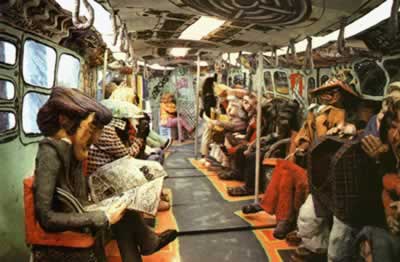
“Subway” (from Ruckus Manhattan), 1976– Red Grooms

A woman had been through a long and hard day at the office and was coming back home in the late evening. The day had seemed to drag on; she was exhausted and looking forward to getting back home where she would hit the hay. She went into a metro station where she got on a train and made herself comfortable on a seat. She noticed a woman sitting opposite her who was staring at her intently. She tried to ignore it but each time she looked over, the woman was there with her eyes wide open and the woman had not blinked or moved in any way at all. That strange woman carried on staring at her.

At one of the stops a passenger got onto the train and sat next to her. He quietly advised her to get off at the next stop; she decided to take the advice because she was apprehensive about what the woman wanted. The next stop was a busy one and she thought if that woman tried to follow her, she would be able to lose herself in the crowd.

When the train came to the next stop, she hurried off the train and the man followed her. The man was relieved and said to her “I’m going to contact the police. That was really frightening. I didn’t want to alarm you on the train but the woman sitting opposite you was dead and there were two men sitting either side of her, keeping her upright.”

Copyright © 2009 Manasvi Gautam. All Rights Reserved