Akoopar by Shri Dhruv Bhatt

The Play

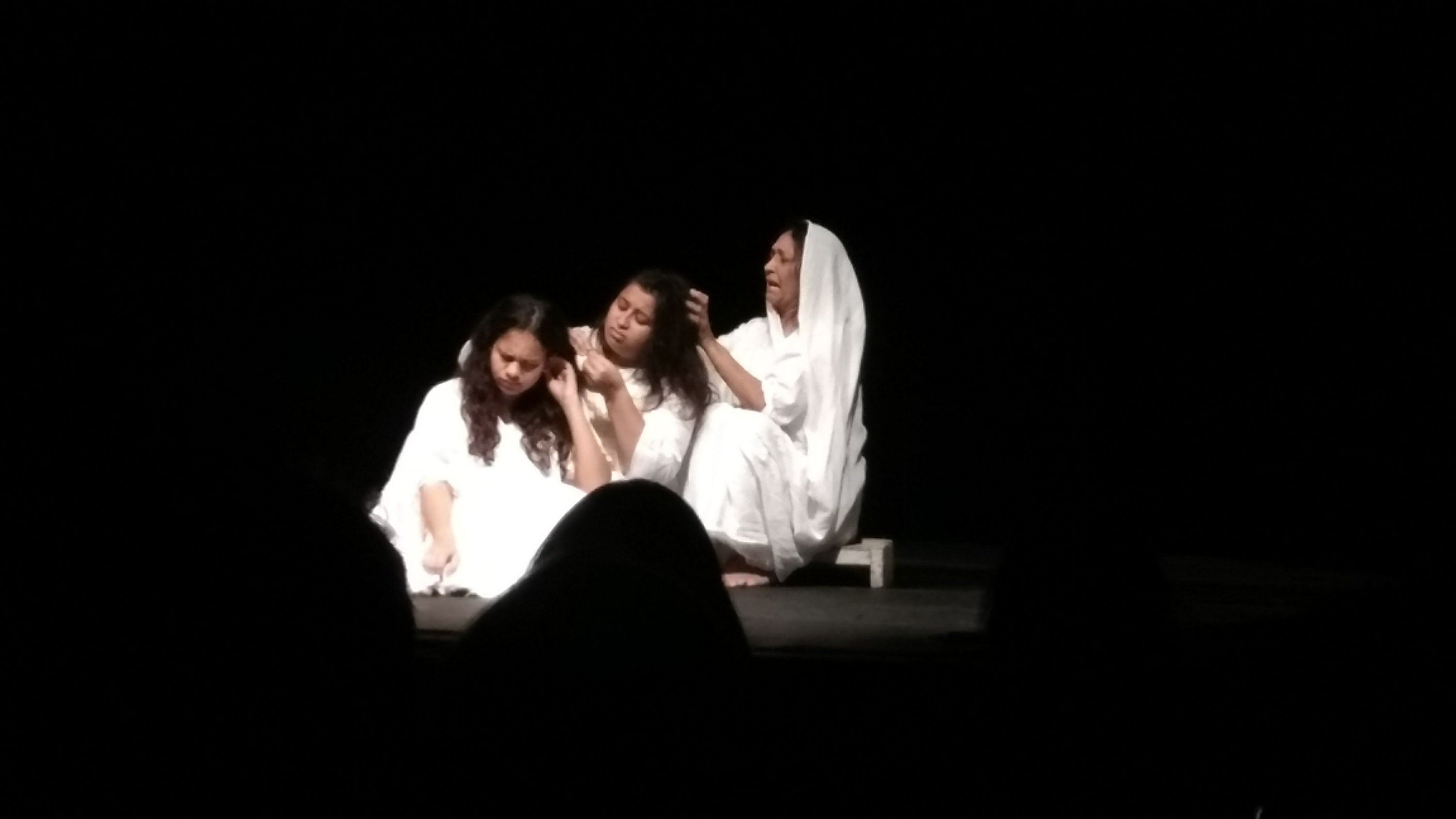
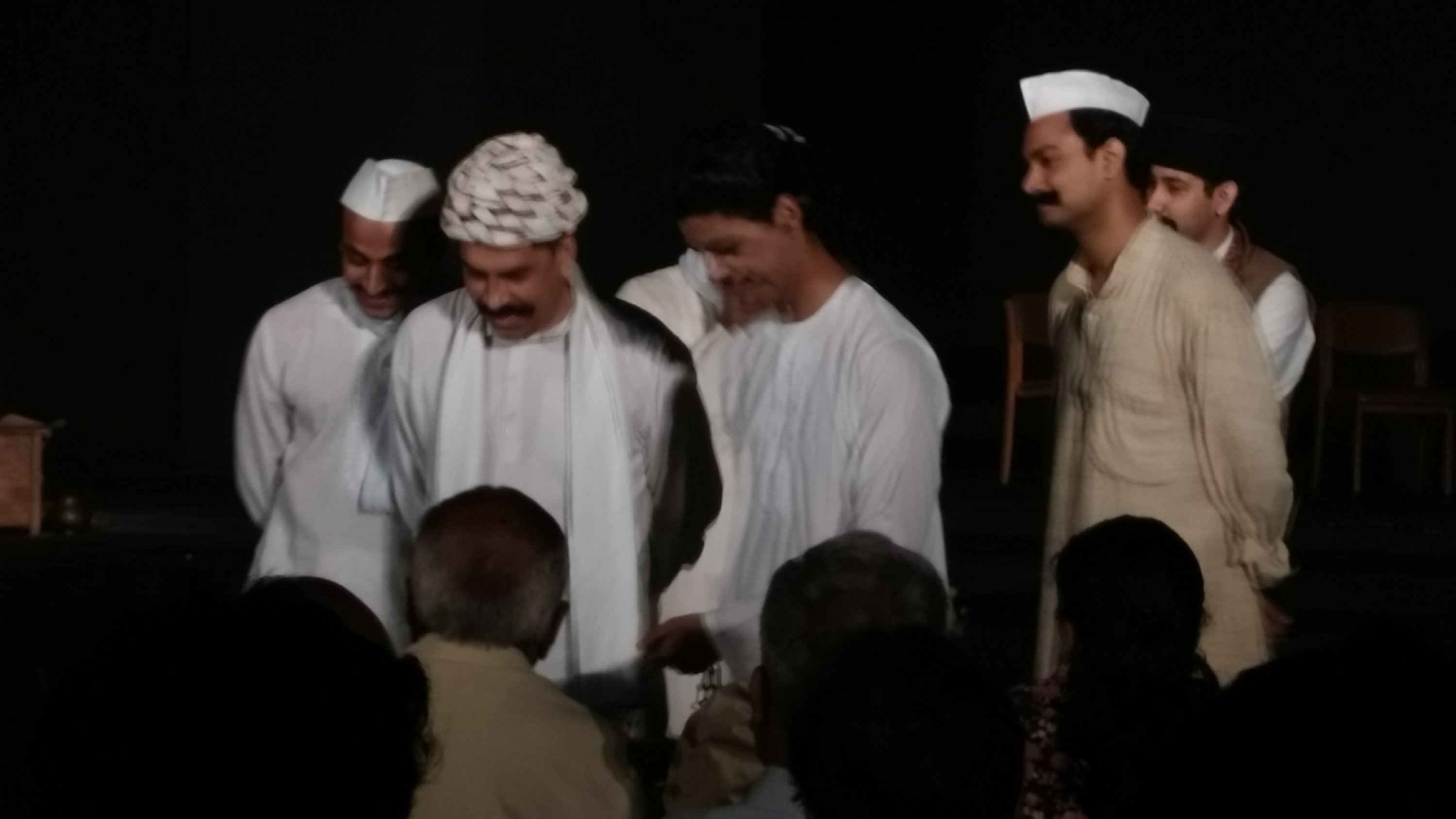
Akoopar is based upon the first novel in the history of Gujarati literature, which deals with the life of Maldharis and their relationship with lions, nature and the animals of Sasan Gir- the last homage of Asiatic lion. Written by Shri Dhruv Bhatt, this play won two awards this year.

Director’s Note

Akoopar is the only play in Gujarati theatre, based on life of Maldharis. The unnamed narrator, who is a painter, has an assignment to paint the elemental form of Earth, under a grand project. The artist is an outsider who gradually unfolds the inner world of the Gir forest.

To create and understand reality, a team of artists and technicians stayed in Gir forest for ten days, in turns. They met a lot of Maldharis, forest officers, staff, rescue operators and forest guides. To bring authenticity to the play, natural sounds of forest, lions, leopards, other animals and Maldharis were recorded. In addition marasiya (death songs), marriage songs and dohas (couplets) were also recorded.

The costumes were made in Sasan village and jewellery as well as properties for the play, was also purchased from there.

The Director

Creative Director and Managing Trustee of JT Memorial Foundation, Aditi Desai pursued a career in theatre since childhood under the guidance of her father, Shri Jashwant Thaker. She developed herself from an actress to an activist, trainer, director, producer, film maker and script writer. Her key areas of interest are theatre, video film making, development of popular educational material and Gender and theatre training. She has directed 18 plays and made 21 documentaries, docu-drama, video-spots and programmes based on various social and environmental issues. She has also acted in plays directed by Bharat Dave, Naushil Mehta, Raju Barot and many more. Desai has worked extensively in Regional Television, feature films, documentaries and radio in last twenty two years.  She has been the pioneer of street theatre in Gujarat, on issues pertaining to women and has conducted over sixty theatre training workshops in Gujarat and Rajasthan.  Desai has also been a faculty member and course coordinator for theatre in J.G. School of Performing Arts.


The Playwright

Born on 8th May 1947 in Gujarat, Shri Dhruv Bhatt was always interested in writing fictions and plays since childhood. He retired as a Section Manager from an engineering firm. Some of his notable works are Khovayelun Nagar, Agnikanya, Samudrantike, Tattvamasi, Atarapi, Shruvantu, Gaye Tena Git, Karnalok and Lovely Paan House. His work, Samudrantike has been awarded by Gujarati Sahitya Parishad as a rural novel, by Gujarati Sahitya Academy as a travelogue, by Marwadi Sammelan as best literary work and by Goverdhanram Tripathi Award committee as a novel. His works Gaye Tena Git, Akoopar, Karnalok and Tattvamasi have been awarded by Gujarati Sahitya Academy.


The Group

Jashwant Thaker (1915-1991) was the doyen of Gujarati theatre. He initiated the Navi Rangbhoomi Movement in Gujarati and was the founder member of the Gujarat chapter of IPTA aka Lok Natya Sangh. To honor his memory, JT Memorial Foundation was set up in 2005.

The Foundation works towards development communication, with a focus on gender. It believes that communication and training can be used to strengthen oppressed people and catalyse social movements. They create productions to empower children, youth, women and community members. All the plays under this foundation are usually in Gujarati. Some of their plays are Agnikaya, Akoopar, Kasturba, Savitribai Phule,Patra Mitro, Udan Charkaldi, Kaagdo, Prem etc.


Play It, So 17 Dances About Something

The Play

It’s 2044. Janina, Jan and Janka start working on an experimental documentary. In one of the rooms of a well-maintained museum theater, while making use of some former technologies (MacBookPro, overhead projector, etc.), costumes (Milan Fashion Week, 2013) and emotions (early twenty-first century cinema, dance, theater), Janina, Jan and Janka try to play out that SOMETHING that was the THING.

Directors’ Note

In 2012, with a symbolic show Celebration so the end and Once Again, we closed two decades of the existence of Dada Theatre. With the performance , Play it, So 17 Dances About Something,  we’re going to enter a new Dada Epoch, by loosening the shackles binding all artistic creation of such a long-lived form. Please let us not reveal the inspiration and intentions that accompanied us while working on Play it. The inspiration and intentions are, in fact subject to constant evolution until the premiere day. To those impatient, we can offer a short note announcing the show. However, we cannot resist not mentioning that we’re approaching 100th anniversary of the first emanation of Dada (Zürich 1916). Hence, once again we would like to publicly confess our belief that, since that memorable event, everything has only been as it is, and can no longer be any different. Play It, So 17 Dances About Something, is a collective brainchild of three Dada artists: Anna Steller, Katarzyna Chmielewska and Leszek Bzdyl, the co-founders of this one of a kind and legendary Theatre.

The Directors

Leszek Bzdyl – A dancer, actor, choreographer, director as well as founder and artistic director of Dada von Bzdülöw Theatre, he has been involved in a professional stage career since 1987. He graduated from Department of Philosophy and History, University of Wrocław, in 1990 and founded Dada von Bzdülöw Theatre in 1993 with Katarzyna Chmielewska. He has been awarded by the Minister of National Education (1999), the Marshal of the Pomerania Region (2006) and Theatre Pasta International Theatre Awards – India (2007) for his artistic achievements. In 2010, he was conferred with a ‘Meritorious for Polish Culture’ medal, by the Minister of Culture and National Heritage.

 Katarzyna Chmielewska – A dancer, choreographer, director, dance teacher as well as founder & artistic director of Dada von Bzdülöw Theatre, Katarzyna graduated from the State Ballet School in Gdańsk (1984-1993), following which she studied at P.A.R.T.S in Brussels (1996-1997). She has been involved with numerous Polish cultural institutions e.g.: the Ballet Group of the Baltic State Opera House, Gdańsk (1993-1994), Gdańsk Dance Theatre (1994-1995), City Theatre, Gdynia (1997-2000), Klub Żak, Gdańsk (2000-2008) and Wybrzeże Theatre, Gdańsk (2008-present). She has been awarded by the Mayor of Gdańsk and the Marshal of the Pomerania Region for outstanding and lifetime artistic achievement.

Anna Steller – A dancer, performer and choreographer, Anna has been an actress and dancer in Dada von Bzdűlőw Theatre, since 2003. Since 2004, she has been performing with ‘Read My LipsTheatre’. In 2005, she co-established ‘Good Girl Killer’ collective. She is a proud recipient of the Dance Web Scholarship for the 2003 Impulstanz dance workshops and festival in Vienna. In 2012, Steller was awarded by the Marshal of the Pomerania Region for her outstanding achievement in the field of dance and theatre.

The Group

Dada von Bzdülöw Theatre is an independent group of professional dancers and actors staging performances, in cooperation with home and foreign cultural institutions, such as: Teatr Wybrzeże, Gdańsk,  Klub Żak, Gdańsk,  Dance Advance, Philadelphia, USA, Les Hivernales, Avignon, France, Old Brewery,/Poznań and Teatr Nowy, Łódź; Nuova Foundation, Poznań. Since 2008, it is affiliated with Teatr Wybrzeże, Gdańsk, and has been regularly staging all its premiere & repertoire performances there. As of today, Dada has produced more than 45 performances, some of its productions are, Play it, so 17 dances about something, Enclave 4/7, Invisible Duets, Le Sacre, Caffè Lattè and Red Grass.

Directed, Choreographed by:
 Katarzyna Chmielewska, Anna Steller, Leszek Bzdyl


Snake, Love and Sexuality

Ravindra Tripathi’s

Theaterama_LogoKADEN_UGETSU06

There are a lot of stories in Indian mythology and folklores where you find the snake or the serpent as sexual motif. Some modern plays  are also based upon it. For example Girish Karnad’s play Nagmandala. The snake as sexual motif is not limited only to India. In 13th bharat rang mahotsav, the Japanese play Ugetsu Monogatari (directed by Madoka okada) also presents the snake as a charmer and lover of human being.

 It is story of 10th century Japan. There is a young man, named Toyoo, son of a fisherman. He lives near seashore.  A beautiful woman named Manago comes to his home in a rainy night. Toyoo is attracted towards her. He also lends his umbrella and promises to meet her again in near future. After some days he goes to her house on the pretext of going back his umbrella. During that he gets intimate with her. Manago gives him a beautiful sword as a token of their relationship.  But after sometime it comes out that the sword was stolen from a shrine. Toyoo is caught by the officials on the charge of theft. He is taken to the house of Manago and there it is discovered that actually Manago is not a woman but a serpent. She   transforms herself as a woman to get Toyoo love. Now the question is what will happen of their relationship. Will Toyoo accept Manago, the serpent as his beloved or leave her?

 Ugetsu monogatari is a play about coexistence of natural and supernatural in human life. We are fascinated by supernatural things but it is not always joyful. Sometime pain and sorrow also come with joyful supernatural. Are we ready to accept both of them? Or we want to enjoy one and discard the other thing? Actually ambivalence is part and parcel of life.

It is a stylized play and full of body movements. Four actresses play role of Manago one actor of Toyoo. The director of the play Madoka okada is known for his experimentation. He also assimilates the linguistic beauty of Japanese and traditional theatre of Japan. There are elements of pantomime in it also. It must be underlined that there a good plays from non-western countries in this festival. It is time to call it international bharat rang mahotsav.


‘The Park’ as a metaphor

Ravindra Tripathi’s

Theaterama_Logo

PARK3Three benches for three – yet no space – a scene from ‘The Park’

The 13th Bharat Rang Mahotsva has started with fanfare. Although the city of Delhi is freezing with  severe cold, the theatre lovers are daring with enthusiasm to watch the plays. Even those who  can’t get ticket or passes, can enjoy food with fire in The Foodhub, which serves delicious kababs and  momos . But let us talk about theatre instead of cold and food.

In Sriram Centre, on 8th of January, `The Park’, jointly written and directed by Manav Kaul and  Kumud Mishra, witnessed a houseful of appreciative audience.

`The Park’ is a play of just four characters, mainly three, who come in a public park during daytime. of course  reasons for their coming to the park are different. One wants to spend some leisure time, the  second one to have a nap on a bench and the third one, to watch a woman after she has had a shower.

There are three benches in the park, so there should be no problem for separate and independent spaces for them.  But the problem starts when all of them want a particular bench for themselves. No one wants to leave his preferred bench. They argue and fight over their `rights’. The play starts as a comedy  but slowly and gradually it becomes serious. Laughter disappears and serious identity issues  appear. Right over the bench becomes a bone of contention between them. The burning topics of displacement and dislocation of people, the Indian adivasis, the Palestinians, the Israelis come in  foreground and in the process a comedy turns black. The play becomes a metaphor.  A metaphor for struggles of indigenous people fighting for their demands in many parts of the world . Who has the right of land where Israel exists today? The Israelis, who are there today or  the Palestinians, who are displaced? What is the basis of their rights? Who has the rights in Mumbai?  Does the marathi speaking person have more rights there than those who don’t know this language?  These issues come during their arguments.

As the arguments go further, tension develops and all of them start fighting among themselves.  the dialogue is broken. This shows how we, human beings, don’t settle our differences amicably and democratically. This is not happening only in India, but everywhere.

`The Park’ ends on positive note and initiates a process to think about how we bear our children.  What is the state of our education system? The actors gave commendable performances.


Do you know Janusz Korczak?

Ravindra Tripathi’s

Theaterama_Logo

Dreams-of-Taaleem-EnsembleA Scene from ‘Sunil Shanbaug’s Play ‘Dreams of Talim’

Sometime you hear a true story which is more dramatic than drama, more painful than Greek tragedies. Here is a story for you which Sunil Shanbaug, the director who presented `Dreams of Talim’ in 13th BRM (Bharat Rang Mahotsav), told before a gathering in NSD on 14th of January. We met in `meet the director’ program in BRM.  I was officially asked to conduct the program by Dinesh Khanna, the coordinator. The idea of the meet is a very good concept and well organized by Dinesh and his team members’ i.e. Suman Kumar Singh, Savita Rani, Vipin Bhardwaj and others.   During the course of question-answer session, Sunil narrated  a story which stunned the audience.

Replying to a question, Sunil said that this time (in 13th BRM) initially he wanted to bring another production based on Ravindra Nath Tagore’s Dak Ghar (the post office) in 13th BRM. But, regarding staging of Dak Ghar,there is another story attached to the play, the story of Janusz Korczak. Korczak was a polish writer of children literature during the Second World War.  He was also a principal of a school for orphans. It was the time when Hitler’s German forces were encircling   Poland. Himself a Jew, Korczak was at the receiving end of the Nazi German power, but he was continuing his work. He felt that something unexpected might happen any day and children of his orphanage should be prepared for this. At that horrible time of history, Korczak decided to do a play with orphan students and the name of the play was Dak Ghar. The play was staged. After sometime, the Nazis sent all the children to a concentration camp and they were massacred there. Korczak accompanied the children in graveyards.

In Sunil’s production of Dak Ghar this story is interwoven and it is already staged in Calcutta.    The staging the Tagore’s play in those circumstances and story of Korczak’s integrity and commitment   tells a lot about strength of literature. Korczak was himself a littérateur and wrote for children. But he chose Tagore’s play. Those who have either read or seen Dak Ghar know that it a story of hope and faith of a young and innocent boy. Perhaps Korczak thought that this play will be a moral source of strength at that time of darkness. Or maybe something else was in his mind. Who knows?  But one thing is certain that literature, drama or art has a moral relevance.

 I am eager to see this production of Sunil.


A political play from Bolivia

Ravindra Tripathy’s

Theaterama_Logo

EN UN SOL- PHOTO CREDIT RADOSLAV PAZAMETA-LUCASNIÑOS CUADROEN UN SOL AMARILLO- Photo: Radoslav Pazameta-Lucasninos Cuadro

We, in India, are familiar with South American writers like Gabriel Garcia Marquez, Mario Vargas llyosa and others. But we know very little about theatre of Bolivia, Chile, Argentina and other Latin- American countries. Fortunately, in 13th Bharat Rang Mahotsav there are some plays from these countries which show how lively the theatre scene is there. One can feel the `politics of theatre’ in these plays. But it is not only the political component which is important; there is also immense aesthetic depth in these plays. You can say that Latin-American theatre is as lively as its fiction and poetry.

`En un sol Amarillo’ (In a yellow sun: memories of an earthquake) is play in Spanish from Bolivia. Directed by Cesar Brie, an eminent Bolivian director, this play is about a natural tragedy that took place in this South-American country. On the night of 22nd may 1998, Bolivia was rocked by a massive earthquake, which devastated many cities and towns. A lot of people became homeless. Children died without proper care. The international community sent all type of aids but the government of Bolivia couldn’t distribute it properly and massive misuse of funds aggravated the plight of people. Corruption went rampant. The basic infrastructures were destroyed and remained inbuilt. Those who raised a voice were maimed, misappropriation of fund by the bureaucracy and political class knew no bounds and the victims were mistreated. People died and politicians laughed.

The play is based upon the research and information about this earthquake and subsequent suffering of the people. So there is a lot of reality here. But this is not only a docu-drama. Here you see reality as well as the imagination, prose as well as poetry and design as well as acting. There is physical theatre and comedy in it also. Interweaving of wit, humor, pathos makes this play a human tragedy. We can see here what is happening not only in Bolivia but all over the world. There are many stories of catastrophe also in India, which are full of administrative lapses, monetary mismanagement and political insensivities. The Indian audience will easily identify with this play.  The director of the play, Cesar Brie, had to flee Argentina in 1976 because of dictatorship in that country. He lived and worked in Denmark, Italy and Poland before settling in Bolivia.


Dreams of Talim – A Tribute to Chetan Datar

Ravindra Tripathi’s

Theaterama_Logo

Dreams-of-Taaleem-Ensemble

Last year in BRM (the 12th Bharat Rang Mahotsav)  when  I saw Sex, Morality and Censorship, directed by Sunil Shanbaug, I was quite impressed. And not only me, the entire  Kamani auditorium  was electrified when the performance was over.

This year Sunil Shanbaug has brought another production Dreams Of Talim, written by Sachin Kundalkar. But it there is also a story behind it, which is essential to be told if you want to fully understand this. Actually, before the play starts, the story is told before the audience. It is about late Chetan Datar, a talented theatre person who died young in 2008. Chetan had written a monologue title `No I Madhavbagh’ around 2004. It was never staged during his lifetime.

After Chetan’s death Sunil decided to do one of Chetan’s text on stage as a tribute. Then came Sachin Kundalkar for his support. Sachin wrote a full length play based on Chetan’s monologue. The result is Dreams of Talim.

It is a play about alternative sexuality, an emerging discourse in Indian society. The problem of alternative sexuality is that it is taboo. Despite that it has won a legal battle, the society at large doesn’t accept it, the family abhors it. The play deals with this `taboo’, the issues, questions and passions associated with it.

It has four characters, Anay, Yash, Sita and Sita’s mother. Anay is a young theatre director. He is abandoned by   all his colleagues and friends except one, Yash who still admires him. Both the boys are in special relationship (gay) with each other. Meanwhile, Sita, an actress come in their life. She showed her willingness to act in play which Anay wants to direct a play. When the rehearsal get started the problems of alternative sexuality arise on different planes. Anay is individually facing the problem and Sita is finding it difficult to come to terms with it on emotional level. Simultaneously    many issues about love, theatre and relationships emerge.

The strength of Dreams of Talim is its acting. All the actors, Anand Tewari as Yash, Suvrat Joshi as Anay, Geetanjali Kulkarni as Aai and Divya Jaddale as Sita, give commendable performances.  There is an element of fantasy also in the play which makes it a little bit surrealistic. The play was multi-lingual with a mix of  Hindi and English.


Bharangam 13 – All The Plays of Bharat Rang Mahotsav

Choose Your Plays before you Buy your Tickets

OTHELLO3A Still from one of the plays: Othello

This year  the Bharat Rang Mahotsav will be presenting a fare of 81 productions selected out of nearly 450 proposals received from across India and from around the world. Taking forward the ‘Young Experimenters’ component of last year, BRM 13 also includes productions by graduates of the school in a synthesis of experience, new energy and vision. We present the synopsis of all the plays so that you can pick and choose.

1. Play: A Wife’s Letter
Playwright: Adapted from Rabindranath Tagore’s play Streer Patra
Director: Neelam Man Singh Chowdhry
Group: The Company, Chandigarh
Language: Punjabi
Duration: 1 hour and 10 minutes

The protagonist is a child bride Mrinal who secretly writes poetry to assuage that dank listlessness of her routine and mundane life. She finds companionship with the cows and buffaloes in the house while fulfilling the routine chores of her household. In this monotonous universe enters Bindu, the orphaned sister of her older sister-in-law. This simple event becomes the trigger which unravels layers of experiences that are then shared and collectively explored.

2. Play: About Ram
Director: Anurupa Roy
Animation Visualization: Vishal Dar
Group: Katkatha Puppet Arts Trust, Delhi
Language: Non-verbal
Duration: 55 mins

As the name suggests, the performance is about Ram, the prince who is sent on a long journey far away from his home when he is exiled by his father along with his wife Sita and brother Lakshman. About Ram was created with a performance grant from the India Foundation for the Arts and in collaboration with animator Vishal Dar. It is an experimental theatrical piece using excerpts from Bhavbhuti’s Ramayana and told through animation, projected images, dance, masks and puppets.

3. Play: Aguner Barnamala
Playwright: Hara Bhattacharya
Director: Anirban Bhattacharya
Group: Drishyapat, West Bengal
Language: Bengali
Duration: 2 hrs 25 mins ( including 10 mins intermission)

The play is a psychological journey into the turbulent inner world of the protagonist Kushal, a seventeen-year old young man, who has been referred for psychiatric intervention and treatment after he burns his father to death. It talks about the language of fire as manifested through passion, rage, quest for truth, and desire. The fires of purity, morality, hunger, lust, anger, hatred, and warmth interlock and overlap with each other throughout the play. The concurrent theme of our present social reality intermingling with our past rituals and mythology is woven into the narrative.

4. Play: Andhere Akele
Playwright: Inspired by Ariel Dorfman’s Death and the Maiden
Director: Biplab Bandyopadhyay
Group: Niva Arts, West Bengal
Language: Bengali
Duration: 2 hrs 5 mins (including a 10 min intermission)

The play takes place in a closed room now occupied by three persons– Dr. Sadashib Samanta, a psychiatrist; Jayanta Sarkar, a young lecturer with his own set of aspirations; and Parna, a woman believing in the philosophy of life drenched in the songs of Rabindranath Tagore, yet aware of the stark reality of the pain suffered by her body and soul. As these three people try to establish their own versions of truth, the play looks at the dynamics of negotiations, interactions and conflicts that develop between them

5. Play: Before the Germination (Inspired by Oriana Fallaci’s Letter to a Child Never
Born
Playwright & Director: Manish Mitra
Group: Kasba Arghya, West Bengal
Language: Bengali & English
Duration: 1 hr 10 mins

A simple story, being simply told, Before the Germination, is about a mother’s talk with her unborn child describing the world into which the child would be born in. after hearing what the mother tells it, the unborn child refuses to take birth in such a world. Inspired by Oriana Fallaci’s “Letter to a Child Never Born,” the play addresses the various crises and power structures in contemporary societies and also the aspects of deviant human behaviour.

6. Play: Dreams of Taleem
Playwright: Sachin Kundalkar
Director: Sunil Shanbag
Group: Zero Theatre Company, Maharashtra
Language: Hindi & English
Duration: 2 hrs 10 mins

Anay, an ambitious theatre director is thrilled when Sita, an acclaimed but enigmatic actress agrees to work with him in his new play. Abandoned by most of his young colleagues, except for his gay lover Yash, Sita’s acceptance is a great opportunity for Anay to take his fledgling career forward. But when rehearsals begin, nothing goes according to plan. Anay fears he has lost Yash, and Sita struggles to come to terms with gay relationships. The line between reality and fantasy is blurred, and characters are forced to examine their beliefs and convictions in the mirror of the play.

7. Play: Drowa Jhagmu: Ek Devi ki Kahani
Written & Directed by: Suk Bahadur
Group: Central Institute of Himalayan Cultural Studies (CIHCS), Himachal Pradesh
Language: Arunachali Hindi
Duration:1 hr 30 mins

The play is based on a story from a 1400-year old region of Arunachal Pradesh. The reign of king Kalawangphu is one characterized by violence. One day he comes across a beautiful fairy called Dowra Jhangmu, falls in love with her and marries her after promising to change his ways. He converts to Buddhism and starts a family. But then, the king’s evil first wife, Hachang, returns and tries to kill the children. The plot then moves on to what happens next and how the story comes to a happy ending.

8. Play: Jaan-E-Kalkatta
Playwright & Director: Bhadra Basu
Group: Paikpara Akhor, West Bengal
Language: Bengali
Duration: 2 hrs 20 mins (with 10 min. intermission)

The play tracks the trajectory of Gauharjaan, who, through rigorous training from famous maestros and her innate finer artistic sensibilities, emerges as the ‘Nightingale of Kolkata’ in late 19th Century, Kolkata. Her sharp intellect and unique style of musical rendition make her the ‘Jaan-E-Kalkatta’. One of the pioneers to record her voice in gramophone discs, she amasses huge wealth, but is betrayed and deprived of her fortune by the men she trusts most, and ends up fighting extended court cases. Finally she has to accept the job of the court singer at Mysore where she dies broken hearted in 1930.

9. Play: Kashmir Kashmir
Playwright: Ramu Ramanathan
Director: Mohit Takalkar
Group: Aasakta Kalamanch, Maharashtra
Duration: 100 minutes
Language: English

A honeymoon couple named Rajivlal and Champa, check in Hotel Kashmir Kashmir situated in the middle of nowhere. In this play, the hotel is the protagonist and the multiple story lines are borne along by a shadowy narrator who seems to represent historical influences. The hotel is the metaphor that projects the plight of the people, state and the seemingly endless disturbing situation. Freak and banal events keep occurring in the hotel and mysteries are never resolved. The drama combines the surreal with the satirical to present a dark, pithy and whacky story of Kashmir.

10. Play: Kumbh Katha
Playwright & Director: Trishla Patel
Group: Tpot Production, Maharashtra
Language: Hindi & English
Duration: 2 hours (with 15 mins intermission)

Kumbh Katha draws its storyline from Kumbh Mela, that is celebrated in India because it is believed that during the struggle for power between the devas and asuras, four drops of amrit fell from the kumbh at the four holy places of Nasik, Ujjain, Allahabad, and Haridwar. The fifth drop remained a mystery. This play unravels the fantastical journey of the two brothers, Hari and Amrit, and reveals how their fate is tied to the fifth drop as they journey to bring together all the elements needed to end kalyug and save humanity.

11. Play: Macbeth
Playwright: William Shakespeare
Design & Direction: Pravin Kumar Gunjan
Group: Ahuti Nataya Akademi, Bihar
Language: Hindi
Duration: 2 hrs 10 mins

Macbeth is the last and shortest of Shakespeare’s four great tragedies. Considered one of his darkest works, it is about Macbeth’s bloody rise to power, the murder of the Scottish king, Duncan, the guilt-ridden pathology of evil deeds generating still more evil, the supernatural element of the three witches and their prophecies, and the memorable character, Lady Macbeth, whose ambition for power and love for her husband lead her into an unnatural, phantasmagoric realm of witchcraft, insomnia and madness.

12. Play: Mahakabyer Pare
Playwright & Director: Kallol Bhattacharya
Group: Ebong Amra, West Bengal
Language: Bengali & Santhali
Duration: 1 hour

In Mahakabyer Pare, the Kshatriyas are still rulers of the world. They oppress the Shudras, who finally declare war against them Eklabya is sent to learn the art of warfare from Dronacharya, but since he is a shudra, Dronacharya refuses. Yet, Eklabya learns these skills, driven solely by his desire. When Dronacharya’s Kshatriya disciples inform him of this, he meets Eklabya and asks for his right hand thumb as gurudakshina. Eklabya is ready to pay this price but the Shudras stop him by claiming his thumb to be the weapon of the entire community. He refuses and Dronacharya along with his Kshatriya disciples are imprisoned by the Shudras.

13. Play: Mathematician
Playwright & Director: Gowri Ramnarayan
Group: JustUs Repertory, Chennai
Language: English
Duration: 1 hr 15 minutes

The monodrama, which is set in 500 CE Babylon, the commercial, centre of the ancient world, interweaves dialogue, music and poetry. Castrated and sold into slavery by his father, Nikor is apprenticed to the Greek Plautus, the Chief Economist of Babylon. With his brilliance in mathematics and stagecraft, he attains incredible fame and wealth as the state’s Chief Mathematician, Accountant General and Keeper of the Seals.
When he finds his childhood friend, Salla, now the wife of a debauched prince, Nikor is haunted about questions about himself, the pursuit of knowledge and what Salla means to him.

14. Play: Mirel Masingkha (Will of the Soul)
Playwright & Director: Dr. Yumnam Sadananda Singh
Group: Kanglei Mime Theatre Repertory, Manipur
Language: Non-verbal
Duration: 60 minutes

Presenting the chaotic social structure and utter lawlessness that characterise Manipuri society today, Mirel Masingkha, the Will of Soul, makes an attempt to raise awareness about the various atrocities and acts of terror that people witness in their daily lives. Dedicated to Irom Charu Sharmila, it is a physical play based on her campaign against terror. The soul of Sharmila emerges from these incorrigible events and the stinking rot, throws light on the people’s plight, highlights brutalities like rape, fake-encounters, custodial deaths committed by the army and terrorist activities that threaten the delicate socio-cultural fabric of Manipuri society.

15. Play: Miruga Vidhusagam
Playwright & Director: S. Murugaboopathy
Group: Manalmagudi, Tamil Nadu
Language: Tamil
Duration: 1 hr 45 mins

Donning animal masks and motifs and carrying totem poles, miruga vidusagas (animal jesters), journey into war-torn lands, highlighting the plight of refugees affected by war calamities and drawing attention towards the problems faced by migratory population due to industrialization. They stop briefly to speak about the issues and concerns of indigenous people and women, questioning the control of people by the government and misuse of power by media, and finally appealing to the people for the creation of a world based on love, justice, respect and dignity for natural resources and people.

16. Play: Ms. Meena
Playwright: Rashmi Ruth Devadasann (Inspired by Friedrich Durrenmatt’ The Visit)
Director: Rajiv Krishnan
Group: Perch, Chennai
Language: English (with a smattering of other Indian languages)
Duration: 1 hr 40 mins (with 10 min. intermission)

Ms.Meena, formerly known as Asha, is an iconic film star. She returns to her native village Pichampuram, which has descended into a state of dire poverty. after two decades to make her final film. With news of her arrival there is a new burst of energy and hope in the village and she is hailed as their saviour, while Ravi, her former lover, is pushed to appeal to her on the village’s behalf. Ms. Meena arrives and seems quite willing to help the village. She promises to make the villagers prosperous beyond their wildest dreams. But in return, she demands a terrible price.

17. Play: Khidkiya
Based on Clemens Madge’s German play Im Stillen
Director: Girish Jayant Joshi
Group: Maharashtra Cultural Center, Maharashtra
Language : Marathi
Duration: 1 hr 15 minutes

Khidikya portrays old age related issues, and is a window to the loneliness, failing health, lack of care and attention, and insecure future faced by the elderly in our society. The protagonist Kamala, as a child, used to watch an old woman sit and stare outside aimlessly in an attempt to stay connected with the world. Now, at seventy, she connects to people via the internet, creating an imaginary young girl in love, writing her blog, and receiving responses. However, even as she gets addicted to the interaction, she begins losing her battle against dementia.

18. Play: Ojha Fanoosh
Playwright: Based on Christopher Marlowe’s Dr. Faustus
Director: Gunaker Dev Goswami
Group: Purbaranga, Assam
Language: Assamese
Duration: 1.20 hrs
Inspired and based on Christopher Marlowe’s “Dr. Faustus”, this play is its Assamese adaptation presented in a traditional theatre form. Ojha Fanoosh himself is not just a man, he is a myth. He is the tireless seeker, searching for knowledge, forbidden and otherwise. He is the driving force of curiosity and the ambitious yearning for control over knowledge and the universe, that lurks within all humanity. Since he is not definable as a historical being whose life can be substantiated in documentary evidence, in this play his mystic nature has been highlighted.

19. Play: Park
Playwright: Manav Kaul
Director: Kumud Mishra
Group: Aranya Theatre Group, Maharashtra
Language: Hindi
Duration: 1 hr 20 mins

Any park.
In…just about anywhere.
With three regular benches. And three men…just any men…squabble about the choicest of seats.
Because each one’s claim is the greatest, and the most fundamental.
And…..just about anywhere, there is never enough room for everyone.

20. Play: Roop Aroop
Playwright & Director: Tripurari Sharma
Group: Shabdaakaar Art & Cultural Society, New Delhi
Language: Hindi
Duration: 70 minutes

This play has the popular performing tradition of ‘Nautanki’ as its backdrop. Till some time back—and even today in certain parts of the country—female roles would be played by men who would take on feminine personas, in a performance style that was passed on from generation to generation. The play looks at what happens when women set foot on the stage and start performing. The tussle between accomplished male actors and the aspiring women who wanted to enter what was traditionally seen as the man’s space, could not have been an easy one. This is an attempt by two young actors to explore some of the human dimensions of this phenomenon.

21. Play: Madhabi
Playwright : Bhisham Sahni
Director: Smt Swatilekha Sengupta
Group: Nandikar, West Bengal
Language : Bengali
Duration: 2 hours & 15 minutes (including 10 min intermission)

When Galab offers Gurudakshina to Vishwamitra, the latter in an attempt to teach him humility, demands eight hundred Ashwamedha horses. Unable to meet this demand, and driven by divine intervention he arrives at Yayati’s hermitage. Yayati has nothing to offer to him except his daughter Madhabi, endowed with boons of eternal virginity and the gift of begetting sons destined to be king of kings. What follows is the great drama of Madhabi in quest of eight hundred Ashwamedha horses. Amidst several cross-currents the play explores different aspects of Madhabi—her duty, her love and her identity.

22. Play: Tritiyo Anko, Otoeb
Playwright & Director: Soumitra Chatterjee
Group: Prachyo New Alipore, West Bengal
Language: Bengali
Duration: 1 hr 40 mins

The play starts with something of a prologue where the protagonist, as if in a nightmare, encounters an unknown guest, who is an assassin waiting to kill him. The protagonist then starts his autobiography and travels down memory lane. He reminisces about his family and recounts amusing incidents from his boyhood and youth; he reveals his traumatic experiences during the Great Famine of Bengal, the War of Independence and partition; and he talks about the third phase of his life which is characterized by failing health, the threat of incurable diseases, and the reality of death.

23. Name of the play: Suraj ka Satwaan Ghoda
Playwright: Dr. Dharamveer Bharati
Director: Rajkumar Rajak
Name of the group: Ex-Tra – An Organization, Uttar Pradesh
Languages: English, Polish, Bangla, Bhojpuri, Rajasthani, Hindi
Duration: 1 hr 30 mins

The play presents ‘love’ in various dimensions, and the individual’s struggle to achieve it. The various factors that cause turmoil between lovers include disparity in socio-economic conditions, and different cultural and traditional backgrounds. It focuses on the threats that love faces and also on its faulty interpretation. It aims to influence and initiate positive changes within individuals and society.

24. Play: Shamnadraba Mami
Concept & Direction: Heisnam Tomba
Group: Kalakshetra, Manipur
Language: Multilingual (Manipuri, Bengali, Gujarati, Assamese, Rabha)
Duration: 50 mins

Play:
The play Shamnadraba Mami, meaning disjointed image, is about the unending conflict in Manipur, contextualized against the growing disenchantment with strife, and the torment and turmoil a war-torn land creates in the minds of its people. Reflecting upon the bitter human conditions and the breakdown of social, legal and psychological support systems, the play, in its search for peace, talks about the captive citizens of a free country.

25. Play: Sanchari
Playwright: Sumathy Murthy
Director: A. Mangai
Group: Marappachi, Chennai
Language: Kannada
Duration:50 mins

Play:
Sanchari is the story of Raag Kalyani. The play begins with the different versions of the origin of the raag, be it from medieval Greece, ancient Persia or Arabia. The play then moves on to speak of Indian composers and the history of the raag is traced through a mesh of stories from the sultanate period including Akbar’s court in the north and Krishnadevaraya’s court in south India. The attempt to codify the raag into melakarthas and ragaraagini system is commented upon. The 17th century musicologist, Venkatamakhi, who is said to have banned the raag for her unconventional origins is spoken off and challenged.

26. Play: Some Stage Directions for Henrik Insen’s John Gabriel Borkman
Based on Henrik Ibsen’s John Gabriel Borkman and Texts by the Raqs
Media Collective (Monica Narula, Jeebesh Bagchi and Shuddhabrahta
Sengupta)
Director: Zuleikha Chaudhari
Group: Zuleikha Chaudhari Productions, Delhi
Language: English and Hinidi
Duration: 1 hr 10 mins

Play
The play revolves around John Gabriel Borkman, former bank manager imprisoned for financial fraud and released eight years ago; Ella, John’s former lover; Gunhild, Ella’s twin sister married to John; and Erhart, John and Gunhild’s son. While John was in prison, Ella took great care of Erhart. When the play unfolds, she shares the fact that she suffers from a terminal illness and requests permission for him to live with her and take her name. Borkman agrees but Gunhild refuses; Erhart turns up to say that he cannot live for either of them, or for his father. John leaves the house, goes out into the winter night with Ella, and eventually dies.

27. Play: Siddhartha Gautama Dekhi Buddha Samma…Ek Yatra
Playwright: Vijay Mishra
Direction: Bipin Kumar
Group: Srijana Natya Manch, Sikkim
Language: Nepali
Duration: 1 hr 45 mins

Play
The play is based on an incident that occurred between Icchamati and Nillohith, two newcomers who wanted to join the Sangh started by Gautama Buddha and run by his disciple, Ananda. As Icchamati and Nillohith are about to enter the Sangh, a certain situation arises that takes Icchamati to the verge of violating its disciple. Ananda arrives on the scene and unable to answer her questions, he orders her to leave. Icchamati then expresses her desire to meet the Buddha, but is not allowed to do so. She, therefore, leaves, but only after accusing her accusers of misrepresenting the Buddha and with a promise to return someday. The play looks at what happens after this incident and stresses the multi-dimensional nature of truth.

28.
Play: Sangeet Ranadundubi
Playwright : Veer Ramanrao Joshi
Director: Uday Dhupkar
Group: Navneet Cultural Association, Maharashtra
Language : Marathi
Duration: 2 hours 45 minutes (including 10 min intermission)

Written in 1927 against the backdrop of the freedom struggle, the play tells the story of how King Kandarp of the Kadamba regime surrenders his kingdom as per a peace treaty with the enemy nation, but his fiancé, Tejaswini, opposes this decision. When the enemy’s flag is hoisted, Tejaswini protests and is arrested.The enemy King Matang Yuvraj usurps all power and arrests King Kandarp. Matters come to a head, and finally all ends well as Kandarp, along with his loyalists, wins back kingdom by defeating Matang Yuvraj.

29. Play: The Surprised Body Project
Choreographer: Francesco Scavetta
Group: Wee Company, Italy
Language: Italian

The Surprised Body Project embodies different kind of meetings, both in the sense of cultural meeting, by traveling with residencies in different countries, involving local
dancers, but mostly in a conceptual way: through emphasizing that state of mind that allows us to be open physically and mentally, and that is related to awareness and perception. The goal is the scornful athleticism, the absurd acrobatics of a body in balance, that state of precariousness, not only physical, in which one might fall at any moment, even if this will not happen. The play also explores how the movement can be challenged by limitations in different body parts, with a sense of the body as damaged or scarred, fragmented; a disjointed body manipulation, a concentrate of fluidity and deformation, humour and folly.

30 Play: The Songs of Euripides
Playwright: Euripides
Director: Tomasz Rodowicz
Group: Theatre Association Chorea, Lodz, Poland
Language: Polish, Ancient Greek
Duration: 50 minutes

Play
Songs of Euripides revolves around women called the Bacchae. The performance focuses on reading the choir parts of Euripides’ classic play through gesture, song and dance. The play is contemporary choreia, and through the unity of music, gesture and word is looking for a new language to communicate with the world. The primeval rhythm of Greek texts along with ancient music in the background sets the stage for choral, polyphonic interpretations of the Dionysian myth, as the atmosphere of Bacchic Maenads pervades space, sound, gesture and movement.

.

31. Play: Ugetsu Monogatari
Written & Directed by: Madoka Okada
Group: Kaden Theatrical Art Company, Katsushika, Japan
Language: Japanese
Duration: 1 hour

The play that unfolds in 10th century Japan, opens on a seashore, where a beautiful lady named Manago comes to the house of Toyoo, a son of a rich fisherman, to take shelter from the rain. Toyoo lends her his umbrella and promises to meet her again. One day he goes to her house on the pretext of getting back his umbrella, and gets intimate with her. due to a series of incidents he discovers that she is not human but a serpent who transforms herself into a woman. Driven by her deep passion for Toyoo, Manago, the serpent, stalks him. As the play develops, one is left with the question of whether or not her non-human love will be accepted by him?

32. Play: In a Yellow Sun: Memories of an Earthquake
Written & Directed by: Cesar Brie
Group: Teatro de los Andes, Bolivia
Language: Spanish, with English subtitles

Equal parts docu-play, physical theatre and comic burlesque, En Un Sol Amarillo sheds light on tragedy and corruption with wit and pathos. Fusing actual testimonies with electrifying theatrical imagery, it recreates the feverish atmosphere of Bolivia in 1998, when a massive earthquake rocked the country’s foundations. An emotionally-charged retelling of a community faced with devastation, it is timeless in its urgency, and sheds light on the calamity wrought by the earthquake and the corruption that followed. A gripping story told with wit, pathos, simplicity and creativity that resonates the world over.

33. Play: Khatijabai of Karmali Terrace Based on Stella Kon’s Emily Of Emerald Hill.
Director: Quasar Thakore Padamsee
Group: Q Theatre Productions, Maharashtra
Language: English
Duration: 1 hr 15 mins

The play is about an orphan girl who marries into the Karmali household. We discover Khatija through her exploits and the relationships with those around her as she moves along the fascinating journey of life. Gradually Khatijabai emerges as the powerful matriarch, wrapping her family in ‘the web of her providing’.
Originally located in Singapore, this version has been set in the Khoja community of Bombay. The play opened in November 2004 at the prestigious Prithvi Theatre Festival and has been staged successfully in Bombay, Bangalore, Chennai and Hyderabad since then.

34. Play: Khwabon Ke Musafir
Playwright: Intizar Hussain
Director: Zia Mohyeddin
Group: National Academy of Performing Arts, Pakistan
Language: Urdu
Duration: 1 hr 20 mins

Khwabon Ke Musafir, based on a short story by the eminent Urdu writer, Intizar Hussain, deals with the clash that occurs between the different cultural lineages that migrants from different regions brought with them to Pakistan. It also looks at the new culture that started emerging in the new geographical and historical entity that Pakistan emerged as.

35 Play: Muaré
Concept, Direction & Performance: Marina Quesada and Natalia Lopez
Group: Marina Quesada and Natalia Lopez
Language: Spanish (with English subtiles)
Duration: 55 minutes

Play
‘Movement and stillness’ are the first in a vast game of oppositions that find their ground in the body of the characters in Muaré. Wandering around at the edge of a party, two slim, frail figures help each other between fantasies, worries, and hope. They remain in suspension, without leaving or entering. They seem trapped in a system that includes being marginalized as part of it. Muaré is like a transparent prism that rotates, sometimes slowly, sometimes fast, showing many faces of the same thing, revealing pieces of the intimacy of those who stand at the border.

36. Play: Chumar Pathrangal
Playwright: N.A.Muthusamy
Director: K.S.Rajendran
Group: School of Drama and Fine Arts, University of Calicut
Language: Malayalam
Duration: 1 hr 10 mins

Chumar Pathrangal is about the political, religious, and film-related posters that are all over Chennai walls. These posters play a crucial role in the lives of the people. The play tries to portray the collective dreams and desires of the society, and is not about any individual. It talks about the clash between the popular, dominating cultural voices and the new radical, critical voices in social, political and cultural circles. The intolerance inherent in the dominating culture and its way of dealing with new voices is depicted in the play via theatrical language through the body, voice and imagination of the actors.

37. Play: Sharel-Sha
Playwright : Nelladhaja Khuman
Director: Domarendra Akham
Group: Public Theatre Artists Association, Manipur
Language: Manipuri
Duration: 1 hr 10 mins

Sharen-Sha (Sacrificial Animals) is about the evil of child abduction and sacrifice, and its traumatic impact on the parents of victims. Worried about their children’s security, womenfolk become ‘meira paibis’ during the night, holding flames and guarding the village. They pressurize the abductors to bring the kidnapped children for an open session in public. But the threatened children, unable to express their true feelings, agree to become sacrificial animals.

38. Play: Great Expectations
Group: National School of Drama Student Diploma Production
Playwright: Inspired by Charles Dickens’ Great Expectations
Design and direction: Swati Mittal
Language: Hindi
Duration: I hour

Pip, an orphan, lives with his old sister and her husband. He meets an escaped convict named Abel Magwitch and helps him against his will. Magwitch is recaptured and Pip is taken care of by Miss Havisham. He falls in love with the cold-hearted Estella, Miss Havisham’s ward. With the help of an anonymous benefactor, Pip is properly educated and he becomes a snob. But eventually, through a series of unfolding mysteries Pip’s ‘great expectations’ are ruined. Finally, life makes him work as a clerk in a trading firm with his friend, and that is where he eventually finds his peace.

39. Play: Pedro Paramo: Love Stories of Our Cities Inscribed
Group: National School of Drama Student Diploma Production
Playwright: Adaptation of Juan Rulpho’s short novel Pedro Paramo
Direction: Firoz Khan
Language: Hindi
Duration: 1 hour

Since the world around us has been formed because of continuous change and the rise and fall of civilizations, it is possible that our present world order may also follow the same path and get wiped out to give place to a new order. The play contains several interesting characters and is full of incidents structured around an entire world teeming with life and creatures that are in contact with our present world. The non-linearity of the text can be seen as symbolic of the ever-changing shifts and points of view in our lives, its pace, complexities, etc.

40. Play: An Autobiography of a devil
Playwright: Kakarkapudi Narasimha Yoga Patanjali
Director: Shiva
Group: National School of Drama Student Diploma Production
Language: Hindi
Duration: 1 hour

Once up on a time a devil who lives in a forest decides to write his autobiography. As he does so, the forest is visited by Gandharva who comes to eat the mahua flower with his peacock, and the autobiography is read by him. The argument between the devil and Gandharva generates four stories, after which Gandharva suggests that the devil stop writing the autobiography.
41. Play: Bisarjan
Playwright: Rabindranath Tagore
Director: Suman Mukhopadhyay
Group: Tritiyo Sutra
Language: Bengali

Gobindamanikya, Tripura’s monarch, on realizing the futility of blood sacrifices, issues a ban on these unnecessary slaughters at the altar of the Goddess, which causes a general discontent in the state that is encouraged by high priest Raghupati. In the fray is caught Jayasingha, a Rajput by birth, who has unquestionable faith in the deity and his mentor. Caught between blind faith and a mixed sense of morality, it seems that the only way he can break the stalemate is by his own sacrifice that would make possible the offering so cherished by Raghupati and would save the noble king as well.

42. Play: Archeekaal
Group: Roshan Art Centre
Playwright: Syed Yaqoob Dilkash
Director: Reshi Rashid
Duration: 1 hour and 10 minutes
Language: Kashmiri

Play
Archeekaal is all about Kashmir. Kashmir as it was in the past, Kashmir as it is now, and the future Kashmir envisioned by the people. The play highlights the Kashmir of today as viewed from all spheres of life – social, political, cultural, economic, and intellectual. It examines and explores the reasons for the present turmoil, and also tries to bridge the gap between Kashmir and the rest of the country when it shows the feelings of a Kashmiri mother for her son and also for a soldier who dies. The play stresses on peace, humanity, and unity as the only solution to the Kashmir problem.

43. Play: The Barber of Seville
Text: Pierre-Augustin Caron De Beaumarchais
Director – Éric Vigner
Group: CDDB-Theatre of Lorient, National Drama Centre, France
Language: French
Duration:

Play
The Barber of Seville is a love comedy confronting desire and feelings, reason and impulses.The plot involves a Spanish count, Almaviva, who has fallen in love at first sight with Rosine. To ensure that she really loves him and not just his money, the Count disguises himself as a poor college student named Lindor, and attempts to woo her. His plans are foiled by Rosine’s guardian, Doctor Bartholo, who keeps her locked up in his house and intends to marry her himself. The Count’s luck changes after a chance reunion with an ex-servant of his, Figaro, who is currently working as a barber and therefore has access to the Doctor’s home. Figaro devises a variety of ways for the Count to access Bartholo’s home and talk to Rosine. After many developments, the story culminates in the marriage of the Count and Rosine.

44. Play: Forest & He Who Burns
Director: Wendy Jehlen
Group: ANIKAI Dance, USA

Forest
Language: Non-verbal
Duration: 1 hour

Brother Blue’s voice, sound and breath open the door to the world of the Forest. The butterfly is the gatekeeper, our god of the threshold, discovery, wonder, the space between. In the end, his breath brings us back out into the mundane, changed. Brother Blue, to whom Forest is dedicated, was a storyteller and performer of international acclaim, and one of my personal mentors.

He Who Burns
Language: Urdu, some Korean and English
Duration: 1 hour

The play is an exploration through dance, text, video, and music of the figure of Iblis (Satan) as understood in Sufi traditions. It talks about the nature of humanity’s relationship with the divine, the eternal quest for unity and the illusion of duality in the human experience.

45. Play: Aroj Charitammrito
Playwright: Masum Reza
Director: Tariq Anam Khan
Group: Nattokendro
Language: Bengali
Duration: 2 hrs 30 mins

Aroj Charitammrito is a true story based on the life of Aroj Ali Matubbar – a self educated man, a philosopher, a thinker, asking questions and challenging all superstitions, as well as stories made up by religious leaders (clergymen), or the hujurs.

46.Play: All About Love
Playwright: Alexander Oles
Director: Alexey Kuzhelny
Group: Suzirya Kyiv Academic Theatre Art Studio
Language: Ukrainian
Duration: 1 hr 7 mins

The play, using classic literature and sounding sharply contemporary, unites different generations, centuries and even historical epochs in the understanding of supreme values of human life. The meaning of the performance is transmitted to the audience via an animated cartoon, a puppet show, and through pantomime and plastic drama. The performance is imbued with modern and folk Ukrainian music in contemporary adaptation, and the production uses metaphors, symbols, and allegories.

47. Play: Pueta Peralta
Director: Francisca Bernardi and Maria Pas Vicens
Group: Chile de Papel, Chile
Language: Spanish with English subtitles
Duration:45 mins

The voice of the popular sectors of Chilean society at the end of the 19th, beginning of the 20th century was the Lira popular, single-sheet published poems in décimas that where illustrated with simple woodcuts, commenting from a distinctive perspective on national occurrences and local events affecting the poet. One of these poets was Juan Bautista Peralta.
This is his story, the story of a poor, illiterate and blind man who became a poet, a singer and a trade union leader; and it is the history of Chile in that era, seen from the perspective of the people, from the singing to the humane and the divine.

48. Play: Sagara Kanyaka (Lady from the Sea)
Playwright: Henrik Ibsen
Director: Jyothish M.G.
Group: Abhinaya Theatre Research Centre, Kerala
Language: Malayalam
Duration: 1hr 45 mins

Play
The play, an adapted version of Ibsen’s Lady from the Sea, focuses primarily on the three lead characters–Ellida Wangel, Dr. Wangel, and the stranger. This stranger, once engaged to Ellida, has a compelling power over her and has returned to take her away. The story weaves through absurdities, the lack of understanding and the constant search for meaning, selfhood and existence in human relationships.

49. Plays: Creeper
Playwright& Director: Ram Ganesh Kamatham
Group: Actors Ensemble India Forum (AEIF), Bengaluru
Language: English
Duration: 1 hr 10 mins

Creeper is a modern re-imagination of the tale of Vikram and Betal. It is about two story-tellers in the city, who have amazing stories to share, but the problem is that they don’t agree on how to tell the story! The play slams this mythos into a contemporary urban setting – creating a shadowy world that is immediately recognizable, yet bizarre and entertaining. The performance freewheels us through a modern urban landscape, with a racy text and riveting performances.

50. Play: Khatijabai of Karmali Terrace Based on Stella Kon’s Emily Of Emerald Hill.
Director: Quasar Thakore Padamsee
Group: Q Theatre Productions, Maharashtra
Language: English
Duration: 1 hr 15 mins

Khatijabai of Karmali Terrace is about an orphan girl who marries into the Karmali household. We discover Khatija through her exploits and the relationships with those around her as she moves along the fascinating journey of life. Gradually Khatijabai emerges as the powerful matriarch, wrapping her family in ‘the web of her providing’.

51.Play: Hamlet Machine
Group: National School of Drama Student Diploma Production
Playwright: Adapted from Heiner Muller’s Hamlet Machine
Director: Anjali Shinde
Language: Hindi
Duration: 1 hour

Play
Hamlet Machine is supposed to be a historical play depicting the fall of Communism in Germany. It comprises characters from Shakespeare’s Hamlet and also borrows a few situations from the original play, while departing from it in other ways. The play is about the broken dreams of revolution, motherhood, art, survival and humanity; about individuals who move with the times and those who get left behind.

52. Play: Reshmi Roomal
Group: National School of Drama Student Diploma Production
Playwright: Based on Shakespeare’s Othello
Director: Prashant Parmar
Language: Hindi
Duration: 1 hour

Play
A non-professional theatre company is rehearsing Shakespeare’s Othello. The actors playing the roles of Iago and Desdemona, Narendra and Nega respectively, are a couple in real life. However, Neha has a suspicion that Narendra is involved in an extra-marital affair with Priya, who is playing the role of Emilia in the play. Because of this suspicion, Neha is assailed by doubts that disrupt the rehearsals of the play. The climax is reached during the handkerchief sequence, and Neha is finally left feeling as heartbroken as Desdemona, who was also betrayed and killed in a parallel tragic pattern.

53. Play: Aattramai
Group: Koothu-p-pattarai Trust
Playwrights: N.Muthuswamy, Sundara Ramaswamy, Ku.Pa.Rajagopalan & Siranjeevi
Director: N.Muthuswamy
Language: Tamil
Duration: 1 hr 30 mins

Play
The entire production is a compilation of 4 short – Aattramai deals with the contrasting lives of to young two newly married women; Prasadam is about a poor policeman who wants to celebrate his daughter’s birthday but lacks the money to do so; Karuvelamaram revolves around a tree that has grown in a disputed public land; and Jothidappuli is about a poor person trying desperately and unsuccessfully to get a job. The stories depict the irony and vices prevalent in our society, and strike just the right balance with their subtle and effective acting, authentic Tamil dialogues, countryside music, and tongue-in-cheek commentary.

54. Play: Gaddi Charan Di Kaahal Bari Si
Group: Manch-Rangmanch
Playwrights: Baldev Singh Dhindsa, Dr. Jaswinder Singh, Harpreet Sekha, Veena Verma, Surjit Patar (poet)
Direction: Kewal Dhaliwal
Language: Punjabi
Duration: 1hr 15 mins

Play
This play is a combination of poems and short stories that tell of the lives of young, illegal immigrants. Due to several compulsions they are forced to leave their countries and move to foreign lands that they have exalted and idealized images of. However, instead of paradise-like lands of opportunities and plenty, they are faced with lives of exploitation, bad living conditions and a fugitive-like existence. The play, therefore, is the representation of the defeated hopes of such people.

55. Solo Performance: Sweet Sorrow
Choreographer: Preethi Athreya
Duration: 55 minutes
Language: Dance using texts in English, French, Tamil and Telugu

The theme of loss and the indulgence in pain is a most urgent story, waiting to be recounted in all its detail, if only to be exhausted in the continuous retelling of it. Combining dance, text, film, and music, Sweet Sorrow plays with the intersection of universal icons and well-known cliches about loss and longing with the more obscure personal narratives of the same. In doing so, it tries to touch the crucial ‘absurd’ that is at the heart of all loss.

56. Group Performance: Inhabited Geometry
Choreographer: Mandeep Raikhy
Collaborators: Anusha Lall, Swati Mohan, Manju Sharma, Rajat Bakshi, Sanjay Singh
Rana & Mandeep Raikhy
Language: Non-verbal
Duration: 43 minutes

Inspired by the notion of lived experience of architecture in Gaston Bachelard’s Poetics of Space, Inhabited Geometry aims to define, architecturally and imaginarily, the idea of home. As an investigation of the idea of ‘site,’ cultural as well as architectural, and an attempt to create a new vocabulary emerging out of experiments with bharatanatyam, this piece is essentially an exploration undertaken with six dancers to paint a picture of an imaginary home. By tracing the entire process of inhabiting an architectural form – Inhabited Geometry engages with the idea of ’home’ simultaneously as a tangible place and a place of dreams.

57. Play: Charandas Chor
Playwright: Habib Tanvir
Direction: Anup Hazarika
Group: Ba (The Creative Breeze), Guwahati
Duration: 1 hr 35 mins
Language: Assamese

Play
The play is about a thief who promises his guru that he will never to tell a lie. Charan attempts to show his sincerity by offering never to do four things – eat off golden plates, ride an elephant at the head of a procession, marry a queen and accept the throne of a country. The guru then tells him that since he had so generously undertaken to give up four things on his own account, he should also undertake to give up one little thing – lying – at his guru’s request. The thief consents and that is how the promise comes to pass.

58. Play: Salaam India
Playwright: Nicholas Kharkongor (inspired by Pavan Verma’s bestseller Being Indian)
Director: Lushin Dubey
Group: Theatre World, Delhi
Language: Hindi, English
Duration: 1 hr 30 mins

The play has four actors who portray sixteen characters altogether. Different situational excerpts from their life bring about contradictions, joy, humor, hope and aspirations that drive them. Inspired by Pavan Verma’s bestseller Being Indian, four intertwined vignettes in the play explore the issues of regionalism, dowry, and the growth of technology in a traditional society. The stories cover all classes of society in contemporary India.

59. Play: Dara
Playwright / Director: Shahid Nadeem
Group: Ajoka Theatre, Pakistan
Language: Urdu
Duration: 2 hrs

Dara is about the dramatic and moving story of Dara Shikoh, eldest son of Emperor Shahjahan, who was imprisoned and executed by his younger brother Aurangzeb. Dara was not only the Crown Prince, but also a poet, painter and sufi. The play also explores the existential conflict between Dara the crown prince, and Dara the Sufi and the artist.

60. Play: Santa Maria de Iquique: Revenge of Ramón Ramón
Director: Manuel Loyola
Group: El Oraculo Theatre Company, Chile
Language: Non-verbal
Duration: 55 mins

In 1907 there was a massive killing of miners and their families in the North of Chile in which four thousand people were murdered. The play is based on the mission of a survivor worker, Antonio Ramon Ramon, who decides to avenge the death of his brother by executing General Silva Renard, who was responsible for the genocide.

61. Play: The Bitter Belief of Cotrone the Magician
Playwright & Director: Andrea Cusumano
Group: Centre for the Experimentation of Space Applied Dramaturgy (CeSDAS)
Language: English & Italian
Duration:

A nomadic site-specific performance, the play draws inspiration from Luigi Pirendellos’s The Giants of the Mountains, and is a stunning visual theatre piece fusing puppetry, projections, performance and live soundscapes. The creative process extends beyond the original site, continuing to evolve throughout the duration of the project; reaching, influencing and being influenced by multiple spaces, narratives and audiences.

62. Play: My Country, Life for Remembrance, and The Quest
Group: Lamusica Independent Theatre Group
Director: Nora Amin
Playwrights: Eva Balzer, Saleh Saad, and Nora Amin
Language:
My Country: English
Life for Remembrance: Arabic
The Quest: Live music & dance

Between the search for a personal and true homeland, the struggle to survive or even to die in dignity and be remembered, and the quest to grasp the soul and find
one’s own transcendence, this triple bill My Country, Life for
Remembrance and The Quest navigates between three different theatre
styles, all heavily incorporating physical expression.
My Country is a highly poetic and metaphoric dance theatre piece. Set between Germany,
Egypt and India, it tells a journey of a young woman who gathers pieces of
herself in different cultures to recreate her own identity.
Life for Remembrance is an unusual account of the incidents of Saleh Saad, a
theatre maker who died on 5 September 2005 along with almost seventy
theatre artist in a horrifying fire in a theatre venue in Upper Egypt.

The Quest is a piece based on vocal expression and physicality, combining live music
and physical and dramatic inspiration from sufism, on how to find our own
spirituality within and to affirm our being

63. Play: Othello
Playwright: William Shakespeare
Director: Atefeh Arab Tehrani
Group: Indra Theatre Group, Iran
Language: Non-verbal
Duration: 1 hr 15 mins
Shakespeare’s Othello, the Moor of Venice is a tragedy revolving around four central characters: Othello, his wife Desdemona, his lieutenant Cassio, and his trusted advisor Iago. The play explores the complexities and conflicts of human emotions. This performance of Othello will be performed on the basis of the physical movement of actors, in relation to their partners as well as to their own individual actions.

64. Play: Miranda
Playwright: Farrukh Dhondy
Director: Jatinder Verma
Group: Tara and Lucid Arts, UK
Language: Dance, with musical score and text in English

The play is a tale of a wannabe bollywood actress, Miranda, who joins a mysterious touring theatre company in Goa, where she meets British actor, Ferdie who she falls in love with. Farrukh Dhondy’s monologue weaves questions of identity, decolonisation and gender, to produce a gentle mix of mystery and magic realism.

65. Play: The Amorous Lotus Pan
Based on the original by Shi Nai’an, the homonymous Sichuan Opera by Wei Minglun and the play by Ouyang Yuqian
Director: Professor Chen Gang
Group: Central Academy of Drama, China
Language: Chinese
Duration:
The plot traces the story of Pan Jinlian, orphaned at an early age and sold to Zhang Dahu, a rich man, who rapes her and gives her to Wu Da, a dwarf, as a punishment. Over time Pan falls in love with Wu Song, Wu Da’s younger brother, who doesn’t reciprocate her feelings. Finally, she gets involved with Ximen Qing, with whose help she poisons her husband.

66. Play: Makaraakshaya (The Dragon)
Playwright: Yevgeny Shvarts
Director: Dharmasiri Bandaranayake
Group: TrikonE Cultural Foundation, Sri Lanka
Language: Sinhala with English subtitles
Duration: 2 hr 10 mins
This play is a political satire aimed at totalitarianism in all forms. The plot is based on the attempt of the hero, Lancelot, to liberate people in a land suffering under the Dragon’s brutal rule. However, his killing of the Dragon in a fight does not free the people; all that changes is the Burgomaster acceding to the position formerly occupied by the Dragon, and he realizes that his task is much more complex – the killing of the dragon in each one of them.

67. Bikhre Bimb
Playwright: Girish Karnad
Dir: Rajinder Nath
Group: Padatik, Kolkata
Lang: Hindi
Duration:

Manjula Sharma is not a very successful Hindi short-story writer who suddenly becomes wealthy and internationally famous by writing a best-seller in English. The question haunting her, however, is whether in opting for the global audience, she has betrayed her own language and identity? Now, without warning, it is her own “image” that decides to play confessor, psychologist and inquisitor.

68. Homage to Shyamanand Jalan
Dir: Vinay Sharma
Presented by Padatik, Kolkata
Language: Hindi
Duration:

Homage presents excepts from5 plays directed by Shyamanand Jalan , showcasing at least one representative work from each decade of the Padatik years. In between the staged excerpts are projected glimpses of his other directorial works and of Shyamanand the actor. Homage combines all their energies to express how Shyamanand’s theatre explored a diverse range of styles and content.

69. Garbage Project
By Harish Khanna, Delhi
A broad-based exploration of materiality, the project is an exploration of life in garbage by an actor, created in collaboration with other actors. Amongst other things it looks at the idea of garbage as waste, of the body as garbage or producer of garbage… in relation to the body of garbage. It will include four improvised performances based on images of lives in/and garbage from different parts of the country. Spread over four days the performances will be on the NSD campus.

70. Play: What Happened? The 80*81 findings.
By: Georg Diez and Christopher Roth
Language: English
Duration: 90 minutes

It was in the year 2010 that two researchers came up with the idea that the years 1980 and 1981 represented a major shift in world history, the Great Transition. The play is the representation of the findings of this research that Diez and Roth called 80*81.

71. Play: Jagadamba
Playwright: Ramdas Bhatkal
Director: Pratima Kulkarni
Groups: Aawishkar, Mumbai
Language: Hindi
Duration: 2 hrs with 10 mins intermission

The play Jagadamba tells the story of Kasturba Gandhi, a woman who neither followed Bapu blindly, nor resigned to her fate as the wife of the Mahatma. Most often, she resisted his experiments, his new ideas; but once she understood what they meant and the bigger picture behind them, she followed him wholeheartedly, devotedly even. The play traces her personal, political as well as emotional journey from Kasturba to Jagadamba.

72. Play: The Hardcore Machine (Based on Bertolt Brecht’s “Buckower Elegies”)
Script & Direction: András Urbán
Group: András Urbán Company, Serbia
Language: Hungarian (with English subtitles)
Duration: 50 mins
Brecht-The Hardcore Machine tells the story of a young working girl, who, before polishing her nails, lifts up a worker’s glove and enters the wonderful world of ideology and corporeality. During the rehearsal process the actor only exists as a body. The body acts. Physical action evokes dramatic and historic contents. This is where the dramatic actor – he who executes and plays – enters the scene.

73. Play: Quality Street
Author: Chimamanda Ngozi Adichie
Director: Maya Krishna Rao
Group: Vismayah, New Delhi
Language: English
Duration: 50 mins ( approx.)

Quality Street is a story of a mother and daughter, set in Lagos, Nigeria, but it can be transposed, with a few details changed, to several cities across the world. At a deeper level, it is a story that looks at issues that lie at the core of people’s lives – of culture, values, relationships within a family.

74. Performance: Grey is Also a Colour
Choreographer: Navtej Johar
Group: Abhyas Trust
Duration:

Grey is Also a Colour is a dance-theater piece devised and performed by Navtej Johar. Inspired by Doris Lessing’s novel The Grass is Singing, it is a story of human entanglements across class and colour boundaries. The piece examines and illustrates the theatrics of staunch social stances that are used to silently undermine, intimidate, control and steadfastly maintain class inequalities.

75. Solo Performance: Zindagi Madhur hai Kumansenu mein
Story: Abioseh Davidson Nicol
Adaptation, Design and Direction: Vageesh Kumar Singh
Language: Hindi
Duration: 50 min.

The story is about Bola, the protagonist of the story lives happily in the village Kumansenu, with her grand-daughter Asi, and is visited by her son, Meji. It portrays the beauty of life even though it depicts a society constrained in superstitions and supernatural powers. It shows the protest of a woman, almost living a life of enslavement in a male dominated society, in its own way.

76. Performance: In Vivo
Choreographer: Mickael Le Mer
Duration: 50 mins

In Vivo tells the story of the company, its doubts, its questioning, its searching. The dance is like the life of all human beings with its ups and downs, meetings and glances. In Vivo literally means ‘within the living’, and the performance is a living dance which does not need labels, and where the dancers enact emotions with their bodies, which when transformed into vocabulary, confirms the original identity of the company.


NSD’s 13th Bharat Rang Mahotsav Theatre Festival to open Festival featuring 81 productions

CHARANDAS_PHOTO_14

Still from Charandas Chor the Opening Play

National School of Drama, 6th Jan 2010

The National School of Drama is one of the foremost theatre training institutions in the world and the only one of its kind in India. Set up by Sangeet Natak Academy in 1959 as one of its constituent units, it became an independent entity in 1975 registered as an autonomous organization, fully financed by the Ministry of Culture, Government of India.

The school has two performing wings; Repertory and Theatre–in-Education. In 1999, the school organized its first National Theatre Festival, which was christened Bharat Rang Mahotsav, generally held during January each year. The festival, since it is hosted by a training institute such as the NSD, in fact works as training tool, by offering drama students an opportunity to view national and international performances, on one platform. Since there are very few functioning repertories in India and many productions do not enjoy long run, the festival is a rare opportunity to see so much together.

13th BRM  

The 13th Bharat Rang Mahotsav, marks the beginning of the New Year with another milestone for the prestigious National School of Drama (NSD), as its annual national and international theatre festival opens with concurrent shows at multiple venues in Mandi House over two weeks from 7 to 22 January 2011. The BRM or Theatre Utsav, as it is popularly known, has come to be regarded as one of the largest and most important theatre festivals in Asia.

In keeping with the tradition of presenting outstanding theatre that allows for meaningful engagement, this year also the BRM will be presenting a rich fare of 81 productions selected out of nearly 450 proposals received from across India and from around the world. Taking forward the ‘Young Experimenters’ component of last year, BRM 13 also includes productions by graduates of the school in a synthesis of experience, new energy and vision.

Indian Component

The 13th BRM is inaugurated this year with an energetic and lively production of Habib Tanvir’s Charandas Chor from Assam directed by one of NSD’s alumni, Anup Hazarika.The works of eminent contemporary Indian playwrights like Girish Karnad’s Bikhre Bimband Dharamveer Bharati’s Suraj Ka Saatwan Ghoda are presented in striking new productions, alongside classics like Ibsen’s Lady of the Sea (Sagara Kanyaka) and Some Stage Directions for Henrik Ibsen’s John Gabriel Borkman, Alexander Pushkin’s Little Big Tragedies and Tagore’s ‘ A Wife’s Letter’ and ‘Bisarjan’. Shakespearean texts are re-explored in Macbeth and Othello (Reshmi Rumaal) while the human predicament in times of political turmoil is seen in Hamlet Machine, Samanadraba Mami, Gaddi Charan Di Kaahal Bari Si, Sharel Sha among others. Wishing to pay respects to Shyamanand Jalan, one of the most eminent of the 70’s generation of theatre director/actors who passed away recently, we have an evening devoted to him entitled Homage which showcases scenes from some of Jalan’s most outstanding productions produced by Padatik, Kolkata.

In dance/choreographed pieces like Grey is Also a Colour and Sweet Sorrow the focus is on inventing a movement based visual language. Zindagi Madhur hai Kumansenu mein, Quality Street, Khatijabai of Karmali Terrace and Salaam India revisit and reinterpret the received texts; While original scripts form the basis of Before The Germination..,Dreams of Taleem, Park, Mathemagician and Tritiyo Anko among others.From puppet plays to mime to dance/choreographed pieces to devised and experimental work in new media; the festival offers something for everyone.

International Dimension

This year the Festival will be hosting 23 productions drawn from 20 countries – China, Pakistan, Chile, France, UK, Bolivia, Chile, Japan, Egypt, Argentina, London, Germany, Sri Lanka, USA, Poland, Bangladesh, Nepal, Serbia, Ukraine, Italy and Norway.

At the forefront of the international section this year we have three theatre productions from France. The classic opera by Beaumarchais, Le Barbier de Seville, will be seen in a spectacular adaptation with a French director, Eric Vigner, directing a group of Albanian actors of the National Theatre of Tirana. Also from France is In Vivo, a dance piece, “Silent Words” a mime performance by Laurent Decol, as well as a photographic exhibition on the Footsbarn Theatre.

It is for the first time that there is such a large component from Latin America. We have the opportunity to see some contemporary works with Santa Maria de Iquique: Revenge of Ramon Ramon and a puppet performance Pueta Peralta (Chile), En un Sol Amarillo(Bolivia), Muare (Argentina). The foreign component like the overall festival is as eclectic as it is diverse. From China we have “The Amorous Lotus Pan” based on the original Sichuan opera of the same name. My Country, Life for Remembrance & The Quest (Egypt), Miranda (UK), He who Burns, Forest (USA), Surprised Body Project(Italy/Norway) are all fine examples of physical theatre. One can also find unique conceptualization in Ugetsu Monogatari (Japan) and All About Love (Ukrainian), while plays like Songs of Euripides, Brecht-The Hardcore Machine revisit received text. From the SAARC countries we have Khariko Ghera (Nepal), Khwabon Ke Musafir and Dara ( Pakistan), Makarakshaya-The Dragon (Sri Lanka), Aroj Charitammrito (Bangladesh) andStones and Mirrors (Afghanistan).

Festival in Chennai

In keeping with the practice started four years ago of sharing the fare invited for the festival at Delhi with another city, a part of the repertoire for BRM 13 will travel to Chennai with 19 of the invited productions for the Festival slated there from January 11 to 20, 2011. BRM Chennai will be presented at two venues Sir Mutha Venkatasubba Rao Concert Hall and Museum Theatre in the city.

Other Allied Events

The Festival, as a melting point of different cultures provides a unique opportunity for enjoyment of theatre as well as professional interaction. A series of synergetic wrap around programmes that have been organized around the Festival comprises ‘Meet the Director’ which includes talks & interactive sessions with some of the directors/designers on Performance Language/Scenography/Set & Light  Design. Three Photographic exhibitions include Abhi-Vyakti, an exhibition celebrating the actor, working methodologies of Asian theatre schools (part of Asia-Pacific Bureau of Drama Schools meet); and an exhibition on the Footsbarn Company, France. There will be other programmes like, a special performance of dance and music by Min Tanaka & Aki Takahashi, French mime by Laurant Decol, solo performances based on African  themes, four improvised performances on garbage called The Garbage Project and a performance on Social Gaming. The Asia PacificDrama Schools’ Workshop and Festival will also be a part of the allied events.

The Scale 

The 81 performances and dozens of associated events in Delhi take place at seven venues – the Kamani Auditorium, the Shri Ram Centre, the LTG Theatre and the four venues within the premises of the NSD—Abhimanch, Sammukh, Bahumukh and Open Air besides its studio spaces like Abhikalp and TIE Space.

There are simultaneous performances and events spread over five to six venues each day during the two week run in Delhi and 18 productions at the two venues in Chennai during an eight day run there. BRM 13 will host around 3,000 theatre people from acrossIndia and the world. As in the past, the festival shows are expected to run to full houses, attracting nearly 70,000 spectators in Delhi and about 10,000 viewers in Bhopal.

To design, mount and coordinate a festival of this size in two cities involves a logistical feat that the NSD manages with élan because of its highly trained technical personnel, faculty and staff and the commitment they bring to the cause of theatre worldwide.

The mega event is an opportunity for the professionals, public and students alike to engage with the process and practice of contemporary theatre arts.


The Owl and the Pussy Cat – Art review by Seema Bawa

Director: Satyajit Sharma

Director: Satyajit Sharma

Actors: Kavita Dang and Kumud Mishra

Actors: Kavita Dang and Kumud Mishra

The Owl and the pussy cat went to sea in a beautiful pea green boat…

Thrown together in a low-rent bachelor’s flat instead of a ‘pea-green boat’, the odd couple in this highly amusing Bill Manhoff comedy, is certainly not at sea! ‘The Owl’, Felix played by Kumud Misra, a highly accomplished actor, is a self-styled intellectual author – while ‘the Pussycat’ played by Kanika Dang, is a wannabe actress and model – however, to pay the bills she entertains gentleman callers, a prostitute but not promiscuous.

Having noticed the stream of gentlemen caller at her apartment through his binoculars, the peeping owl does his ‘civic’ duty by informing the superintendent of the building. The pussycat with nowhere to spend the night seeks revenge by imposing on the owl for a bed. And then, through a battle of wits, words, and wisdoms they both start to ‘educate’ each other as well as the audience in ways they never knew they could.

The current production by Dotted Line Productions has wisely kept it simple and has not endeavored to create convoluted and over intellectualized caricatures of the protagonists. The director, Satyajit Sharma, an NSD Alumni with several outstanding acting and directorial performances to his credit, takes two great actors who handle some good old fashioned repartee rather well; coupled with adept handling of a witty script to put together an eminently watchable show.

The play focuses on two people who get to know each other, have sex, and eventually fall in love. As in most romantic comedies, one-liners abound and the protagonists are shown falling from their own self constructed identities. The fight in Felix’s apartment after Doris barges in at the beginning is hilarious. She gets upset by his use of big words, but eventually buys her own guide to extending one’s vocabulary. He is horrified by her “filthy” animal existence exemplified in his use of words like gutter slime and filth for her, but delights in the new experiences she has to offer. The two show each other new ways of looking at things and which is why Doris and Felix’s chemistry works for the audience. It’s is akin to what happens in real life. Their romance is played for laughs, but it’s also sweet and touching. Felix, like most men, has to have a near nervous breakdown before deciding Doris is the one for him through a bitter-sweet dream sequence that evokes meta-theatre. As each displays their softer selves, the audience realizes they have more in common than they think. The two are in transition; looking for that obscure goal of success; he in writing, she in acting. This shared ground draws them together and reflects to the audience a very real struggle that we all experience in relationships.

Odd couples, whether of the same or different sexes have been a comedy formula for decades. The play enthralls with its at times salty language. Most importantly, Kumud and Kanika have a very definite chemistry. Though Kanika’s is better delineated and in intrinsically is the more outrageous and attractive character (being the underdog) in the script, it does not steal the focus. Kumud interprets the inherent wimpy-ness and prissyness of the character with a paradoxical male strength and libido. This makes for a powerful performance that converts the essentially mono-dimensionality of the character into a rather complex and conflicted one. The interlude when the wimpy Felix transforms briefly to a randy ‘baby’ is remarkably executed with Kumud performing from each pore of his being.  Kanika has put in a lot of effort into building her character but while she is able to bring to fore the tartness of Doris, the vulnerability written into the character does not come out as well as it may have. Though this prostitute has a heart and it shows.  While the play per se is not deep enough to allow for great acting, it does give scope to the two protagonists to demonstrate impressive technical finesse; the director who is apparently debuting for the group needs to be complemented for this.

In order to be memorable theater, the discovery by Felix and Doris that they are good for each other need  not be revelatory in the vein of a metaphysical revelation, but should be funny. The director and his cast achieve this with ease. The humor in “The Owl and The Pussycat,” depends largely on sarcasm, insult and the sort of logic that has Doris announce: “I may be a prostitute, but I’m not promiscuous.” A lot of the humor of the play depends on language and the “play” thereon. Much is made of the fact that Doris doesn’t understand words like despicable, aesthetic, assimilate and intrinsic while Felix who seeks to define himself through words or concepts finds them completely incapable of addressing his feelings for Doris. A comedy based largely on language and timing is always a difficult ask and the current production delivers in aces.

Directorial skill is amply demonstrated in terms of technique, stage craft and spatial usage. The fundamentals of good stagecraft such as blocking, body language and use of space have a refreshing rehearsed certainty and professionalism fast disappearing from current productions.  Interludes of well chosen music pieces and the intermittent use of gaps during the play deserve to be commended. This despite the somewhat inadequate lighting arrangement around the proscenium of the LTG auditorium