Balladyna

The Play
Balladyna and Alina are sisters who live with their mother in a poor hut in the middle of a forest. A nymph Goplana – the queen of the Gopło Lake – is in love with Balladyna’s beloved, Grabiec, and because of her jealousy she intervenes in peoples’ lives and changes their destiny. To the sisters’ hut comes a rich prince Kirkor, who was led there by Skierka, Goplana’s servant. Goplana wanted Kirkor to fall in love with Balladyna so that Grabiec could be just hers. However, Skierka made a mistake and Kirkor fell in love not only with Balladyna, but also Alina. In order to get a husband, the sisters compete with each other in collecting raspberries; the one who fills a pitcher first will marry Kirkor. When Balladyna finds out that Alina is winning, she kills her with a knife.
Director’s Note Balladyna becomes the Polish queen (“against contradictions and history,” as the author says). Her career is a band of crimes and lies, but also a hell of remorse and horror. She is constantly accompanied by the
belief that someone else controls her life. It was the enraged Goplana, the malicious sister, the possessive, the primitive mother, and in the background men obsessed with power. Although Slowacki’s work is almost 200 years old, the question of whether to stop the machine of evil and live honestly after reaching one’s dream destination remains as up-to-date. The world is changing: instead of legends, we have a virtual reality, instead of a sword, sophisticated tools of crime, but human feelings, ambitions, hatred and jealousy remain the same.

The Director
Katarzyna Deszcz is a graduate of the Faculty of Law at the Jagiellonian University and the Faculty of Direction in Drama at the Academy of Fine Arts in Cracow. In 1982, together with her husband Andrzej Sadowski, she founded the Mandala theater group in Cracow, which exhibited nearly twenty experimental shows on stage in thirty-four countries. In the repertoire she has been directing since 1991, initially with her husband. In 1995, she collaborated with the Scarlet Theater in London, where she has been working on projects in England, Ireland and Scotland. She conducts workshops for directors and actors in theater centers in Poland, England, Egypt, India, Ireland, Japan, Germany and the USA. In 1993-94 she was a lecturer at the English Dartington College of Art in Devon. In the years 1999-2008 she was a lecturer at the Academy of Fine Arts in Cracow. The Playwright Juliusz Słowacki was a Polish Romantic poet. His works often feature elements of Slavic pagan traditions, Polish history, mysticism and orientalism. His style includes the employment of neologisms and irony. His primary genre was the drama, but he also wrote lyric poetry. His most popular works include the dramas Kordian and Balladyna and the poems Beniowski and Testament mój. The Group The Aleksander Węgierko Drama Theater, in Białystok, is the only facility of this sort in the Podlaskie Voivodship. Its main stage can hold as many as 500 audience members. Along with mainstream
productions, the group also has a selection of performances for young viewers i.e. adaptations of classic
literature for children as well as staging of contemporary fairy tales.

Cast & Credits

Woman III Danuta Bach
Balladyna Justyna Godlewska-Kruczkowska
Woman I Arleta Godziszewska
Widow Krystyna Kacprowicz-Sokołowska
Alina Urszula Mazur Goplana KatarzynaSiergiej
Woman II JolantaSkorochodzka
Sparkfire Monika Zaborska-Wróblewska
Von Kostrin Bernard Bania
Chancellor Andrzej Sadowski
Impling Patryk Ołdziejewski
Servant, Man II Sławomir Popławski
Gralon, Man I Piotr Szekowski
Hornbeam Marek Tyszkiewicz
Hermit Franciszek Utko
Kirkor Leszek Żukowski
Costumes Andrzej Sadowski, Elżbieta Wysocka
Music Katarzyna Deszcz, Patryk Ołdziejewski
Visualizations Krzysztof Kiziewicz
Stage manager Jerzy Taborski
Scenography Andrzej Sadowski
Playwright Juliusz Słowacki
Direction Katarzyna Deszcz


ATTENDS, ATTENDS, ATTENDS… (POUR MON PÈRE)

The Play
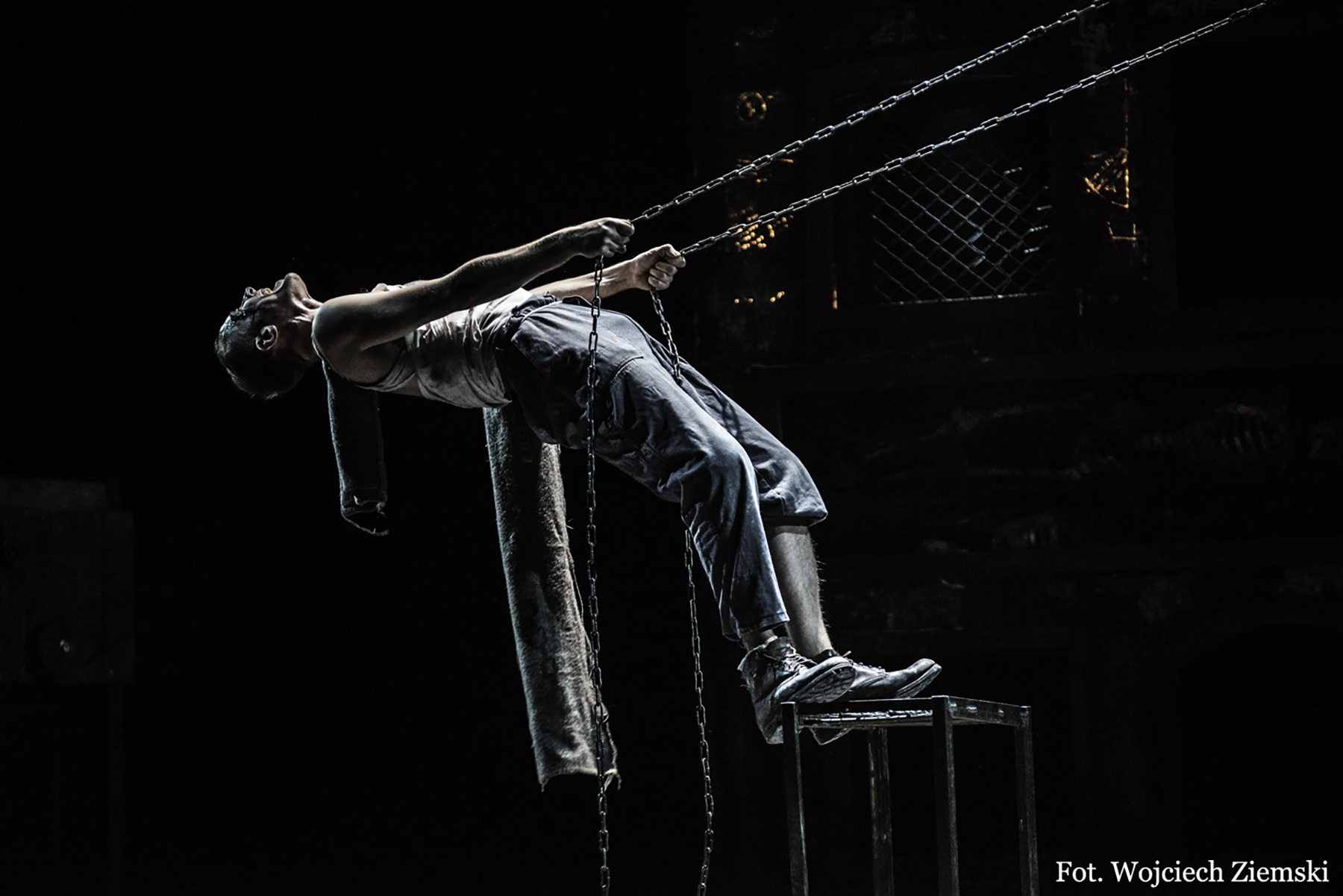
In Attends, Attends, Attends… (Pour Mon Père) the son has an imaginary exchange of thoughts with his father… a dialogue in which he bids his father to wait and be patient. He asks his father to open himself up to his son’s time. He asks his father to withdraw into his son in order to become a child again and prepare for death. The son reveals himself as Charon, the ferryman that prepares the father for the last passage. He knows death like none other. Like the performer he’s become, he’s a specialist in dying. Every night again he allows death and birth to come. Every night again he crosses the Styx, he is after all the accomplice of the spiritual, he awakens phantoms and sends them back to their heaven and hell from which they were born. He knows his role well, it is on, he has played it so often. Father will you join me?
For this solo, Jan Fabre was inspired by the life of Cédric Charron, a dancer with whom he has worked closely since As Long as the World Needs a Warrior’s Soul (2000). In this performance Jan Fabre explores the art of postponing. The postponement creates a reserve, an instant in which everything is still possible, in which you don’t have to make
choices yet. You reserve yourself in time, as well as in space: respite will also create a distance, will retreat upon itself in a movement of patience. There is something erotic even about postponement: opening oneself up for what is yet to come. But not quite yet.

The Director & Playwright
Jan Fabre is a graduate of the Municipal Institute of Decorative Arts and the Royal Academy of Fine Arts. He is well known both at home and abroad as one of the most innovative and versatile artists of his generation. Over the past 30 years, he has produced works as a theatre maker, author and visual artist. Jan Fabre is renowned for expanding the horizons of every genre to which he applies his artistic vision. In the late 1970s, still very young, Jan Fabre
caused a furore as a performance artist.
He makes a clean break with the conventions of contemporary theatre by introducing the concept of ‘real-time performance’ – sometimes called ‘living installations’ – and explores radical choreographic possibilities as a means of resurrecting classical dance. Fabre has been writing his own plays since 1975, although it was not until 1989 that they were first performed. His recent 24-hour project Mount Olympus, to Glorify the Cult of Tragedy is
internationally praised as one of the most outstanding theatre productions of the last decade.

The Performer
Cédric Charron, born in Bretagne, France, completed his MA, and decided to study performance and dance at P.A.R.T.S in Brussels, in 1997. He started to work with Jan Fabre in 1999, and has performed many of Fabre’s works. He also collaborated onPreparatio Mortis, a solo for Annabelle Chambon, and dances in Pierre Coulibeuf’s filmLes Guerriers de la beauté. He founded the Label Cedana, together with Annabelle Chambon and collaborated with artists such as Boris Charmatz, William Forsythe, Thierry de Mey, Michèle Anne de Mey, Fatou Traoré, Filip Sangdor etc.

The Group
Troubleyn is a theatre company with an extensive international practice, and home base is Antwerp. Troubleyn's mission is two-fold: creating and presenting the stage work (theatre, dance …) and by extension coordinating research projects, book publications, films, lectures and giving shape to the working of the Troubleyn / Laboratory that houses both the rehearsal studios and the offices. This building not only functions as a rehearsal room and as a workplace for emerging talent, but also as a laboratory for independent research into body and language.

Cast & Credits

On Stage Cédric Charron
Music Tom Tiest
Dramaturgy  Miet Martens
Light Jan Fabre, Geert Van Der Auwera
Costume  Jan Fabre, Andrea Kränzlin
Translation to French Michèle Deghilage
Production Troubleyn / Jan Fabre
Co-Production Festival Montpellier Danse
Text, Direction & Choreography  Jan Fabre


Across The Sea (Puppet Play)

The Play
This is a non-verbal musical puppet performance for children aged 4 +. Across the Sea, as the title suggests, is about an adventure that takes a baby penguin from Antarctica across the sea to Africa. In this journey the baby penguin meets many new & strange creatures, and makes friends fearlessly and without judgment. This is a story of friendship between diverse people in today’s global world. This play addresses issues like being separated from family, adjustments and being free of prejudice and judgment. It celebrates diversity, differences and the spirit of childhood.

Director’s Note
This piece was created over a month of devising with the actors of TIE (Theatre-in-Education) Company. The story of a little lost creature emerged and became the story of a lost penguin baby, separated from his family but determined to survive and make new friends. The story emerged in pieces as the actors responded to stimuli like story-telling without words, playing with material and with different forms of puppetry. The little penguin has all the qualities of little children, and lives their fantasies of travel and adventure while learning about Africa and Antarctica. We hope that with this play would make the children in the audience fall a bit in love with theatre and puppets.

The Director
Anurupa Roy is a Puppeteer, Puppet Designer & Director. She has trained at the Marionette Teatern, Dramatiska Institute, University of Stockholm, and at the Scoula De La Marionette. In 1998 she started Katkatha Puppet group which was registered as the Katkatha Puppet Acts Trust in 2006. Anurupa has been an artist-in-residence at Rote Fabrik, Zurich; APPEX, Bali, Indonesia; University of California, Los Angeles; Deutches Forum for Figunrenteater, Germany; and Charleville Mezeires, France. She is a recipient of the Bismilla Khan Yuva Puraskar (SNA) 2006.

The Group
The Theatre-in-Education Company (Sanskaar Rang Toli) of the National School of Drama was established on October 16, 1989, and is one of the important educational resource centres in the country. The TIE Co. consists of a group of actor-teachers working-with and performing-for children. The major focus of the company is to perform creative, curriculum based, and participatory plays in school, designed and prepared specially for children of different age groups. The company holds a one month long intensive Summer Theatre Workshop for Children organized in May-June every year. TIE Co. also participated in the International Theatre Festival at Warsaw (Poland). Participated in International Symposium on Actor’s Training Theatre Showcase at Beijing (China), Manila (Philippines) and also performed in International Theatre Festival at Shinzouka (Japan). Jashn-e-Bachpan and Bal Sangam are biannual festivals organised by the company where it invites plays by and for the children from different parts of the country. Bal Sangam is a festival of Indian performing folk and traditional arts presented by children practicing these arts from different regions of the country.

Cast & Credits

Baby Penguin Soumita Kundu
Penguin’s Parents Aparna Kapoor, Manoj Sharma
Penguin  Manoj Kumar, Nidhi, Mahesh, Soumita, Manoj Sharma, Aparna, Mridul, Jayotsna
Egg  Soumita, Jyoti Bala, Piyush
Fish Manoj Sharma, Aparna, Mridul, Nidhi
Ants  Aparna, Mahesh, Jyoti, Piyush
Ostrich Aparna, Mahesh
Giraffe Tasabber, Nidhi, Mridul, Manoj Sharma
Flamingo Jyotsna, Piyush, Aparna, Jyoti, Kaleem, Mahesh
Crab Manoj Kumar
Baby Elephant Tasabber Ali
Crocodile Nidhi S Shashtri
Bird Jyoti Bala
Mother Elephant Jyotsna, Mahesh, Kaleem
Hunter Mridul
Tourist Manoj Sharma, Aparna
Mountain & Water Set- Up Tasabber, Piyush, Manoj Kumar, Jyoti, Mahesh
Shadow Jyotsna, Piyush
Light Operation Meeta Mishra
Light Assistant Dhirendra
Music Operation Vikramjeet Singh
Stage Manager Tasabber Ali
Director Anurupa Roy
Chief of TIE Co. Abdul Latif Khatana


Crossings : Exploring the facets of Lady Macbeth

The Play

Four performers represent the facets of Lady Macbeth, in constant conflict, to create a fluid performance, bringing together elements of Indian classical dance, movement, the original text of Macbeth, Hindustani classical, folk and tribal music.
Crossings mirrors the journey of Lady Macbeth through Shakespeare’s original play. She receives a letter from Macbeth telling her of his encounter with three witches who foretell that he will be King. This plants the idea of killing King Duncan in Lady Macbeth’s mind to further her husband’s ambition. Battling her own conscience and femininity, she plans and executes a gruesome murder. She is consequently haunted by the images of blood even as she plays a gracious hostess at the coronation banquet where the guests become suspicious of the truth. Bereft of support and company from her equally guilt-ridden husband, her world crumbles towards a lingering death.

Director’s Note
Poetry, lyricism, allegory, metaphor, repetition, imagery, rhythm, representation, symbolism – all imbue both Shakespeare and classical dance. Lady Macbeth is arguably Shakespeare’s most complex and layered female character. When I watched a Schezuan Opera actress in a riveting solo rendition of the character, I asked – could one interpret Lady Macbeth through Indian classical dance?
We embarked on this remarkable journey in December 2003, with text, music, movement and design responding to each another in a myriad different ways, encountering parallels in Indian mythology and iconography, finding fresh possibilities in rendering both text and dance. The performance, as it stands today, has been distilled through several versions since the first workshop production in April 2004, and presents Lady Macbeth in all her magnificent complexity.

The Director
Vikram Iyengar is a dancer, choreographer, theatre director, performing arts researcher, writer and curator based in Calcutta. He is the co-founder and artistic director of Ranan and project initiator of The Pickle Factory – a hub for dance and movement work. Noted for the conscious bringing together of kathak dance, movement, spoken drama and design, his production work spans choreography for stage and film, dance and theatre explorations, and performance collaborations. His international credits include co-choreography with Helena Waldmann for the Faust Prize nominated Made in Bangladesh. He also works regularly with contemporary choreographer Preethi Athreya. He was the co-editor of India Theatre Forum’s web-based e-Rang from 2009 to 2015, and is a guest lecturer/ presenter at several universities in India and abroad. He is an ARThink South Asia Arts Management Fellow (2013-2014) and Global Fellow of the International Society for the Performing Arts (ISPA), 2017. A member of Kick Start – an international platform for arts entrepreneurs, Vikram is currently one of the four Asian participants in the International Arts Leaders programme of the Australia Arts Council. He was awarded the Ustad Bismillah Khan Yuva Puraskar for contemporary dance by the Sangeet Natak Akademi in December 2015.

The Group
Ranan is a kathak-based performance company with the express desire to demystify classical dance and make it accessible and enjoyable for a range of audiences. Its work is committed to sharing the magic of the arts, and spans three areas: practice, production, promotion. The group works with kathak dancers, actors, and designers, creating connections between different performance languages, and keeping kathak at the centre of our experiments.

Cast & Credits
Created With / Performers Anubha Fatehpuria
Dana Roy
Debashree Bhattacharya
Jayati Chakraborty

Original Music and Vocal Nageen Tanvir
Percussion Siddhartha Bhattacharyya
Stage and Costume Design Vikram Iyengar
Lighting Design Sudip Sanyal
Production Amlan Chaudhuri

Concept, Design, Direction Vikram Iyengar


Badi Bua Ji

The Play

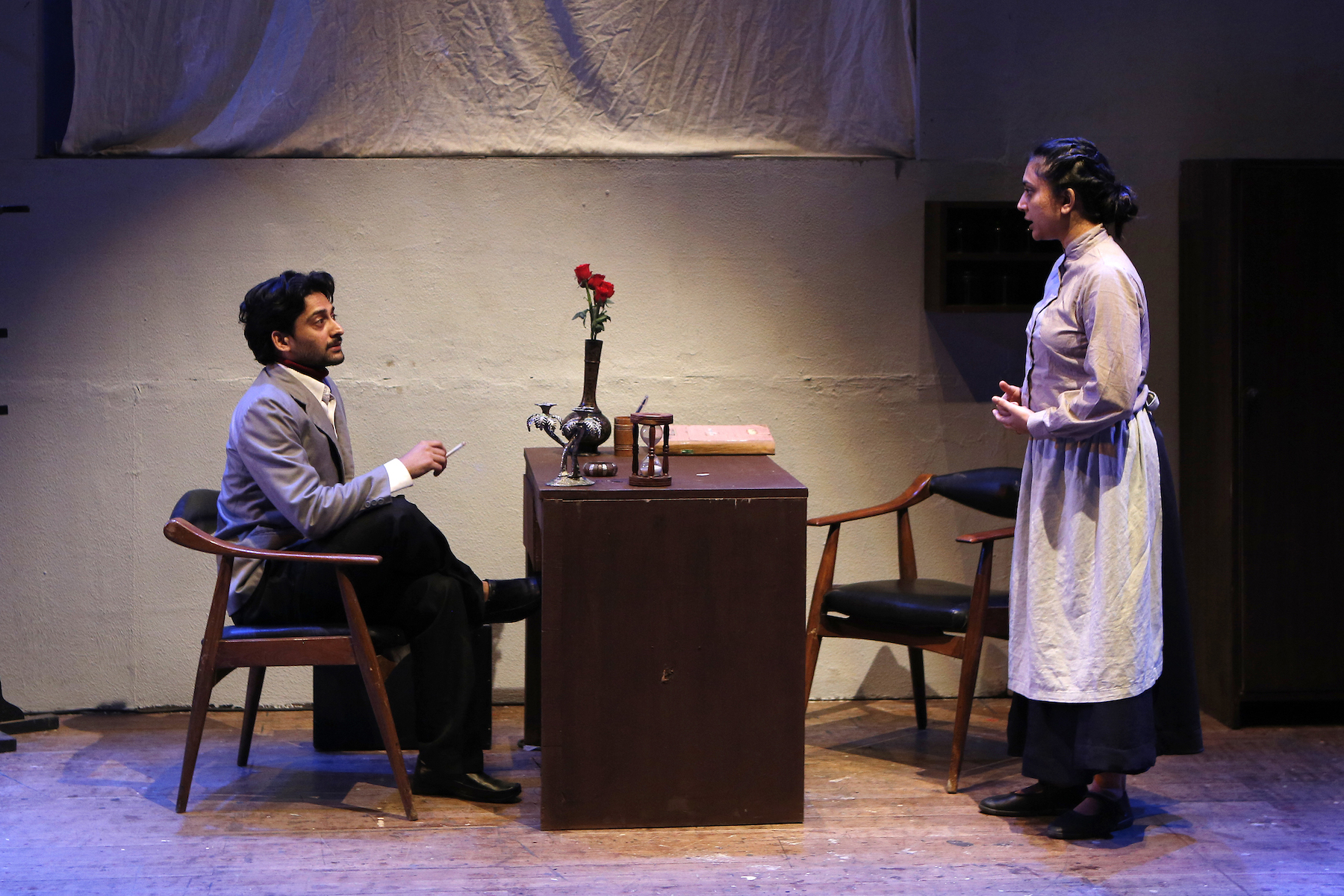
Set in the 1960’s, this play moves from comic relief to comic relief…! The relief, however, one shall realize, is from the rather serious determination and steadfast passion that a fairly large crowd of young theatre enthusiasts nurtures in its attempt to stage a play that is meant to open in two days’ time. Their dream of doing well is hindered by an aged matron who also happens to be the aunt of the heroine of the play. Theatre or no theatre, acting or no acting, lies or no lies, this generation or that generation – you shall join these dilemmatic crossroads with the characters of the play to partake in a roller coaster ride of love, unity, traditions and passion for the stage. And yes…they finally staged the play successfully!


Director’s Note

Can a language have what has come to be called ‘purity’? Is accent a part of one’s identity or does it exists outside an individual’s personality, therefore demanding avoidance, removal, extermination? Is language necessary for communication, to build one’s identity? Our body carries its culture with it – a fact that no one can escape. I wanted to incorporate our multifarious cultural codes entwining and entangling with each other within the context of the play. Dealing with this concern seemed exciting and through the process a Garbha Nataka i.e. a play within a play, could generate. You shall find, like in our lives, that many events take place simultaneously throughout the play. This simultaneity is what I see as an important characteristic emerging within my performance-making process. The structure of the play, and the structure of the space-design for the play, both carry strong threads of simultaneity. Do not be disturbed by it! One does not get to witness everything happening around one’s life! Maybe, one does not need to. Let’s be as realistic as possible! So…. Lights, Sound, Make-Up, Costume … Action….!


The Director

Sagnik Chakraborty has done the three-year diploma course with specialization in Design and Direction from National School of Drama, New Delhi. He has been an active theatre worker from Siliguri, West Bengal. Now he is working as a freelance designer and director.


The Playwright

Badal Sircar was a dramatist and theatre director from Bengal. He was the founder of Shatabdi, a theatre company founded in 1976. His plays Ebong Indrajit, Basi Khabar and Saari Raat are regarded as classics and are timeless. He was awarded the Sangeet Natak Akademi Award in 1968, Padmashri in1972, and the Sangeet Natak Akademi Fellowship in 1997. His real name was Sudhindra Sircar, and he was born on July 15, 1925 in Kolkata. Badal studied Engineering and Literature. His earlier works were comedies, and later he wrote on serious subjects. After writing the landmark play Ebong Indrajit, he wrote a series of extraordinary plays like Baaki Itihaas (1965), Pralap (1966), Tringsha Shatabdi (1966), Pagla Ghoda (1967), and Shesh Naai (1969).  


The Group

This play is being presented as a part of National School of Drama’s graduate showcase (class of 2017), which aims to provide a platform for emerging theatre practitioners, allowing them to share their work with a wider audience.   


Cast & Credit

Badi Buaji                       Rukmini Sircar

Yogin                              Manohar Pandey

Anu                                Suman Purty

Shambhu                       Vivek Emmaneni

Nitai Da                          Niranjan Nath

Phuphaji                         Rohit Jain

Ananth                            Abhinav Lucky Pateriya

Pratima                          Jina Baishya

Munni                             Pallavi Jadho

Dhruvesh                       Lanuakam

Shashaank                    Ujjawal Yadav

Mr. Sen                          Baljeet Singh

Mrs. Sen                        Swati Dubey

Girl                                 Abhilasha B. Paul

Set Design                    Sagnik Chakraborty

Light Design                  Ujjawal Yadav

Operation                      Aruja Srivastava

Music Composition       Sayan Chakraborty, Abhinav Lucky Pateriya

Lyrics                            Divyangana Sharma, Sayan Chkraborty,

Vocal                            Shruti Sahu, Sukanya Chattopadhyay

                                     Lanuakam, Sayan Chkraborty

Percussion                     Sayan Sarkar

Sound Engineer             Sukanya Chattopadhyay

Costume Assistance      Goge Bam

Stage Manager              Greeney Francis, Debarati Sikdar


Playwright                Badal Sircar

Translator                Pratibha Agarwal

Director                   Sagnik Chakraborty


KARTIK?!

The Play & Director’s Note

This play has a storyline that could have been based on tomorrow morning’s newspaper headlines. Using the wonderful theatrical device of three actors playing the central character of Kartik, we are able to enter his fractured world. We simultaneously see him as he was before the accident that changed his life; we also see him as he is immediately after the accident, recovering in hospital, at home and in school; as well as when he is an adult. The play brings together the present, past and future in a seamless whole. It has been a fascinating journey with the actors and my own team. We have interviewed teenagers, their parents and teachers; watched their interactions in school, home and on the metro; created improvisations; spent hours mastering the intricate choreography; enjoyed the shopping for clothes that capture today’s Delhi; and worked hard at creating over 36 characters, played by just 14 actors!


The Director

Educationist, theatre director and activist, Feisal Alkazi lives and works in New Delhi. Over the past forty years he has carved his own niche with his group, Ruchika. He has directed over 200 plays with adults in Hindi, English and Urdu. Most recently, two plays, Noor and A Quiet Desire, written by him have been produced. In addition, he has directed over 100 productions for schools all over India. Ruchika also runs a training program in theatre for children since 1997. Feisal has written 24 books as well and is a counsellor with Sanjivani. In the field of disability, he has directed 30 films and produced several plays.


The Group

The Theatre-in-Education Company (Sanskaar Rang Toli) of the National School of Drama was established on October 16, 1989, and is one of the important educational resource centres in the country. The TIE Co. consists of a group of actor-teachers working-with and performing-for children.  The major focus of the company is to perform creative, curriculum based, and participatory plays in school, designed and prepared specially for children of different age groups. The company holds a one month long intensive Summer Theatre Workshop for Children organized in May-June every year. TIE Co. has participated in many international theatre festivals and symposia in countries including Poland, China, Philippines and Japan. Jashn-e-Bachpan and Bal Sangam are biannual festivals organised by the company where it invites plays by and for the children from different parts of the country.  

Cast & Credits

Sutradhar Kartik                                       Manoj Kumar

Old Kartik, Gym Teacher, Shashank        Manish Saini

New Kartik                                                Mridul Anand

Mummy                                                    Aparna Kapoor

Papa, Changezi, Bhaiji                            Mahesh Kumar

Raghav                                                    Manoj Sharma

Himanshu, New Dancer                          Tasabber Ali

Nancy                                                      Jyoti Bala

Doctor Fatima, Rubina, Announcer        Jyotsana

Inspector, Nurse1                                    Nidhi S Sasthri

Anshika, Nurse2, Vicky                           Soumita Kundu

Anthony, Shiny                                        Piyush Verma

Drug Peddler, Teacher                            Kaleem Zafar

All Street Voices & Dancers                    Jyotsana , Aparna Kapoor, Soumita Kundu, Piyush Verma,                                                                                            Mahesh Kumar, Manoj Sharma, Nidhi S Sasthri


Choreographer                                        Vishwa Kant Singha

Assisted by                                             Sandeep Kashyap

Costume Design                                     Shaik Sheeba   Assisted by Jyotsana

Set, Poster & Brochure Design               Jagan Shah  Assisted by Kamal Kumar

Light Design                                            Mona Chawla  Assisted by Joginder Singh, Dhirender Kumar

Light Design                                           Mona Chawla   Assisted by Joginder Singh, Dhirender Kumar

Music Operation                                     Sheel/Vikram Jeet Singh

Stage Manager & Property                    Nidhi S. Sasthri

Tailor                                                      Saroj Silswal, Akhtar Ali

Sound                                                    S. Manoharn, Pratap Singh, Subhanjan

Photography & Videography                 Deepak Kumar

Assistant TIE                                         Co. B.S Rawat

Administration Staff                               Pirat Singh Negi, Darmiyan Singh, Shailender Kumar,

                                                               Neha Bhatt

Attendant                                               Md. Rashid, Pawan Kumar

Chief of TIE Co.                                   Abdul Latif Khatana

Asst. Director Mona Chawla

Translation & Adaptation                   Kiran Deep Sharma

Design & Direction                             Feisal Alkazi


Paule Chalati Pandharichi Vaat


The Play

Vari, a religious procession, has mesmerized the whole Maharashtra for the past 800 years. It is a valuable treasure of Maharashtrian culture. It is not only a celebration but also underlines the human progress, cultural and religious overflow, and gives us universal energy. It also symbolizes religious humanism, unity, and brother-hood, and gives us experience of stress-free life with self-discipline and physical fitness. Due to today’s stress-full life, competition and rat race, it is difficult for an individual to participate in Vari, and experience the sublimity. Keeping the same in mind we have planned this Vari Natya (Vari through drama/play) so the audience can experience this procession from Alandi to Pandharpur.


Director’s Note

Vari Natya is a celebration that points out the vices in human nature and gives a social message.

It makes you realize the importance of going to Pandharpur once in a life time. After viewing the play everyone will carry the grandeur and the positive attitude of varkaris. They have the potential to keep themselves content in any condition with their and peace of mind. Though Pandurang is the God of suppressed/down trodden class, our play will highlight their richness and importance too. Our play is a revolution for new generation to be one with the tradition, worship, unity, diversity and the immersion of Vari.


The Director & Co-Playwright

Dr. Sandeep Mane, despite working with the Government also manages Karmbhumi drama

at Kashil, Satara district. He has also worked with Saraswati Theatres to provide recognition to the

rural districts’ performers. He has managed various plays at Shahapur, Thane, Panvel, Raigad

and many other places in and around Mumbai. He is the co-writer & director for Paule Chalati Pandharichi Vaat.


The Playwright

Paule Chalati Pandharichi Vaat (A million steps heading towards the abode of God in Pandharpur) is a

Vari Natya (Musical performance of a Theatrical Play). We are leaping towards 21st century with the wings of novelty and modern thinking, in a fast paced life. Progress in life is evident when we follow such virtues and vices, especially in a modern day society which is under stress. While we move ahead towards progress we may also get stuck like a stick in mud, with social insecurities and incurable diseases of mind and body. Keeping this in mind Joy Kalamanch and Saraswati Theatre joined hands to produce and present Paule Chalati Pandharichi Vaat.


Cast & Credits

Kirtankar                  Suresh Chauhan

Gojakka                    Sulbha Jadhav

Mann                        Mangesh Kasekar

Mukta                       Sayli Kajdodkar

Vinekari                   Madhu Shinde

Shantakka               Sneha Paradkar

Rukmani                  Archana Jagtap

Vitthal                      Sachin Gajmal

Co- artists                Komal Kasare, Kajal Kasare, Tejal Kasare

                                   Madhuri Gayakwad, Aankanksha Rakde,

                                   Krutika Kambde, Ruchita Dongre,

                                   Shefali Sawant, Monika Vayal, Rajesh Vadunj,

                                   Prakash Bhagat, Vikas Kot, Aakash Rajguru,

                                   Prashant Dawde, Pradeep Jadhav, Pravin Kadam,

                                   Sailesh Godpade, Vishwanath Chandorkar,

                                   Rohan Kasare, Somesh Palande


Set & Lights Design          Sunil Devdekar

Lyrics                                  Shashank Kondilkar & Mohan Samant

Music                                  Datta Thite

Choreographer                 Sachin Gajmal

Make-up                            Aniket Kadokhe & Vaibhav Parshette

Costume                            Master Balwant & Savita Jethe

Sound                                 Nilesh Gawde

Setting Boys                      Ram Sagre & Team

Lights Equipment           Sayli Lights

Backstage                          Savita Jethe, Rajesh Valunj & Gajendra Sapte

Instrument player           Vinay Sawant

Sculptor                             Srikant Dhalkar & Ratan Aambekar

Host                                    Sandeep Vichare

Production Manager      Moiz Tarwadi

Producer                           Joy Nagesh Bhosle (Joy Kalamanch)

Concept                             Sachin Gajmal


Playwrights           Yuvraj Patil & Dr. Sandeep Mane

Director                  Dr. Sandeep Mane


A STRAIGHT PROPOSAL by Happy Ranajit

A Straight Proposal 3

The Play

The play covers the life of Mitesh the protagonist of the play, the ups and downs in his life which goes parallel to the ups and downs of the LGBT movement in India. The play unfolds a series of love stories of Mitesh and his relationship with his brother and father which bring out the several problems in gay community. A secret life and a mysterious death of Mitesh in this play are not just incidents they become metaphors for us.


Director’s Note

The pink triangle was one of the Nazi concentration camp badges, used to identify male prisoners who were sent there because of their homosexuality. We all condemn Hitler for his deeds. The play speaks about the problems and possibilities of LGBT (Lesbian Gay Bisexual and Transgender) culture in India in current political scenario in India. It’s about a man who is in constant search of a committed relationship and who wants to live with dignity. Each scene of this play is a portion of diary of an imaginary character Mitesh. Each page of the diary is related to the moment of LGBT in India, an article number of IPC which makes every act of an individual a crime in some or the other way.

A story of one diary, four love stories, one phone call, four days of love, one promise, four lovers and one gun.


The Playwright & Director

Happy Ranajit started working in theatre since his childhood at Odisha and after completing masters in science, he joined NSD and successfully completed his degree with specialization in acting in 2008. He has acted in more than 60 plays with many eminent directors like Ram Gopal Bajaj, Amal Allana, Anuradha Kapur, Tripurari Sharma, Anamika Haksar, Abhilash Pillai, K.S Rajendran, Dilip Shankar, David Freeman and Powel Miskinviz. In 2010, he participated in the physical theatre workshop by theatre ZAR, Poland.

Apart from acting, he also conducts acting workshops, writes and directs plays. He has written and directed following plays – Familiar Strangers, Moth******er, Hangover, Love ka Overdose, Wizard of Numbers Genuine Liars, A Straight Proposal, Ward No. 30, Bhagyashree ka MMS Dekha Kya. Out of which Familiar Strangers and Genuine Liars got published recently in one book called “Strangers and Liars”

He got the best actor award at Mahindra theatre awards 2010 for his performance in Roop Aroop. He also won the best actor award at the international GATS theatre festival for the play Richard III at Beijing, China. He has received the Bismillah Khan Yuva Puraskar by Sangeet Natak Akademy for acting for the year 2012.


The Group

Established in 2010 and got registered in 2012 by a group of young artists. Unicorn Actors’ Studio is set with a purpose to give platform to ideas, new thoughts and experimental performances. The group focuses on evolving new texts, new language of performances, collaborative works and performances on a regular basis. The group has produced two plays so far such as Ernest Hemmingway’s The Old Man and the Sea and Shakespeare’s Romeo and Juliette. Familiar Strangers is the third and latest production of this group. The group has travelled in many parts of India and has conducted acting workshops.


Cast and Credits

 Mitesh                        Dilip Shankar                           

Dhruv                          Teekam Joshi                            

Amar                            Nitin Goel                                 

Kranti                           Yuvraj Bajwa                            

Turag                            Junaid Kaifi                              

Amitesh                       Shaurya Shankar                       

Colonel Bakshi           Ashok Dhawan                         

Pink Boys                    Vaibhav Raj, Aditya Sinha, Anjeet Tushir, Aman Sood.            

                                      Harshvardhan Chaturvedi   


Lights                          Happy Ranajit 

Sound Design            Sandy Singh

Sound Operation      Akshay Sharma

Video Projection       Akash Mahamana       

Costumes                   Anupriya Bhagat

Choreography           Gilles Chuyan

Property                     Deepanand

Backstage                   Lucky

Production                Sachin kumar

Stage Manager         Mohit Raj Saxena

Asst. Director           Gauri Dewal


Playwright & Director   Happy Ranajit


KHAMOSHI SILI SILI by Joseph Stein

Khamoshi Silli Silli 1

The Play

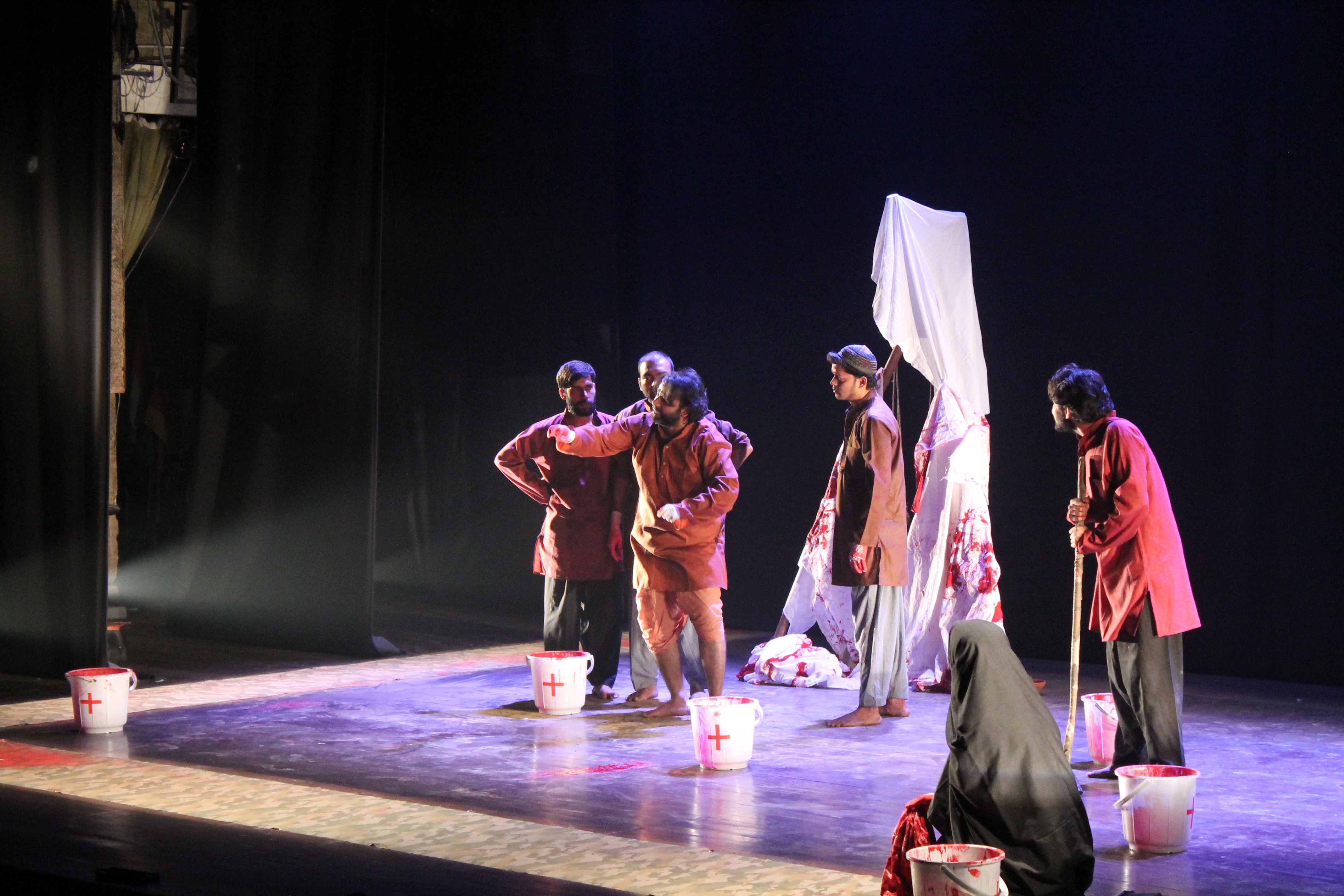
This play is a translation of Fiddler on the Roof written by Joseph Stein. It is a musical that deals with the displacement of communities. The story is neatly bound to the Kashmiri situation in our country. Prithvi Nath loves his daughters, and goes against the traditional norms, allowing them to marry men of their choice. Shuhul, the third daughter chooses to marry a Muslim…


Director’s Note

Going along with the central theme of the play, the contemporary situation of our society took the forefront. The final situation chosen is the plight of the Kashmiri Pandit community. This choice is to support the script with a relevant social background which can be projected on a larger canvas, and can highlight the pain and problems of the people who have been displaced from their own land.


The Director

Suresh Sharma did PG diploma with specialization in Acting from National School of Drama in 1985.

In 1987-88 he established the only non-government Repertory in the district of Mandi (Himachal Pradesh). From 1996-98 he worked as the Artistic Director of Sri Ram Centre for Performing Arts, Delhi. In 1998 he established the first non–government fully residential Theatre Academy in Mandi, Himachal Pradesh. Mr. Sharma has been felicitated by Sahitya Kala Parishad. Sangeet Natak Academy awarded Mohana, a play written and directed by him, under the Young Director’s Scheme.


The Playwright

Joseph Stein (May 30, 1912 – October 24, 2010) was an American playwright best known for writing the books for the musicals Fiddler on the Roof and Zorba. His greatest success came from writing the book for the 1964 musical play Fiddler on the Roof, for which he won three major awards, including two Tonys.


The Translator

A playwright, actor and director of great repute, Asif Ali Haider Khan obtained a PG diploma with specialization in Acting from Nation School of Drama. Later, he worked with NSD Repertory Company as an actor for many years. He received the Sangeet Natak Academy’s Ustad Bismillah Khan Yuva Puraskar for playwriting in the year 2006. Currently, he is teaching Modern Indian Drama at National School of Drama, New Delhi.


The Group

Established in 1964 with only four members, the Repertory Company is the regular performing wing of the School. It was set up with the dual purposes of establishing professional theatre on one hand and continuing with regular experimental work on the other.


Cast & Credits

Prithvinath Zutshi             Shanawaz Khan

Jungaash                              Shruti Mishra/ Sampa Mandal

Shuhul                                  Aparajita Dey

Sheen                                    Sukhinjeet Kaur

Nonika                                  Rukmini  Sircar

Himaal                                  Aparna Menon

Didda                                    Bornali Borah

Leelawati                             Sampa Mandal/ Shruti Mishra

Shambhunath                     Deep Kumar

Gaffara                                  Sikandra Kumar

Bakshi Singh (Kimma)      Rajib Kalita

Brijlal                                     Niranjan Nath / Raju Roy

Rajguru                                 Dhutadmal Ravi Babasaheb

Policeman                             Vivek Emmaneni

Somnath                                Mazibur Rehman

Badrinath                              Naveen Singh Thakur

Paadshah                              Siddheshwar Kashinath Thorat

Makkhan Lal                        Raghvendra Pratap Singh

Krishanpir                            Mahendra Singh

Firdous                                  Mohan Lal Sagar

Grandmother                      Shruti Mishra / Sampa Mandal

Chorus                                  Moti Lal Khare, Abdul Kadir Shah,

                                               Naveen Singh Thakur, Md.Suleman,

                                               Dharam Singh Bisht, Naresh Kumar,

                                               Mazibur Rehman

                                               Bijja Aparna Menon

Male                                     Naveen Singh Thakur

Male-1                                 Naresh Kumar

Male-2                                 Mazibur Rehman

Kukka                                  Raju Roy/Niranjan Nath

Woman-1                            Sukhinjeet Kaur

Woman-2                           Shruiti Mishra / Sampa Mandal

Male-1                                 Dharam Singh Bisht

Male-2                                 Pradeep Aggarwal


Set Design                                    Bansi Kaul

Set, Props Execution                 Rajesh Bahl

Set Execution                              Ram Pratap, Dharam Singh, Manoj Kumar

Light Design & Operation        Govind Singh Yadav

Assistance                                    Md. Suleman, Pradeep Aggarwal

Costume Design                         Kirti V. Sharma

Assistance                                   Pushpa Vishwakarma

Costume in-charge                    Budh Ram

Chief Costume Coordinator    C.S. Bhatia

Assistance                                   Parvati Bisht

Sound Operation                       Mukesh Kumar

Sound & Music Recording       S. Manoharan, Subhanjan

Property Design                         Suresh Sharma

Property in-charge                    Motilal Khare

Music                                           Kajal Ghosh

Tabla & Dholak                         Om Prakash

Octopad                                      Narender Kumar

Harmonium                              Naveen Singh Thakur

Tumbkh                                      Feroz Ahmed

Rabab                                          Gulam Qadir

Gara                                             Fearoq Ahmed

Sarangi                                        Syed Yaseen

Kashmiri Diction                       Ashwath Bhatt

Dance Classes                            Sonal Modi Vorah

Choreography                            Norbu Tshering

Make-up                                      Raju Roy, Shruti Mishra

Assistance All Repertory Artists


Playwright                     Joseph Stein

Translator                    Asif Ali Haider Khan

Director                          Suresh Sharma


AKA-NANDUN by Bhawani Bashir Yasir

Aka Nandun 1

The Play

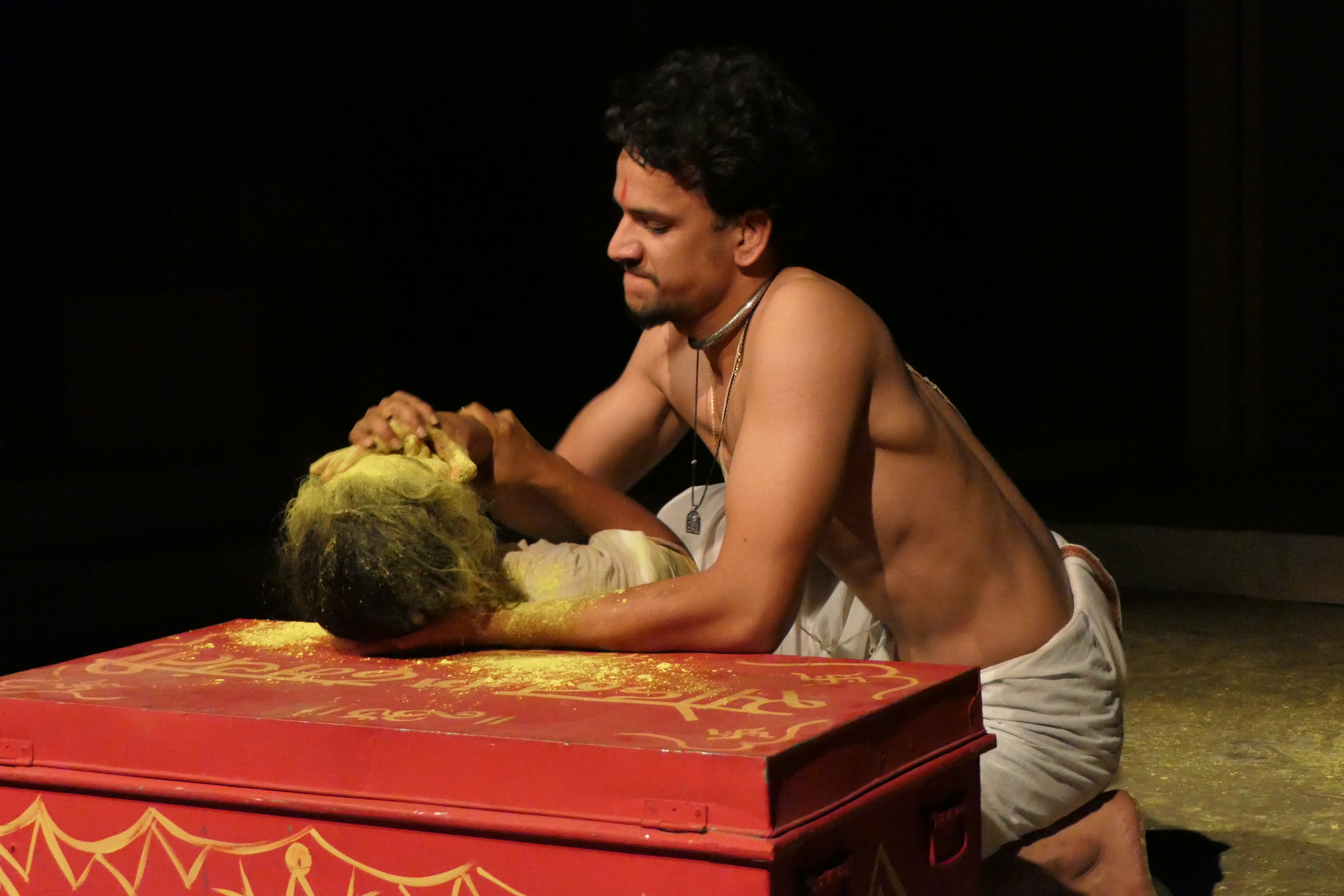
The play Aka-Nandun, which means ‘The Beautiful’, is based on a mystic legend, about a Hindu king who has seven daughters but no son. When he gets old he prays for a son who could inherit his kingdom. A jogi comes in his dream and blesses him with a son on the condition that he should name the son Aka-Nandun and promise to return him to the jogi when he is 12 year old.

The son is born, named Aka-Nandun, brought up with royal care, and sent to the royal Pathshala to learn Vedas and Puranas. When he is 12, the saint appears before the king. The king begs the Jogi to take his whole kingdom and wealth, but not his son. The jogi declines and orders the king to slaughter his son, and orders the queen to cook him for his feast. When the feast is ready, he orders the queen to divide it in 11 plates – eight for ladies, one for the king, one for the saint, and the eleventh for Aka-Nandun. Then he orders the queen to call out for Aka-Nandun to enjoy the feast. The queen calls for Aka-Nandun, who, to the surprise of all, appears. The jogi disappears and all sing the glory of the jogi.


Director’s Note

Kashmir has a distinctive culture, based on the fusion of Shiv-mat and Islam, which has given birth to a tolerant, mystic and socio-religious philosophy during the last seven hundred years. And this is mostly known as Kashmiriyat. Aka-Nandun is based on a mystic Kashmiri poetic fable, written by mystic poets and endorsed popularly, and which emphasises the highest sacrifice of ones greed, lust, power, ego and worldly luxuries, and submit to the highest authority of the Almighty. The play translates this through the folk format of Daastaan with sublime actions, theatrical visuals and traditional music and dance.


The Playwright & Director

Bhawani Bashir Yasir, born at Doru-Shahabad in Anantnag district of Kashmir, is a post-graduate in Kashmiri literature, a renowned Playwright and Theatre Director, who after passing out from National School of Drama, New Delhi in 1987 with distinction in Stage Craft, preferred to go back to his state to institutionalise the theatre of Kashmir on professional standards, in line with Kashmiri sensibilities. He established EKTA in 1988, now internationally recognised as the authentic theatre institution of the state.


The Group

Ensemble Kashmir Theatre Akademi, popularly known as EKTA was founded in 1988 by Bhawani Bashir Yasir after passing out from NSD. EKTA organises a national theatre festival known as Budshah Theatre Festival, in which plays from all regional languages of the state, and special entries from rest of India are also invited. EKTA has participated in many national and international theatre festivals.


Cast & Credits:

King (Ram Gopal)                         Bhawani Bashir Yasir

Queen (Sonei Maal)                     Shaheena Nazir / Haseena Sofi

Seven Princesses                          Nusrat Jalal, Rukhsana Tantrey,

                                                         Tabbasum Aslam, Iqra Binti Hassan,

                                                         Naazima Yusuf, Kousar Aejaz,

                                                         Khushbu Bashir

                                                         Aka-Nandun Arhaan Nisar

                                                         Tabeena Manzoor

The Hermit (Jogi)                        Aamir Hussain Mir

Raj-Guru                                        Farooq Ahmad Mir

                                                         Daastaango Bashir Lone


Chorus (Dancers & Singers)      Nisar Ahmad Rah, Mir Shaukat Hussain,

                                                         Syed Muzamil Rasool, Asrat Hussain,

                                                        Junaid Ahmad Rather


Harmonium                                 Shaukat Bhat (Sultanpuri)

                                                        Rabaab Farooq Ahmad

Saarangi                                        Mohd. Amin

Dholak/Nout                                Tariq Ahmad

Stage Props                                   Nisar Ahmad Rah & Syed Muzamil

Costumes                                      Bhawani Bashir Yasir / Bashir Lone

Light Design                                M. Muzamil Hayat Bhawani

Production Controller               Gulzar Ganaie

Stage Manager                            Mir Shaukat Hussain

Associate Director                     M. Muzamil Hayat Bhawani


Music, Design & Direction      Bhawani Bashir Yasir