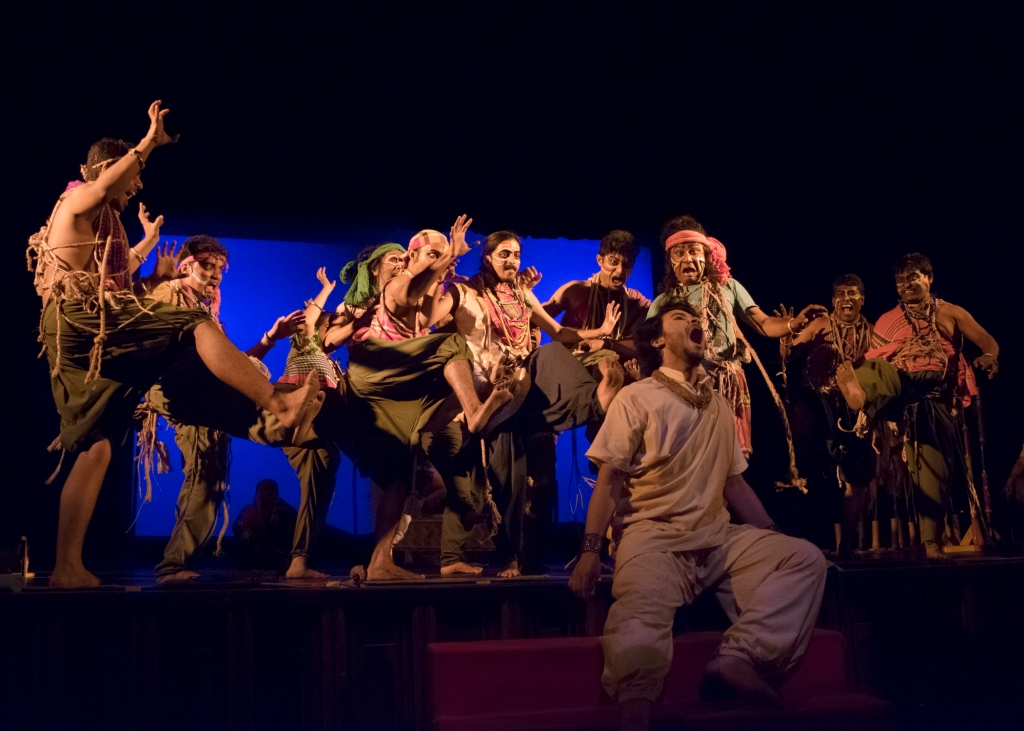
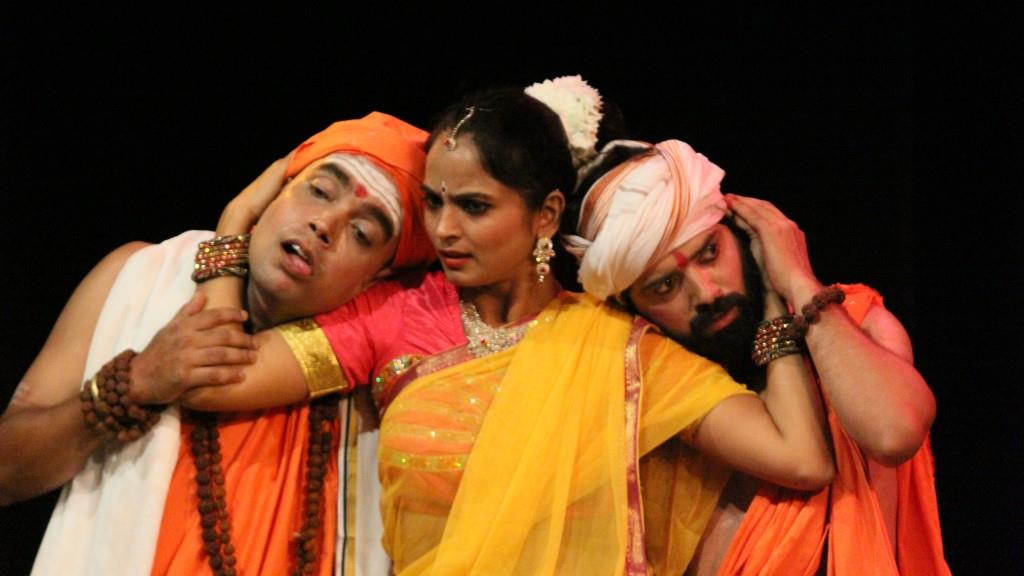
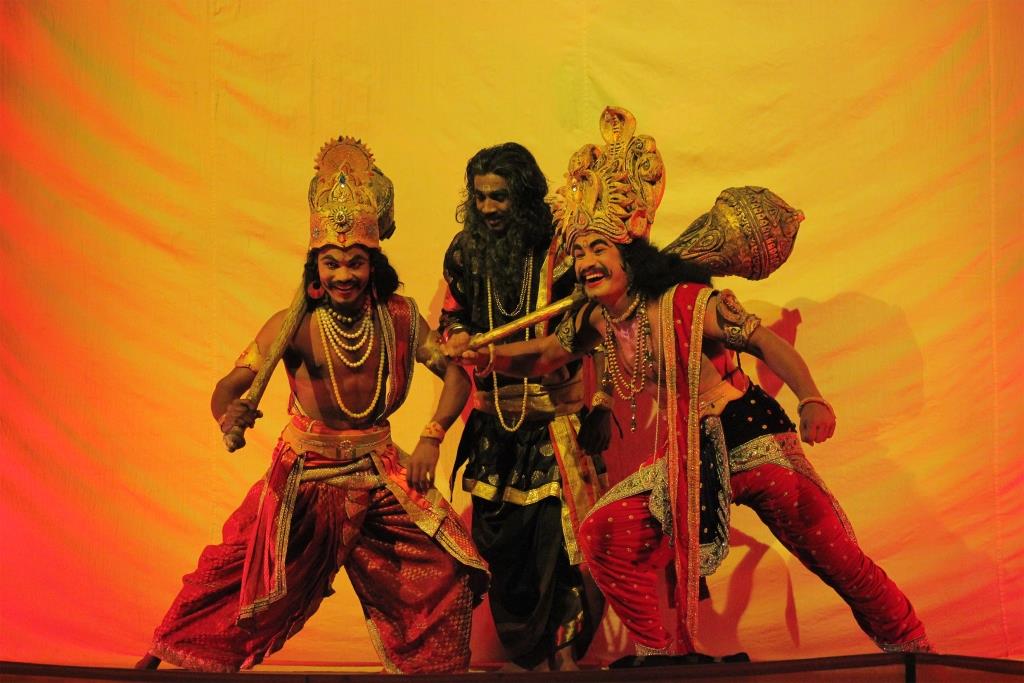
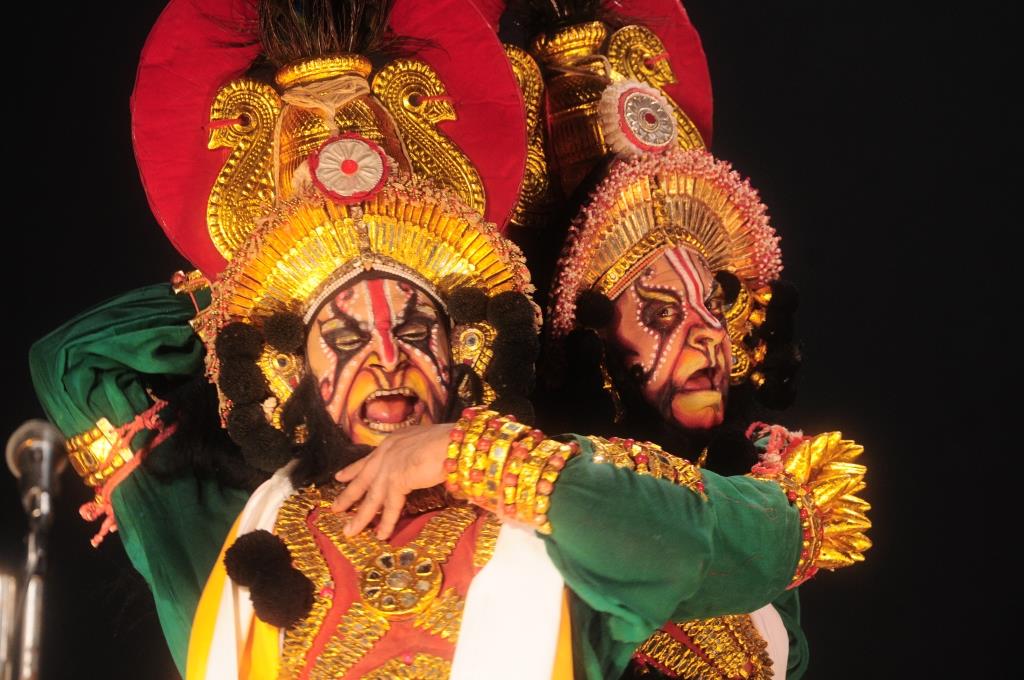
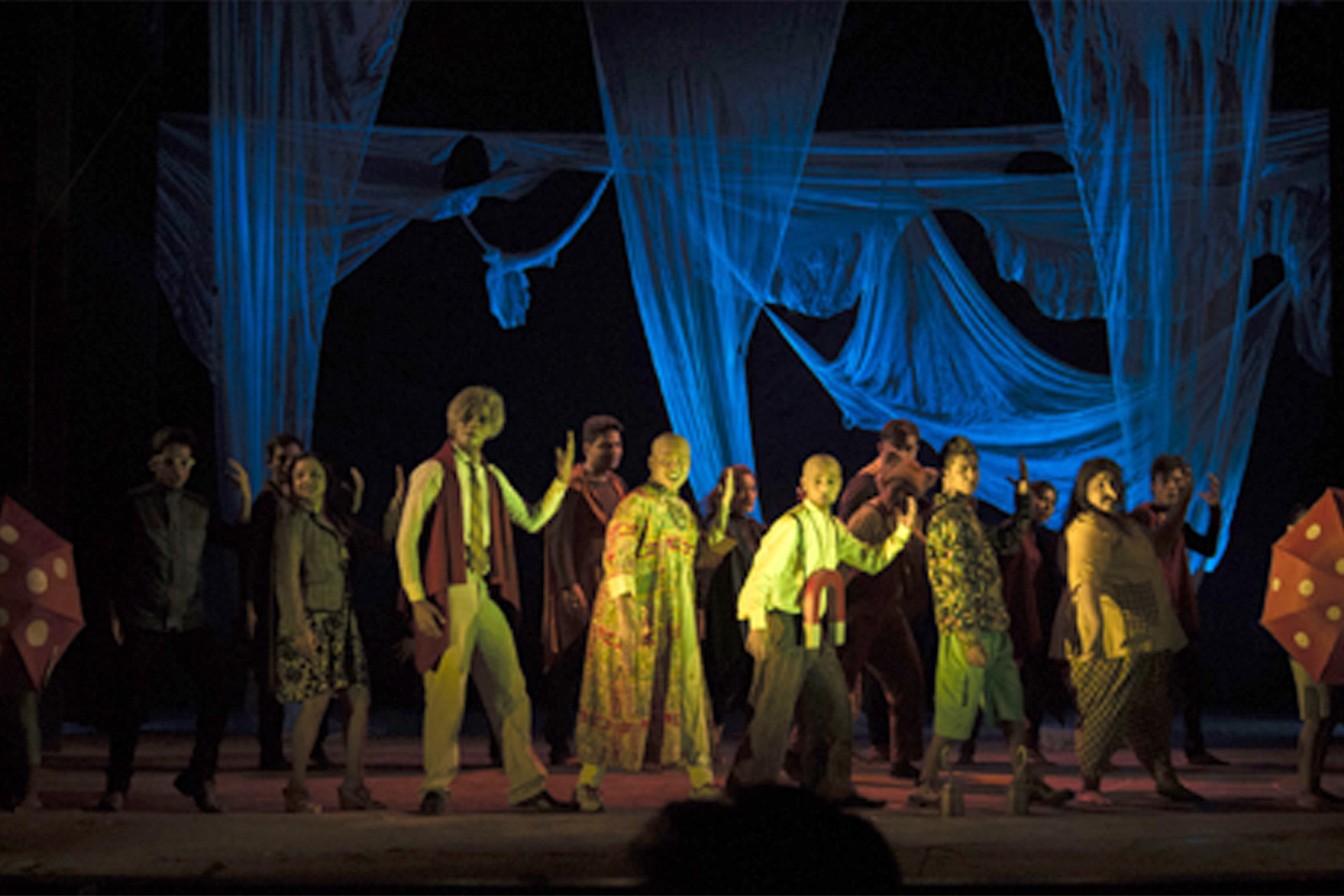
Satish Georgy Kashyap & Sandhya Sharma’s PHOOL SINGH – NAUTANKI (SWANG)

Directors: Satish Georgy Kashyap & Sandhya Sharma

Group: Swang, A Folk Art Academy, Haryana

Language: Haryanvi

Duration: 1 hr 15 mins

The Form

Swang is a folk dance drama of Rajasthan, Haryana, Uttar Pradesh and Malwa region of Madhya Pradesh. It incorporates suitable theatrics and mimicry accompanied by song and dialogue. It is dialogue-oriented rather than movement-oriented. Religious stories and folk tales are enacted by a group of people in an open area or an open air theatre surrounded by the audience. The themes are drawn from subjects like morality, lives of inspiring personalities, folk-tales, stories from Indian mythology and in recent times, more current themes like health and hygiene, literacy, etc.

The Play

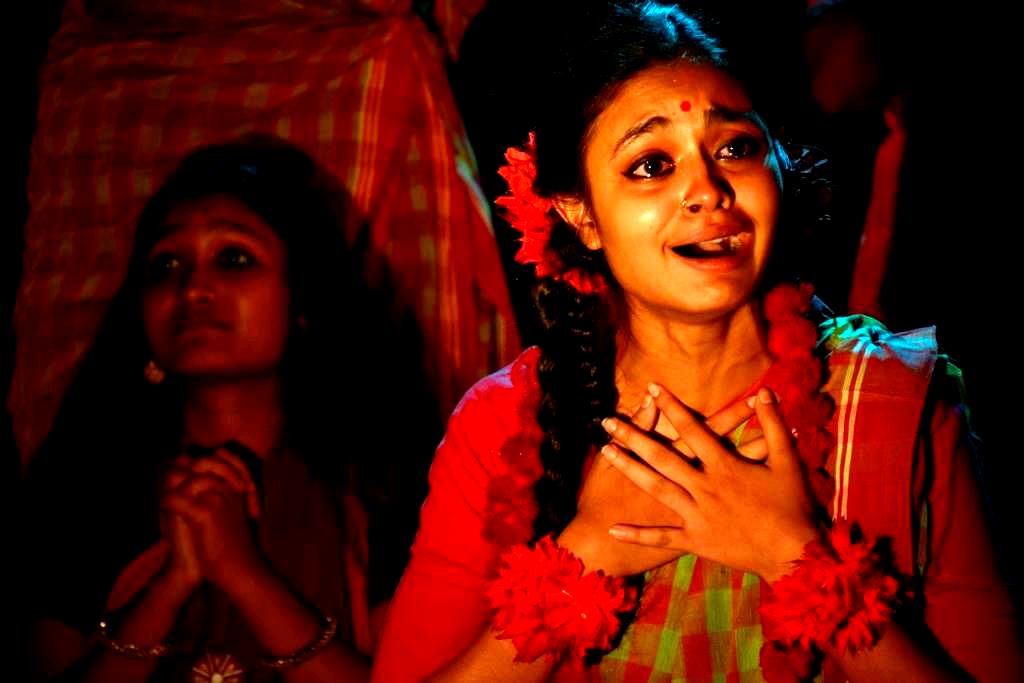
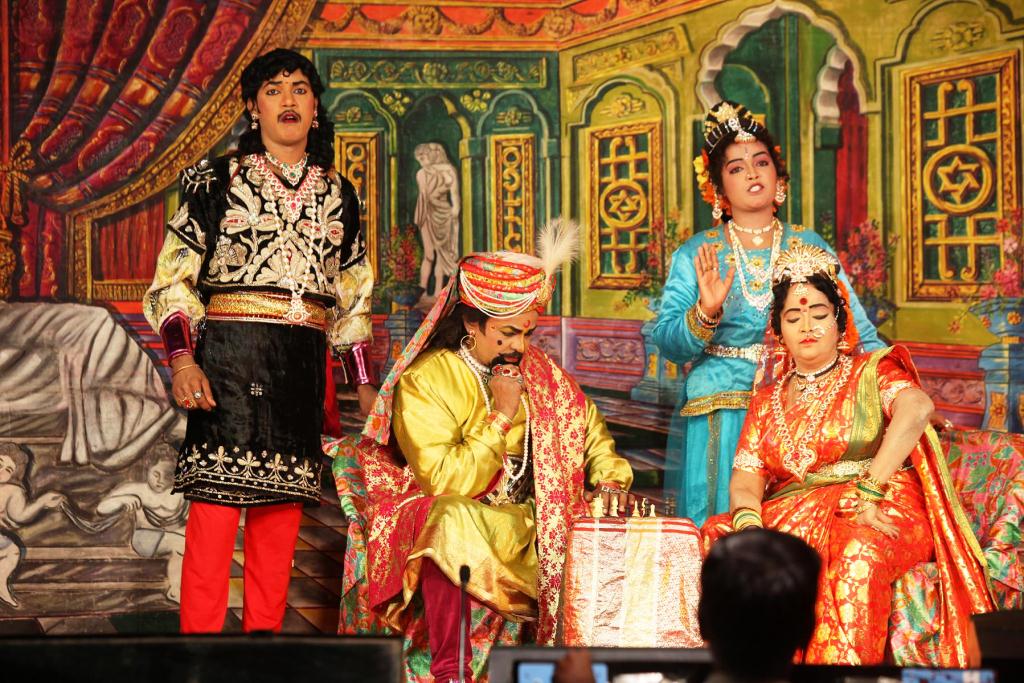
This is a hilarious romantic love story of Sialkot province and Multan State, now in Pakistan. King Gaje Singh is the ruler of Sialkot. He has two sons, Bhoop Singh and Phool Singh. Once, Prince Phool Singh returns home after a hunting expedition and asks his sister-in-law (Bhabhi) for water. She retorts by saying, “If you really want to dominate this way, go and get married to the beautiful Nautanki, so that you can ask her for water more gracefully”. Young Phool Singh feels insulted and is determined to marry Shehzadi Nautanki. How he marries Nautanki is a beautiful narrative of Swang/ Nautanki tradition.

Director’s Note

It is always a great pleasure for us to associate ourselves with Swang whenever we get a chance. Folk music and folk dances are the main ingredients of Swang. Phool Singh-Nautanki is a fantastic love story on morality and governance and leaves an impact on the contemporary world. The content of the story inspired us to work on this script. It came as a blessing in disguise. Shortage of an actor changed the design of the play in such a creative manner that it became an original Swang. Swang means to imitate, ‘Rang bharna, Roop bharna’. The final design is a classic example of Swang. Costume design was kept in its original mythological form. Nakkara, clarinet, dholak, harmonium and the singing chorus made this a memorable production.

The Directors

Dr Satish Georgy Kashyap got initial education from his father Pt. Shiv Kumar Kashyap. A trained surgeon, Satish left the field of Medicine and joined the family tradition and his passion. For further training he went to Denmark and learned Commedia dell’arte at Copenhagen. Under the leadership of his mentor Ole Brekke, he has performed as a clown in Sweden, Norway and Finland. Back in India, along with his partner Dr Sandhya Sharma, he became a disciple of Pt. Suraj Bhan Shastri and started performing the Swangs of Pt. Lakhmi Chand Gharana.

Dr Sandhya Sharma learnt the wonderful art of folk drama, Swang, from her mentor and Guru, Dr. Satish Kashyap, while performing Swangs like Jaani Chor, Pingla-Bharthri and Nautanki.  She is a trained folk dancer and has won various National awards. Presently, Dr Sandhya Sharma is working as Asst. Prof. of Culture in CCS Haryana Agricultural University, Hisar and contributing in the research and development of Haryana Folk Lore and Culture, especially Swang.

The Group

Swang – A Folk Art Academy, is an amateur group formed by artists of the region and led by Pt. Shiv Kumar, an eminent Swang performer. Pt. Suraj Bhan Shastri, a disciple of Pt. Lakhmi Chand Gharana, and Dr Ram Kumar Yadav, a pioneer art promoter, are patrons of the group.  Swang – A Folk Art Academy is primarily working for the preservation of Swang, an ancient folk theatre form of Northern India. The group has produced many ancient, mythological stories in Swang form and staged them all over India.

Cast & Credits

On Stage: Satish Kashyap, Sandhya Sharma, Vinod Goldi, Hawa Singh, Rajesh (Nagada), Om Parkash (Clarinet), Pankaj Bhardwaj, Richa Valecha, Chanchal Goyal, Ashish Sharma

Back Stage: Anil Saini, Shri Niwas, Mahesh Sufi, Ram Narayan, Ram Nivas

Directors: Satish Georgy Kashyap & Sandhya Sharma


Arpita Dhagat’s ITEM

Playwright & Director: Arpita Dhagat

Group: Astitva Art Foundation, Ahmedabad

Language: Gujarati

Duration: 1 hr 5 mins

The Play

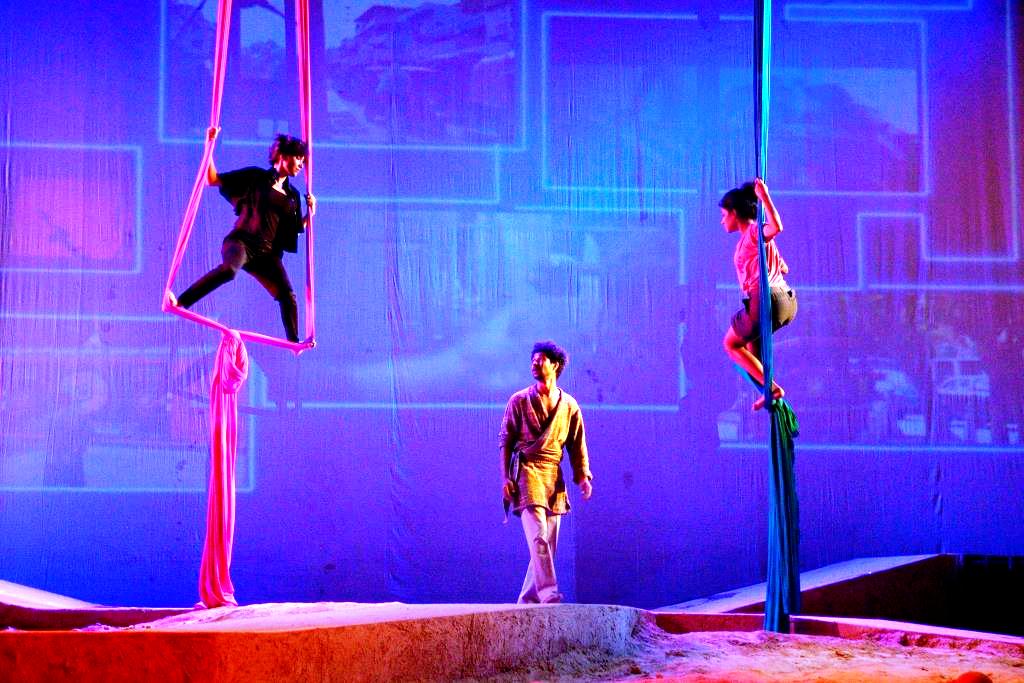
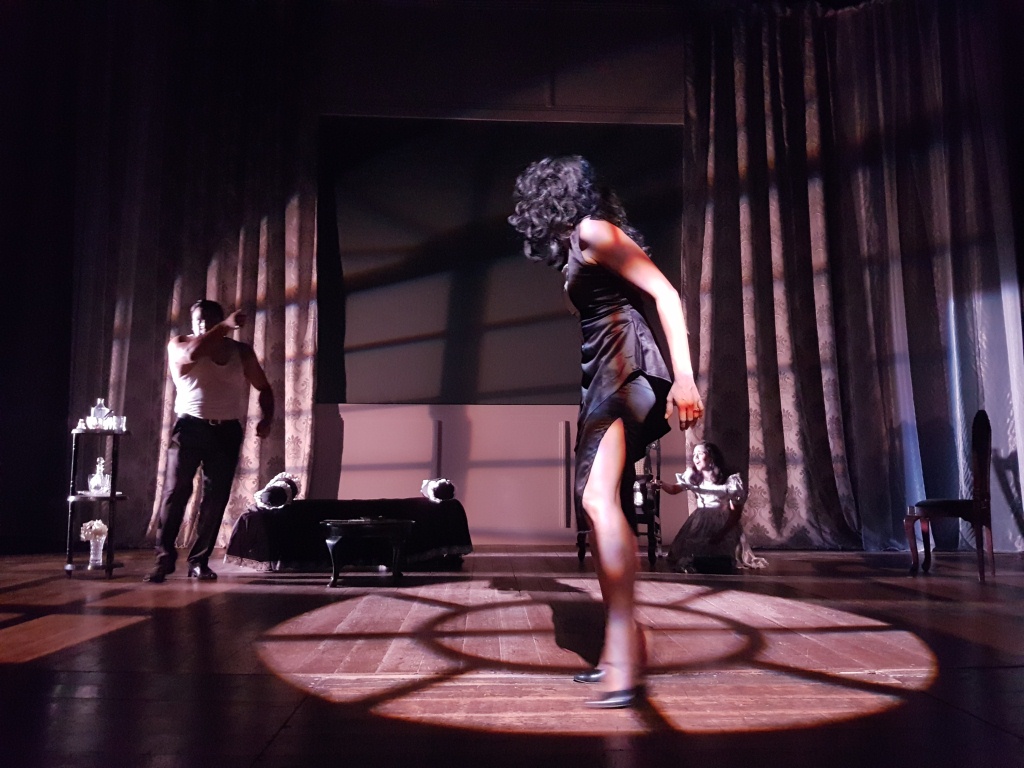
The play begins by establishing how any girl who grows up in an average middle-class family, is expected to become the son of the family. These girls continue to make an effort to become the son of the family till the point they break down. The women have never been taught how to love themselves or respect their own identity. They are conditioned to follow set standards of beauty as per prevailing popular culture. We, the society, want women to play an expected role and follow all social norms. We become insecure with independent women having their own mind. Thus, the play is a constant juggling of the expected roles and the real self, narrated as a story and popular imagery.

Director’s Note

When we talk about mental health issues, we focus mainly on the younger generation, denying the other sections of the society, especially women home-makers. If a woman is going through any mental illness, it would reflect on the mental health of the whole family. My research topic for NSD fellowship – “The role of theatre as an aid for mental health for women” – made me question the performance language in which I could communicate with larger number of audience and make them realize how the society conditions a person’s psyche and gives it inferiority or superiority complex which causes anxiety and depression. Bollywood, being a popular medium of entertainment and storytelling, reflects the state of the society, builds and breaks many beliefs, and also influences us. Throughout the performance we have questioned the ways in which the women are being portrayed. In pursuit of ideal role model against the real self, one finds that one is losing own voice.

The Director & Playwright

Freelancer Arpita Dhagat is a performer and performance maker, with specialization in design and theatre techniques from National School of Drama, New Delhi. She has worked as a Cultural Outreach Programmer with LEAF Foundation, under which she has curated and coordinated a month-long arts festival, Abhivyakti City Arts Project. Arpita, as an artist, is keen about different mediums of art expression, and has been exploring how it changes the equation between the audience and the artist, and the art work itself, and what scope of interaction it may open up. She is interested in collaborative interdisciplinary art through performances. She is also a founder member of Astitva Art Foundation, which aspires to grow as an inter-disciplinary art school.

The Group

Astitva Art Foundation is a result of artist Navin Dhagat’s vision. It was established in 2002 with the intention to nurture the expression in society. Astitva Art Foundation is a long term commitment in art education for children and interdisciplinary arts. AAF is a group of multi-disciplinary artists coming together and working in the field of theatre and visual arts. The group has also worked as theatre consultant for MGIS (Mahatma Gandhi International School) in Ahmedabad. It has done 21 productions with many shows along with two art residencies and many workshops in Ahmedabad.

Cast & Credits

On Stage: Vaidehi Bhagwat, Pooja Purohit, Harshika Joshi, Dhruti Joshi, Bhoomiti Prajapati, Arpita Dhagat

Off Stage:  Dhruv Pandit, Sangeet Shrivastava, Aarti Zala, Drashti Dhagat, Akshy Thakar

Singer: Prachi Shah

Music Composer: Harshit Acharya

Recording and Mixing: Ocean Harmony

Music Operator: Aarti Zala

Lighting Design: Sangeet Shrivastava

Video Art: Jigna Goaudana, Sumedh Kumar

Set & Props in-charge: Akshy Thakar

Costume in-charge: Drashti Dhagat

Production Manager: Dhruv Pandit

Produced by: Abhivyakti City Arts Project 2018

Concept, Design, Script & Direction: Arpita Dhagat


Sujan Mukhopadhyay’S DON…TAKE BHALO LAGE

Adaptation & Direction: Sujan Mukhopadhyay

Group: Chetana, Kolkata

Language: Bengali

Duration: 2 hrs 25 mins

The Play

Renowned poet, theatre director, and actor Subhomoy Dutt, has been arrested for his outrageous comments against the state, and locked in custody with other petty convicts. Subhomoy transforms the jail into a stage and starts performing the story of the ‘Mad Knight’ Don Quixote, with all the jail inmates as performers. The prison cell metamorphoses into a space of eloquent metaphors and bizarre events of Don and his mate, Sancho. Adapted into a modern day situation, this musical carnival emerges with forms like Kirtan, Flamenco, Rabindranath’s song, Rock-N-Roll, Toppa and Western Classical.

Director’s Note

“To dream, the impossible dream”… has been the quest of Don Quixote, and his squire Sancho Panza. The play begins in a local prison, where a famous playwright, actor and poet, Subhamoy Dutt, is arrested for his illegal step towards the state through his propagandist play. I wish to study today’s terror and ill-tolerance in this “play within the play” through the local jail inmates, who are waiting for their verdict. Designed as an opera, this is a hard hitting musical, questioning our reality, and arguing our existence in the modern socio-cultural situation.  

The Director & Adapter

Sujan Mukhopadhyay has acted in about 30 plays and written several scripts for theatre, television and cinema. He was awarded with Stagecraft award for Ghasiram Kotwal and Popular Viewer’s Choice Award for Don..Take Bhalo Lage. He has performed in Mumbai, Pune, Hyderabad, Nagpur, Chennai and all the other cities of India, and major cities of the USA, Theatre Olympics in Agartala, and Bharat Rang Mahotsav. He was awarded the Best Director and Actor awards in various competitive events. He has also directed a feature film Chocolate in Bengali (available in Netflix).

The Group

Chetana was founded in 1972. It has produced 33 full-length Plays and 13 short Plays in its journey of 46 years. Chetana received numerous awards and citation from various cultural institutions. It has organised a number of Theatre Festivals, Seminars and Workshops etc., and performed in all the districts of West Bengal and in almost all the major cities of India. Chetana has staged different plays in the Theatre Festivals organised by the National School of Drama and Sangeet Natak Akademi. It has toured USA and Canada with its productions in 1980 and 1990. Chetana performed Mareech Sanbad in Bourdeaux (France) in 1999. Sponsored by the ICCR it took part in the Ibsen International Theatre Festival held in Oslo (Norway) in 2004 and performed in London (UK) the same year.

Cast & Credits

Don/Subhomoy: Suman Mukhopadhyay   

Sancho Panza/Satyajit: Sujan Mukhopadhyay        

Aldonza: Nibedita Mukhopadhyay                           

Governor: Amitabha Ghosh                                                                                    

Inn-Keeper: Tarun Bhattacharyya                            

Dr. Carrasco: Debnath Chatterjee                              

Padree: Sushovan Guha                                             

Pedro: Rahul Sen Roy                                                 

Antonia: Sourali Ghosh                                              

House-keeper: Somrashmi Ghosh                              

Inn-Keeper’s wife: Monalisa Das                                                                     

Horse/Gypsy dancer: Beauty Das                   

Mule/Gypsy dancer: Ashmita Ghosh                                

Mother: Ruma Bakhuli

Son: Parikshit Ghosh

Police: Rajat Narayan Bhattacharya

Muleteers: Pinaki Chakraborty, Debashis Naskar, Abhisek Mukherjee, Suvajit Dutta, Krishanu Das

Guest Appearance as Barber: Arun  Mukhopadhyay

Dance:  Sudarshan Chakraborty

Music Arrangement/

Background Score: Probuddha Bandyopadhyay

Light: Soumen Chakraborty

Sound Design: Anindyo Nandy

Costume: Arnab Sengupta

Make-up: Md. Ali, Ayon Ghosh

Set Design: Sujan Mukhopadhyay

Set: Bilu Dutta

Songs: Suman Mukhopadhyay, Arun Mukhopadhyay

Musicians: Subir Sanyal, Subhodip Guha, Deeptesh Mukherjee, Daayaad Mukherjee

Translation: Arun  Mukhopadhyay

Adaptation & Direction: Sujan Mukhopadhyay


Dr. B M Shrikantaiah’s ASHWATTHAMAN Director: Jagadeesh R.

Playwright: Dr. B M Shrikantaiah

Director: Jagadeesh R.

Group: Sri Shivakumara Rangaprayoga, Chitradurga

Language: Kannada

Duration: 1 hr 30 mins

The Play

This play is said to be the first poetic play in Kannada. In this play Ashwatthama, an immortal hero from Mahabharata, is transformed by the author to enable him to meet his tragic end. The play breaks from the traditional image of Ashwatthama as one blessed with the gift of immortality. Aswatthama in the Mahabharata is a bachelor while in the play he is married and has a son called Rudrashakti. Ashwatthama attempts to avenge the death of his father (who had been deceitfully killed by the Pandavas) by attacking them at night. However, he ends up killing their young children and is so embarrassed that he takes his own life.

Director’s Note

Ashwatthaman throws light on how fate plays a vital role in the life of a powerful warrior and an honest human being named Ashwatthama, his character, personality, and his relationship with his father and guru Dronacharya. This adaptation of Sophocles’ Ajax into Kannada by B M Shri is a wonderful attempt of blending the story of Ashwatthama with the famous Greek tragedy. Being a theatre practitioner I have attempted to bring this play on stage to express my views on war.  A civilization evolves with the belief in harmony with everything around it. But in war, killing other people must somehow become acceptable–morally, legally and psychologically. One way to conceive this is to imagine that the enemy is a non-human entity. Ashwatthaman, in B M Shri’s haunting adaptation of Sophocles’ Ajax, comments on the hero’s crazed attempt to massacre his own comrades-in-arms, and is a metaphorical interpretation of the cruelty of war, an ongoing phenomenon from the mythological world to the contemporary world. This play is an attempt to make one realise how war is the wicked output of the human race and a paradox to the concept of civilization.

The Director

Jagadeesh. R graduated in Design and Direction from National School of Drama, New Delhi in 2013. He is also a sculptor and a musician. He won the state award for theatre music in 2006. He visited the 2nd Asian Theatre Festival at Beijing, China & NAPA (National Academy of Performing Arts) International Theatre Festival at Karachi, Pakistan. Currently he is working as the Director at Sri Shivakumara Rangaprayoga Shale, Sanehalli, Karnataka.

The Playwright

Belluru Mylaraiah Srikantaiah, known popularly as B. M. Shri, was an Indian author, writer and translator of Kannada literature. He was awarded the Rajasevasakta Award by the Maharaja of Mysore. He was the president of the Kannada Sahithya Sammelana in 1938 at Gulburga. B M Sri Circle, a circle in Bangalore, has been named after him.

The Group

Sri Shivakumara Rangaprayoga Shale is a residential theatre school established in 2008. The course is backed by 25 years of experience of Kalashangha and 15 years of the Shivasanchara Theatre repertory. This school is designed in the Gurukula system, with a broad syllabus adapted from the best theatre institutions of the country.

Cast & Credits

Ashwatthama: Chetan Dharwad

Krishna : Pinjar Aashif

Rudra: Prasanna Chalawadi

Bhargavi: Anupallavi G

Rudrashakti: Basavaraj

Draupadi: Sangeetha D M

Duryodhana: Varun Gowda K L

Eklavya: Vinayak Suresh Kalal

Bheema: Hanumantha

Messenger: Harish Kumar T

Chorus: Boregowda, Thippeswamy R Sarvesha, Niranjan Rao Pawar, Rajkumar, Dilip Kumar, Priyanka Somanatha, Shashank H M, Yashas Nagaraj Srivatsa

Light Design: Vinod Laxman Bhandari

Make-up: Kiran T C

Singer: Jagadeesh R

Percussion: Prakash Badiger, Raju L, Madhu E

Playwright: Dr. B M Shrikantaiah

Director: Jagadeesh R.


William Shakespeare’s MACBETH Director: Israfil Shaheen

Playwright: William Shakespeare

Director: Israfil Shaheen

Group: Department of Theatre and Performance Studies, University of Dhaka, Bangladesh

Language: Bengali

Duration: 1 hr 30 mins

The Play

The play begins in a military camp, where the Scottish King Duncan hears the news that his generals, Macbeth and Banquo, have defeated two separate invading armies one from Ireland, led by the rebel Macdonald and another from Norway. Macbeth is a brave and loyal Thane to King Duncan. After hearing a prophecy that he will become king himself, Macbeth is overcome by ambition and greed. Bolstered by the prophecy and his wife’s encouragement, he kills King Duncan and takes the throne. Afterwards, Macbeth’s guilt, fear, and paranoia lead him to commit even more murders to secure his power. His confidence in the prophecies eventually leads to his down fall and he is overthrown and killed by those he had wronged.

Director’s Note

Border-crossing and timeless author Shakespeare is one of the focal points in my artistic engagement in theatre for the last twenty five years .Working on Shakespeare’s Macbeth, for me, is questioning about the dynamics of contemporary political power structure in Bangladesh and the globe as well. Since theatrical creation is always a collaborative effort, this production of Macbeth is also an outcome of a group effort that comes from my colleagues and students (performers) in terms of dramaturgy, scenography, choreography and acting. At the Department of Theatre and Performance Studies in University of Dhaka, my works primarily concentrates on the pedagogy of training the students as performers, and then I try to set the aesthetic criteria for a theatrical production that seeks to generate its meaning in relation to the immediate realities of people. They never give the answers to the vibrant questions of the time, but offer various choices so that audience can think and ponder. This production will also engage the audience in same way.

The Director

Dr. Israfil Shaheen is an internationally acclaimed director based in Bangladesh, and a Professor at the Department of Theatre and Performance Studies, University of Dhaka. He graduated from the National School of Drama (India) in 1991, and obtained PhD on political theatre from the Rabindra Bharati University (Kolkata, India) in 1999. He served the Department of Theatre and Performance Studies as its Chair from 2006 to 2009. He has taught at Rabindra Bharati University in India, conducted numerous workshops, and delivered lectures on acting, improvisation, and ethnographic research in Bangladesh, India, South Korea, China, Russia, UAE, USA and United Kingdom, Spain, Italy, Poland, France, Czech Republic etc.

The Playwright

William Shakespeare (26 April 1564 – 23 April 1616) was an English poet, playwright and actor, widely regarded as the greatest writer of the English language and the world’s greatest dramatist. His plays have been translated into every major living language and are performed more often than those of any other playwright.

The Group

In 1989, a subsidiary course on Theatre was instituted directly under the supervision of the Dean of Arts at the University of Dhaka. A similar course on Music was instituted in 1992, also under the Dean of Arts. These two separate units were brought together in August 1994 and named Department of Theatre and Music.

Now after some administrative and pedagogic transformation the Department of Theatre and Performance Studies sets its educational and artistic criteria that envisions to produce Graduates and Postgraduates through its praxis in context of local, regional and global histories, trends, aesthetics and politics.

Cast & Credits

Witch &Apparition: Tamanna Islam, Farzia Hoque Farin, Adity Chatterjee

Macbeth: Rageeb Nayeem, S M Latiful Khabir

Lady Macbeth: Kirtee Bejoya

Duncan: Syed Al Mehedi Hasan

Malcolm: Moammmad Rafiqul Islam Sabuj

Donalbain: Rageeb Nayeem, S M Latiful Khabir

Banquo: Md. Tariqul Haque

Fleance: Md. Aminur Rahman,

Macduff: Moammmad Moniruzzaman Ripon

Lady Macduff: Tamanna Islam

Son of Macduff: Ahammed Raufur Rahim

Lennox: Md. Aklakuzzaman Anik

Ross: Abdullah Al Zabir

Captain: Md. Shamim Miah

Murderers: Md. Shamim Miah, Md. Aklakuzzaman Anik, Sk .Abdul Kiyum

Doctor: Md. Owali Hossain Amdad

Gentlewomen: Tamanna Islam, Farzia Hoque Farin

Seyton: Md. Sanzidul Islam

Attendants & Soldiers: Syed Al Mehedi Hasan, Md. Aklakuzzaman Anik, Sk. Abdul Kiyum, Md. Owali Hossain Amdad, Md. Shamim Miah, Md. Tariqul Haque, Rageeb Nayeem, S M Latiful Khabir, Md. Sanzidul Islam, Md. Aminur Rahman, Ahammed Raufur Rahim

Set and Light (Redesign): Ashiq Rahman Leeon

Directorial Assistants: Tanvir Nahid Khan, Mohsina Akhter, Amit Chowdhury

Technical Assistant: Shahabuddin Miah

Makeup and Costume Design: Kazi Tamanna Haque Sigma,Ummey Somaiya

Costume Design Supervision: Wahida Mollick

Choreography: Amit Chowdhury

Music: Mohsina Akhter

Music Operation: Rudra Sawjal

Stage Managers: Md. Shamim Miah, Farzia Hoque Farin

Production Manager: Rafiqul Islam Sabuj

Overall Coordination: Ahmedul Kabir

Dramaturge: Shahman Moishan

Playwright: William Shakespeare 

Director: Israfil Shaheen


Sasidharan Naduvil’s HIGUITA – A GOALIE’S ANXIETY AT THE PENALTY KICK

Playwright & Director: Sasidharan Naduvil

Group: Remembrance Theatre Group, Kerala

Language: Malayalam

Duration: 1 hr 30 mins

The Play & Director’s Note

This is an independent dramatization of two famous works, one by N.S Madhavan (Higuita) and the other by Peter Handke (The Goalie’s Anxiety at the Penalty Kick). Higuita was staged for the first time 20 years ago as a 30-minute short play. The stage arrangement consists of a football ground with a church on one side. Father Geevarghese is the church vicar of a small town somewhere near southern part of Delhi. He had once heard the story The Goalie’s Anxiety at the Penalty box from Father Capriaty, his friend from Italy. Geevarghese, on his tiny television set in his room, is watching the world cup football match. In the centre circle of the football ground, the then and now Father Geevarghese, meets the people from his past – Lucy Marandy, Jabbar, his friends, and family. Imprisoned in their boxes, the goalkeepers stand like caged birds under the scorching sun. But what excitesGeevarghese is the image of Higuita, walking back peacefully to his own post, after kicking the ball to the farthest striker of his team towards the rival post. Father Geevarghese watches himself overcoming all barriers like Higuita. He retorts against the injustice happening in front of him. Footballs are ablaze and swinging in the air, and from the dark, someone yells…

The Director & Playwright

Sasidharan Naduvil was born in 1963 in a remote village named Vallachira in Thrissur district of Kerala. Since his childhood, he was fond of theatre and performed many plays during his school and college days. Later in 1980s, he became a disciple of Jose Chirammel and joined the Root Theatre Group, one of the renowned theatre groups in Kerala, run by the theatre activist Chirammel. Being a theatre person for the last 35 years, Sasidharan has acted in more than 12 plays, written 27 plays, and directed more than 400 plays. He has won inter-university drama competitions eleven times held at various universities of Kerala, including the South Zone and National Festival, and has been awarded many a times.

The Group

Campus theatre personnel of NSS Engineering College, Palakkad and theatre artists from various districts of Kerala founded Remembrance Theatre Group (RTG) in 2003. It has participated in festivals like Mahindra Excellence in Theatre Awards, Bharat Rang Mahotsav, PRD Festival, KSNA Festival, Keli Theatre Festival, Prithvi Theatre Mumbai, 8th Theatre Olympics 2018, and Ochre Theatre Festival, Canberra, Australia. RTG is actively performing in Trichur, Calicut, Bangalore, Doha, Sharjah, Dubai, Abu Dhabi and Australia. It has an ensemble of plays like Hemingway’s Old Man and the Sea, Jean Genet’s Balcony, Shakespeare’s Macbeth, Sasidharan Naduvil’s Pithalasalabham, and N S Madhavan’s Higuita.

Cast & Credits

Fr Geevarghese: Jijoy P R  

Jabbar: Manikandan

K Geevarghese/Higuita: Rishnan Unni

Narrator 1/ Commentary: Thamam Mubarish

Narrator/P T Master/Geevarghese Father: Sumesh Manithara

Priest 2/Footballer 1: Roshin

Team Manager /Malappuram Guy: Sreekumar Prigi

Stage Manager/Referee 2/Coach 2: Paul D Joseph

Referee/ Actor: Aravind Patel, Hena Patel     

Sevens Foot Baller 2: Aditya Patel, Athira Patel   

Foot Baller 3: Sanaji Kumar

Foot Baller 4: Rajesh Prasad

Foot Baller 5: Vyshakh

Foot Baller 6: Henson

Foot Baller 7: Tom  

Foot Baller 8: Jithin

Foot Baller 9: Githin

Foot Baller 10: Viswajith V Menon

Foot Baller 11:  Hiran

Foot Baller 12: Akhilesh Pali

Others: Sonia Giri, Archana, Ganga, Aswathy, Kavitha, Abhilash Arimbur

Technicial/Malappuram Guy: Francis

Music Direction & Execution: Satyajith

Light Design & Execution: Murali

Playwright & Director: Sasidharan Naduvil


Lisa Perterson & Denis O’Hare’s AN ILIAD Directors: Guy Roberts & Rebecca Greene Udden

Playwrights: Lisa Perterson & Denis O’Hare

Directors: Guy Roberts & Rebecca Greene Udden

Group: Prague Shakespeare Company, Czeh Republic

Language: English

Duration: 1 hr 45 mins

The Play
Aided by two Muses, a single, modern day storyteller takes the stage—possibly Homer, possibly one of the many bards who followed in his footsteps. He retells Homer’s classic tale of the Trojan War – The Iliad, specifically focusing on the story of the great fighters Achilles and Hector. As he shares his tale with a modern audience, references with wars throughout the ages collide with the ancient story of Greeks and Trojans. As a traveling storyteller, he uses poetry, music, humor, and poignant accounts of war to share the experience from the perspective of a fighting Greek soldier and a poet, a tale he is fated to tell throughout time.

Director’s Note
The Iliad is the foundational epic of Western civilization — all of our basic ingrained beliefs about men and women, the role of the individual to the group; duty to country/tribe vs. duty to individual/family; what is just and correct action when faced with injustice and corruption —are brought wonderfully to life in The Iliad. This production brings these thrilling questions to a very human and relatable level in an easily digestible evening of theater. The audience will leave with a keen understanding not just of the story of Achilles and Helen of Troy but also hopefully with a renewed hunger to think about and address the timeless questions in their own lives. The phenomenal original score by Patrick Neil Doyle, lifts the entire experience and transports us back 2500 years ago to the plains of Troy making us feel that we are there with the great people of legend.

The Directors
Guy Roberts – Artistic Director of Prague Shakespeare Company, Guy won the 2018 Best Actor Houston Theatre Award for his performance of The Poet in An Iliad. He is a 2015 recipient of the Tomas Garrigue Masaryk Medal of Honor, in recognition for his work promoting arts and artistic freedom. In 2014 Guy received the inaugural Sidney Berger Award from the Shakespeare Theatre Association. His award-winning work as actor, director and producer has been seen in over 200 productions in the United States, Czech Republic, France, the Netherlands, Hungary, Austria, Slovakia, Poland, Qatar and Egypt and has been honored with multiple awards. Guy served as Artistic Director of the Austin Shakespeare Festival (USA) from 2001-2007. He received his BFA from Boston University. Guy resides in Prague, Czech Republic with his wife, the actress Jessica Boon.
Rebecca Greene Udden- co-Director An Iliad and Founding Executive Artistic Director of Main Street Theater Company located in Houston, Texas USA. Some of her major works as director are- Enemies, Wolf Hall and Bring Up the Bodies (First American Productions), Twelfth Night (Prague Shakespeare Company), Silent Sky, Peace in Our Time, Heartbreak House, The Real Thing, The Heidi Chronicles, Arcadia, The House of the Spirits, Copenhagen, The Little Foxes, Pride and Prejudice, and many more. She is also a celebrated actor Memory House and Richard III are two such productions of Prague Shakespeare Company in which she acted. Her some other acting assignments have been The Last Night of Ballyhoo, The Sisters Rosensweig, Hapgood, Hamlet, and more. She has also designed costumes of numerous productions.

The Playwrights
Lisa Peterson is a nationally renowned director who works in NYC and regional theatres around the USA. She was for ten years Resident Director at the Mark Taper Forum. She won an Obie Award for her direction of Caryl Churchill’s Light Shining in Buckinghamshire at New York Theatre Workshop.
Denis O’Hare is a writer and Tony Award-winning actor who has performed on Broadway and off-Broadway as well as in numerous regional productions and in film and television. His TV work includes roles on HBO’s True Blood and FX’s American Horror Story.

The Group

Based in Prague, Czech Republic, the award-winning Prague Shakespeare Company presents professional theatre productions, workshops, classes, lectures and other theatrical events of the highest quality, conducted primarily in English by a multinational ensemble of professional theatre artists, with an emphasis on the plays of William Shakespeare. Celebrating its 11th year, PSC has entertained, enriched, enlightened and inspired students and audiences not only in the Czech Republic but in the United States, Hungary, France, Egypt, Qatar, the Netherlands and elsewhere around the world with performances that are fresh, bold, imaginative, thought-provoking, and eminently accessible, connecting the truths of the past with the challenges and possibilities of today.

CASTS & CREDITS
The Poet: Guy Roberts
Muse / Athena: Jessica Boone
Muse / Musician: Fanette Ronjat

Composer & Sound Designer: Patrick Neil Doyle
Director of Production & Stage Manager: Eric Sammons
Light, Set Designer & Technical Director: Adam Thornton
Sound Engineer : Jacob Sanchez

Playwrights: Lisa Perterson & Denis O’Hare

Directors: Guy Roberts & Rebecca Greene Udden


Rhishikesh Vaidya’s MORPHOSIS Director: Bapi Bose

Playwright: Rhishikesh Vaidya

Director: Bapi Bose

Group: Circle Theatre Company, Delhi

Language: Hindi

Duration: 2 hrs 30 mins

The Play

Prasad is a popular theatre actor, who considers himself to be the best and doesn’t value his co-actresses. His ego is quite visible during his conversation with his secretary Mohit. During the days of his struggle, Bhowmik, a fellow actor & friend, comes to meet him with an issue which leads to a heated argument between the two. Bhowmik challenges Prasad to work in the play titled Morphosis, since Prasad doesn’t have enough talent for the lead role of Manas. Prasad accepts the challenge and approaches Guruji, the director of the play. Guruji had once insulted Prasad and this time too he leaves no stone unturned to humiliate him, and yet chooses Prasad for the role of Manas. The process begins – tireless preparation for the character, journey of commitment, strict discipline, dedication, sacrifice, love and self-analysis…. and finally a ‘Morphosis’.

Director’s Note

The play is based on the real story of an arrogant actor and a top ranking film director in Bollywood who appeared in the actor’s life as a blessing in disguise and turned him into a very successful, and one of the highest paid actors in the industry. It is a play about what an actor and acting is all about. The text of the play has been kept as it is.    

The Director

The multifaceted Bapi Bose is a prominent and radical director, activist, ideologue and thinker of Contemporary Indian Theatre. Mr. Bose is a practitioner of New Media and Installation Art which he incorporates consistently in many of his productions. He teaches in many theatre institutes and theatre departments of various universities including the National School of Drama, New Delhi. At present he is working as a freelance designer, director, and teacher, and is the Founder & Artistic Director of Circle Theatre, a professional theatre company in Delhi. He has been awarded scholarships and fellowships, Netaji Samman (Gold Medal), Natsamrat Award, Patliputra Lifetime Achievement Award etc. Bapi Bose has been bestowed with the National Award, conferred by the Central Sangeet Natak Akademi, New Delhi.

The Playwright

Rhishikesh Vaidya’s first literary work was Krishna Nahi Ban Paunga, a collection of Hindi ghazals and poetry. During the preparations of civil services, he came across the works of Mohan Rakesh. These inspired him to become a playwright. He has written stage plays and Radio plays. Jawab Do Gandhi, Uske Baad, Khat-Khat-Khat, Kaun and Morphosis are some of his noted plays. He bagged the Mohan Rakesh Award by Sahitya Kala Parishad and a short film was produced on his play Ateet Aur Vartman based on Birsa Munda. His plays are broadcast by All India Radio, Indore.

The Group

Formed in 2002, under the leadership of Bapi Bose, Circle Theatre staged its first production in the 4th Bharat Rang Mahotsav (the International Theatre Festival of NSD). All its productions have excelled in terms of artistic quality, expression and social message. It has been awarded by the Sahitya Kala Parishad and the Govt. of NCT Delhi; and has participated in Bharat Rang Mahotsav and its Satellite Theatre Festival in Kolkata, and also in the 8th Theatre Olympics held in India. Circle Theatre has a library of over a thousand books and journals on theatre, and has been regularly engaged in organizing training programs and other theatre activities.

Cast & Credits

Prasad: Sahil Singh Sethi

Gurujee : Suman Vaidya

Disha: Swati Kumar

Bhowmick: Akhilesh Dwivedi

Kumar: Hurmat Ali Khan

Doorva: Anupama Kaushik

Mohit: Kamal Kashyap

Chowkidar: Akhilesh Dwivedi

Malati: Tanu Suneja

Artists of the Company: Prince Mishra, Raju Sharma, Jagdish Mali, Shailendra Kumar, Akash Sarraf, Ashwani Saini, Ashish Singh, Amitesh Raj, Maitreyee Kuhu                        

Stage Manager: Akhilesh Dwivedi

Set, Costume & Property Design: Bapi Bose

Set Execution: Dalvir Singh (Billa)

Set In charge: Prince Mishra

Set Assistance: Ashish Singh                       

Light Design: Bapi Bose

Light Execution : Barun Kar

Costume In charge (Male): Akash Sarraf

Costume Assistance (Male): Ashwini Saini

Costume In charge (Female): Maitreyee Kuhu                        

Costume Assistance (Female): Swati Kumar

Property In charge: Raju Mishra

Property Assistance: Shailendra Kumar

Sound, Music Design & Selection: Bapi Bose

Sound Editing & Mixing: Shubhanjan

Sound & Video Operation: Barun Kar

Video Installation & Editing: Vishal Mahale

Choreography: Arun Kumar

Make-up: Rajeev Roychowdhury

Brochure & Poster Design: Bapi Bose

Layout & Printing: Gautam, Zen Advertisement

Still Photography: Piyal Bhattachariya, Samik Sen

Exhibition & Research: Bapi Bose

Liaison & Publicity: Vikas Bahari

Production In charge: Shahbaz Khan

Technical In charge: Barun Kar

Assistant to Director: Jagdish Mali

Assistant Director: Vikas Bahari

Playwright: Rhishikesh Vaidya

Concept, Scenography & Direction: Bapi Bose


Harold Pinter’s THE DUMB WAITER Director: Thawai Thiyam

Playwright: Harold Pinter

Director: Thawai Thiyam

Group: Chorus Repertory Theatre, Imphal

Language: Manipuri

Duration: 1 hr 13 mins

The Play

Two hit-men, Abo and Tomba, are waiting in a basement room for their assignment. As the play begins, Abo, the senior member of the team, is reading a newspaper, and Tomba, the junior member, is tying his shoes. Tomba asks Abo many questions as he gets ready for their job and tries to make tea. They argue over the semantics of “light the kettle” and “put on the kettle”. Abo continues reading his paper for most of the time, occasionally reading excerpts of it to Tomba. Abo gets increasingly animated, and Tomba’s questions become more pointed, at times nearly nonsensical. In the back of the room is a dumbwaiter, who delivers occasional food orders. This is mysterious and both characters seem to be puzzled why these orders keep coming; the basement is clearly not outfitted as a restaurant kitchen. Tomba goes to the bathroom. Abo listens carefully—we gather from his replies that their victim has arrived and is on his way to the room. Abo shouts for Tomba, who is still out of the room. The door, that the target is supposed to enter from, flies open. Abo rounds on it with his gun, and Tomba enters, stripped of his jacket, waistcoat, tie and gun. There is a long silence as the two stare at each other before the curtain comes down.

Director’s Note

The play is an expression of absurdity of life portraying the psychological contrast in human behaviour and analysis of inner truth and freedom.

The Director

Thawai Thiyam was born in Imphal on 15 August 1982. He received training in Dramatics and Performing Arts at the Chorus Repertory Theatre, Imphal. This included stagecraft, design, martial arts, direction etc. Because of his passion for theatre-arts he joined the prestigious Institute of Calcutta Puppet Theatre, Kolkata to study theatre design, theatre architecture, scenic design, property and mask making, and a section of puppetry and performance under the able guidance of Padmashree Suresh Dutta. He has participated in quite a number of major national and international theatre festival held in India and abroad. Thawai Thiyam has directed many plays in his debut including Bachae, Shaknaidaba Waree, Maharaj Indrajit, Rajya Abhishek, Punaragomon, Andha Yug, and The Dumb Waiter.

The Playwright

Harold Pinter (10 October 1930 – 24 December 2008) was a Nobel Prize-winning British playwright, screenwriter, director and actor. One of the most influential modern British dramatists, his writing career spanned more than 50 years. His best-known plays include The Birthday Party (1957), The Homecoming (1964), and Betrayal (1978), each of which he adapted for the screen. His screenplay adaptations of others’ works include The Servant (1963), The Go-Between (1971), The French Lieutenant’s Woman (1981), The Trial (1993), and Sleuth (2007). He also directed and acted in radio, stage, television, and film productions of his own and others’ works.

The Group

The Chorus Repertory Theatre was established in the valley of Manipur, a small hill state in the easternmost part of India, in April 1976 under the able and dynamic guidance of Ratan Thiyam. Located on the outskirts of Imphal, Manipur’s capital city, Chorus Repertory Theatre’s two acre campus has been slowly built (and six times rebuilt after disastrous monsoons) to accommodate a self-sufficient way of life with housing and working quarters for the company. It is now an important regional and national centre for contemporary theatre.  On its 25th anniversary, the company dedicated its first permanent theatre called ‘The Shrine’, a 200 seat auditorium conceived and designed by Ratan Thiyam with space for set construction and storage.

Cast & Credits

Abo: Ibomcha Sorok / Robindro

Tomba: Somo

Stage Manager: Jilasana Meetei

Set & Props: Tarpon, Lokendra

Costume: Somo, Tarubi

Light: Angoutombi

Music: Tomba, Basanta

Production Manager: Ibomcha Sorok

Administration & Publicity: Dolendro

Back stage: Vijay, Tarpon, Tarubi, Rahul, Ajitkumar

Front of the House: Sandhyarani, Rojita, Russia

Playwright: Harold Pinter

Adaptation in Manipuri: Ratan Thiyam

Design & Direction: Thawai Thiyam


Sadhana Ahmed’s SAPTAPARNEE Directors: Sohag Sen, Sima Mukhopadhyay, Suranjana Dasgupta, Tulika Das, Adrija Dasgupta, Abanti Chakraborty, Ishita Mukhopadhyay

Playwright: Sadhana Ahmed

Director: Sohag Sen, Sima Mukhopadhyay, Suranjana Dasgupta, Tulika Das, Adrija Dasgupta, Abanti Chakraborty, Ishita Mukhopadhyay

Group: Rangakarmee, Kolkata

Language:  Hindi & Bengali

Duration:   1 hr 30 mins

The Play

Saptaparnee is a collage of seven mono-acts shaped after seven women characters sketched by Tagore. They have been chosen from his novels, dramas, poems and short stories. A craving for love, and an unending search for fulfilment run through them.

Director’s Note

Saptaparnee is a tribute to the creative genius of Rabindranath Tagore and his oeuvre. We find his texts extremely rich in nuances. They motivate us to read between the lines, to search for more and more meaning hidden underneath. Rabindranath has this rare ability to keep us together at a time which is out of joint.

The Directors

Sima Mukhopadhyay, Director of Chandara, is a director, playwright and actor from Kolkata. She received Master’s Degree in Drama (Acting) from Rabindra Bharati University in 1985. At present she heads Rangroop.

Suranjana Dasgupta, Director of Kadambini, is a director, playwright, actor and singer from Kolkata. Suranjana made her film debut in Aparna Sen’s 15 Park Avenue. She has also acted in a telefilm titled Antigone Chatterjee with Anjan Dutta.

Tulika Das, Director of Chitrangada, is a director and actor from Kolkata. She was associated with Bohurupee theatre group for 28 years. In 2015, Tulika directed Nero. At present she is associated with the theatre group Bohuswar.

Adrija Dasgupta, Director of Malati, is a director, designer and actor from Kolkata. She received her PG Diploma-in-Drama (with Specialization in Acting) from NSD. Adrija is a committed theatre worker who keeps conducting theatre workshops and directing children’s productions for the economically deprived and physically challenged children.

Sohag Sen, Director of Damini, is a theatre-director and actor-trainer based in Kolkata. Her association with theatre and allied media spans a period of almost forty years. As an actor, she started her career under the guidance of the legendary Utpal Dutta, in the year 1969. Sohag Sen has been a visiting faculty at National School of Drama, Satyajit Ray Film and Television Institute, Rabindra Bharati University, Kolkata Film and Television Institute, The Film and Television Institute, and The Calcutta Media Institute.

Abanti Chakraborty, Director of Nandini, is a theatre director based in Kolkata. A Masters in Applied Linguistics and Translation Studies from Hyderabad Central University, Abanti had been a Special Fellow in Directing, at Yale School of Drama in 2010. In 2010 she received the Bismillah Khan Yuva Puraskar in Theatre Direction from Sangeet Natak Akademi.

Ishita Mukhopadhyay, Director of Ela, is active in Bengali theatre for more than three decades. Her first directorial venture was an adaptation of The Room by Sartre. Her group Ushnik was formed in 1984.

The Playwright

Sadhana Ahmed is a cultural activist and a poet-cum-playwright based in Dhaka, Bangladesh. Sadhana participated in various artistic movements that led to the fall of military rule in Bangladesh in the late-1980s. She was the Founder-President of Sparsha Abritti Parishad that operated from Bhairab. Sadhana Ahmeder Duti Natak, her first book consisting of Domer Madar and Maatbring, was published in February 2017.

The Group

Established in 1976 with a small set-up, Rangakarmee today spearheads the Hindi theatre in Kolkata with 43 productions in its repertoire. Rangakarmee has performed not only in India but also in countries like Pakistan, Bangladesh, Germany and USA.

Cast & Credits

Chandara of Shasti: Karuna Thakur

Director: Sima Mukhopadhyay

Kadambini of Jibito O Mrito: Mrinmoyee Biswas

Director: Suranjana Dasgupta

Chitrangada of Chitrangada: Anubha Fatehpuria

Director: Tulika Das

Malati of Sadharan Meye: Maya Ghosh

Director: Adrija Dasgupta

Damini of Chaturanga: Senjuti Mukherjee

Director: Sohag Sen

Nandini of Raktakarabi: Kathakali

Director: Abanti Chakraborty

Ela of Char Adhyay: Sanchayita Bhattacharjee

Director: Ishita Mukhopadhyay

Calligraphy: Hiran Mitra

Production Coordinator: Tripti Mitra

Production Assistant: Anirudh Sarkar

Set in-charge: Shankar Dey

Music operator: Pradeep Dutta

Light operator: Shashanka Mondal

Stage Design: Sanchayan Ghosh

Light Design: Badal Das

Music Score: Bhadra Basu

Dramaturge: Anshuman Bhowmick

Original Scrip: Sadhana Ahmed

Concept: Usha Ganguli