Jyotishwar Thakur’s DHURT SAMAGAM Director: Prakash Jha

Playwright: Jyotishwar Thakur
Director: Prakash Jha
Group: Mailorang Repertory, Delhi
Language: Maitihli
Duration: 1 hr 20 mins

The Play
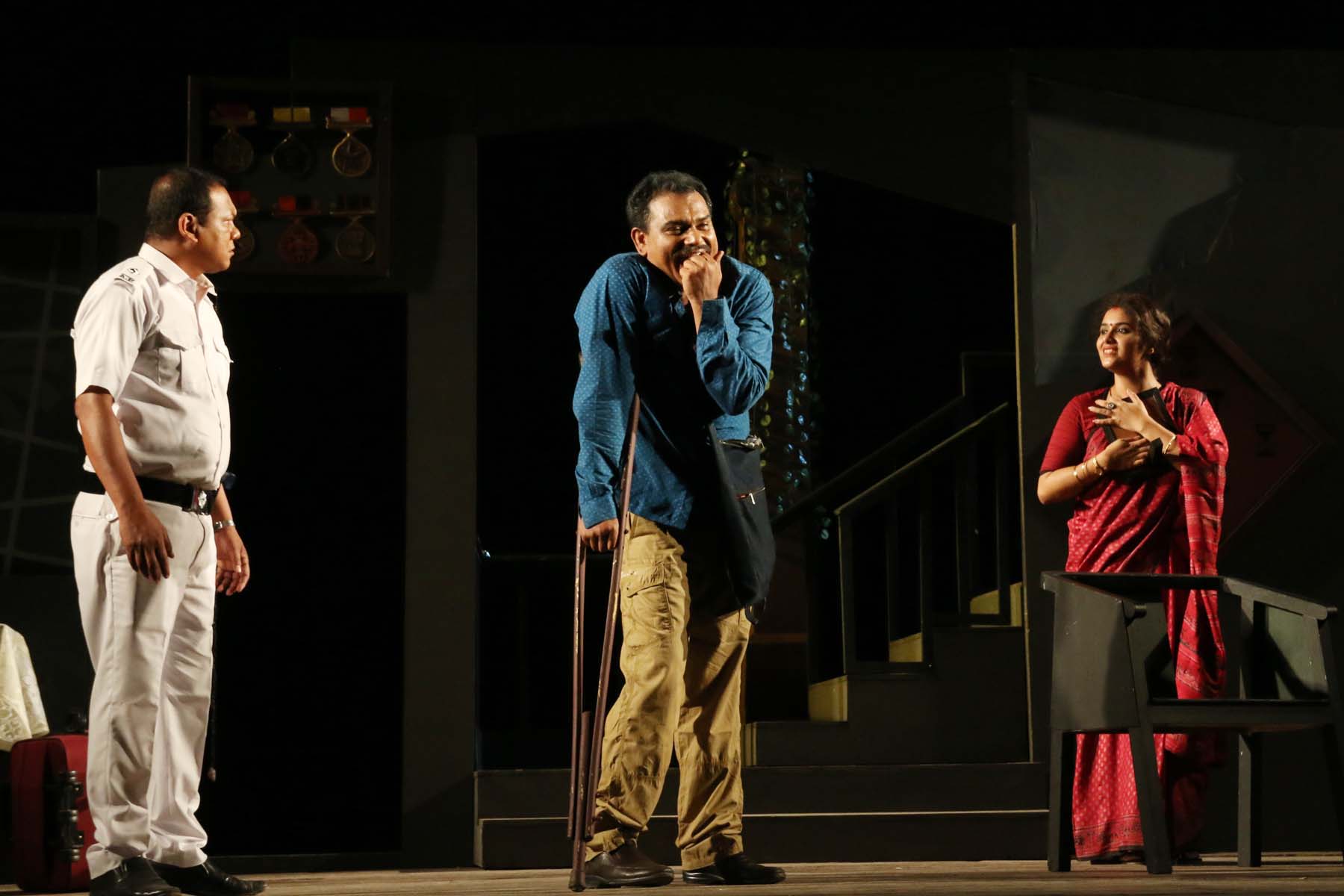
Most of the plays in Maithili language are based on the stories derived from the lineage of Lord Krishna and his characteristics. But in Dhurt Samagam a saint and his students are the central characters. Every character in the narrative is one up in cunningness from the other. The saint along with his student, Snatak visits late Thakur’s place for alms, the household people take plea of impurity due to death in family. Vishwanagar and Snatak then visit Suratpriya’s place. Here, the mentor-disciple start fighting amongst themselves for a prostitute named Anangsena. Both of them take the prostitute to Assajaati Mishra to resolve their fight, but Assajaati Mishra and his helper Bandhubanchak both turn out to be more lecherous than them. Finally, Assajaati Mishra proclaims that it is this sly nature that has helped him to con the world and obtain his beloved. It is this essential nature which is the most precious thing for him in the world. However, he says that he always hopes for the peace and happiness of the universe.

Director’s Note
Dhurta Samagam, written in thirteenth century is the first Maithili play. As Jyotishwar Thakur himself belonged to the Mithila region he placed the action of the play in same region. A seven hundred years old play is as relevant today as it was back then. This became a strong reason for us to produce it. The physical postures in our production are inspired from Sanskrit drama tradition and folk form Kiratniya.

The Director
Dr. Prakash Jha, a Phd in theatre, has been associated with theatre since 1994. He is the only director working in Maithili presently. He is the founder director of Mailorang Repertory and a senior research fellow of the Min. of Culture, Govt. of India. He has, to his credit four published works, out of these three are edited works and the fourth one is a translation. He has directed more than 30 plays and acted in more than 40 plays. His plays have been a part of Bharat Rang Mohatsav. Presently, he is working as a co-editor of Rang Prasang, a magazine published by the National School of Drama.

The Playwright
Poet and playwright, Jyotishwar Thakur is assumed to have lived from 1260 to 1340. He was a resident of Pali Village of Madhubani district of the present-day Bihar. He was an ardent devotee of Lord Shiva. He was given the the title of “Kavi-Shekar” because of his great writings. His Sanskrit text titled Panchsayak is based on ‘Kaamshastra’. His other work, Varnaratnakaar is assumed to be the best work of that time.

The Group
Mailorang Repertory, Delhi was founded in 2005 with the aim to preserve the essence of cultural heritage and diversity of Mithila region amongst the people living in NCR. Since then it had served the objective of promoting the regional art and culture such as Natua-naach, rasanchowki, kirtaniya etc. This group has presented more than 60 plays within the country and also in neighbouring states like Nepal. Several renowned artists have been associated with Mailorang with the sole objective of promoting art and culture. The plays presented by the group have been appreciated worldwide.

Cast & Credits
Nati: Pooja Priyadarshini
Nat: Raman Kumar
Suratpriya: Manisha Jha
Anangsena: Sonia Jha
Baba Vishwanath Jha: Mukesh Jha
Snatak/Bangat Lal: Jitendra Kumar
Thakur ji: Sanjeev Yadav/Mayanand Jha/Santosh
Misar ji: Rituraj
Vidushak/Bandhubanchak: Nitish Kumar Jha/ Manoj Pandey
Moolnashak : Mayanand/ Mannu Jha
Chorus 1: Nitish/Govind
Chorus 2: Deepanand/ Nikhil
Chorus 3: Shivswaroop/ Vivek
Chorus 4: Mnish Raj/ Manishankar
Chorus 5: Mannu Jha/ Roshan/ Harsh

Music: Rajesh Pathak, Anil Mishra and Deepak Thakur
Lead Singers: Rajeev Ranjan/ Sushmita Jha
Co-Singers: Amarjeet, Bhaskar Jha, Jyoti Jha, Shivani Jha, Nitish
Choreography: Bhoomikeshwar Singh
Assistance: Pratibha Singh, Puja Priyadarshani & Raman Kumar
Costumes: Sonia Jha
Assistance: Mannu Jha, Sony Jha and Daalchand (costumes)
Set & Light Design: Shyam Kumar Sahni
Assistance: Sanjeev Kumar Bittu
Make-up: Mukesh Jha and Deepak Thakur
Property: Nitish Kumar, Mannu Jha and Sanjeev Kumar
Communication: Deepak Yatri, Mayanand Jha and Sanjeev Kumar
Brochure and Poster: Sanjeev Kumar
Photography: Deepak Yatri, Swabhimaan, Vikram
Rehearsal Supervision: Neera Jha, Manish Tiwari
Production Controller: Mukesh Jha
Performance Text: Prakash Jha

Playwright: Jyotishwari Thakur
Co-director: Shyam Kumar Sahni
Director: Prakash Jha


KURUKSHETHRA Director: M. Ganesh

Playwrights: B. Puttaswammayya, P. Vajrappa, Kallor Shreenivas & P Kuvmpu
Director: M. Ganesh
Group:  Satyashodhana Ranga Samudaya, Heggodu
Language: Kannada
Duration: 2 hrs 15 mins

The Play
On the basis of the text of Mahabharatha along with the text of the play Kurukshethra by B. Puttswamaiah and P.Vajrappa, the masters of Karnataka company theatre, this performance has evolved keeping in mind the present times. It has been performed as Kurukshethra/Shri Krishna Sandhana all over Karnataka by P. Vajrappa and Kalluru Shrinivas. Their texts and songs are used in our production along with the poems of Kuvempu.

Director’s Note
In my native place, Thimmappana Halli and in surrounding villages, I enjoyed watching the enactment of Kurukshetra, Ramayana, Danashura Karna, Raja Vikrama etc. that were performed annually. When I came to Bangalore for my higher studies, my ties with company theatre were left behind. When I look back and think about how I felt then, watching company theatre, I feel amused. I wouldn’t miss even the all-night rehearsals of these plays. As I was a kid I wouldn’t get any opportunities to act but no one could withhold my opportunity to watch those plays. Saturdays and Sundays being holidays, it was my turn to look after the cattle. I used to rehearse these stories with my fellow cattle men. The mud from the wells that were being dug was our ‘Aharya’ (Make-up), the bamboo sticks were our bows and arrows, worn out plastic pitcher the weapons (Gada), the surrounding lakes became rivers and seas, the greenery was a dense forest, and we the characters of Ramayana and Mahabharatha. I had never thought that the games, which we played as kids, would become the texts for my future studies. Ninasam has taught me these playful games in our theatre course, but with discipline. In the year 2014-15 Ninasam trained students with different texts of Kurukshethra. Though the group was of young students, their singing and acting was of professional level. The nearby villagers came in crowds to watch this play. I had thought of doing this play much earlier for Janumanadata, but it couldn’t be possible for many reasons. Now, the actors Manju Sirigere, Nagaraja Sirsi, Sharath S Mysore, Uma Y G Kolara, Shrinivasa Murthy Tumkuru, along with the help of other actors and technicians, came together to recreate this play for Janumanadata.

The Director
Dr. M. Ganesh did his Masters in Kannada from Bangalore University. He completed theatre training at Ninasam Ranga Shikshana Kendra, Heggodu and then got appointed as a faculty at Ninasam. He received Doctorate from Kuvempu University for his thesis on Kannada Rangabhoomiya Hosa Sadhyathegalu (New possibilities in Kannada theatre). Being an actor, director and organizer, he has worked in many theatre troupes including Ninasam Tirugata, Charaka, Kinnaramela, Protheo, Spandana, Kagodu Rangamancha, Nanu Mandya and others. Sangeet Natak Academi awarded him with Bismillah Khan Yuva Puraskar. He was also awarded the best actor award for the movie Dhali in Bellimandala and Ambegalu film festival. Currently he is working as the Director of Shivamogga Rangayana.

The Group
In order to keep up the dreams of liberty, equality and fraternity, and to keep Ninasam training active and creative for two more months after completion of the course, a group Janumanadata was started and has been running for the past thirteen years. It was officially renamed Satyashodhana Ranga Samudaya in 2016. The group works under the leadership of Dr. M. Ganesh, the teacher at Ninasam institute, along with Ninasam pass-outs and other theatre lovers.

Cast & Credits
On Stage: Y Manjunath, Nagaraj Sirsi, Uma Y G, Alebasappa, Manjappa Huligi, Shivaraja, Vani Reddy, Poornima,
Sathish Chauhan, Basavaraj, Dingri Naresh, Peerappa H Doddamani, Naveen Prathap, Rajath, Shruthi V, Mahantesh, Durga

Music: Arun Kumar M
Music operation:  Raghav Kammar, Basavaraj
Lighting: Sathish Chauhan

Playwrights: B. Puttaswammayya, P. Vajrappa, Kallor Shreenivas & P Kuvmpu
Director: M. Ganesh


Parthi Subba’s VAALI MOKSHA (Yakshagana) Director: Karemane Shivananda Hedge

Playwright: Parthi Subba
Director: Karemane Shivananda Hedge
Group: Sri Idagunji Mahaganapati Yakshgana Mandali, Keremane, Karnataka
Language: Kannada
Duration: 1 hr 30 mins

The Play
Vaali Moksha describes the incidents leading to the revelation and death of Vaali, the king of ‘Vaanaras’ or the tribe of the apes. The alliance between Rama and Sugreeva that happens here becomes a crucial point for the later happenings in the Ramayana.

Director’s Note
This episode is selected from the Aranya Khanda of the Ramayana composed by Parthi Subba, a 16th century Yakshagana playwright. This play has an interesting conflict between two communities, viz human and semi-human/ape like. Traditionally, this play was limited to the dialogue/conversation/ vaachika based Taalamaddale. I have tried exploring the new interpretations and possibilities of already existing traditional theatre elements, music and rhythm which helped in enhancing the portrayal of characters and the story, using choreography to create a spectacle. Here one can see a spectrum of moods (other than the main-stream popular depiction of Veera, Bhayanak, Hasya) including Love (Shringara), Sorrow (Karuna), Wondor (Adbhuta) and Tranquility (Shanta). It is an effort to reach new audience, breaking the barriers of language through simple narration and direction, without losing the framework of impromptu dialogue delivery, dance and narrative motives of Yakshagana. A short and powerful presentation of the story within the limited performance time has made this play successful in and abroad India. To conclude in a nutshell, even though direction of this play was a challenge, I found it as an artistic opportunity.

The Director
Sri Keremane Shivanand Hegde is the present director of this Yakshagana Troupe. He is also Guru and Director of a Yakshagana Training Center – “Srimaya Yakshagana Ranga Shikshana Kendra” at a remote village of Coastal Karnataka. Shri Hegde is a fifth generation Yakshagana artist in Keremane family. He has studied and practiced many classical and folk dance forms apart from Yakshagana and has toured all over the globe heading the Yakshagana Mandali. He has been conferred with many awards (Aryabhata International Award, Kuvempu Deepa Award, Ajithashri, Kusumashri, Chittani Awards etc.) and titles (Yaksha Sarathi, Nritya Param etc.). Currently, he is Academic Council Member of Karnataka State Dr. Gangubhai Hangal Music and Performing Arts University, Mysore and Member of Executive Board and The Chairman of Folk and Tribal Community of Sangeet Natak Academy.

The Playwright
Yakshagana poet Parthi Subba, believed to have lived in about 1600AD, is a celebrated composer of many Yakshagana Prasangas (or poetic episodes). Subba is believed to be the originator of new regional style, the Tenkutittu, the ‘Southern School’ of Yakshagana. He is also believed to be the author (probably the compiler and editor) of Sabhalakshana, a collection of songs used for the preliminary (Purva Ranga) of Yakshagana. Himself a Bhaagwatha and an actor, Subba widely travelled. His Ramayana is being used all over Karnataka by the traditional theatre by all styles of Bayalata.

The Group
Yakshagana is a rare 500 year old operative art form which belongs to our rich Indian heritage originating in Karnataka. It is a combination of dance, drama, music, dialogues and stories taken from Indian epics and mythology. Sri Idagunji Mahaganapati Yakshagana Mandali, Keremane® was established in 1934 by my grandfather Shri Keremane Shivarama Hegde. This Mandali is a non-profit NGO, and the performing unit of our organization has toured extensively in India and abroad i.e. USA, England, Spain, Bahrain, France, China etc. Many awards and recognitions have been conferred to the Mandali from all over the world, the prestigious ‘Raja Mansingh Tomar Award’ conferred by MP Govt. being the most recent i.e. last year.

Cast & Credits
Shri Rama: Keremane Shivanand Hegde
Hanuman: Timmappa Hegde
Sugreeva: Ishwar Bhat Hamsalli
Stree Vesha – Tara: Sadashiv Bhat Yellapura
Vaali: Vighneshwar Havgodi
Ravana: Seetaram Hegde Mudare
Lakshmana: Shridhar Hegde Keremane
Angada: Chandrashekar N.
Poorva Ranga / Kapi: Vinayak Naik
Poorva Ranga: Nakula Gouda
Poorva Ranga: Lokesh Naik
Poorva Ranga: Ganapati Kunabi
Tere / Kapi: Krishna Marathi

Bhaagwatha (Singer): Ananta Hegde Dantalige
Chande Player: Krishna Yaji Idagunji
Maddale Player: Narasimha Hegde Mururu

Director, Choreographer & Guru: Keremane Shivanand Hegde


Mahesh Elkunchwar’s KOLA Director: Achyutha Kumar

Playwright: Mahesh Elkunchwar
Director: Achyutha Kumar
Group: Theatre Tatkal, Bangalore
Language: Kannada
Duration: 1 hr 45 mins

The Play
Kola is the second part (Magna Talyakathi in Marathi) in the Wada trilogy written by Mahesh Elkunchwar. It is a poignantly written family drama having its roots in the first part Wada Chirebandi. However watching Kola as an independent entity will give you an equally mesmerizing theatrical experience. Set in rural Vidharbha, the play talks about relationships, aspirations, joys, sorrows, anger, insecurity and many other human emotions which an individual from any place can easily relate to. It traces the story of three generations. It looks at how people from the older generation adapt to the ways of the new generation. The play also throws light on the lives of young people who live away from home but prefer to stay connected to their roots.

Director’s Note
Kola unveils the tales of many generations of a family along with the emotional struggle of relationships. But the conversation is not just dramatic; it also takes you to the depths of the character. I feel, when instead of acting, actors try to live their roles on stage, the intensity of the play multiplies manifold. In this production, the actors have tried to explore the emotional side of each character. We have experimented to see if the actors can be prevented from falling prey to the obsession of acting and made to perform by forgetting the fact that they are acting before an audience for two hours.  If, in each performance, the actors are able to be the characters themselves (only when on stage), the motive of this play is achieved. This is the belief and commitment of the play too. Through Kola the audience will witness the metaphorical and poetic form of the play.

The Director
Achyutha Kumar is a well-known actor in the Kannada and Tamil film industries. Achyutha received theatre training at Ninasam Theatre institute. He went on to form Protheu theatre with like-minded friends, and acted and directed a number of plays under the banner. He started his acting career in television with filmmaker Girish Kasaravalli’s serial Gruhabhanga. After a series of television serials, he started acting in Kannada films. He has acted in more than 150 films so far and has been honoured with two state awards, three Filmfare awards and a SIIMA award. He formed the team Theatre Tatkaal four years ago and has directed two plays under the banner – Nanna Thangigondu Gandu Kodi and Kola.

The Playwright
Mahesh Elkunchwar, born in Nagpur on 9 October 1939 is an Indian playwright who has written more than 20 plays, in addition to theoretical writings, critical works, and active work in parallel cinema as an actor and screenwriter. He is credited as one of the most influential and progressive playwrights, not just in Marathi theatre but also Indian theatre. He was awarded the Sangeet Natak Akademi Fellowship. His first play Rudravarsha was written in 1966.

The Group
Theatre Tatkal is a group of artists active in both theatre and audio-visual media. Theatre Tatkal has set out with a mission of producing plays of excellent artistic merit. The group comprises of professionally trained theatre artists, television actors, film artists, musicians, painters, writers, directors and intellectuals. Theatre Tatkal has produced Shakespeare Manege Banda, written by Prof. Natraj Huliyar, and Nanna Tangigondu Gandu Kodi written by P. Lankesh. Kola written by Mahesh Elkunchwar, translated by Nandhini K.R. and Prashanth Hiremut, and directed by well-known actor Achyutha Kumar is the group’s latest play.

Cast & Credits
On Stage: Apeksha Ghaligi, Bindu Raxidi, Kali Prasad, Kiran Naik, Nandini Patawardhan, Shailashree, Sharada GS, Shivaprasad, Shrunga BV, Veeresh MPM, Yashodha

Set Design: G Channakeshava
Lighting Design/Execution: Raghu Shivamogga, Naveen Sanehalli
Sound Design: Veeresh MPM
Technical Design (set): Raghu Sirsi
Translation to Kannada: Nandini KR and Prashanth Hiremath
Associate Director: Gopalakrishna Deshpande

Playwright: Mahesh Elkunchwar
Direction: Achyutha Kumar


Manish Mitra’s KANKA O LEELA (Based on Mymansingha Geetika) Director: Mary Acharya

Playwright: Manish Mitra
Director: Mary Acharya
Group: Kasba Arghya, Kolkata
Language: Bengali
Duration: 1 hr 30 mins

The Play
Kanka, son of a poor Brahmin, loses both his parents when he is an infant and is adopted by an untouchable childless couple. But they too, die soon-after, and Kanka is adopted by a Brahmin, Garga, who gives him good education. Garga’s daughter Leela is very fond of Kanka. Kanka, well-versed in Hindu scriptures becomes a Muslim. His compositions become famous all over the country, but the local Brahmin community hates Kanka and they incite Garga against him. Infuriated Garga poisons Kanka’s food. Leela who has seen this asks Kanka to leave their house. Garga realizes his mistake and his disciples try in vain to find Kanka. It is said that he has drowned. But he comes back only to find Leela, unable to bear the news of his death, dead.

Director’s Note
In this age of moribund capitalism and extravagant consumerism, it is the task of the artist to look into the deep ethnic roots of traditions and culture of the society he/she belongs to. This search inspired us to structure the play with folk motifs and folk music. This episode from the ballads of Mymansingha Geetika has a social significance also. Kanka O Leela has a very strong religious implication. The love of Kanka and Leela is secular and in full accord with the themes of the other episodes of the ballads. And so is the criticism pointed against the Brahmin community which is the main culprit in this case, and also the cause of the tragedy.

The Director
Mary Acharya was an actor in the West Bengal Government State Repertory before joining Kasba Arghya. She has acted in all of Kasba Arghya’s recent productions. She took training in Pandavani from Shanti Bai Chelak and performs Pandavani regularly. She is the Production Controller in Kasba Arghya’s magnum opus production Urubhangam. Mary has also performed in Eugenio Barba’s theatre Odin Teatret in Denmark and has extensively travelled Europe, especially Poland, where she gave a mesmerising solo performance as Lady Macbeth.

The Playwright
Manish Mitra has written eight plays in Bengali including Sankat, Riot, Journey to Dakghar, Binodini, Raktabhumi, Prem Parab Katha and Chanakya, the elaborated script of Urubhangam, Antigone, Before the Germination and many others. In recent times he has initiated a new process of developing plays on the basis of a unique collaboration between a group of musicians and the actors which gives rise to a flowing musicality of the subject text. His work with Sanskrit plays is significant. His plays have been performed widely all over the country and also in Europe.

The Group
Kasba Arghya is a group of creative theatre workers who have been engaged in various theatre activities for the past 27 years. Since its inception the group has worked to preserve its connection with the country’s ethnic roots and has done extensive work on folk dances, folklores and traditional theatre forms of the country under the guidance of eminent theatre director Manish Mitra. It also runs a child repertory with deprived and slum children of Kolkata. The group has travelled globally and the productions Urubhangam and Macbeth Badya have gained international repute. Kasba Arghya’s work with Sanskrit plays is very significant. All Arghya productions are accompanied by live music played by a very efficient group of musicians.

Cast & Credits
On stage: Mary Acharya, Sayak Mukherjee, Sima Ghosh, Tapas Chatterjee, Raju Bera, Sanjib Kumar Das, Sourav Chakraborty, Shrabani Ghosh, Kaushtav Gupta, Lina Chatterjee, Aparupa Das, Samraj Das, Jyotiska Banerjee, Nimai Pramanik, Shikha Chowdhary, Jaya Basu, Anupam Das, Nibedita Ray

Vocal: Nilanjan Mishra, Sima Ghosh
Esraj: Samyabrata Mukherjee
Harmonium: Subir Sanyal
Percussion: Ratnadeep Mukherjee
Costume: Sima Ghosh
Light: Chandan Das
Production Manager: Bijoy Chatterjee

Playwright: Manish Mitra
Director: Mary Acharya


Bhoja Raju Garu’s JAI PATHALA BHAIRAVI Director: Surabhi Jayachandra Varma Rekandar

Playwright: Bhoja Raju Garu
Director: Surabhi Jayachandra Varma Rekandar
Group: Sri Venkateswara Surabhi Theatre, Hyderabad
Language: Telugu
Duration: 2 hrs

The Play
Thota Ramudu, a gardener’s son, loves Indumathi (the only daughter of the king of Ujjaini). The king rejects their love but gives Ramudu an option that if Ramudu earns a lot of money, he can marry his daughter. To obtain evil spirits, Mantrik Nepala needs a good, bold and young man. He finds out about Thota Ramudu and brings him for this purpose, promising him the wealth which he needs to marry Indumathi. Just before the prayers, Thota Ramudu finds out about the Mantrik’s evil intentions. He gets the evil spirit to kill the Mantrik and marries Indumathi. The disciple of the Mantrik comes to know about this. He bring back his master to life with the help of Sanjeevani. Mantrik obtains the idol of the evil spirit through cheap tricks and kidnaps Indumathi. Thota Ramudu with his moral strength kills the Mantrik and brings Indumathi back.

Director’s Note
The play Pathala Bhairavi is based on the movie by the same name written by Pingali Nagendrarao Garu. This story has been dramatised by Sri Surabhi Bhoja Raju Garu. Our plays are mostly mythological stories, and the young audience is not interested in them. So I directed this love story with the young members of Surabhi. Finally, this play is running successfully in our repertory. The production has socially relevant messages, special effects, tricks, and music.

The Director
Surabhi Jayachandra Varma Rekandar is the grandson of Padmashri Surabhi Babji. He is a recipient of Ustad Bismillah Khan Yuva Purskar Award from Sangeet Natak Akademi, New Delhi; Narasimha Rao Rangasthala Yuvapuraskaar from Potti Sriramulu Telugu University, Telangana; and many other awards and honours. He has performed in more than 4,500 shows. He has directed Jai Pathala Bhairavi, Kurukshetra, Annamayya Vennela, Kanaka Tara and Baala Mayabazaar and participated in many national and international theatre festivals. He has staged 13 performances in Passages International Theatre Festival, France. He has also conducted many workshops on Surabhi Theatre Techniques.

The Playwright
Rekandar Bhoja Raju was the second son of Rekandar China Venkata Rao and Nataka Kala Praveena Smt. Subhadramma. He was an actor and a great technical expert of theatre skills. He was a wig-maker, moulder, scenic painter, electrician, lighting expert, engine mechanic, besides being harmonium and tabla player. Bhoja Raju died in 2005 at Visakhapatnam while performing the role of Mayala Marati in Balanagamma.

The Group
Surabhi Theatre was established in 1885 at Surabhi village in the Kadapa District. It was invited by the Passages 2013 Festival Committee for performances in the cities of Metz and Paris in France, with 50 artists and technicians for a period of 35 days, and coordinated by Alliance Françoise, Hyderabad. French Minister for Culture, Aurélie Filipetti came to watch the play Bhakta Prahlada. The Hon’ble Mayor, Metz France, honoured Surabhi Babji with a gold medal. Now the children belonging to the 7th generation will be performing the play Mayabazaar.

Cast & Credits
Ramu (Hero): R. Jayachandra Varma
Organiser & Anji: V. Upendar
Indhumathi: V. Hema Manasa
Baka Baka: V. Lekhaj
Pourudu: V. Rishik
Pourudu: R. Ravi Varma
Santhamma: R. Padmaja Varma
Pathala Bhairavi: R. Shyamala
Sinikudu: R. Arun Kumar
Nalini: V. Saiteja
Thappu: Thappu V. Chenna Kesava
Ithihasam: V. Reeta Devi
Makari: V. Alekhya
Dingari: V. Nagaraju
Yakshini: V. Rajeswari
Chelikathe: V. Rajini
Chelikathe: V. Jabili
Chelikathe: V. Rupa
Raju: R. Vasudeverao
Poururalu: R. Thirumala
Rakshasa: S. A. Shiva
Vagaloi Vagalu: S. A. Hema Maalini
Cheli Kathe: M. Neeraja
Pourudu: M. Koushik
Kathakuralu: M. Snigdha
Kathakuralu: Y. Dhiksha
Chelikathe: Y. Bhargavi
Rani: V. Lakshmi
Pourudu: A. Govind Rao
Jyothishyulu: Mallesh Ballastu
Sinikudu: V. Bhanu Prakash
Kathakralu: D. Annapurna
Chelikathe: A. Deepika
Sinyadhipathi: V. Krishna Babu
Beka Beka: V. Mohan Krishna
Muthaiduvu: V. Pankaja Syamala
Manthrikudu: V. Ajay Kumar
Sadhajapa: S. Sharath
Chelikathe: V. Bhavani

Special Effects: V. Niranjanrao
Harmonium: R. Seshu Raju
Tabla: V. Prabhu
Tabla: M. Nagaraj
Electrician: Sv. Kishore, R. Ravi Varma
Team Manager & Singer: R. Harika Varma

Playwright: Sri Bhoja Raju Garu
Director: Surabhi Jayachandra Varma Rekandar


William Shakespeare’s ENCRYPTION (HAMLET) Director: Susheel Kant Mishra

Playwright: William Shakespeare
Dramaturgy: Vishala Ramachandra Mahale
Director: Susheel Kant Mishra
Group: NSD Students’ Diploma Production, New Delhi
Language: Hindi
Duration: 1 hr

The Play
Encryption is based on William Shakespeare’s Hamlet. It is an attempt to weave a parallel narrative which represents the present day. At the centre of this narrative is a person who is troubled by the ever increasing absurdity and contradictions of the society. Indecisive –‘To be or not to be’ (Hamlet) and the inference of a person from the present time, in varying situations are juxtaposed; do they match? Duration of the events in this play is one day. Two coffin makers/gravediggers are making another coffin. Along with the narrative of Hamlet, a coffin is being constructed. The coffin which is being constructed is waiting for a corpse. Completion of the coffin, hence awaiting death, is the circle that brings an end to the performance.

Director’s Note
My association with the characters of the play Hamlet goes back to my initial days in theatre. The conflict, not being able to decide, and drifting between being and non-being becomes the destiny of Hamlet. Even today, I observe similar situations around me. By introducing the character, I intend to address the links of such situations. As a student of Theatre Technique and Design I started to work with fellow performers, and our explorations began with sources from space, scale, texture and colour. During this process, performers experimented various ways of expressing, which in turn developed into a body of performers and designers, working in tandem. Along with this, through installations, we tried to explore sexuality, sense of loss etc.

The Director
Susheel belongs to Satna, Madhya Pradesh. As a member of Rang Vidushak, he participated in various national and international theatre festivals. He did a one-year certificate course from National School of Drama, Sikkim Theatre Training Centre. He has worked as a guest artist/designer/visiting faculty at Madhya Pradesh School of Drama, where he has conducted stage-craft classes. He has designed sets for plays directed by NSD Direction Students and Santanu Bose. Susheel has designed property and head-gears for the play Skandgupt directed by Alok Chatterjee. He has directed Pagla Ghoda, Bhasa’s Urubhangam and Panchhi Aise Aate Hain.

Dramaturgy
Vishala Ramachandra Mahale, graduated from NSD in 2014 with specialization in Theatre Techniques and Design. He has written many plays including ​Inquilaab Zindaabad, Pratiksha, MKD, Nidaan, Dot Dash Dream Delusion, Inertia.303, 01:12:58 (A play based on Lakshman Purbathe Massacre), Incision 66M, Mad Man’s Diary (based on a story by Lu Xun), Jehanara (A play based on a Novel by Lyane Guillaume) to name a few. He has translated and developed performance texts Roti (based on a Kannada story by P. Lankesh),​ Tarr Aaya/Tarr Arrives (based on a Kannada story by Devanuru Mahadeva); adapted Dr. Faustus, Titus Andronicus, Peer Gynt, A Vacant Lot (based on a play by Ota Shogo), Hamlet Machine (based on Heiner Muller’s play), A Doll’s House Story, ​Infinite (based on Proof by David Auburn). He has co-scripted short films February 29, Yeduretu; feature length films Spaces for Rent… and Kaggantu in Kannada. Currently Vishala is working as a freelance designer, playwright, dramaturge, and director.

Cast & Credits
On Stage: Sanjeev Gupta, Rachana Gupta, Sarfaraz Ali Mirza, ShalucYadav, Debashree Chakraborty, Indira Tiwari,
Bhagyashree Tarke, Bulkic Kalita, Melody Dorcus, Param Badhania, Jayanta Rabha, Guneet Singh, Parag Baruah, Punsilemba Meitei, Ravi Chahar, Rakesh Kumar, Rahul Kumar

Assistance in Light: Kiran Kumar
Assistance in Set: Shyam Kumar Sahni
Make-up: Parag Baruah, Rachna Gupta
Sound/Music: Santosh Kumar (Sandy)
Sound Operation: Melody Dorcas, Ajay Khatri
Video & Operation: Ujjwal Kumar
Video Execution: Pranshu Chowdhary, Nitin Kumar
Installation & Exhibition: Maneesh Pachairu, Dillip Majhi, Pooja Dange
Assistance in Installation & Exhibition: Ankur, Melody Dorcus, Tushar Karan, Shohaib Tyagi, Akki Kumar, Akash Srivastav, Hemant Raj Konwar, Kavita Yadav, Chaman, Ashish Kumar Nayak, Nirutpol Mohan, Kamal Anand, Shamsher Ahmed
Choreography: Vikram Mohan
Poster & Brochure: Ujjwal Kumar
Production Controller: Mahadev Singh Lakhawat

Playwright: William Shakespeare
Dramaturge: Vishala R. Mahale
Concept, Design & Direction: Susheel Kant Mishra


Jehan Aloysius’ STORMY WEATHER

Playwright & Director: Jehan Aloysius

Group: CentreStage Productions, Sri Lanka

Language:  English

Duration: 1hr 10 mins

The Play

Stormy Weather is a murder mystery that keeps the audience guessing till the end. One morning, Noel, a man with many enemies, is discovered murdered in his bed with fifteen stab wounds. The prime suspects are summoned to the house by an unconventional inspector who interrogates each of them. Noel’s wife, sister and lover seem to have strong motives. The arrival of a storm complicates the investigation further, till the murderer is finally revealed.

Director’s Note

Stormy Weather is presented as a black & white murder thriller, in the film noir or ‘Dark

Cinema’ style of movie-making of the 1940’s and 50’s. The show also consciously uses melodramatic elements from ‘whodunit’ and horror genres. The show aims to take elements of the film noir genre and transplant those elements into the three dimensional space of live theatre. The characters may seem to reveal a desire to escape the characters they are forced to play while trapped within the silver screen. There are several layers to the performance that attempt to allow the characters to transcend their cinematic stereotypes. I wrote Stormy Weather in 1995, inspired by a nightmare. My script was first produced in 1999 by the University of Colombo and also included in my collection of plays which was shortlisted for the Gratiaen Prize for literature for the year 2000. I approached the script as a director rather than playwright, when I decided to include the movie element and add clichés from horror and thriller genres in the new production.

The Director /Playwright

Jehan Aloysius is a full-time theatre practitioner as well as a visiting lecturer at the University of

Visual and Performing Arts. Over the last two decades, he has been associated with The Royal Court Theatre of London, ART of Bangalore, Theatrum Botanicum of Edinburgh, Brave Theatre Festival of Poland, Rikskonsertene of Norway, The British Council, as well as the National School of Drama (by participating in the Bharat Rang Mahotsav Drama Festivals and also the 8th Theatre Olympics 2018). Jehan played lead roles at the Edinburgh Fringe Festival in the multi-award winning productions of Children of the Sea and Finding Marina. He has produced theatre and workshops in Norway, Poland, Scotland, Qatar and India. In 2001, Jehan founded CentreStage Productions, an amateur theatre troupe which produces original theatre in Sri Lanka. As a playwright, Jehan has been shortlisted for The Gratiaen Prize for literature, for The Screaming Mind (2000) and The Ritual (2008), and was on the panel of judges of the 2014 Gratiaen Prize. Jehan’s humanitarian efforts, though his Stage Hands Project, include work with children affected by poverty, natural disaster and war, as well as physical theatre productions with those living with mental and physical challenges.

The Group

CentreStage Productions is an amateur theatre troupe founded in 2001 by Jehan Aloysius, in order to produce and promote original theatre in Sri Lanka. Its productions are regularly studied in local universities, and several scripts have been nominated for Sri Lanka’s highest literary award, The Gratiaen Prize. Its ground-breaking ‘mix-able’ productions of An Inspired Swan Lake and Nutcracker (which have been featured on CNN and the BBC), combined soldiers who had lost limbs in the recently concluded ethnic war, with hearing impaired and mentally challenged performers who were all trained and choreographed by Jehan Aloysius.

Cast & Credits

The Inspector: Jehan Aloysius

Noel Richards: Joshua Joseph

Therese: Michelle Herft

Avanti: Tanisha Wijesinghe

Charmaine: Trudy Herft

Rachel: Melmari Cruse

Lighting:  Thushan Dias

Sound: Stephan Wijesinghe

AV Screen: Dion Nanayakkara

Backstage:  Aadil Osman

Music Composed & Performed: Jehan Aloysius

Video Designed & Directed: Jehan Aloysius

Playwright & Director: Jehan Aloysius


Samik Bindu’s STORY OF LORI Director: Mayukh Dutta

Playwright: Samik Bindu
Director: Mayukh Dutta
Group: Chetla Krishti Sansad, Kolkata
Language: Bengali
Duration: 1 hr 30 mins

The Play
The play opens with two cats ushering in a retro-future backdrop. Three notorious business tycoons monopolize the ‘intangible cultural heritage’ through diplomatic support of the greedy state-minister, by luring the Master Chef King, an indifferent, careless food aficionado. ‘Nerdy’, a pseudo-human-robot designs surveillance gadgets to track hapless commoners, daring their basic rights of singing lullabies and cooking food, which have now become red-listed. Public life is jeopardized with hungry, sleepless children and a helplessking in self-proclaimed exile. Ultimately the cats come to rescue by finding a special little girl. Together, they find the king and make him cook a unique recipe with powers to instil humane sanity in ‘Nerdy’ by deleting his robot-mode.

Director’s Note
The story is set in a fairy-tale-like background. The play symbolically depicts how crony capitalism is denying the basic rights of the people via monopolizing the natural resources of a country. The greedy corporates use state-of the-art technology to accomplish their mission. In the play three notorious businessmen monopolize two intangible cultural heritage of the people; bed-time folk-tale lullabies, ritually sung by the people for their children to make them fall asleep at night, and traditional recipes. Red-listing and commercialization of these basic rights, along with severe surveillance, results in sleepless nights, hungry, imprisoned offenders, and choked public life. Two cats find a little-girl and the king, a Master chef, to cook an ancient recipe which destroys the ‘villains’ strategies, finally restoring the situation to some extent.

The Director
Mayukh Dutta has performed in more than 40 plays ofChetla Krishti Sansad.He has worked with renowned directors of Bengal like Pinaki Guha, Raja Bhattacharyya, Manish Mitra, Tulika Das, Debesh Roychowdhury and many others.He has attended workshops of many eminent personalities like Goutam Halder, Anjan Deb and Feisal Alkazi.Story of Lori is his first directorial work in theatre.

The Playwright
Dr. Samik Bindu is currently an Assistant Professor in the Department of Zoology at Panchanan Barma University (Coochbehar, West Bengal).He is a member of Chetla Krishti Sansad and is associated with children’s theatre for last 30 years. He has acted in 15 plays produced by the Sansad and written four plays staged by it.

The Group
Chetla Krishti Sansad was established in 1985 for the welfare of children, and with the dream of making a social change by giving expression to the thoughts of down-trodden children through theatre. Till date it has staged more than 40 productions and has received rave reviews. Now, the group has extended to a large family; the ones who started their journey as child artists in the group have now grown up to mature theatre workers. In addition to children’s welfare, the group is now equipped with productions by adults. Although the group is run only by donation and meager financial support from the common people, without any Government or non-Government sponsorship, the determination and discipline of our theatre workers give us the hope to change the mode of life through theatre.

Cast& Credits
Bhije Biral: Partha Debnath
Biral Tapaswsi: Piali Samanta
Mr. Baron: Aritra Dey
Mr.Tycoon: Tanmay Banerjee
Mr.Magnate: Abhishek Dey
Mantri Charmagaj: Swarnendu Das
Raja: Adrija Basu
Adabata & Man 1: Chiranjeet Haldar
Jeera Bata & Man 2: Ayan Debnath
Mr.Nerdy & Sena 2: Arkoranjan Bhattacharya
Miss Info: Shubhannita Guha / Monomita Chaudhury
Special Child: Mrittika Chakraborty

Children 1: Tanirika Das
Children 2: Dibyatanu Dutta
Children 3: Aman Ghosh
Senapati: Sundarraj Roy
Radhuni & Man 3: Anirban Saha
Women 1: Pritha Biswas
Woman 2: Sayantika Dey
Woman 3: Srabana Chattopadhyay
Sena 1: Mayukh Dutta

Music: Subhadeep Sarkar & Aritra Dey
Set Design: Swarnendu Das
Stage set-up: Surojit Dey
Make-up: Bhanu Mitra
Light: Kalyan Ghosh
Costume: Piali Samanta
Props: Adrija Basu
Choreography: Sreya Das

Special thanks to Pinaki Guha, Samarjeet Dey, Sayantani Dey, Rwitobroto Mukherjee, Pushan Dasgupta, Anwesh Bhattacharya, Kaushik Pal, Arka Chakraborty, Debajyoti Bhattacharya, Tunak Banerjee

Playwright: Samik Bindu
Director: Mayukh Dutta


SOCRATES Director: Rajoo Barot

Novel: Shri Manubhai Pancholi ‘Darshak’
Adaptation: Bharat Dave
Director: Rajoo Barot
Group: Ahmedabad Theatre Group, Ahmedabad
Language: Gujarati
Duration: 2 hrs

The Play
Socrates is a classic testimony of the most remarkable period of Greek history (Peloponnesian War period). The story dawns with the era of the staunchly democratic leader Pericles and his years of contribution towards the society of Athens, and culminates when Socrates, the brilliant thinker, is sentenced to death by a venom quaff. Greeks are known for their superior body built, and exquisite features. However, the story forms Socrates’ image as ‘protuberant lips, flat nose, huge and lost eyes’ which is quite different from typical Greek masculine features. Who can call such a differently looking and thinking human an enlightened personality? What was ‘true wisdom’ to Socrates?

Director’s Note
I have genuinely felt that the nation’s democracy is blemished through the deceitful acts of derision and shady deals. This instigated and inspired me to show the speculum of Socrates to the society that is governed by mockery and corruption. The apostle of Nirvana, Lord Buddha, has paid the utmost reverence to the tyranny of citizens, meagre and lavish alike. This has built within me, an acute conviction and faith in the autonomic form of government. My forthright rationale to stage this classic is to give the society an aspiration as its law systems and governance are undergoing a very delicate phase.

The Director
Rajoo Barot, an NSD Graduate (1977), is an actor, director, singer, documentary film-maker and light designer. He is the founder of the Ahmedabad Theatre Group, and the initiator of documentation and promotion of theatre songs of Gujarat through a group activity titled Tarz-e-Thatter. He has directed several commercial television serials and has travelled extensively with the NSD Repertory Company. He has received many awards such as the Sangeet Natak Akademi’s Gaurav Puraskar, Information Department of Gujarat’s Best Documentary Award, and the Best Playback Singer Award for the film Dikari Mari Vhalno Dario. One of his most appreciated works is Haiye Ham to Tarasnu Na Rahe Tham, which he made for the Pravah Drinking Water & Sanitation Campaign, and which was performed by 50 groups in their own dialects and traditions in more than a thousand villages in Gujarat.

The Playwright
Bharat Dave did Diploma in Direction from National School of Drama, Delhi in 1976. He retired as the Chief Producer, Video Production Group, Development & Educational Communication Unit (DECU) of Indian Space Research Organisation (ISRO) Ahmedabad after serving for 32 years. He was in USA for the Fulbright Internship programme in the field of communication technology in television programme productions and public broadcasting. He received the Gaurav Puraskar 1991 for the commendable contribution to Gujarati theatre.

The Group
Ahmedabad Theatre Group, was set up in 1992. It has produced and performed many plays reflecting its vision. ATG has been invited many times to participate in the international drama festival Bharat Rang Mahotsav organised by NSD, New Delhi and has also participated in the 8th Theatre Olympics with the production Paritraan at Mumbai.

Cast & Credits
Socrates: Praveen Hirpara
Xanthippe: Deepti Joshi
Crito: Priyank Upadhyay
Media: Garima Bharadwaj
Crishiyas: Kamal Joshi
Aspasia: Vaibhavi Bhatt
Pericles: Rajoo Barot
Apollodorus: Vaishakh Rathod
Judge: Chirag Parekh, Nitish Parekh
Meno: Harshdeep Jadeja
Harmippus: Gopal Barot
Anateus: Vishal Shah
Ajes: Praful Panchal
Meletus: Dhruv Pandit
Jailor: Harshdeep Jadeja
Soldiers: Harshdeep Jadeja, Jigar Shah
Chorus: Female Mausam Mehta, Malka Mehta, Nupoor Shah, Vaibhavi Bhatt, Neeta Pattani, Deepti Joshi,
Garima Bharadwaj
Chorus: Male Rajoo Barot, Jigar Shah, Harshdeep Jadeja, Priyank Upadhyay

Stage Manager: Chirag Parekh
Back Stage: Dhruv Pandit, Neeta Pattani, Anil Rathod, Vishal Chauhan, Shubham Balapure, Ravi Patil
Set & Lights: Kabir Thakor
Lights Operation: Kamal Joshi, Vaishakh Rathod, Dhruv Pandit
Costumes & Props: Arpita Dhagat
Assistant: Vaibhavi Bhatt
Chorus Text: Chirag Tripathi
Music: Nitish Parekh
Assistant: Priyank Upadhyay
Music Operator: Nitish Parekh, Dhruv Pandit
Make-up: Shabana

Novel: Shri Manubhai Pancholi ‘Darshak’
Adaptation: Bharat Dave
Direction: Rajoo Barot