Romeo, Juliet and Seven Clowns | Manohar Khushalani

Romeo Juliet & Seven Clowns
Colourful Costumes Lively Production

A Review by Manohar Khushalani
Published Earlier in IIC Diary May-June 2013

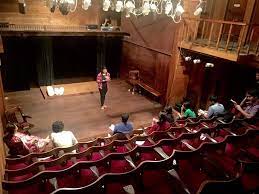
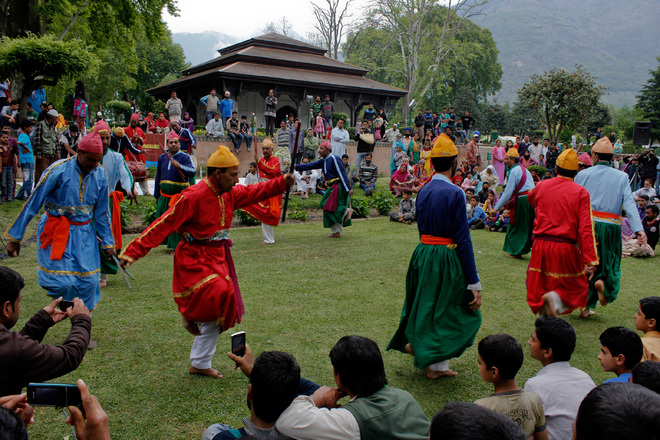
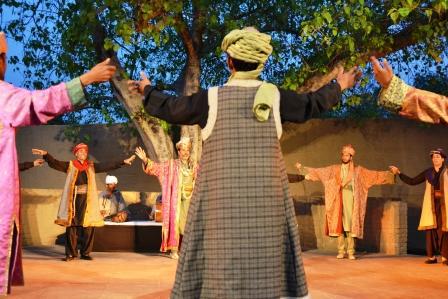
The only thing this play had in common with Shakespeare’s ‘Romeo and Juliet’ is the story line on which the spoof is based. Thankfully, the names of characters had been kept the same as those in the classic, otherwise one would have been at a loss on how to relate to the title of the play. The story has been given the look and feel of a folk lore in the tradition of romantic tales, such as those about; Umar-Marvi, Reshma-Shera, Sasi Punoh and what have you. Purple Mangoes is essentially part of, CEVA, a street theatre group, and it was therefore far more challenging for them to put up such an abstract, but artistic, rendition of the theme. Yet, they managed to pull it off as a stand alone theatre piece, but, it was definitely not Shakespeare. Which is why, one came across such divergent reactions from the audience. Not withstanding, everyone danced with the performers at the end.

The director of the play was Sukhmani Kohli, a woman, yet there were no women in the play. Even Juliet was performed by a male actor, who however, never made us feel the absence of a female cast. The choice of Bulleh Shah’s Sufi poetry would ordinarily have been considered bizarre, yet again, it was some how carried off, perhaps, because the group, which performs largely in rural Punjab, preferred drawing from its own roots.

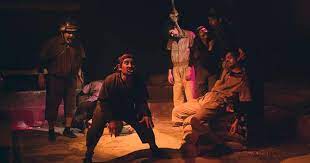
Experimentation had been unleashed with aplomb in this play. The biggest. being the usage of clowns as tragic figures. According to Kohli, the play is an attempt to go beyond the traditional idea of the red nosed clown who makes people laugh, and see it as an essential part of a human soul that is naïve, warm, accessible, eager for life and ‘ready for anything’. There was jugglery, a live orchestra and choreographed blocking. So much fluidity and coordination of movements with music, would not have been possible without intense improvisational routines. It seems that the actors went through a month long workshop that helped them discover how to portray their ‘own inner clown’

IIC Diary May-June 2013


Diary of Anne Frank – a review by Manohar Khushalani

Original Title: A face of fascism published in Pioneer on 31/12/2000
DOI: 10.6084/m9.figshare.12639266

A Leaf from Diary of Anne Frank

Ruchika Theatre Group is one of the oldest surviving theatre groups of Delhi. The reason is simple. It keeps regenerating itself. The Diary of Anne Frank was one such exercise in which, Feisal Alkazi, the director of the play, used an entirely inexperienced cast, inducted from the Little Actors Club. Obviously, therefore, there would be unevenness of talent, but viewed within those limitations The show put up at India Habitat Centre last week held together due to sheer sincerity of effort and excellent performance by Gayatri Khanna, Keerthana Mohan and Sahil Gill. The actress who deserves special mention is Aarti Sethi, who gave a vivacious performance in the lead role of Anne Frank, despite the fact that she had an asthmatic attack just before the show began.

The Diary of Anne Frank has sold more than 25 million copies, since it was first published in 1947. Anne Frank has become a symbol of 10 million Jews murdered by Hitler, one million of whom were children like her.

The theatrical version of this diary by Mrs and Mr Hackett was published four years later in 1951. It is a lucid and slick adaptation of the diary of the sensitive Jewish teenager who died at Bergen-Belsen, Germany, in 1945. Anne Frank received this ready-to-write diary on her 13th birthday, just before she and her family had to go into hiding in Amsterdam, which was occupied by Hitler’s army since 1940.

Her engagingly personal account in which she was cooped up in a stifling Attic for over two years with her parents, sister Margot, another family, the Van Dans and Janice Dussel – a fastidious middle aged dentist who had little patience for Anne’s effervescent liveliness.

The chronicle derives it’s appeal from its engaging mix of the mucky details of life during war and candid revelations of confused emotions of an adolescent girl.

Otto Frank began preparing and stocking an attic behind his business office at Prinsengracht 263 into a hiding place. When the freedom of the Jews began to be severely restricted, with does and don’ts about where they could shop, swim or study. It is this annexe where all the action in the play takes place. Feisal had orchestrated simultaneous action in various living areas of this claustrophobic space that brought alive the ambiance. In one scene while Anne is talking to Margo in the bedroom. In the meanwhile Janice waits impatiently on the sofa for them to finish their conversation in the living room, others are playing cards at the table. It was such skillful touches that heightened the drama.

According to the director, Feisal Alkazi, improvisations were used to develop this as a play about fascism mainly to get the younger generation involved in the issues. However, the improvisations appeared to bring out the tension between the generations. The political statement emerged more in the brochure, at the level of relationships. Älso, the sexual empathy between Anne and Van Dan’s son Peter, the mixed feelings between the two sisters; and, above all, the relationship between “a girl of 13 who has no friends” and an inanimate object – her diary – whom she chose to call ‘Kitty’, were all well worked out. As usual Feisal had chosen his music pieces well and the clear playbacks of well-recorded voice-overs synchronised perfectly with the action on stage. MK

Diary of Anne Frank
A Face of Fascism


Acting Tips by Prof. Manohar Khushalani on Instagram

Acting Skills by MK
Prof. Manohar Khushalani’s Live Interview on Instagram

Was invited for this program by one of the new Lockdown Channels
created by a producer from Colours TV Channel . They are interviewing
celebrities  informally to help people knock off their blues

Acting Tips with Manohar Khushalani. Spiced with hilarious anecdotes from
my Theatre life. Please watch it live today 16th May 2020 on Instagram.
7 pm India
2.30 pm UK
6.30 am LA
9.30 am NY.

 Follow the link below. It will come live at times mentioned above.

https://instagram.com/theactingstudio_tausif?igshid=1vptrgojda9zv


Celebrating 150 years of the Mahatma | Manohar Khushalani

A review of the festival at IIC _ Gandhi Ki Dilli

Published earlier in IIC DIARY
Sanatan Sangeet Sanskriti’s, Words in the Garden, curated by Ashok Vajpeyi, is an annual celebration of Literature, Arts and Ideas, of Delhi, this time as a tribute to Gandhi, it was also capsuled as Bapu ki Dilli.

The event thus opened with a film directed by Shyam Benegal, The Making of
the Mahatma,
featuring Rajit Kapoor as Gandhi and Pallavi Joshi as Kasturba.at IIC
The film is based upon the book, The Apprenticeship of a Mahatma, by Fatima
Meer it relates to his 21 years in South Africa where he evolved and fine tuned
his Satyagraha Philosophy. For those who have not seen the 1996 film, it
reveals a different Gandhi and his attempt to come to terms with his
headstrong idealism, which sometimes set him on a path of confrontation even
with his wife. Pallavi, affectionately called, Kastur, by Gandhi etches out a
strong personality for Kasturba unlike the common perception of her being a
pliable person

On the same day we saw an unusual theatre exercise. Stay Yet a While, was a
play reading directed by M.K. Raina, inspired from an unusual and rare
collection of letters exchanged by Mahatma Gandhi and Rabindranath Tagore,
along with some essays by them, curated by Sabyasachi Bhattacharya. The
production retained the flavour of the text by keeping it simple, the content
was powerful enough to sustain the performance handled deftly by seasoned
actors; Avijit Dutt as Tagore and Oroon Das as Gandhi. Preeti Agarwal, the
debutant, was the narrator. Raina’s style of Direction is very original, he
chooses performers for their ability to think and analyse and not for their
histrionics. Also without imitating the body language of the protagonists, they
were able to bring out their larger than life personalities. The result was a
didactic presentation exploring the ideas of two philosophical giants.

Ras Chakra’s Har Qatra Toofan, directed by Vinod Kumar, was yet another play
reading in the series about Gandhi which. The idea was to demystify the
legend, through the eyes of women of his time. Thus the reading was made by
women actors from letters and essays by Sarojini Naidu, Mahadevi Verma,
Ismat Chughtai, Taj Sahiba Lahauri, Anne Mary Peterson, Ellen Horup and Ima
Tarlo. The inspiration for the collection came from the historian Ram Chandra
Guha’s path breaking writings, considered by critics to be the last word on the
subject; Gandhi before India and Gandhi: Years that Changed the World,
1914-48

Besides, the festival was also replete with discussions on topics and ideas
ranging from Sustainable Living, Sparrows to Gandhi’s favourite Bhajans and
even his nutritional philosophy expressed through a lunch curated by Pushpesh
Pant, with unfamiliar cuisine, like Bajre ki Khichri, Methi ke Theple and many
such minimalistic gourmet items

DOI: 10.6084/m9.figshare.12562184


Plays of Social Relevance and on Feminist Issues / Manohar Khushalani

Firstly on Women’s Day it is important to recall the innumerable street plays we did on women’s issues mostly under the banner of Theatre Union and Workshop Theatre

Om Swaha‘ was about dowry and bride burning. It contributed towards sensitizing the media and the nation on this issue.’  

‘The Rape Bill” was about custodial rape and insensitive cross examination of victims in courts. It was performed when a select committee was examining the new rape bill before it became an act in the parliament. It also informed women about their rights.

Pardon ka Parcham’  was prepared by us after Roop Kanwar an 18-year old Rajput woman committed Sati  on 4th September 1987 at Deorala village of Sikar district in Rajasthan. These plays were collectively evolved by our group Theatre Union.

I would also like to recall my brothers and sisters in arms, an endless procession of street theatre co-warriors who came, sometimes stayed for a while and sometimes stopped briefly for a production or two and moved on. In no particular order they were: Sudhir Mishra, Sushmita Mukherji, Bina Pal. Meenu Chatutvedi, Anamika Haksar, Nandini, Anil Mehta, Anuradha Kapoor, Ravi Shankar, Umesh Bisht, Maya Rao, Vandana Bisht, Sushil Prashar, Sujasha Dasgupta, Chandrashekhar, Urvashi Butalia, Ragini Prakash, Vibhuti Nath Jha, Dr. Harivansh Chopra, Krishan Tyagi, Kumkum Sangaria, Ein Lal, Dr.Ravi Mahajan, Satyajit Sharma, Tapush Chanda and me, Manohar Khushalani. If I have forgotten anybody then please remind me.

I also directed Dario Fo’s ‘Can’t Pay Won’t Pay‘ for TU, it was a proscenium play. The play Kanthi Tripathy’s Kurukshetra and After which I directed for StageBuzz was also a proscenium play based on the Stree Parv  of Mahabharat. Which takes up the issue of women’s plight during War. And of course how can I forget that as an actor I acted in Henrik Ibsen’s ‘Dolls House and Tendulkar’s ‘Khamosh Adalat Zari hai‘ ! Both monumental plays in their own right.

With Workshop Theatre which emerged out of a workshop conducted by the Theatre Giant Badal Sircar at Sri Ram Center in 1979-80 we did a few plays on social issues, the most important amongst the was Badal Sircar’s, Bhooma. It took us 6 months to develop the play, which we translated from Bengali to Hindi collectively. We were young and sentimental, and broke down before the audience and audience too became sentimental about the plight of the villagers and farmers of Sunderbans who had to till and plow a land made fallow by salinity. Other plays we did was William Hinton’s Fanshen, Bertolt Brecht’s, Measures Taken and a children’s play; Kaddu Ram evolved by Workshop Theatre

Would also invite the readers to a conference being conducted by Natrang Pratisthan to discuss our memories of Theatre Union and it’s plays on

Manohar Khushalani


Raunaq & Jassi: Watch Out Thespians, Bollywood is Here / Manohar Khushalani

The Legendary Balcony scene, in Raunag and Jassi inspired from Romeo and Juliet

The Legendary Balcony scene, in Raunaq and Jassi inspired from Romeo and Juliet

The show of Raunaq & Jassi at Jawaharlal Nehru Stadium was a blockbuster, though, not as big as Director Feroz Abbas Khan’s earlier hit, Mughal E Azam. What appears to be a new trend or perhaps a solution for the beleaguered Amateur Theatre, about how to make the ends meet. The approach is to be commercially savvy. Have a big budget production with all the frills that technology demands, get a sponsor and launch it on a big scale. Designed by John Narun, the Cyclorama had the digital projections of luminescent landscapes and skyscapes with a wow appeal. Lighting by David Lander was in sync with the background projection just as Fali Unwala’s set was. The arches and balustrades seem to flow out of the landscapes. Piyush Kanojia has given the foot tapping melodious music, and Mayuri Upadhya choreographing the play with Bollywood style vigorous dances, Yes, one is giving credits to the technical crew first because they were largely responsible for the bells and whistles which made the production stand up and be noticed. Talking about the technical crew, one cannot ignore audio projection, which was flawless with the actors using Bluetooth microphones to be heard loud and clear. This is where some discomfort is felt by traditional actors who have been trained in mikeless voice projections. The nuances and earthy qualities of human voice are lost and actors tend to ignore making the effort to modulate their speech patterns. This was clearly visible to a trained ear when the actors tended to declaim rather than emote. So let’s not get carried away by the glitz and glamour.

The script which was obviously inspired by Shakespeare’s, Romeo & Juliet, was written by Iqbal Raj. The poetic adaptation was indeed remarkable and played a major role in success of the production. The lyrical quality of the verse did full justice to the bards tale. Like the original 16th century play, “Raunaq and Jassi” too explores a long-standing hatred between two feuding families the Jagirdars and Chaudharys, and a chance encounter leading to an intense romance between young Raunaq (Omkar Patil) and Jassi ( Neha Sargam) who belong to either clans, leads to a compelling tale of helpless but hapless love. The two lovers are torn between loyalties to their own clans and the fatal attraction to each other.

Khan, however, insists his production was an original script told in an Indian context.”It is kind of a homage to Shakespeare, but it is a completely original piece of writing, and the fact that we are doing a musical, that’s the fresh aspect of it,” He is reported to have said. There is some truth in that because,  very simply, while Romeo and Juliet can be considered a tragedy as the protagonists – the young lovers – are faced with a momentous obstacle that results in a horrible and fatal conclusion. On the other hand Iqbals play has a happy ending because Raunaq is able to convince both families to give up their decades old rivalry and allow them to marry.

The play has a huge cast of  30 artistes including dancers and actors, It has 11 songs including two original compositions by the playwright. The performers have done a remarkable job. Dancers were agile and their steps were in perfect sync with the music. While the character of Jassi is played by Neha Sargam, actors Omkar Patil and Mahendra Singh Pal took turns to play Raunaq. One does not know who was playing Raunaq,s role on the day of the show. Neha’s performance stood out for her intensity laced with live singing. What is remarkable is the fact that all performers sang live, there was no playback except for the background scores which were played behind the crooner’s voice in Karaoke style. The lead singer Mirande Shah was like the spine of the play her matchless singing held the play together as she doubled up as a Sutradhar. The audience was applauding clapping and tapping their toes with memorable folk songs such as ‘Dama Dam Mast Kalandar’, ‘Kala Sha Kala’ and ‘Tumhe Pyaar’. This review would be incomplete without a word for performers who played supporting roles.and gave substance and flesh to the story. Dhai Maa (Sonal Jha) and Gurdip Mama (Jeetendra Shastri), who had a romantic history of their own in the play gave a peppy performance and drew huge applause. Gurneet in the role of Jarnell, the antogonist suitor of Jasssi with his remarkable stage presence was impressive. Farhan Fatema gave a robust enactment as the Chaudhraen with her clear diction and energetic voice.

This entire production became successful because of the visionary approach of the Director Feroz Abbas Khan with his out of box ideas in Production design and in booking Ashish Hemrajani of Book My Show to produce the play


Schedule: 21st Bharat Rang Mahotsav Feb 2020

If you are at wits end on which play to see, just check out the preview in this E-Mag itself (www.stagebuzz.in), under the Category: Theatre


Godava and Shruti’s Play: A Case of Clairvoyance or Executing Miss K

Dramaturge: Godavar & Shruti
Director: Shruti
Group: NSD Student Diploma Production, New Delhi
Lang: Hindi
Duration: 1 hr

The Play
K, a gender queer writer living a reclusive life with his brother, is visited one evening by two police officers. In the Kafkaesque interrogation that follows, K finds that the police has resorted to Orwellian measures – it has hacked K’s Wog to discover their whereabouts. The subsequent interrogation is an attempt to determine the connection between K’s stories and two murders, although other motivations flit around like shadows telling their own tales – and foretelling K’s destiny. A Case of Clairvoyance or Executing Miss K is a sketch of the questions that need to be asked, rather than those asked – and perhaps answered during K’s interrogation. Questions also surface from the palimpsest of memories unravelled through the interrogation and K’s stories. The play is presented as a dystopian drama inspired by Martin McDonagh’s The Pillowman, Franz Kafka’s The Trial, the works of Jorge Luis Borges, and colloquial folk narratives, besides drawing from the vast pools of real life incidents. Its production also digs deep into various traditions of storytelling thus paying homage to a long, rich literary history.

Director’s Note
The title of this play is a reverent salaam to the various tropes and traditions that have enriched and informed our worldview and gone a long way in lending flesh and blood to the characters whose lives we trace through our play. It highlights the theme of foreknowledge, which is woven multi-ply into our narrative. The play’s title also underscores the perception of our protagonist, K, by the State, as a delinquent needing to be silenced. In Brechtian sense, the title foreshadows the play’s conclusion, but leaves us wondering as to the whys and the wherefores of the impending execution.

The Director
Founding Director of The P[ART]licle Collective, a multidisciplinary artists collective, Shruti is an English (Hons.) graduate (gold medallist) from Delhi University, a Postgraduate-Diploma holder in Acting (gold medallist) from Jamia Milia Islamia University, and a graduate in Dramatic Arts with specialization in Direction from the National School of Drama, New Delhi. She also holds a Senior Diploma in Hindustani Classical Music (vocal) from Prayag Sangeet Samiti (Allahabad). With an amateur and professional theatre background spanning eight years and over twenty productions, she has donned the hats of an actor, director, designer, as well as significant managerial posts for which she has been awarded at various events and competitions. She has appeared in cameo roles in full-length feature and short films.

Dramaturg
Godavar, formally known as Raghuram S Godavarthi, is a writer focusing primarily on poetry and stage plays, with one published collection of poems to his credit (A Turn of Poetry, Brown Critique-Sampark, 2013). As a student at the University of Alabama in Huntsville in the USA, he participated extensively in amateur theatre, writing, adapting, and translating – as well as directing (and acting in) as many as 12 productions (4 full-length) between 2006-2010 in Hindi and English. He lives with his family on the outskirts of Mumbai.

The Group
This play is a part of National School of Drama’s graduate showcase of class 2019. It aims to provide a platform to encourage emerging theatre practitioners to share their work with a wider audience.

Cast & Credits
K Aditi Arora
K’s Alter Ego Yashaswini R.
Tilottama Tukaram Aditi Arya
Abhigyan Atmaram Salim Husen Mulla
Taher K. Kamm Sayan Sarkar
Chorus Ayush Awasthi, Indra Bhushan, Vishesh Bajpai, Deepan Singh, Himanshu Pal, Sachin Jha,
Arpit Chauhan

Associate Director & Light Designer Greeny Francis
Art Director Argha Kamal Ganguly
Associate Art Director Shiv Swaroop
Documentation & Media Designer Amresh K. Anand
Movement Director Yashaswini R.
Live Music Ramesh Hembrams
Abhishek Kaushal
App. Developers Immersive Stories Pvt. Ltd
Costume & Make-up Abhilasha B. Pout
Stage Manager Arpit Chauhan
Floor Manager Sachin Jha
Production Assistants Akshay Singh, Animesh Barman
Scenographer Shruti

Dramaturg Godavar
Co-Dramaturg & Director Shruti

Contacts
Shruti
M: +91 9650555377
E: shruti.officialid@gmail.com


Binod Sharma’s Play: Murta Murta Neel Dipali

Playwright & Director: Binod Sharma
Group: Gandharba, Guwahati
Language: Assamese
Duration: 1 hr 45 mins

The Play
The play is based on the lives of the acclaimed Assamese singer Dipali Borthakur and fine artist Neel Pawan Baruah. The couple had lived a life of eternal love. The conjugal bliss of the couple was plagued by a rare motor-neuron disease that Dipali Borthakur had been suffering from before her marriage. After the demise of Dipali, Neel Pawan is left in solitude with an array of memories of his beloved wife. A journalist visits Neel Pawan for an interview and Neel Pawan speaks about his beloved wife Dipali, their heavenly love and life. He speaks what his art is all about, remembers great artists and eminent persons of all times for their contribution to their specific fields of work. Neel Pawan Baruah, the son of a great Assamese poet Binanda Chandra Baruah, recollects his childhood. He tells how he was fascinated towards fine arts since he was a child. The play showcases the achievements earned by both the artists in their specific fields.

Director’s Note
I have designed the play to ensure lucidity in different sequences while the scenes are being enacted by artists. A child born in Sonari of Sivasagar, a small place in the eastern part of Assam, comes in touch with the greatest contemporary artists of her time in Assam and India, and struggles throughout her life to uphold the interest of the masses in the matured stage of her life through her songs and in the long run, makes a name for herself. The characters are given original touches through their dialogues, behaviour and costumes. In many of the scenes, indigenous folk art forms are used to choreograph stage blocks.

The Director & Playwright
A graduate of NSD, Binod Sharma is currently working in theatre and films, acting and directing plays for Gandharba, a Guwahati (Maligaon) based institute of acting and music. He has had acting experience under reputed directors like Kirti Jain, Ram Gopal Bajaj, Devendra Raj Ankur, M K Raina, Anuradha Kapur and Raj Bisaria. He has worked as an actor in NSD Repertory and as an instructor in camps across the country. He has 25 plays to his credit as a playwright. Binod has received training at Kanhaiyalal’s theatre camp in Manipur. He is the founder secretary of Antaranga Natya Gosthi, Assam’s Mirza-based drama group.

The Group
Gandharba is an acting and music institute based at Boripara, Maligaon in Guwahati which was founded in 2004. It has been imparting lessons to students on music, acting and fine arts, and conducting workshops on drama including that of NSD, and pursuing research works on folk culture. Gandharba’s recent production Murta-Bimurta Neel-Dipali has been successfully staged at Baan Theatre in Tezpur, at Shankardev International Auditorium at Kalakshetra in Guwahati, and at Jonaki Kareng Naat Utsav, Nalbari in the state of Assam.

Cast & Credits
Neel Pawan Baruah (Young/Old) Jagadish Deka
Neel Pawan Baruah (Child) Suraj Das
Dipali Borthakur (Child) Harshita Das
Dipali Borthakur (Young) Dipannita Das
Dipali Borthakur (Old) Santana B Thakuria
Nabakanta Baruah Chandra Shekhar Choudhary
Tribeni Jha Bulen Bharali
Bhaben Borthakur Pradyut Bikash Das
Mukul Baruah Dhiraj Mazumder
Nirmal Prabha Bardoloi Chandamita Goswami
Rudra Baruah Dhrubajyoti Kumar
Dipika Borthakur/ Jonali Nilakshi Sarma
Sunil Pawan Baruah Prasanta Kumar Das
P.C. Goenka Gautam Kumar
Journalist Bhupen Deka
Rikshawala Hirendra Kumar Pathak

Light Dimpal Das
Music Arnab Bashistha
Projector Himjyoti Baishya,
Voice & Vocal Dr. Amarjyoti Choudhary, Hiranmoi Goswami, Bhaskar Jyoti Acharya & Rinki Thakuria Kumar
Costume Bishwajyoti Misra & Pankaj Kalita
Make-up Tibrajyoti Boiragi
Set Design Manik Kakati/Mintu Bhuyan
Concept & Design Dhrubajyoti Kumar
Asst. Director Akhilesh Hazari

Playwright & Director Binod Sharma

Contacts
Director, Gandharba (Acting and Music Institute)
Boripara, Maligaon, Guwahati, P.O. Pandu
Dist. Kamrup (Metro) Assam 781012
M: +91 9864133245, 9365343195
E: gandharba2004@gmail.com


Girish Karnad’s Play: Bhanga Bhanga Chhobi

Playwright: Girish Karnad
Translator: Srotoswini Dey
Director: Tulika Das
Group: Kolkata Bohuswar, Kolkata
Language: Bengali
Duration: 1 hr 10 mins

The Play
The play opens with Manjula Ray in a television studio, giving one of her countless interviews. Manjula is a successful Bengali writer whose first novel in English has got favourable reviews from the West. She talks about her life and her darling husband Pramod, and fondly reminisces about Malini, her wheel-chair bound sister. After the interview, Manjula is ready to leave the studio but is confronted by an image. Gradually Manjula starts unfolding her life showing two facets of the same character. The conversations between the character on stage and the chhaya-murti go on and Manjula peels layer after layer, revealing raw emotions and complexities of the relationship between Manjula, Promod and Malini. We can relate to both Manjula and Malini… all of us being flawed in some way or the other, and that’s what makes us human.

Director’s Note
I wanted to explore the text of Girish Karnad’s Broken Images with my own understanding of Manjula, the lady portraying two facets of the same character. Despite all her shortcomings and flaws, she did not degenerate into a stereotypical vamp. Although she had made unforgivable mistakes, wasn’t there enough reason for her to exercise duplicity and betrayal? I found myself asking this question and wanting to see the larger picture through another prism. It has taken years for the Bengali stage to come up with an adaptation of the 2004 play. The Bengali translation by Srotoswini Dey Bhanga Bhanga Chhobi helped me to stage it. Theatre, I feel, should not be just entertainment. It should encourage a bit of soul searching too. I am thankful to Mr. Karnad, Srotoswini and the team of Bhanga Bhanga Chhobi of Kolkata Bohuswar to help me do just that.

The Director
Tulika Das is an actor and director of Kolkata Bohuswar. After her M.A. in Theatre, she joined Bohurupee and acted in several plays under the direction of Kumar Roy and also directed four plays, which received a lot of appreciation. In Kolkata Bohuswar, she directed Choturthir Jor, Bhanga Bhanga Chhobi, Agnipaak and Anandamath. Tulika is working with under privileged children and young adults, using theatre as a tool to build their capacity to overcome the barriers around them. She is actively involved in Human Rights movement of people with disabilities.

The Translator
Srotoswini Dey, M.A., MPhil, is an Assistant Professor of English Language in a college of West Bengal. She is a theatre lover and is trying her best to enrich the Bengali theatre through the translation of scripts of famous playwrights who have written in other Indian languages. She has also published a book Re-reading of Vijay Tendulkar’s Ghasiram Kotwal: a Critical Study of Vijay Tendulkar.

The Group
Kolkata Bohuswar was established in January 2017 in order to create and promote innovative theatre. The word ‘Bohuswar’ means a collective of different kinds of voices. True to its name, Bohuswar is home to individuals of different ages, genders, religious identities and places of residence. The group has produced the play Choturthir Jor, based on a story by Ismat Chugtai (selected for 8th Theatre Olympic), Bhanga Bhanga Chhobi, based on Girish Karnad’s Broken Images (selected for 21st BRM), and Agnipaak, based on a play by Mahesh Dattani. The group had organised a November theatre festival (2018) along with a theatre workshop for young theatre workers with Ruchika theatre group, Delhi. The group facilitates inclusive theatre workshops for the under-privileged children in the rural areas of West Bengal.

Cast & Credits
On stage Sukriti Lahori Sinha, Piyali Guha Roy, Tulika Das

Off stage Mayukh Dutta, Monomita Chaudhury, Rashmi Natua, Sampreeti Chakraborty
Sumita Basu, Biswajit Roy, Arka Ranjan Bhattacharya, Tanmoy Das, Bobby
Kar, Arko Roy, Tapas Roy, Indrajit Mukhoty
Music Kalyan Sen Barat
Set & Light Gagandeep
Make-up Piali Samanta

Playwright Girish Karnad
Translator Srotoswini Dey
Director Tulika Das

Contacts
Kolkata Bohuswar
18, Deodar Street, Kolkata- 700019
West Bengal
M: +91 9830262165, 9830872209
E: bohuswar.kolkata@gmail.com
sukritilahori@gmail.com