C SHARP C BLUNT

The Play

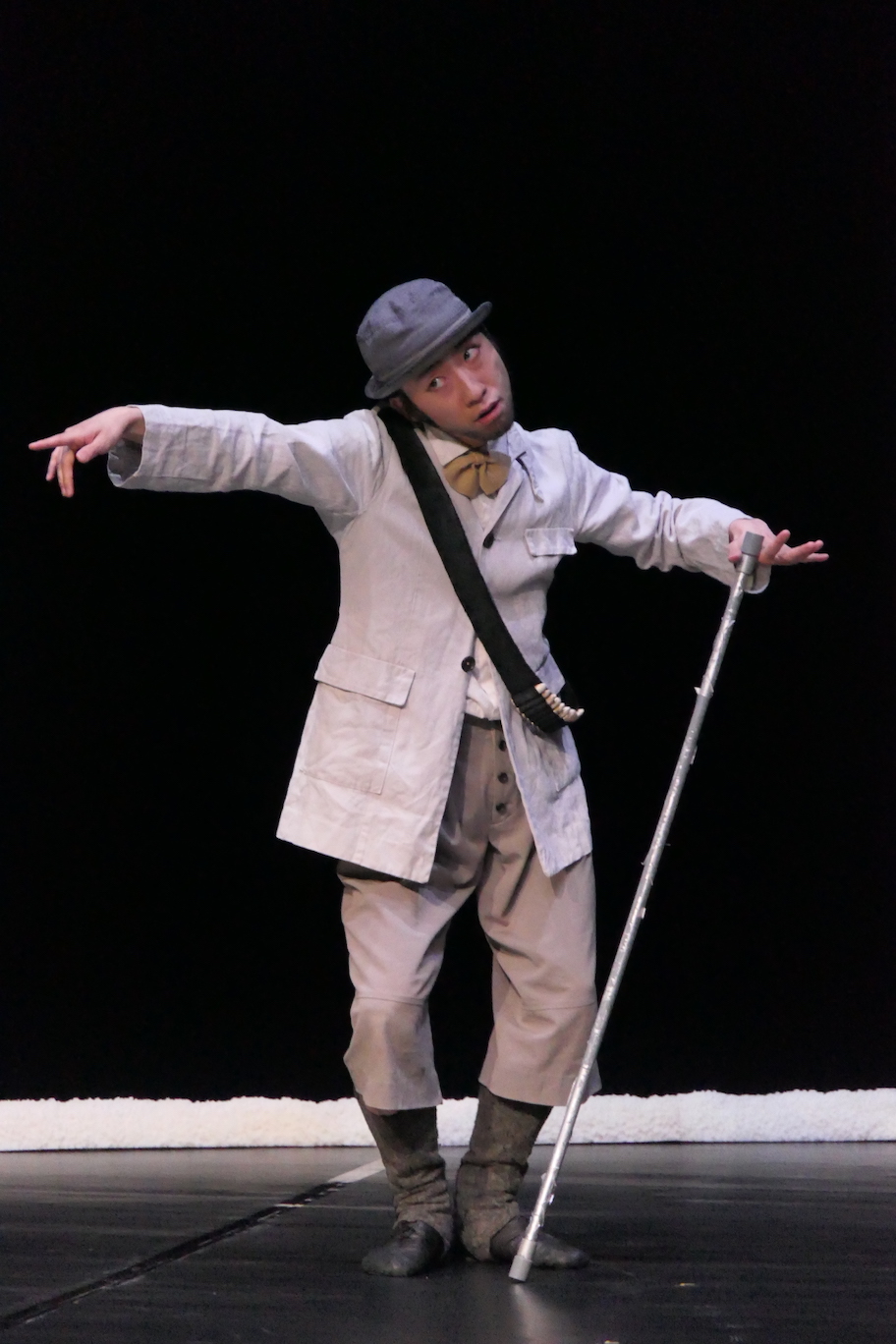
Meet Shilpa, an attractive, interactive and user-friendly mobile phone application that has been projected to be the most popular mobile applications of 2013. Created, incorporating the latest technology, Shilpa will sing for you – in the flesh. She will sing what you want to hear in her sugary and husky voice, and shake her hips when you want her to, dancing to your favourite tune. Best of all, she behaves exactly the way women are supposed to behave in the eyes of men; that is, until the next update is released.

C Sharp C Blunt is the latest offering by Germany’s, Flinntheater, in an Indo-German collaboration that explores the realms of digital dramaturgy, repetition and user choices to create a new hybrid form of theatre-meets-performance art.

Director’s Note

Our team comprises of working women in the entertainment/art industry today and we felt the need to say something about its limits for women, the small sexisms, the twisted images we have to battle and the glass ceilings – but we wanted to do it in an entertaining and satirical way. This play has been devised from the realm of our shared experiences, but certainly lays more focus on the experiences of women performers in India than in Germany. Swar Thounaojam, Ritu Bhattacharya and Irawati Karnik contributed to this play in different ways, but the centre was certainly Pallavi and the disparate worlds she occupies in one day. I consider myself more of a frame worker than a director in the classical sense. I am interested in performers that have a need to express a certain issue. I try to frame this issue and give it an exciting and contemporary form that the audience would like to watch and engage in. We had nothing, but some secondary text material, when we started. About five lines from Donna Haraway’s, A Cyborg Manifesto made it into the play. But the rest of our script is based on wild improvisations and after a while some ideas, scenes and performance oriented moments prevail. Then we had to weave this into a performance that had logic in recurring themes, symbols and ideas as well as an energetic dramaturgy, that would keep the audience engaged although they are not following a linear narrative.
As technology and the media shape the way we perceive and interact with the world, I like to reflect this in my theatre. The concept of user inputs and user choices has been intriguing me for a while because it is contradictory to the theatre set up, where there is a group of people instead of only one user. It is an experiment, all I can say is: Come and use the App and ‘C’ for yourself.

The Director

Sophia Stepf lives in Berlin and has an MA in Dramaturgy for Theatre and Media from Leipzig and Toronto. She has been involved in theatre for the past fifteen years, as a director, dramaturge, critic and scout and is the Artistic Director of the company, Flinntheater that has produced acclaimed performances with writers and performers from India and Nigeria. Her play India Simulator won several awards in Germany and her documentary play A Small Small World travelled to Dhaka, Bangalore, Bremerhaven and Hamburg. Her new play The Power Play was invited to Lagos/Nigeria in December 2012..

The Group

Flinntheater Company was found in 1992 in Kassel /Germany and has produced and co-produced seventeen plays. Since 2007, the sisters Sophia and Lisa Stepf are the artistic directors of the group and work with professional teams of actors, writers and musicians. Since 2009, their productions take up globally relevant issues and are devised with the input of writers, performers and musicians from countries, like India, Bangladesh and Nigeria. Flinntheater has an education branch too and puts up its productions for schools and young people. Flinntheater was awarded the art award of the city of Kassel and the culture award of the Dr.-Wolfgang-Zippel-Foundation. The play, India Simulator (2009) has won several awards. The group has toured India, Bangladesh, Germany and Nigeria with its productions.


Inna Ki Awaaz by Syed Asghar Wajahat

The Play & Director’s Note

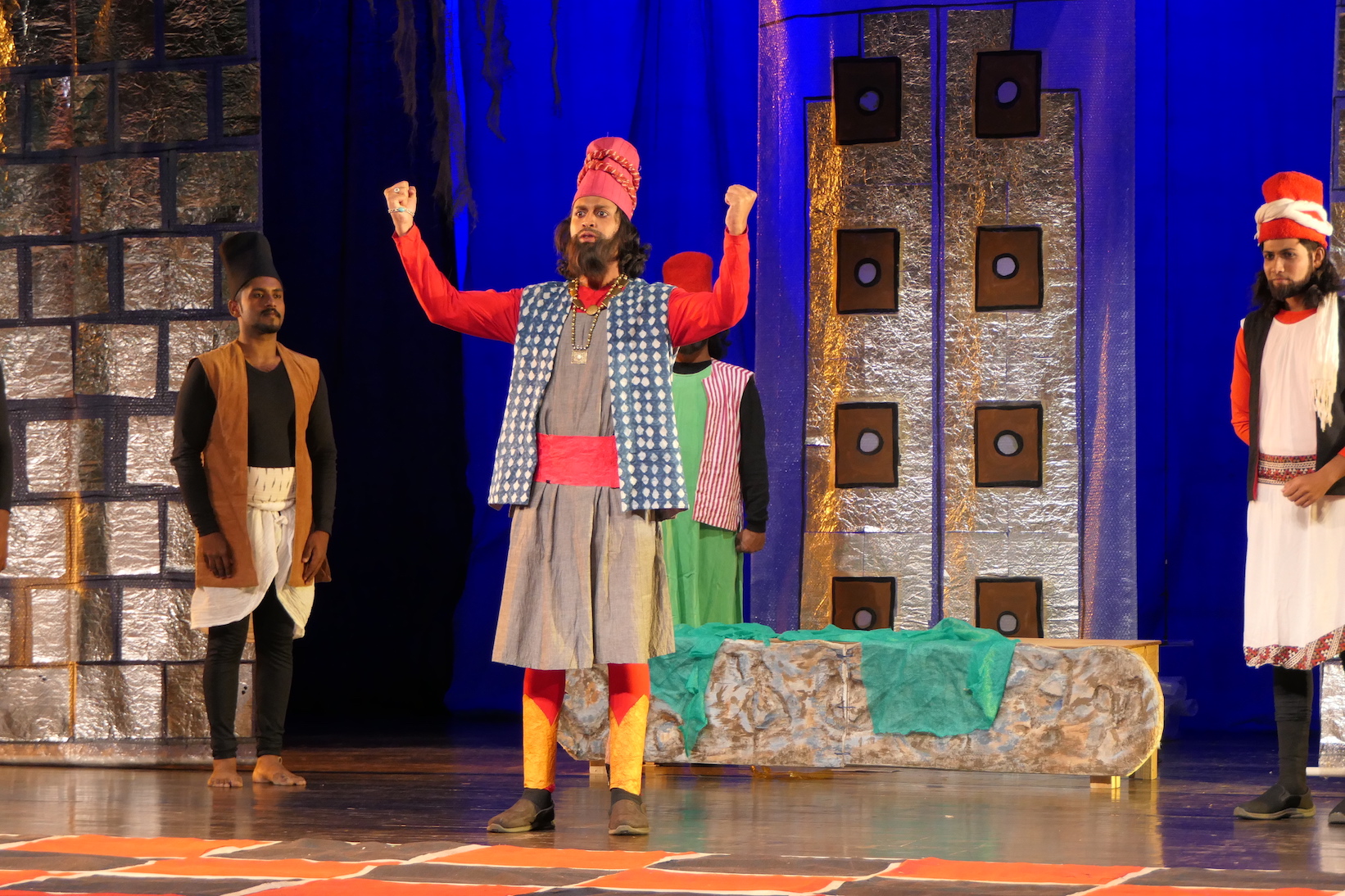
Inna Ki Aawaz is political satire based in an imaginary country where the king is a tyrant. Inna is a common man employed in the construction of a new palace for the king. He has got a melodious voice, all the workers, masons gather around him to listen his magical singing. He becomes so popular amongst lower strata of the kingdom that king feels threatened by him

The play Inna ki Aawaaz deals with the individual’s hidden tendencies both at political & social level. How an individual overplays the tricks to save his power, how important it becomes for him to suppress the voice of opposition.

The effective plan is not to finish the existence but to create such a situation where these voices are diverted and never find their way out.

It resembles a lot with contemporary political scenario where one’s supremacy includes the opposition to play safe, and after its utilization, is disposed off.

Secondly, it directs to the tendency of an individual, who after attaining one certain position forgets his own landscape and gets addicted to the facilities provided.

And this uncertainty leaves him somewhere near nowhere.

The Director

Shyam Kumar Sahani started his theatre journey from his group ‘Theatre Unit’ and later moved to Begusarai where he worked with ‘Akashganga Rangchaupal’. He has acted in Andha Yug, Andher Nagari, Panchlight, Godan, Kafan, Macbeth, Civilization on Trial etc. His directrial ventures include Papa Kho Gaye, Bas Aakar Chale Jana, Aaj Ka Hatimtai, Faans etc. He has worked as designer in many plays and has also done Art Direction for TV serials.

 The Playwright

Syed Asghar Wajahat, popularly known as Asghar Wajahat born July 5, 1946 is a Hindi scholar, fiction writer, novelist, playwright, an independent documentary filmmaker and a television scriptwriter, who is most known for his work, ‘Saat Aasmaan’ and his acclaimed play, Jis Lahore Nai Dekhya O Janmyai Nai, based on the story of an old Punjabi hindu woman, who gets left behind in Lahore after the partition and then refuses to leave.

He has published five collections of short stories, six collections of plays, street plays and four novels.

The Group

This play is being presented as part of the National School of Drama’s Graduate Showcase (Class of 2014), which aims to provide a platform for emerging theatre practitioners, while allowing them to share their work with a wide audience.


Chanakya by Mihir Bhuta

The Play

Chanakya brings to life the great visionary and statesmen, Chanakya, but in a modern context. Realizing the threat of invasion and conquest and equally driven by the desire to improve the condition of his kingdom, Chanakya decided that it was imperative to create an authority figure who could rule the subcontinent as well as the hearts of his subjects. It was because of his brilliant manoeuvers and the integrity of his intentions that the cruel rule of the Nandas ended and was replaced by the Mauryan Empire, marking the beginning of a new era in Indian history.

The second version of Chanakya was started immediately after the 26/11 terror attack on Mumbai and its first show was dedicated to the memory of martyr Constable Tukaram Umbale.

 Director’s Note

Internal discord, external threat, polluted politics and the despicable corruption of public servants – Was this the scenario in the times of Chanakya? Or are these just the headlines of today’s newspaper? The fabric of our once magnificent society has corroded from within and without, and we are plagued by the decay of morality and social consciousness. Only the austerity and selfless commitment of Chanakya’s thoughts and concepts can rebuild this society and restore it to its previous glory. This play is our modest attempt to look into the past and to present an opportunity for introspection for society and its leaders.

The Director

Manoj Joshi has been an actor on stage, in television and in films for the last twenty five years. His work includes performances in television serials like Ek Mahal Ho Sapno Ka, Damini, Kehta Hai Dil, Yeh Meri Life Hai, and others; and films like Aan –Men At Work directed by Madhur Bhandarkar, Jaago directed by Mehul Kumar, and Devdas directed by Sanjay Leela Bhansali. His work on stage includes Hindi plays like Chanakya, Rageela Re, Golmaal Pyar Ka, and Gujarati plays Suryavanshi, Doctor Tamhe Pann, Gandhi Virrudh Gandhi, among others.

Playwright

Mihir Bhuta is a well known playwright of theatre from Gujarat. He has to his credit more than fifteen plays such as Atank, Atmas and Shapath. He has won ‘Best Writer’s’ Trophy in the full length play competition organized by the Abhiyan Magazine and the ‘Best Script of the Decade’ award for Chanakya by the Gujarat Government. He has written for Gujarati, Marathi and Hindi television serials such as Khel, Aakaashpeltana and Chauraha. He has also written for films like Tore Aanchi Ki Chaiyaa Tale and Shortkut. Mr. Bhuta is also a member of the Committee for Awards for Gujarati Films; has designed and runs the Gurjari Channel and the Sankraman Studio as Creative Director.

The Group

‘Manoj Joshi Creations’ started its production of Gujarati and Hindi plays and theatre activities in 1995. The prime objective of the group is to promote theatre artists, youth and other aspirants. Some of the group’s major productions include Rangeelo, Ghasiram Kotwal, Rangeela Re and Shobha Yatra. In 2008 it produced three one-act plays, Chhoti Si Kahani Se, with amateur actors to promote inter-collegiate theater activities; and in 2009 it revived the Hindi historical Chanakya.


DU and ME by Shrirang Godbole & Vibhawari Deshpande

The Play

As we all know, we live in a jet age. This is an era of connection, exchanging and growing beyond geographical boundaries and that has brought about a great deal of cultural crossovers, amalgamation and conflicts.

Uday, Uma, their daughter Radha and grandmother Aaji live in a typical Maharashtrian urban upper middle class family. Uma is presumably a free modern mother who believes that her daughter needs western exposure. Hence, she enrols Radha in a student exchange program between Berlin and Pune. Deshpande family welcomes Boris Seidler- a young boy from Berlin, Germany through this exchange program.

Du and मी, deals with this in a very light hearted manner. The play talks about all the bittersweet, amusing, disturbing and alarming moments, such a cultural contrast might bring out. It also says that two people from across the globe can cross over all the socio-cultural boundaries and connect with each other when they talk a language of love.

 Director’s Note

Grips Theatre, Berlin and Maharashtra Cultural Centre, Pune has a long collaborative association. It started in 1986 when Max Mueller Bhavan and Theatre Academy, Pune collaborated to produce the first Grips play Chhan Chhote Vaitta Mothe. Since then this theatre movement has strengthened over the years. With more than 1500 shows of 13 productions in the last 26 years, it is one of the strongest Children and Youth theatre movements in India.

During the 25th Year celebrations in 2012, when Grips Theatre founder Volker Ludwig and his team visited India, an idea of “Author Project” was struck upon.

Author Project is a novel concept where both Indian and German Grips writers are working upon a “common script”. Michael Flucht, the then director of Max Mueller Bhavan initiated the Author project in which Shrirang Godbole & Vibhawari Deshpande from India and Lutz Huebner from Germany collaborated. A common text of the play Du & Me (You and Me) evolved through interactions and improvisations with artists in Germany and India. This play is first being performed in Marathi in Pune. It will be performed in Berlin by Grips actors February 2014. It is for the first time that a common text is being performed by both the theatres.

The Playwrights & Directors

Shrirang Godbole: Actor, writer, director and lyricist in theatre, films and television has been associated with ‘Theatre Academy’ and ‘Maharashtra Cultural Centre’ for more than 35 years. He has written both mainstream and experimental plays. He is a writer-director for GRIPS plays since 1986.

Vibhawari Deshpande: Actor, writer, director in theatre, television and films, has been associated with GRIPS theatre movement through ‘Maharashtra Cultural Centre’ for more than 25 years. She has written & directed 8 plays till date.

Lutz Huebner (Co-writer): Is an Award winning contemporary playwright from Germany. His work has been translated into over 10 languages and has been staged around the world. He is an immensely respected theatre personality all over Europe.

 The Group

‘Maharashtra Cultural Centre’ is a public charitable trust based in Pune since 1965, devoted to the promotion of performing arts mainly Drama, Music and Dance for the last 49 years. The centre has two intimate experimental auditoria at Pune named- ‘Sudarshan Rangmanch’ & ‘Jyotsna Bhole Sabhagruha’ which now have become a hub for theatre activities.

The multifarious cultural activities of the Centre are – Production of experimental & GRIPS plays, seminars and workshops in performing arts, Indian classical music and dance lessons and film and art appreciation workshops.


Co-writer:                                                      Lutz Huebner

Written & directed by:                                 Shrirang Godbole, Vibhawari Deshpande


Ma Aak Nirvik Soinik by Koushik Kar

The Play

A mother is a woman. She gives birth to a new life, which is why she cannot take away a life. Maybe for this reason, there is no woman-martial group worldwide. Men fight and exhibit their strength and power and rule over the world. They willingly dedicate their youth to mass slaughtering and cherish the crude political gamble. The mother is the only loser in this whimsical primitive game as she has to empty her lap every time.

Anaturi is one such mother who tries to inflict in her only son, Kohen, the seed of the eternal virtue of love. It is her continuous fight to protect her son under the warmth of her safe apron strings from the ill-effects of war-loving King Bumbujang or against the shimmering of sharp weapons of the Souramati King. It is a war pledged against war.

 Director Note

A warring world. Since the very dawn of creation, man has existed by applying only his strength and power. The entire world becomes afflicted towards establishing the rule of the most powerful and the mighteous. The state power is not only the sole origin of this exhibiting warring nature. This love for power & violence gets infected in every man, in every child.  For of this millennium through the game of blood and war like Max Paine, Prince of Persia or Contra video games or to relish over the blood smeared screen and rejoice over killing, as in WWF Action TV shows.  As the child grows up, his addiction to taste blood and violence also grows. This greed thrashes him into dirty politics in schools, colleges, which calls for inter country quarrels in the guise of narrow patriotism and thus nationalism culminates into nasty terrorism.Here, in my play, there is the story of a mother who struggles all-out to keep her only war-loving son away from the deadly weapons and bloodshed and imbibes the value of eternal love.Mother is a woman and she alone can give birth to a child. When a life is lost in war, it is only a mother’s lap that becomes void.

But at times, a mother needs to pick up arms in her hand to establish the virtue of love and mercy at the cost of giving up precious gem that is her only son. It is a war waged against war, a war to establish eternal love against crude violence.My play is dedicated to mothers world-wide who have lost their sons in war. A mother is actually ‘a fearless warrior’.

The Director & Playwright

Koushik Kar has been a theatre personality with over 12 years of experience as an actor and director. He is known for being a keen planner, strategist and implementer ensuring successful management of operations in theatre. His time- centric approach is coupled with a flair for executing production. He has been the Founder–President of Kolkata Rangeela’He essayed many important roles in major productions of Yuganata, Rann, Minerva Sangskriti Charchakendra and Nirnoy. He was honoured with Best Director Award for Terrorist andDour.

The Group

‘Kolkata Rangeela’ was founded last year under the leadership of Koushik Kar. It launched its first production, Ma Aak Nirvik Soinikwith the unveiling of its logo by the eminent theatre personality, Bibhash Chakraborty.

The organisation is ready for shouldering the responsibilities of offering a new focus on the Total Quality Theatre. While trying to fulfill the objectives of entertainment, education and information, it would pay special attention towards developing the thought process of the theatre workers and audience.

Playwright & Director           Koushik Kar


Les Chants de l’Umaï

 The Play

Les Chants de l’Umaï consists of five sequences, set in a surreal Indo-Arab context with Persian and Jewish influences, in which dance stems from singing in long undulating iterations, somewhat like the chants of ancient manuscripts. While creating this show, Marcia Barcellos was particularly inspired by the Carnatic songs and signifying gestures of Indian sacred dances. In the imaginary, dream-like state that Marcia Barcellos creates in this piece, she is Umaï, the womb of the universe, or a woman-dragon of the fictional territory of Gravbekistan. In this ode to femininity, the reconstructed memory of many fantasized imaginary divinities is conveyed through five songs loosely derived from Indian or African melodies. Each of them, in the manner of ancient theatre, introduces an epic poem of a past era that only the body-memory can tie us to. As a loyal disciple of American choreographer, Alwin Nikolais, Barcellos uses the whole gamut of effects, including video, lighting, holograms and props created by the co-founder of Systeme Castafiore, Karl Biscuit. The intersection of a movement vocabulary particular to Barcellos and ever-evolving scenography, Les Chants de L’Umaï goes as close as it can to a reimagined world.

Director’s note

“It’s an operatic form that combines singing and dancing, with a dramatic and scenic device to carry it all. The theme, a sort of distant past, reinvented or a prehistoric mythology revolves around feminity. Umaï is a word from the ancient Mongolian which means matrix. Through this form we created different women characters which form a kind of mythology of the origin of the world. Each piece is preceded by a song, in a mysterious language, which announces the next one, a bit like with the Greek chorus. We take the viewer on board of a rather contemplative epic poem, with a great freedom of interpretation.”

 The Director

Système Castafiore is directed by theatre director and musician Karl Biscuit and Brazilian dancer and choreographer Marcia Barcellos, both of whom, having worked with Alwin Nikolais, remain followers of his style of total dance-theatre in which dance is just one element in an integrated performance including sound, light and theatrical effects. They first entered the new French dance movement through the Lolita collective, before founding their own company in 1989. Together, they created 19 performances including choreographies for national ballets. Naturally gifted with humor, talent, imagination and a rare ingenuity, they put experimentation at the forefront of their art.

The Group

Dance company Système  Castafiore  has no equivalent on the French performing arts scene. Operating for over 30 years, it has created its own universe, flirting with Dadaism. Co-directed by choreographer Marcia Barcellos and director/composer Karl Biscuit, the company’s representation of reality reflects the madness of our world through an extraordinary work of experimentation between movement, sophisticated projections and sound installations.


Dance & Songs: Marcia Barcellos

Music & Direction: Karl Biscuit


Tamasha Na Hua by Bhanu Bharti

The Play

To commemorate Tagore’s 150th anniversary, a theatre group is shown busy, rehearsing his celebrated play Muktdhara. During the rehearsal, an argument about the relevance of the play in the present time erupts among the actors. This argument leads to the famous debate between Tagore and Gandhi, and the issue of man’s freedom in today’s scenario. The discussions leads to many real issues faced today, like the Farraka ‘barrage’ and its effect on Bangladesh agriculture and fisheries, the effects of free economy and consumerist culture on the society as well as ‘Gandhian socialism’ v/s ‘Marxist socialism’. After serious arguments and counter arguments among the actors, the debate remains inconclusive and the play unperformed.

Director’s Note

Men’s aspiration for freedom has engaged the best minds in the realms of religion, philosophy, ethics, science, arts and politics for centuries. With industrial revolution, economy acquired a central place in all the discourses related to the concept of human freedom, in modern age. With this economy, machine and its relation to the development of human society also became greatly significant.

All through the freedom movement of India, there were great minds that were watchful and emphatic in avoiding the narrow nationalistic view of freedom and kept the larger issues of men’s freedom as the central discourse; freedom, not only from a foreign rule, but a complete freedom at all levels – material and spiritual. While the freedom of the country was paramount, universal humanity was never out of sight. This was a unique feature of our ‘national’ movement for freedom. Among these great minds with a universal vision, Mahatma Gandhi and Gurudev Rabindranath Tagore were the most prominent.

I felt that Tagore’s ideologies merited a revisit in the context of the tumultuous modern times. As a tribute to his work and ideas, the play Tamasha Na Hua depicts a group of theatre actors rehearsing one of Tagore’s most popular works – Muktdhara. The narrative is essentially a discussion among the actors on the relevance of the play which leads to a serious debate about the freedom of men in the present political, technological and cultural context.

The Director and Playwright

An NSD alumnus, Bhanu Bharti is best known for his bold innovations and creativity in Indian theatre. In search of an authentic theatre experience, he has engaged in a lot of things, from conventional modes to the freedom of folk idioms, highly stylized Noh and Kabuki theatre to the utterly liberated tribal Bheel ‘Gavari’ style of his native Rajasthan. Such eclectic influences have informed his seminal directorial output like Pashu Gayatri, Amar Beej, Kaal Katha, Taambe ke Keere, Chandrama Singh urf Chamku and Katha Kahi Ek Jale Hue Ped Ne. Indefatigable and multi-dimensional, he is acclaimed as an actor and as author of original plays like Tamasha na Hua, Chandrama Singh urf Chamkoo, Katha Kahi Ek Jale Ped Ne and Nachinai. He has launched many thought provoking events such as the Centenary of Satyagraha, Pravasi Bharatiya Divas, and Celebration of Indian Freedom – Bharat Utsav.

He has been honoured with the Sangeet Natak Akademi Award in the field of theatre as a director and the prestigious ‘Nandikar’, an award for lifetime contribution to theatre.

The Group

Aaj Rangmandal was established in 1984 by Shri Bhanu Bharti in Udaipur, Rajasthan. It created a special niche for itself in the theatre scenario. During this process, a need to involve the urban actors along with tribal actors was felt, to further its creative and innovative pursuits. Thus Aaj – Delhi was found and since then, this unique theatre company consisting of the urban and the tribal actors is constantly involved in its innovative and thought provoking work. Aaj Theatre Company presents a theatre festival of its own productions in Delhi, every year. Some of its most important theatre productions are: Pashugayatri, Amar Beej, Kal Katha, Katha Kahi Ek Jale Ped Ne, Naachni, Mahamayi, Dehantar, Bapu etc.


Playwright & Director –  Bhanu Bharti


Jamal-E-Begum Akhtar by Vidushi Rita Ganguly

The Play

Jamal-E-Begum Akhtar, a solo performance, is being presented by, Prof. Vidushi Rita Ganguly (Padmashree), the well-known theatre artist and vocalist. The presentation is based on the life and times of her own Guru Mallika-e-Ghazal, Begum Akhtar. The play has evolved over the years as a result of Prof. Ganguly’s long association with Begum Akhtar as her pupil and her extensive research on the professional woman musicians of the country and the music that thrived in the royal courts of yesteryears. The present play is in Hindustani language and is an adaptation of a Bangla play of the same title, which was recently performed in Bangladesh with resounding success.

The play is designed in free story telling format, which necessarily precludes any fixed written text. With her gift as a storyteller, she takes recourse to improvising the text as the play develops. This is perhaps for the first time that an ekal is being staged on the life of a legendary artiste.

Begum-Akhtar

Begum Akhtar (7 October 1914 – 30 October 1974), was a well-known Indian singer of GhazalDadra, and Thumri genres of Hindustani classical music. She received the Sangeet Natak Akademi Award for vocal music, and was awarded Padma Shri and Padma Bhushan (posthumously) by Govt. of India. She was given the title of Mallika-e-Ghazal (Queen of Ghazals).

Begum Akhtar was born in Bada Darwaza, Town Bhadarsa, Bharatkund, Faizabad District, Uttar Pradesh. Her father, Asghar Hussain, a young lawyer who fell in love with her mother Mushtari and made her his second wife, subsequently disowned her and his twin daughters Zohra and Bibbi (Akhtar). Akhtar was barely seven when she was captivated by the music of Chandra Bai, an artist attached to a touring theatre group. At her uncle’s insistence she was sent to train under Ustad Imdad Khan, the great sarangi exponent from Patna, and later under Ata Mohammed Khan of Patiala. Later, she travelled to Calcutta with her mother and learnt music from classical stalwarts like Mohammad Khan, Abdul Waheed Khan of Lahore, and finally she became the disciple of Ustad Jhande Khan.


The Director

Born and brought up in Lucknow, Professor Rita Ganguly was drawn to music since her childhood. The daughter of freedom fighter and founder of the National Herald, the eminent litterateur, Dr K L Ganguly, Rita was encouraged from an early age towards academic advancement as well as artistic excellence.
She regularly performs a two and a half hour solo play on her mentor, Begum Akhtar which has travelled throughout the world at all major theatre festivals. It is also her homage to the gurus of dance, music and theatre who have influenced her own life, and contributed to world culture through their commitment to truth. She pioneered a multimedia production on the 7 stages of Sufism, entitled Ruh-e-ishq, celebrating 50 yrs of India’s independence.
For her outstanding contribution in the field of classical music, she has been the recipient of a slew of awards. These include the Padmashree, the Sangeet Natak Akademi Award for Ghazal Gayakee, the Priyadarshi Award, the Rajiv Gandhi Shiromani award, Critics Circle of India award and most recently, the Lifetime Achievement Award from the Broadcasters Association, Ministry of Information & Broadcasting.

Concept, Research, Design & Script                         Prof Rita Ganguly


Dahananta by Debasis Majumdar

The Play

This is a tale of a lower middle class septuagenarian couple Akinchan and Sabarni- lonely, isolated and deserted. Their elder son Abhirup, a methodical careerist lives in Oklahoma with his family. Their daughter, Ratnasree and son-in-law Romit, who stay in Delhi, can be called selfish, covetous and hypocrites. Their youngest son, Dhritirup, an extremist yields to his political belief of terrorism by sacrificing himself in a police encounter. Grief engulfs the couple. They mourn Dhritirup’s death and keep the sorrow within themselves. Abhirup and Ratnasree avoid their parents and gradually, the couple becomes more alienated and insecure.

Their loneliness and isolation compels them to think, what will happen to either of them if one of them dies?   Who will provide them a shelter or lend a hand of support? Such questions bother them, thereby making their life a burden. Both of them decide to consume sleeping pills. But was that inevitable?  Another fold of this play raises a question on the future of our socio-political scenario. The quasi-fascist politics that prevails under the veil of democracy, the terrorism or the ideology of Rabindranath Tagore to search humanity within one’s self – which one of these ideologies will survive?

The Director & Playwright

Shri Debasis Majumdar was born in Baktiarpur, Bihar in 1950 and grew to adulthood in Kolkata amidst the political turbulence of the early 1970s. Starting as a poet in Bengali, he found his true calling as a dramatist with the production of Dansagar (1975) based on Premchand’s well-known story Kafan. Shri Majumdar formed the theatre group ‘Sudrak’ in 1977 and launched its first production Amitakshar in the same year. The play subsequently won the West Bengal Natya Akademi’s Award (1980) and was translated and performed in several Indian languages. In Hindi, Amitakshar was named as Tamrapatra. Out of some forty plays and numerous critical essays written by him, Samabartan, Ishabasya, Asamapta, Chandalini, Pratinidhi, Swapna Santati, Rangamati and Dahananta are some of his most notable plays. These plays were produced by Sudrak and have been published in various literary periodicals. Shri Majumdar has been the recipient of various awards like the prestigious Sangeet Natak Akademi Award (2005) and State Natya Akademi Award for his plays, AmitaksharSwapna Santati and Rangamati.


The Group

‘Sudrak’ came into existence on 9th October 1977. With its first production, Amitakshar in 1978, Sudrak established itself as one of the leading theatre groups, involved in the Experimental Theatre Movement of Bengal. Besides the appreciation received from the audience, Amitakshar received applause from eminent personalities like Satyajit Ray, Shambhu Mitra, Samaresh Basu, Ganesh Pain etc. The play is considered as one of the best ten original plays ever written in Bengal and has been translated into seven national languages.

Some of the remarkable plays by Sudrak are Amitakshar, Ishabasya, Chandalini (Based on Rabindranath Tagore’s Chandalika), Rangamati, Pakhiwala, Sahajsajan, Dahananta andParyabarto.

Apart from theatre,  Sudrak publishes ‘Natya Patra : Sudrak’  each year. The group also publishes books based on theatre like Tripti Mitra. Since, 2008 Sudrak conducts National Theatre Festival, called ‘Sudrak Utsav’ at the Academy of Fine Arts, Kolkata. Besides the theatre festival, the group also organizes exhibitions on painting and sculpture.

Playwright & Director  Debasis Majumdar


Joymoti by Anup Hazarika

The Play

The play Joymoti, is about an iron lady of 17th century Assam history, who with her fortitude and self sacrifice  entirely changed the course of destiny of the ‘Ahom Empire’ when the atrocious ruling of a certain class of the Ahom royal family were about to lead the entire Ahom kingdom to its doom. The play not only gives information about Joymati’s life but also focuses on her inner thoughts and mental power.

Director’s Note

“What Joymati might have thought during her days of sufferings?”—were the key questions haunting us before preparing the play. We were searching for the answer in the available references in the Assam history and other forms of literature. Our discussions with various persons who spent much of their time in the scholarly study of Assam history and particularly on the Ahoms were other resources and inspirations in writing and shaping up the play. But still our search is on; hope someday we will get the answer.

Playwright & Director

Anup Hazarika, the playwright & director of the play Joymoti, graduated from National School of Drama in 1990. He specialized in acting. So far he has directed 32 stage plays for both amateur and mobile theatre of Assam. He established his group Baa (The Creative Breeze) in 1995. As an actor he acted in 72 stage plays, 21 feature films, more than fifty television serials, tele-films and a number of radio plays. Apart from that he enjoys translating plays & dramatizing plays from different stories & novels. He has already translated Mohan Rakesh’s Ashadh Ka Ek Din into Assamese and staged the play under his direction in 1993. In the year 2008 he was awarded the best light designer’s award by The Mahindra Excellence in Theatre Awards (Meta) & in 2007 he was awarded the best supporting actor’s award by the Govt. of Assam for his performance in Assamese cinema. Presently he is working at Regional government Film & Television Institute, Kahilipara, Guwahati as a lecturer of Acting

The Group

 BA (A Cultural Organization), of Guwahati, Assam was established in the year 1995, by a group of active theatre workers. So far the group has staged several plays including Arun Sarma’s Agnigarh, Mahendra Borthakur’s Sinsa Paneer Mass, Jimoni Choudhury & Pakija Begum’s Menaka and Habib Tanvir’s Charandas Chor. Apart from producing stage plays the group has organized production oriented intensive theatre workshops and children theatre workshops in collaboration with National School of Drama and Sangeet Natak Akademi in Guwahati.