Kafan – Kafan Chor by Munshi Premchand & Amin Kamil

The Play & Director’s Note
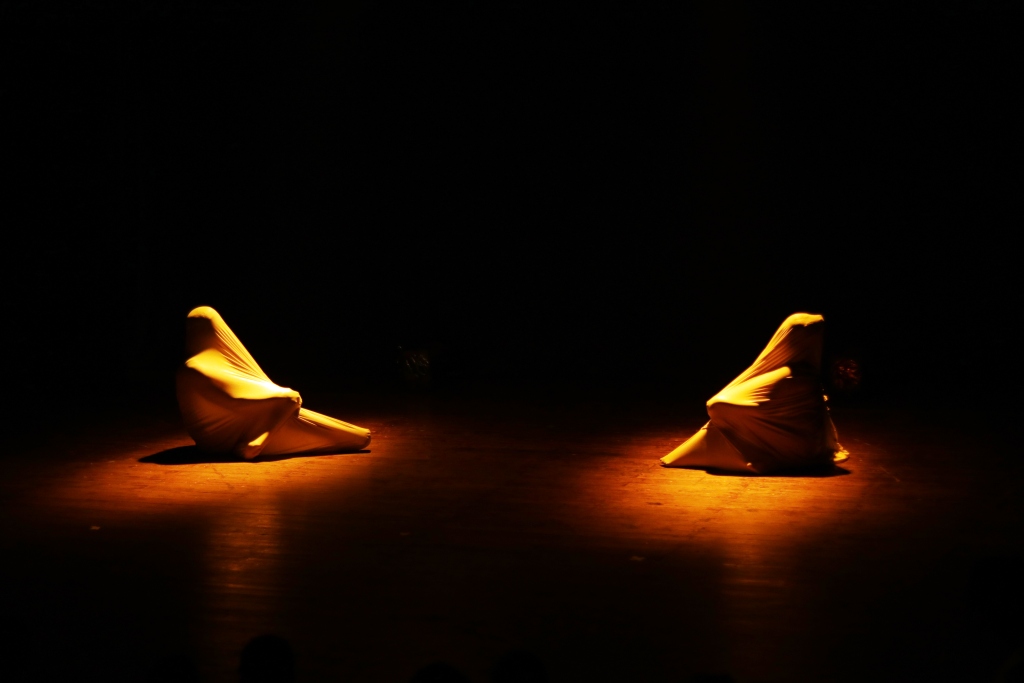
In today’s world, while we claim that the nations have come closer to each other, this global convergence has also unleashed a strange trail of war, violence and up-rootedness, where the victor and the vanquished are caught in the same ritual of death. This death, physical or metaphorical, is cutting across national borders, faiths and cultures. Seeds of hatred are fodder for brutality, poverty, misery and hopelessness. Kafan – Kafan Chor has two great short stories, one of Munshi Premchand and the other of Amin Kamil (A renowned Kashmiri author). The performance takes an absurd tragic journey, through the contemporary helpless human condition, looking at the past and present, known and unknown forces, which create this landscape of death and destruction. The performance has also
taken poems from different lands, different poets, and poems by soldiers in the battlefield. Despite great scientific advancement, has mankind lost the basic value of being humane?

The Director
M. K. Raina is a well-known theatre luminary, who has been working in the field of theatre for the last three and a half decades, innovating, studying, analyzing, writing and teaching. He has worked extensively in both contemporary and traditional theatre in South Asia and has been instrumental in reviving the traditional folk theatre of Kashmir, Bhand Pather. He has been a visiting faculty of several national and international Institutions, such as National School of Drama, Central University of Hyderabad, Indian Institute of Technology Hyderabad, University of Hawaii USA etc. He has been a fellow at the Stanford University, USA and a scholar-in-residence at the Jamia Millia Central
University, New Delhi. He is a well-known social and cultural activist and is a founder member of SAHMAT, a trust formed to promote communal harmony and social equality. He is also a trustee of the South Asia Foundation, India, and the Artistic Director of the theatre group, Prayog. He has also made documentaries and films for various national institutions and for national channels. For his long term contribution to theatre, he has received several awards including the Sangeet Natak Akademi Award, Sahitya Kala Parishad Samman, Sanskriti Award and B. V. Karanth lifetime achievement award.

The Group
Three Arts Club is one of Delhi’s oldest theatre groups, founded in 1943. TAC enthralled and entertained its audiences for four decades (1943-1983). Former presidents Dr. Rajendra Prasad and Dr. Zakir Hussain, and former Prime Ministers Pandit Jawahar Lal Nehru and Shri Charan Singh, as well as theatre and film luminaries like Prithviraj Kapoor, Shobhana Samarth and Sunder graced its performances. The club also has the distinction of being one of the first groups to give a platform to women on the Delhi stage. Since it revival in 2008, Three Arts Club organizes annual theatre festivals and has to its credit production of 19 plays in various genres ranging from comedy to drama. TAC has made rapid strides in both the technical and artistic aspects of theatre, especially after its association with M.K. Raina. In June 2017 TAC organized a week- long workshop under his able guidance. Three
Arts Club also extends its activities to educational institutes with the aim of promoting histrionic skills among the new generation and has organized many inter-school theatre competitions. True to its original mission (TAC performed children’s theatre in the 1950s), the group provides a platform to school children in Delhi NCR to explore their creative side and stage their own productions.

Cast & Credits
On Stage : Avanish Pandey, Durgesh Kumar, Kriti V. Sharma, Mukul Singh, Nupur Jain, Pankaj Sharawat,
Sachin Srivastava, Shalini Singh, Vipan Kumar

Lights : Govind Yadav
Sound & Music : Rakesh Kumar Singh
Costumes : Kriti V. Sharma
Stage Manager : Shalini Singh
Back Stage : Avinash Singh, Nidhikant Pandey, Sanjeev Singh
Producer : Anuradha Dar
Hindi Translation of KafanChor : Asif Ali

Storywriters : Munshi Premchand & Amin Kamil
Director : M K Raina


Agarbatti by Ashish Pathak

The Play
In order to rehabilitate the widows of Behmai massacre, the government opened an incense stick factory. Until killing the jailed Bandit Queen of Chambal, Lala Ram Thakurain postpones the last rites of immersing the ashes of her husband. Damayanti initiates a discussion questioning why all those massacred were only men, and not women. Series of events, arguments, break- downs and imputing allusions lead them to the appalling truth that a convict committing the crime without participating in it is also a criminal. Lala Ram Thakurain mixes the ashes of her
husband in the incense stick powder as natural justice.

Director’s Note
This is not just a play for me but a relationship. It has my voice. Initially, I thought about the contemporary value of this play and came to the conclusion that it is a serious question on humanity, if caste, class and gender differences still exist in the 21 st century. This play has a serious discourse which reached a point that created a boiling turbulence felt by me during the process of the play. I consider this play as an extension of classic film ‘Bandit Queen’, although the questions and issues raised in the play go beyond that. It was painful going through Phoolan’s life, character and Behmai as an event, but it is even more painful to perform this play since it brings us to the situation where we are ashamed as human beings

The Director
Swati Dubey was born on 1 st February 1988 in Chhatarpur (Madhya Pradesh). She did her graduation in Microbiology and Journalism. She did MBA in Rural Management from Gujarat. She did a one-year diploma course in theatre from Madhya Pradesh School of Drama. In 2014 she got selected for three year diploma course in National School of Drama and specialized in Design and Direction. Presently she is doing theatre in her city Jabalpur

The Playwright
Ashish Pathak was born on 8 September in 1977 at Jabalpur (M.P.). He got involved in theatre during his college days. His knowledge of psychology, sciences and social issues sharpened his writing skills. His plays Popcorn, Red Frock and many more have gained lot of popularity. Ashish believes Drama is be the best weapon to oppose social evils, which not only makes his dramas entertaining but also gives them a conservative and developing platform to innovate more. He has also directed many plays like Vishkanya, The Dumb Dancer, Maaya, Pratiuttar, Vijaynagar, Agarbatti, Popcorn, Red Frock, Yugpurush-Abhipurush, Manusmriti, Sugandhi, Hayvadan, Azaadi ki Mahagatha, Chouraha, Ek Akeli Aurat, Daariyo Fo, Jaadu ka Suit, etc.

The Group

This play is being presented as a part of National School of Drama’s graduate showcase (class of 2017), which aims to provide a platform for emerging theatre practitioners, allowing them to share their work with a wide audience.

Cast and Credit
Thakurain : Rukmini Sircar
Suman : Aruja Srivastava
Kaushalya : Babi Baruah
Parvati : Shwetha Rani H. K.
Lajjo : Pallavi Jadho
Kalli  : Jina Baishya
Nanhi Bai : Goge Bam
Damyanti : Swati Dubey
Ramkali : Rachna Gupta
Sukkan Bai : Snehlata Tagde
Heera : Gagan Shrivatava
Sohan Singh : Bhupendra Singh Jadawat
Shivpal Lala : Aamir Mallick
Bansi Thakur : Vivek Emmaneni
Raghu Thakur : Niranjan Nath
Lala Ram Thakur : Manohar Pandey
Surjan Thakur : Baljit Singh
Set Execution : Rohit Jha
Light Operation : Susheel Mishra
Sound Operation : Pooja Vaidvikhyat
Voice-overs : Govind Namdev, Babi Baruah
Set, Light & Costume Design : Swati Dubey

Playwright : Ashish Pathak
Design & Direction : Swati Dubey


Bipannata

The Play

Bipannata is the story of the helplessness of Sulagna Dutta, a woman in her late 50s, a widow and a single parent. She represents the middle class, who wakes up to a daily routine expecting a more or less secured lifestyle. She is neither a political bigwig nor a celebrity, but one of those you wouldn’t even notice when passing by. She has raised her son Ujaan to be a responsible man and who is now a computer engineer. The only problem is that he has his own well defined opinions. He is sensitive and reacts like a normal human being to events happening around him…events of large scale state generated violence that permeate into our lives and induce a constant state of fear. Sulagna is worried for her son, who goes into bouts of depression and hides at home, refusing to go out and participate in a world he cannot question. She sets up an appointment with a renowned psychoanalyst Dr. Ahana Roy.

What follows is a heartrending search into fear psychosis and the resulting helplessness. Are we all trying to hide in our cocoons? Are we afraid to question? How is an individual supposed to negotiate in these circumstances? Do we need help? And who can help?

Director’s note

Choice of Bipannata – a rationale: The play tries to address the feelings of fear and helplessness that we carry within us in these hard times. How is one supposed to react to the violence that one witnesses daily? To questions of state induced terrorism, rape, capital punishment…….? Is one expected merely to drink it in with his morning cup of coffee? Or can one exercise his basic right of speech and thought? Can one help himself? Is there someone who can help? Can he expect any help at all?

The Director

Sohini Sengupta is an upcoming director and a leading stage artist and trainer of Nandikar. She has acted as the lead in most of Nandikar’s recent productions and also in some of the plays sponsored by the British Council and other reputed theatre groups from Kolkata. Her character in Aparna Sen’s film Paromitar Ekdin brought her major acclaims, including the award for the Best Supporting Actress at National Film Awards, the highest Indian recognition given to film artists. She has also received the Sangeet Natak Akademi’s Ustad Bismillah Khan Yuva Puraskar for her contribution to theatre.

The Playwright

Debatosh Das (born 11th, January 1972) is a contemporary Bengali novelist and short story writer. He is a Post-Graduate in Comparative Literature from Jadavpur University. He has written- two novels, four plays and fifteen short stories so far. He also writes features on varied topics in different newspapers regularly. He appeared in Bengal theatre with his maiden play

O Chand in 2012, which deals with the Maoist movement in India. Bipannata is his second play. It was published in the theatre magazine ‘Bahurupi’ in 2013.

The Group

‘Nandikar’ is a 53-year-old institution which has been at the forefront of the national theatre movement since its birth in 1960, and is recognized for the diversity, quality and scale of its sustained activities. Nandikar has produced about 80 plays, performed nearly 8000 times across the nation, featuring in all major national and state festivals, as well as abroad. Many of its productions, e.g. Natyakarer Sandhane, Chhati Charitra, Tin Poysar Pala, Bhalomanush, Football, Antigone, etc., have had more than 400 performances. Beyond its theatre mould, with wide reach and professional quality, it has also carried out diverse socio-cultural activities in various segments over the years. It holds workshops and works with institutions and organizations like Ministry of Women and Child Development, Human Resource Development, Sangeet Natak Akademi, ICCR and NSD under different collaborations. Nandikar is also involved in research, documentation & dissemination of literary, audio and video formats; organizes national integration camps; and hosting international exchange programmes.


Ke ?

The Play

Dr. Sunil Sen. has a tiff with his wife Kurchi, following which he comes to stay at his sister Bula’s and brother-in-law, Arun’s farm house. Manoj, a successful businessman, is Kurchi’s lover. One fine morning, a stranger, Srikanta Gupta, comes to meet Sunil and informs him that his wife, Lily who is Sunil’s patient, has committed suicide that morning. The reason behind the suicide is Lily’s alleged affair with Sunil and her pregnancy. Srikanta threatens Sunil with murder. Sunil, in self defense, approaches his college pal, Rabi, a high rank police officer. But Srikanta is violent with Rabi as well and injures him. Left with no choice, both Rabi and Sunil approach a private detective, Chatak Chattaraj, on Arun’s advice. Can Chatak Chattaraj solve the mystery?

Director’s Note

Ke? (Who?)  apparently conveys the sense of a thriller, but at its core is a blend of complex human relations, empowerment of women, and the modern day stagnancy of the institution of marriage. The soul of the play carries a delicate hint that helplessness arising from individual vulnerability adds to the philosophical belief of life, more than human vaunting. Every space in this production penetrates the other. The office enters the house, the coffee shop makes way into the office, the doctor’s chamber breaks out of the coffee shop – each intertwined with the other, expanding into the entire city and society in the end. Casting of light is meant not merely to represent illumination or darkness, but to signify a process of psychological continuum. In this production, the transition from one scene to the next never occurs in darkness; rather the accompanying music portrays a world proportional to the light, entwining the conscious with the sub-conscious. While a prototype of music and light has been used to illustrate the consciousness of the mind, another pattern is used to depict its sub-consciousness. The association of cricket comes as a requisition in the play. Costumes and make up represent two different colors and mental states. Finally, is ‘Ke? (Who?) about analyzing the registers of life, unconsciousness, cricket, and society, placing them all on the same premise?

 The Playwright & Director 

Bratya Basu is an accomplished theatre artist, playwright, actor and director. His noted plays include Aranyadeb, Shahar Yaar, Virus-M, Winkle-Twinkle, 17th July, Ruddhasangeet, Chatushkon etc. His plays have been staged by various and renowned groups and directors. He has directed three films viz. Raasta, Teesta and Tara and has acted in many films including, Kaalbela, Icchey, Sthaniyo Sambad etc. Basu has bagged many awards and recognitions such as Shyamal Sen Memorial Award, Dishari Award, and Satyen Mitra Award.

Bratya Basu, currently Hon’ble Cabinet Minister and in charge of the Ministry of Tourism for the state of West Bengal, formed his own theatre group Bratyajon in 2008. His recent plays Cinemar Moto and Ke? are milestones in Bengali Theatre.

 The Group

‘Bratyajon’ is the brainchild of ace playwright and actor-director Bratya Basu. The group’s productions have been influenced by the learning, motivation, inspiration and experiences of the renowned playwright and theatre artist himself. Some of the important productions of Bratyajon are Ruddhasangeet, Canvasser, Byomkesh, Chiro Kumar Sobha, Cinemar Moto and Ke?. An important activity of the group is to organize an annual theatre festival, Bratyajon Natya Aayojan. Bratyajon confers Bishnu Basu Smriti Puroskar in the loving memory of the late Bishnu Basu and also organizes Bishnu Basu Memorial Lectures.


BASKET OF DOLLS

The Play

It is for children to play with dolls. In this play a girl Luwangbi and her friend play with their dolls called Thoinu and Luwangba. The play reflects the culture, politics and violence against women of the region. The dolls enact an old story which was a conspiracy hatched between the Burmese army and prince Koirengba who forcibly wants to marry a beautiful married woman called Thoinu. Luwangba, Thoinu’s husband who is the protagonist of the play dies heroically and honorably in the battle. Their small son is buried alive in order to check the overflowing water in the spate of flood. The masquerade gang of Koringba is unable to preserve the chastity of Thoinu. The play shows the courage and patriotism of the Meitei women (Manipuri women). It concludes metaphorically with a belief that if the dolls are not properly kept in their place, they appear in dreams, crying and weeping.

 Director’s Note

This play deals with the situation after the historical event of the battle of Manipur and Myanmar. We say that children reflect the society in their activity and the games they play. In this play, children play with their dolls in which they put up the socio-economic, cultural and political issues that they see in their daily life. The dolls represent the characters and the basket represents the society metaphorically.

The play also attempts to show the condition of the people, crime against women and children at the time of war as well as the power game in the society. This power play is happening since the reign of Kings. Through this power they treat people brutally. Women and children are the worst affected. Nowadays, the armed men are in power. They exercise their power according to their will. Koirengba symbolizes the man in power. In the children’s game, the way the doll is discarded after the play, so is Thoinu, who is raped brutally, and discarded by the gang of Koirengba.

The play shows us the effect of war on children. Today children, who are the pillars of the nation, are gradually getting trapped into the inhuman situation. They are losing their feelings, hope in humanity and their peace of mind, which is not a good sign for the future. The original text has been edited heavily and made concise. It has been put together in a symbolic and stylized form with the help of music and choreography, sustaining the whole essence of the original text.

The Director

Oasis Sougaijam has worked with different theatre directors and choreographers. He has been trained in Manipuri Martial Arts for five years under the guidance of Chingtham Ranjit and also in Manipuri folk dance under the guidance of Nameirakpam Tiken Singh.

He graduated from National School of Drama (NSD) in 2014 with the specialization in Theatre Techniques & Design. During the course of National School of Drama he assisted prominent theatre directors of India and abroad.

 The Playwright

R.K. Leingaklembi is a well known playwright, poet and social activist. She writes both stage and radio plays. Her radio play Ibengi Tampakta Lotluro received National award of all Indian competition. Leingaklembi’s plays attempt different themes working mainly for the weaker section and natural environment. Her play Laidhi Lubak (Basket of Dolls) has been staged at different theatres and has also been made into a movie. She was a junior fellow of Ministry of Culture Govt. of India. As a social activist she works for woman empowerment and to help unrest in the society.

 The Group

This play is being presented as part of the National School of Drama’s Graduate Showcase (Class of 2014), which aims to provide a platform for emerging theatre practitioners, while allowing them to share their work with a wide audience.


The Misunderstanding

The Play
The son, Jan, who for 22 years has been living in an unnamed land, returns to Europe to visit his mother and his sister, Martha. He comes with his wife, Maria, and decides not to disclose his true identity. This is unfortunate, because the two women, who run a lonely inn, murder their guests and rob them for survival. The only other character is the mute manservant, who in the final scene is Camus stand-in for God.

Director’s Note
The play is based on Camus’s concept of an unjust and indifferent world. The misunderstandings of the play exist on several levels, all of which are applicable to life. First there is the simple misunderstanding of identity. Then there is Jan’s failure to recognize the importance of words in relationships. There is the misunderstanding of Maria who failed to recognize that men and women in love cannot share every moment and at some point must part. The mother failed to recognize the promptings of her own sympathy and valued her need for peace more than another
human being. And there is Martha with her own complexities. So for me, these misunderstandings separate a human from himself, from others and from the world. Human desire is in a perpetual conflict with a world that is arbitrary, illogical and unfair; and the life is equally cruel to the innocents and the criminals which defines the absurdity of existence. Just like the saying “grass always looks greener on the other side” the characters of this play dream of something beyond their league and these farfetched ambitions become suffocating for each one. To sum it all “everyone imagines their heaven in the place where somebody hell is”.

The Director
After graduating from Indraprastha College for Women in 2014, Aruja completed her Diploma in Dramatic Arts from National School of Drama in 2017 with specialization in Design andDirection. She is practicing theatre since 2002 with prominent theatre personalities and artistsacross the country. During college days she has directed and acted in various plays and hasrecently assisted Sanjna Kapoor in a Children’s Theatre Workshop and film director Leena
Yadav in her forthcoming venture, Rajma Chawal.

The Playwright
Albert Camus was born on November 7, 1913, in Mondavi, French Algeria. Camus became known for his political journalism, novels and essays during the 1940s. His best-known works, including The Stranger (1942) and The Plague (1947), are exemplars of absurdism. Camus won the Nobel Prize for Literature in 1957 and died on January 4, 1960, in Burgundy, France.

The Group
This play is being presented as a part of national school of drama’s graduate showcase (class of
2017), which aims to provide a platform for emerging theatre practitioners, allowing them to
share their work with a wide audience.

Cast & Credits

Martha: Aruja Srivastava
Mother: Jina Baishya
Manservant: Lanuakum
Jan: Baljeet Singh
Maria: Indra Tiwari
Costume: Aruja Srivastava
Set Execution: Sagnik
Light: Swati Dubey
Sound: Susheel Kant Mishra
Video Design: Vishala
Video Operation: Vinati Sehgal
Playwright Albert Camus
Dramaturgy, Design & Direction Aruja Srivastava


Rajula Malushahi

The Play
Rajula Malushahi is a folklore of love between Rajula, daughter of trader Sunpati Shauka, and Malushahi, a great king of the Bairatha region in Uttarakhand. On knowing that Rajula has been engaged, Malushahi, disguised as a mendicant, reaches Sunpati’s residence. Sunpati poisons Malushahi and disposes off his body in the mountains. But Mirtu Garhwali, a mystic sent by Malushahi’s mother Dharmadehi, revives him from death. Malushahi returns and, after a battle, reunites with Rajula.

Director’s Note
Rajula Malushahi, composed by the renowned theatre musician, late Shri Mohan Upreti is based on his extensive research as imbibed in his work on the folklores of Uttarakhand, and sung by legendary folklorists. The melody and rhythm structure were ingeniously adapted while composing this retelling of the folklore Rajula Malushahi. This production is a tribute to Sh. Mohan Upreti, founder of the group Parvatiya Kala Kendra, who adapted the folk dances and songs of this region to the requirements of contemporary stage, creating various choreographic compositions which were staged in Delhi and other cities of the country and abroad.

The Director
Amit Saxena is an alumnus of National School of Drama, New Delhi. He is trained in Seraikella Chhau dance and Pantomime. Amit has directed plays and musicals for various cultural organizations of Delhi on multifarious themes. He regularly conducts Art & Culture Appreciation Course focusing on inter-disciplinary subjects like body-movement, dance-therapy, mime, voice and speech, ethnic visual arts, and literature, for young students, theatre practitioners and art lovers.

The Playwright
Shri Brajendra Lal Shah was a renowned writer, novelist, poet and playwright of Uttarakhand. In 1992, he was honoured with the prestigious Uttar Pradesh Sangeet Natak Akademi award for his contribution in the field of play-writing.

The Music Composer
Late Shri Mohan Upreti was a teacher, singer, researcher and theatre musician who pioneered the operatic singing traditions of Uttarakhand like Kumauni Ramlila, Jagar and other folk forms and created forays on the modern theatre platforms during the 1970s to 1990s. Operas for which he composed music are Rajula Malushahi, Ajuwa Bafaul, Rasik Ramol, Bhana Gangnath, Uttar Ramcharitmanas, Andha Yug, Inder Sabha, Meghdoot to name a few. He was honoured with prestigious awards like Uttar Pradesh Sangeet Natak Akademi award, Sahitya Kala Parishad award for Theatre Music and Uttar Pradesh Yash Bharati award amidst many others.

The Group
Parvatiya Kala Kendra was founded by Late Shri Mohan Upreti with a view to promote the folk forms of Uttarakhand. The Kendra’s aim is to build an indigenous theatre, which could reflect the life of the hill- people of Kumaon and Garhwal, their aspirations and their problems, their aesthetic sensibilities and awareness.

Cast & Credits
Rajula Ridhima Bagga
Ganguli (Rajula’s Mother) Chandra Bisht
Sakhiyan Abhilasha, Laxmi Mahato, Suman Rani, Neelam Rana,

Tripti Thapliyal, Shreshtha
Pariyan Tripti, Shreshtha, Suman & Abhilasha
Dharmadehi
(Malushahi’s Mother) Babita Pandey
Chorus & Villagers Laxmi Mohato, Neelam Rana, Gargi Latwal, Suman Rani,
Namrata Negi, Abhilasha, Shreshtha, Tripti Thapliyal

Malushahi Sudhir Rikhari
Sunpati Shauka Mahender Singh Latwal
Sidua Ramol Khilanand Bhatt
Bidua Ramol Mukesh Sanwal
Pujari Dinesh Sharma
Phachuwa Duryal Dhruv Kumar
Kalu Kahad & Lachchu Mahar Gaurav Verma
Pachhu Mahar Mukesh Sanwal
Mama Nagmal Gopal Pandey/Dinesh Sharma
Jogi Dal (Khekidas, Bhekidas,
Henidas, Phenidas) Deepak Rana, Gautam Kumar Singh, Laxmi Dutt Sharma,

Dhruv Kumar
Bheku Darwan & Pahri Bhupal Singh Bishit
Mirtu Gharwali Mukesh Sanwal
Chorus & Villagers Deepak Rana, Gaurav Verma, Govind Mahato, Khilanand Bhatt,

Bhuwan Rawat, Gautam Kumar Singh, Shanu

Harmonium/ Cue Control Bhairab Tiwari
Harmonium Navneet Pandey
Tabla Mohd. Idris Khan
Flute Rajender Samwal
Sitar Sayeed Khan
Sarangi Anil Mishra
Percussions Gagan
Folk Instruments of Uttarakhand Ramesh & Party
Music Arrangement Dr. Pushpa Tewari Bagga
Choreography Divya Upreti, Diksha Upreti
Make-up Hari Kholiya
Costume Late Shri Anand Singh Kumaoni, Hari Kholiya
Costume Assistance Mahender Singh Latwal, Chandra Bisht
Property & Set Gopal Pandey
Property & Set Assistance Khilanand Bhatt, Govind Mahto, Bhupal Singh Bisht
Aipan Art Asha Upreti
Lighting Shyam Kumar Sahni
Music Composition Late Sh. Mohan Upreti
Playwright Brajendra Lal Shah
Direction Amit Saxena


Agnijatak

The Play
The play Agnijatak concerns children who are the future citizens of the world and who happen to be the most marginalised beings as they are exposed to both emotional and physical threats. Being vulnerable and defenceless, they cannot fight the atrocities by adults. The play addresses the burning issues of the globe through allegory. Monika, the protagonist hears from her unborn child that no baby is to be born in this ghastly world anymore. The foetus disturbingly questions the mother about the atrocities taking place world-wide. Throughout the interaction between the mother and the unborn child we get to see this planet in a horrifying light. The play ends in an optimistic note where all hope is yet not lost.

Director’s Note
Through directing this play I found an opportunity to convey the disturbing thoughts that come to a thinking mind while observing the terrible degeneration of the world both by physical and metaphysical parameters. Since the play addresses the issues of atrocities, which is becoming a global phenomenon, I, on principle tried to give it a look which is not area, geo or locale specific. Only time is specific here because the acts captured in this play are very much contemporary. I worked with a big cast which is always challenging for a play which is organically intimate. Though this play has elements of an adult fairy tale, I intentionally crafted pieces of news highlighting the morbidities happening worldwide to transform this play from surreal to real, from soul to skin, from the world of fantasy to the burning realities.

Director & Playwright
Ishita Mukhopadhyay has scripted and directed over 20 plays for her own group Ushneek and other groups as well. She had been associated with Desh, a biweekly magazine as a theatre critic for 3 years. She also has written more than 15 plays which have been aired by all India Radio, also scripted and co- directed numerous programmes of Kolkata Doordarshan. She also showed her multi-direction talent while scripted and directed tele-serials for channel Zee (Hindi). In 1984, at the age of 20, she directed the play Ghar, an adaptation of Jean Paul Sartre’s The Room. She also performed as an actor under the direction of Salil Bandhopadyay, Sunil Das, Manoj Mitra, Aloke Ranjan Dasgupta, Wolfram Mehering and others. Ishita has received Uttam Kumar Award, Pramathesh Barua Award, All India Critics Award, All India Women Association Award, Kalaratan Award and many more.

The Group
Ushneek was formed in 1984, and has produced 10 full-length plays, five one-act plays, organized theatre
workshops and taken part in various theatre related activities. It has received A.I.C.C award, Pramathesh
Barua award, Uttam Kumar award and many more. Ushneek has participated in almost all major theatre
festivals and has conducted theatre workshops for mentally challenged children with NGOs. It has also
produced a workshop based production Raat Parider Rupkatha with sex workers of Kolkata. Ushneek is
regularly involved in different theatrical activities like organizing workshops, seminars, play reading
sessions and arranging lectures by eminent theatre personalities.

Cast & Credits

Monika Arpita Ghosh
Prof. Harishankar Mohanti Babu Duttaroy
Biman Gambhira Bhattacharjee
Deb Subhojit Bakshi
Bimbo Arko Sen
Chandrima Sanyal Hena Chatterjee
Doctor Debjit Bhattacharjee
News Reader Subhasish Mukherjee
Chorus Tuli Chatterjee, Chitra Dey, Sagarika Mondal,
Sukanya Chatterjee, Debjit Bhattacharjee, Rittik Patra,
Debasish Mukhopadhyay, Ayan Debnath
Child Artistes Sanchari Dutta, Arkendu Bhattacharjee, Souvik Das, Asmita Chatterjee, Arunika Dey
Set, Costume and Puppet Sudip Gupta
Music Goutam Ghosh
Light Dipankar Dey
Sound Operation Koushik Sajjan
Make-up Aloke Debnath
Script and Direction Ishita Mukhopadhyay


Novelas Ejemplares

The Play
Our will is to stage all of Cervantes’ Exemplary Novels, and time will let us do so in our theatre life. Now is the time to stage The Spanish-English Lady and The Two Maidens – two novels with women as main characters and a common issue: travelling. Travelling with three comedians from the XVII centuries, who are fixed to the stage since then, telling stories to the audiences of all the centuries. Each tale is drawn as a different world, with different languages and resources: by ship, over the sea… by horse, on land.

The Director
Gonzala Martin Scherman was originally an actress at the Royal Drama Art School in Madrid. She started directing plays for her company Factorfa Teatro in 2004. Her drama education also includes Mar Navarro's School following Jacques Lecoq's techniques. She has directed and written plays for children, young audiences and adults. In the last four years she has specialized in classical dramatic plays for young audiences, adapting the best authors of the Spanish Golden Age such as Cervantes or Lope de Vega. She has won several prizes as best director and her plays have received several Audience awards.

The Playwright
Diana I Luque is a playwright and translator. She is a member of several theatre investigation magazines in the writing department. She has written plays both for young and senior audiences, such as EI Nino Erizo (La Machina Teatro), Fisuras CON, Escritos En 10 Escena, La Imagen De 105 Sometidos, La Tierra En 10 Que Habitan 105 Peces, Y Tras 10 Puerto, Premio Ricardo Lopez Aranda, among others. She has translated The Quality of Mercy, by Peter Brook (La Pajarita de Popel. 2014) and The Power of Yes by David Hare (Primer Acto 244, 2013).

The Group
Factorfa Teatro Theatre group was founded in 1993 by Salvador Sanz and Gonzala Martin Scherman. Factorfa has dedicated its creations to young and senior audiences with very important achievements, such as being the finalist in the Max Awards for children theatre with Pinochio. We are located in a Cultural Centre in La Eipa, a District in Madrid since 2007, where we both rehearse and organize theatre workshops for children. We receive the support of the Madrid Community and the Ministry of Culture and Education. We have visited several countries with our plays such as Turkey, Dominican Republic, Equatorial Guinea, Chile, Argentina, USA, Morocco, Mexico and
Colombia.

Cast & Credits

On Stage Teresa Espejo, Paloma Vidal, Ivan Ugalde
Technician Rosa Ana Garda Lara
Custom Designer Juan Ortega
Light Designer Rosana Garcia
Music Advisor Marcos Leon
Stage Movement Mar Navarro
Voice Advisor Chelo Garcia
Music Selection Gonzala Martin
Photography Miguel Sarti
Video Jose Del Rio
Playwright Diana I Luque
Direction Gonzala Martin Scherman


Gul-e-Bakavali

The Play
Gul-e-Bakavali is a play based on an original popular fairy tale written in Persian. Many films have been made on this story, in various languages including Tamil, Telugu, Punjabi, Urdu and others. This production has a new script in a musical format. It has originated from the state of Reva on the banks of the river Narmada. Although Gubbi Veeranna’s Nataka Mandali used to play this story on stage, this version is totally new.

The Director
M S Sathyu has been into theatre since the 1950s. He has a number of plays to his credit, in Hindi, Urdu, Kannada and English. He is also a set and costume designer, having designed almost 100 plays in Gujarati, Marathi, Hindi, Kannada and English, for various groups of Delhi, Bangalore and Bombay. He is also a film producer and director.
The Playwright Sudhir Attavar is a new playwright of Kannada. He is a lyricist in Kannada films. He has also
produced and directed films in Kannada. This version of the play is totally original. It brings about the fairy tale in an effective manner. This year he has received the Karnataka Sahitya Academy Award for Gul-e-Bakavali.

The Group
Amateur Dramatic Association (ADA) is the oldest theatre group of Bangalore, formed over a hundred years ago. The group has its own fully equipped theatre, with a capacity of 600, called ADA Rangamandira. The group has produced a number of plays in English and Kannada. The Rangamandira is also let out for dance, music and other theatrical activities. Gule-e-Bakavali is its latest production with an altogether new set of actors and dancers. This is a collaborative production of Amateur Dramatic Association (ADA) and M S Sathyu Productions.

Cast & Credits

On Stage . Imran Pasha, Sarika, Pavithra PS,
Aishwarya Bhaskar, Vasudha Bharighat,
Sriprasad, Pradeep Kumar,
Rakhesh Adiga/ Ninad Harithsa,
Srivatsa KS, Manoj Kumar, Shreyas,
Yogesh, Sushma Nanaiah, Vidya Chakravarthy,
Hiranmaie S
Sound Vanishree Kulkarni
Décor MC Chethan
Lights Arun Murthy
Make-up NK Ramakrishna
Costumes Jayanthi Marulasiddhappa
Singers Chandrashekar, Subramanya Hegde, Shivalinga, Akanksha Badami
Music Sameer Kulkarni
Co-director MC Anand
Asst. Director Sushma Nanaiah
Playwright Sudhir Attavar
Director M S Sathyu