Burqavaganza – Banned in Pakistan staged in BHARANGAM – Compiled by Manohar Khushalani

Burqavaganza Burqavaganza Burqavaganza Burqavaganza

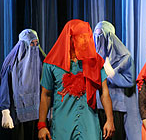
At the recently concluded BHARANGAM, the Theatre Fest organized by the National School of Drama, a Pakistani play, Burqavaganza, produced by Ajoka Theatre Group, was staged at Kamani Auditorium, New Delhi. The play had been banned in Pakistan last year, because of its irreverence to the Burqa, a traditional veil and gown worn by conservative Muslim women. The play is especially relevant and contemporary because the controversy over women covering either their head with a Hijab or also their face and the whole body with aBurqa rages even in the Muslim majority countries which were known for their secular ideals.

For example, Hijab, an obligatory code of dress in Islam, was banned in public buildings, universities, schools and government buildings in Muslim-majority Turkey shortly after a 1980 military coup. Prime Minister of Turkey, Recep Tayyip Erdogan (whose wife and daughters are veiled) had promised before his first electoral victory in 2002 that the “unfair ban” would be abolished. Turkey’s ruling Justice and Development Party (AKP) and the far-right Nationalist Action Party (MHP) opposition party have thrashed out a deal on a compromise head-cover to be allowed on campus after decades of an all-out ban. Under the deal agreed to by the two parties, a day earlier, women at universities are permitted to cover their heads by tying the headscarf in the traditional way beneath the chin.

While the Turkish PM insists that respect for basic human rights is his sole motivation in pushing through the amendments, some believe that the move would cause immense problems and deal a blow to the separation of state and religion, one of the founding principles of the modern Turkish Republic.

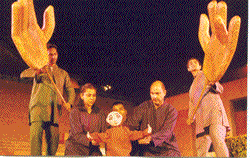
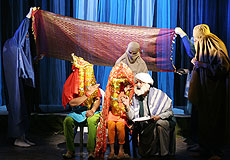
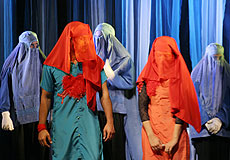
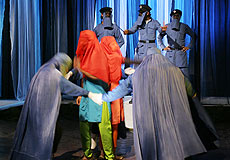
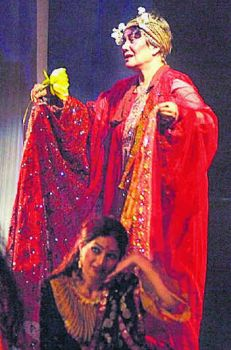
Told in a rollickingly funny mode, Burqavaganza laughs at the pointless rigidity of customs and dress code and ridicules the system that upholds their sanctity. The play follows the story of the young lovers: the progress of their romance, the wedding and the birth of the first child. Meantime, the police, looking for the terrorist leader Bin Batin, and the Burqa Brigade who suspect that their Burqas are too colourful and revealing constantly bicker because of their conflicting agendas. An unveiling ceremony follows where the Minister for Burqa Affairs makes a passionate speech about the significance of the Burqa and everyone celebrates with song and dance.

The charismatic scholar Hijab Hashmi inspires her devotees to keep their eyes open for the traitors in the Burqa Brigade. Bin Batin carries on his bloody fight against the helmet-covered enemy .The stage action is accompanied by telecast of ‘Burqavision’ programmes which include a soap, a documentary ‘Burqa Though the Ages’, News, Sports, a fashion show and ‘Breaking News’. While Burqas of all shapes and sizes create images and situations reminding the audience of the socio-political situation in Pakistan, two maulanas sitting on the edges of the stage, in a TV show, respond to the questions from their viewers about apparently important questions about interpretation and application of religious teachings. The statements of the maulanas are in fact extracts from ‘Beheshti Zaiver’, a book given to girls at the time of their marriage.

Denouncing the ban on the play Madiha Gauhar had then said that the ban was imposed because of pressure from the “burqa brigade”, and that it proved that the government’s enlightened moderation policies were a farce. It was in the early eighties that I had first met Madiha, when I was hanging around with Badal Sircar, Ragini Prakash and Vinod Dua at the Sri Ram Centre Canteen in New Delhi. We were told by Mrs. Acharya, the owner of the canteen, that a Pakistani actress wanted to meet us. We were accosted by this strapping young and beautiful lady who told Badal Sircar that their group had performed his play Juloos (Procession) in Pakistan despite the censorship. A little later, Shahid Nadeem with his Ajoka Theatre Group, performed with our group, Theatre Union, at JNU. Shahid even recorded our play Toba Tek Singh and took it back with him to Pakistan.

Set up by a small group of cultural activists in 1983, during General Zia-ul-Haq’s politically and culturally repressive regime, Ajoka has struggled with determination against very heavy odds to produce socially meaningful art. It has addressed vital, sometimes taboo subjects through its hard-hitting and innovative productions. Committed to the ideals of peace and tolerance within Pakistan and in the neighbouring regions, it has frequently collaborated with theatre activists from other countries of South Asia particularly from India, viz. Indian directors such as Badal Sircar, Safdar Hashmi, Anuradha Kapur and Kewal Dhaliwal.

Founder-playwright of Ajoka Theatre, Shahid Nadeem, known for his commitment to human rights and peace, is the author of more than 35 original plays and several adaptations. His plays have been performed in Pakistan, India, USA, UK, Norway, Bangladesh, Nepal, Iran and Oman. He is currently the Director of PTV Academy; and Co-director of Panjpaani Indo-Pak Theatre Festival, a festival pioneering interaction between theatre activists of India and Pakistan. He has also worked as Communications Officer of Amnesty International, based in London and Hong Kong. He was awarded Feuchtwanger/Getty fellowship in 2001 and has lectured at various universities in the US.

(Sources: Islam Online/NSD/Reuters/ANI)

Cast and Credits

Minister/ Bin Batin/ Chambeli/ Cameraman: Sarfraz Ansari
Maulana 1: Ziafat Arfat
Maulana 2: Imran-ul-Haq
Haseena: Samiya Mumtaz
Khoobroo: Furqaan Majid
Brigade Commander: Khola qurashi
Brigade 1: Asif Japani
Brigade 2: Azaan Malik
Police Officer: Usman Zia
Constable 1: Shahid Zafar
Constable 2: Shehzad
Chorus/Dancers: Taqoob Masih, Nadeem Abbas, Waseem Luka, Meena
Hijab Hashmi/ Mother: Samina Butt
Guitar Player: Vicky

Play and Direction: Shahid Nadeem
Sets and Lighting Design: Kewal Dhaliwal
Music: M Aslam
Costume: Zahra Batool
Assistant Director: Malik Aslam
Production Manager: Imran-ul-Haq
Research: Ziafat Arfat
Video recording / editing: Nadeem Mir, Shakeel Siddiqui


NATI BINODINI steals the show at Bharat Rang Mahotsav

Nati Binodiniimage003

Nati Binodini, presented at Kamani in January 2008 in the NSD Theatre Utsav 2008 by Theatre and Television Associates, New Delhi, Directed by Amal Allana received a standing ovation and was one of the landmark plays of the fest along with Kewal Dahliwal’s  Yatra. Girish Ghosh, Binodini’s Mentor and Theatre Director was brilliantly portrayed by Jayanto Das with his earthy and authentic performance style. The performance of the protogonist was rendered simultaneously by  five actresses: Salima Raza, Swaroopa Ghosh, Natasha Rastogi, Sonam Kalra and Amita Ailawadi. Each one of them represented different ages and stages of the Nati’s life. Salima Raza enthralled the audience with her virtuoso performance and her remarkable stage presence. Nissar Allana’s Moving Venetian Blind style of backdrops with projected images and Glass floor gave the production a kind of slickness that only Nissar can create.

The play opens with the five actresses dressed in white hooded sarees creating a remarkable visual composition. The actresses one by one unfold the multilayered and colored identity of Binodini orchestrated by appropriately dramatic music composed by Devajit Bandyopadhyay.  A take-off from Binodini Dasi’s (1863-1942) autobiography, the play seeks to interrogate and problematize the layered and complex existence of the immensely talented actresses, virtuoso performers in their own right, in nineteenth century Bengali theatre—an existence where their social and economic insecurity became a handle for exploitation by a whole section of the nouveau riche dandified gentry on the one hand, and the mentor-director-playwright-manager of the theatre, on the other. The action is divided into ten sequences, with the ageing Binodini as the Narrator addressing Girish Ghosh and recounting the story of her life, through all its losses and hurts, and its occasional moments of hope and joy. The play ends with an Epilogue where Binodini makes up an uneasy truce with life that had not been very kind to her.

The script jointly deviced by Amal and Salima depicts two journeys—one, that of ‘becoming’ the actress, and the other, the writing of her autobiography, shifting constantly between construction and deconstruction of the dimensions of the persona. Binodini requested Girish Ghosh to write the preface to her book, because she needed the ‘father’ of theatre in Bengal to authenticate the document. He hesitated, declined, then wrote a sort of a condescending apologia. Structurally, the narrative does not follow any time sequence, but there is an overwhelming sense of skepticism about life, humanity and the Almighty.


The partition play, YATRA, moves Bharangam audiences

Yatra

One has been a great admirer of Kewal Dhaliwal’s work and when Madiha Gauhar, the theatre director and actor from Pakistan recommended it to me I realized that it would definitely be a momentous occasion with an intercontinental flavour. And sure enough it was. Like some of Kewal’s previous productions, this too was an intensely moving experience.

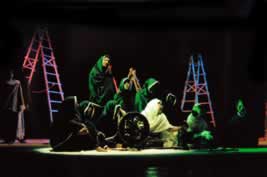
Manch-Rangmanch’s  Yatra 1947, conceived without a script and structured through improvisations, was performed in the Bharangam Fest on 9th January 2008. It draws its material from real life incidents, often from oral history—tales told by elderly relatives who had been through the trauma of the times—portraying the suffering of the people who had to undertake arduous journeys, most often, away from their homeland, to another country and milieu. The play consists of more than 40 poems, originating from both India and Pakistan, with theatre students from both sides of the borders taking part.

At the end of the show with audience applauding quite a few of them holding lighted candles of peace and brotherhood in their hands. When Madiha Gauhar asked them if they knew which actors were from India and which ones were from Pakistan, they all said in unison “we don’t even want to know.” Such was the extent to which the audience had been moved by the depth and emotions of the poetry and the fluidly conceived choreography.

As Kewal puts it; “All of us had heard of Partition through the various stories told by our elders. As the days went by in the theatre workshop, and we started to actually perform those stories, we gained profound insights into what those people would have gone through. Thus one of the purposes of this workshop was accomplished. We have taken small steps in making the younger generation aware of the tragedy of the Partition, making them value both the countries. The play does not try to rub salt into the wounds of Partition, but rather attempts to heal them, to transform the barbed wires of hatred into soft lines of life and love. The Punjabi Theatre group Manch-Rangmanch hails from Chandigarh and has also taken its plays to England, Canada, Germany, USA, Pakistan and Bangladesh.

Cast and Credits

John Paruej, Bakht Arif, Zora Brar, Prabhjot Kaur, Amir Ismail, M Abid Hussain, Bharat Sadana, Jaskaran Singh Sahota, Ranjit Bansal, Rajwinder Kaur Deol, Rupinder Kaur, Gurjot Singh, Gurleen Kaur, Jagwinder Singh Sodhi, Shallu Arora, Vikramjit Singh, Nitin Singh, Varun Patel, Veerpal Kaur, Gurinder Kumar, Kanwal Nain Kaur, Kanwar Gurpartap Singh, Yadwinder Singh, Rahi Batra, Rajiv Jindal, Ranjit Tapiala, Khola Qureshi, Meena Sadiq, Shahzad Sadiq, Nirwan Nadeem, Bikramjit Ranjha, Muhammad Azaz Khalid, Shahid Zafar, Usmaan Zia, Humayun Pervez

Music: Harinder Sohal Singer: Harinder Sohal, Misha Accompaniment: Jagjit Singh (sarangi), Sony (dholak) Properties: Rajiv Jindal, Gurinder Kumar Costume: Humayun Parvez, Kunwargur Partap Sets: Shallu, Shahid and Shahzad  Assistant Director: Zora Brar, Jajwinder SodhiStage Management: Varun Patel


6th Pune International Film Festival inaugurated in a glittering ceremony

Piff_2 It is that time of the year again which is much awaited by lovers of cinema. The Sixth Pune International Film Festival (PIFF 2008) was inaugurated on Thursday, 10th January at the hands of  Sharmila Tagore, Suresh Kalmadi and Nana Patekar in a grand ceremony organized at Ganesh Kala Krida Manch. This week long festival which kicked off from 10th of January will end on 17th January, treating film buffs to an exclusive collection of national and international movies.

Rajlakshmi Bhosale (Mayor of Pune), Antino Gogala (Councilor of Republic of Slovenia in India), Daniel Johar Zonshine (Council General of Israel), Pravinsinh Pardeshi (Pune Municipal Commissioner) graced the occasion. The international jury and guests were also present for the ceremony. Apart from this, some of the renowned Bollywood stars like Nana Patekar, Ameesha Patel, Amruta Khanvilkar (Sade – Made Teen Fame), Zeenat Amman were also present.

The inauguration ceremony of the festival began with the lighting of the lamp by the guest of honors and “A Naandi” which was followed by dance medley on famous songs

Introducing PIFF at the inauguration, Suresh Kalmadi chairman of PIFF 2008 said, “Pune is the cultural and sports capital of the nation, and is home to several famous institutions like FTII, Prabhat Studio and National Film Archives. This event offers a perfect platform to showcase a group of extremely talented film makers from the international arena to Pune. Around 145 movies were selected from across 43 countries for this year’s film festival.” Further he said, “The much awaited Commonwealth Youth Games, 2008 is the next step forward in placing Pune on the international map of sporting arena. This year Pune is the proud host of the 3rd Commonwealth Youth Games which is being held in Asia for the first time, where nearly 71 countries will be participating.

This year’s Lifetime Achievement Awards were conferred upon eminent actors,  Shammi Kapoor and Sharmila Tagore to acknowledge their invaluable contribution to Indian cinema. Later an audiovisual on their  career was screened which effortlessly took the audiences to the golden era of Indian film history.  Nana Patekar stole the show with his sense of humour. He said,” I am very happy to be here today on stage with eminent actors like Shammi Kapoor, Sharmila Tagore and Zeenat Amman and I respect them for all the hardwork they have done to achieve this success.”

Courtesy M/s Perfect Relations