Vivan Sundaram – a tribute – Archana Hebbar Colquhoun
A tribute to Vivan Sundaram: An artist unparalleled in diversity and creative output
A letter from me to Vivan post March 29, 2023
Dear Vivan,
I know I can never meet you again. I can’t hear your eloquent speech in the flesh but I have a recording of our long interview from three years ago – taken during the height of Covid. I have been listening to the recording since the moment I heard you were no longer with us. I feel your presence surrounding me and I can hear your soft voice even when I’ve got the recorder turned off.
[The interview is titled “Investigating the Mind of an Artist” in which Vivan spoke at length about many aspects of his work in response to my questions about his working practice.]
I feel so fortunate that I had the opportunity to have known you right from when I was a teenager – soon after I joined the Faculty of Fine Arts, Baroda and through my years in Delhi.
When I first met you at the faculty in Baroda, as I saw you walking towards me, I was struck by the magnetism of your presence. It seemed to me as if you owned the ground on which you walked as well as the air that surrounded you. I later, and only in stages, got to know of your extraordinary artistic heritage.
My interview with Vivan – a recording, and a pending project
Despite having had the recording of the interview with me since late 2020, I couldn’t work on the interview in any significant manner. There were many reasons for that. However, I have now returned to the interview and I feel that the more I listen to our exchange, hearing Vivan’s voice, the greater is the challenge to formulate my ideas about Vivan’s work and present them in writing.
Although regrets are entirely futile and counterproductive but if I were to consider any regrets that I have with regard to my association with Vivan, they are that I missed seeing his stupendously varied body of work as it was developing and the startling constructions he made and exhibited over the decades, since I moved to Tokyo in the late 1980s.
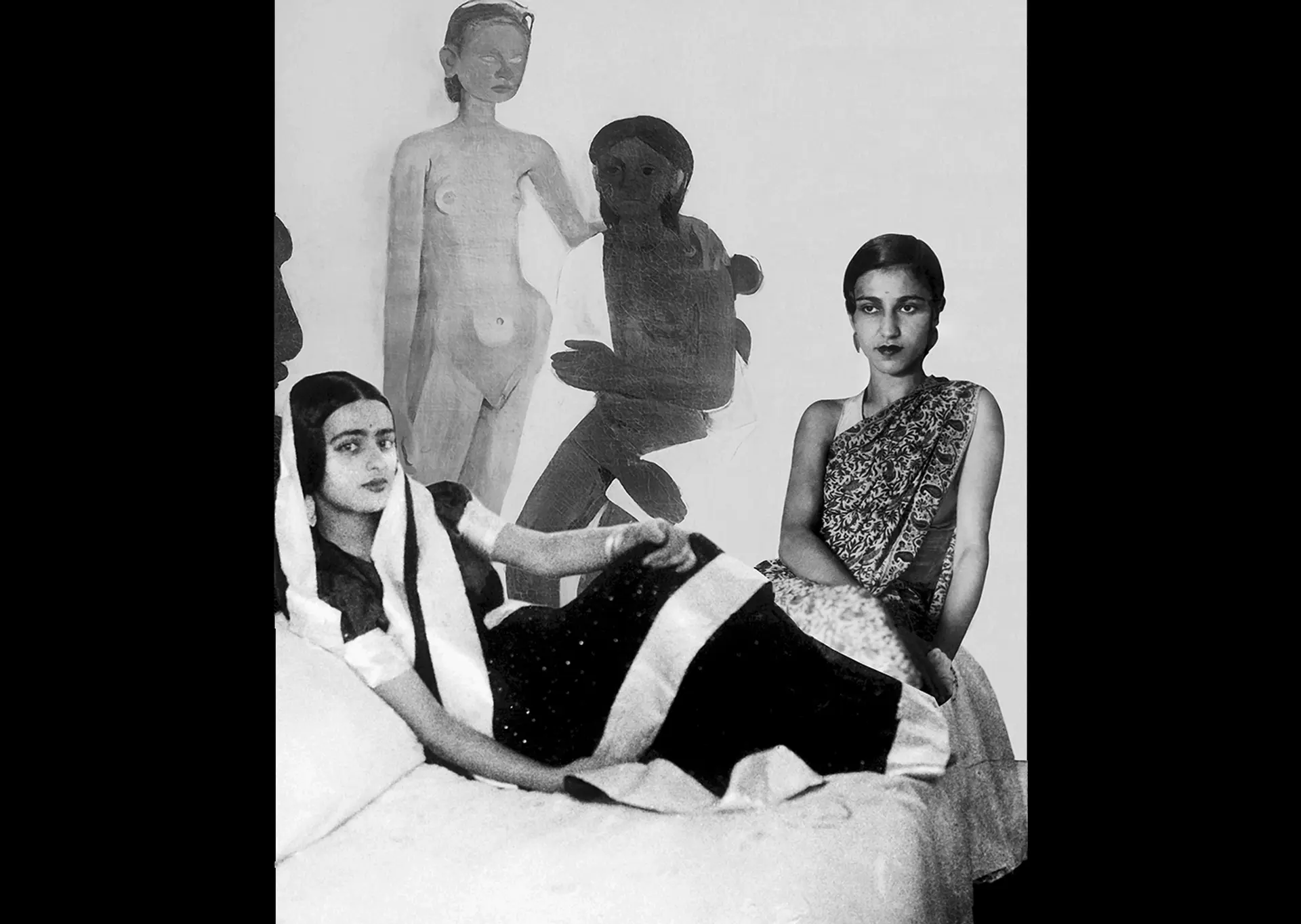
Vivan Sundaram’s Sisters with Two Girls (2001)
There are innumerable images to choose from for Vivan Sundaram and his artworks. Any choice made to use an image is necessarily accidental and arbitrary.
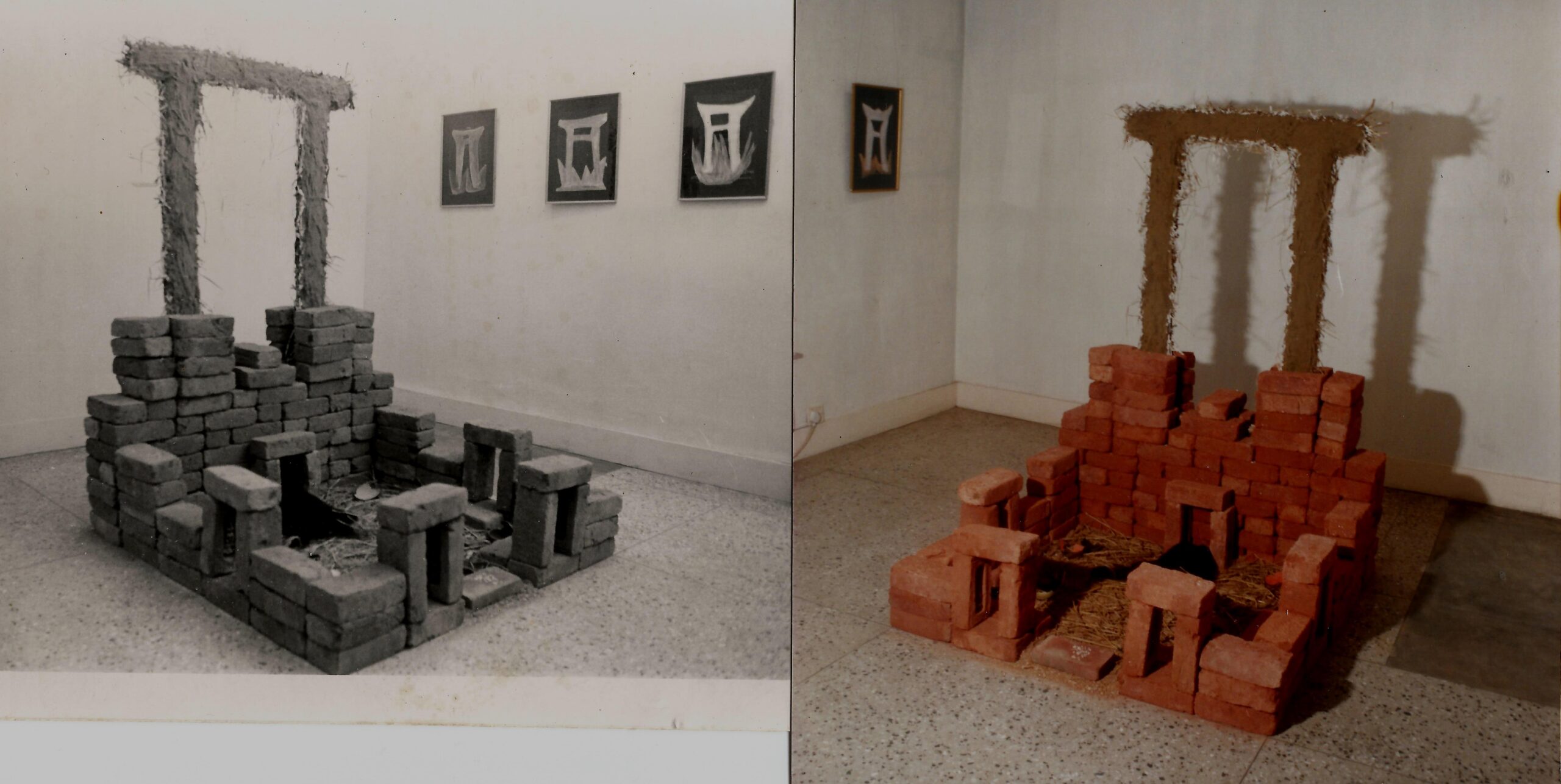
Torii Gateway and Enclosure – Dark Secrets /Archana Hebbar Colquhoun
The murder of Naina Sahni – shot dead by her husband and her body stuffed in a tandoor oven to be burnt to cinder at an upmarket restaurant in New Delhi coincided with my exhibition of Torii sculptures and paintings at the LTG gallery in June 1995.
The principal installation of a Torii gateway in this exhibition was made using wooden planks that were coated with a clay and straw mixture. The Torii structure was erected with supports of low brickwork walls arranged in the form of a courtyard of a traditional Indian home. The brick structure contained within its walls mini gateways made of two bricks placed upright with one horizontal brick placed across at the top, to create little entryways.
At the start of designing the installation, I had originally planned to place in the courtyard space a collection of moulded objects that acted as signifiers or markers of early human history.
This idea of attempting to depict the history of civilization suddenly gave way when I heard of a horrific “Breaking News” item of the Tandoor Murder case just as I was working on the installation.
After I heard the news, my work changed – the structure remained more or less the same as initially planned – but the contents that were to be placed in the courtyard were replaced by objects such as charred remains of coconut shells, other burnt articles, and a full head of a woman’s hair as if yanked in one stroke and flung at the foot of the Torii gateway.
The uploaded image shown below is a doctored one with two images of the same work almost mirroring each other. When the main Torii work was created in the gallery as an installation I had titled it “Boundaries of Experience.” Broadly speaking, the title still holds even after the intrusion – into my work in progress – of an unrelated subject that of a gruesome murder that took place at a walking distance from the gallery.
An important lesson I learnt from doing this show was that when an idea starts to take the shape as an art object a dynamic, external entity may completely hijack your carefully planned art work.
The original title of the work was “Boundaries of Experiences”
Shalini Patel- Banana Tree Drawings during Lockdown/ Archana Hebbar Colquhoun
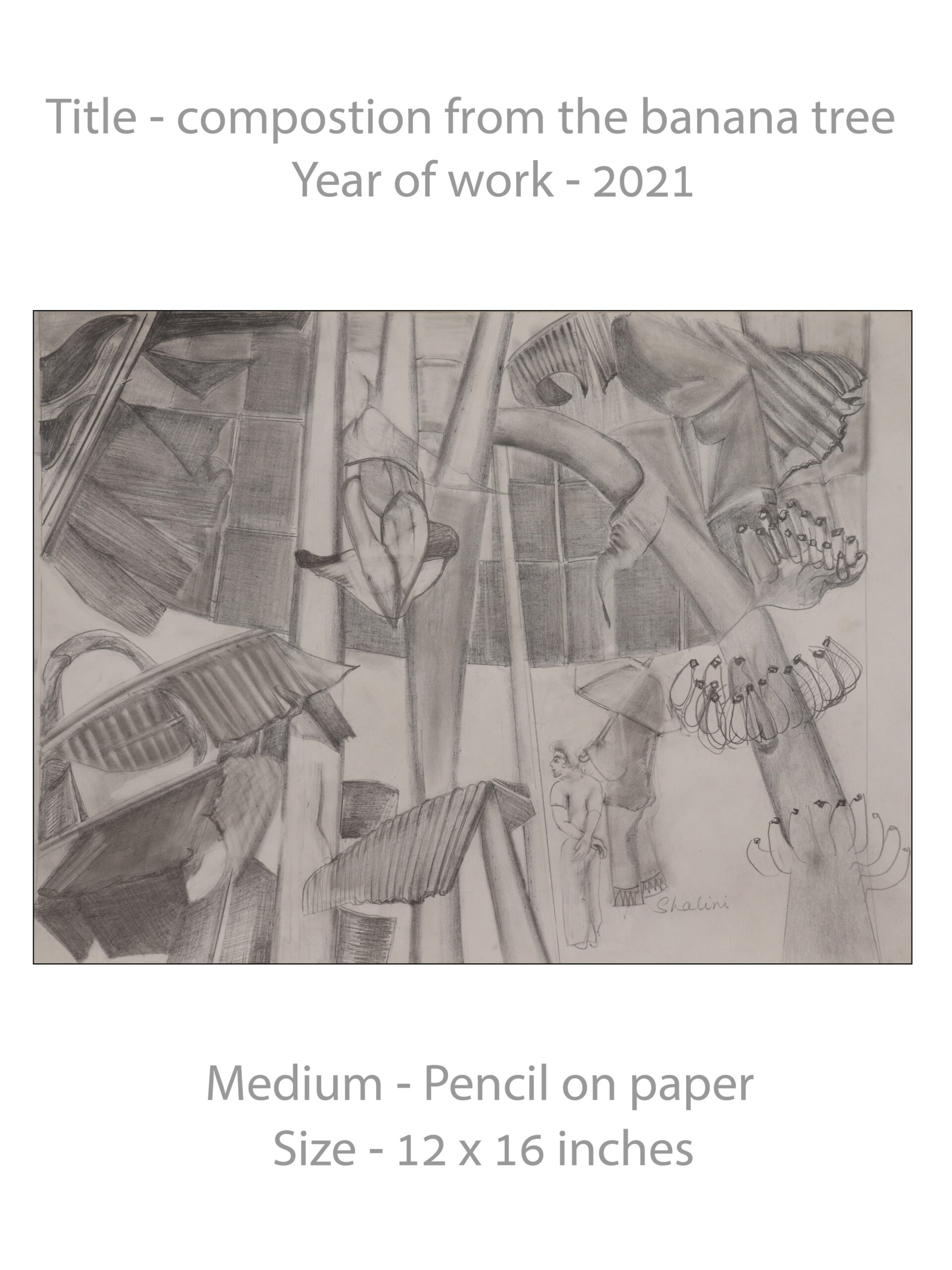
Shalini Patel’s drawings, some in pencil and others in charcoal were done during lockdown. Nowhere to go, nothing much to do outside with friends, acquaintances or passers-by; she had all the time on her hands and the opportunity to observe the banana trees in her neighbour’s yard. For these drawings the view was from the first floor balcony of her house.
It’s these banana plants that lent themselves to serve as artistic models to Shalini’s black and white drawings of 2021. Before we discuss the formal content of the drawings and Shalini’s very own interpretation of this tropical wonder of nature, let’s look at the distinctive form of a banana plant. In fact, there are three distinctive forms in the main within a single banana plant – the trunk, the fruits, and the leaves. A banana plant is often referred to as a tree due its size.
The trunk of a banana plant has a plump tubular form, soft, flexible, fibrous within and covered in layered sheaths, unlike the wooden trunks of shrubs and trees. The leaves are large, very large, and radiate out and become floppy all too soon. Each leaf is an individual growth separating out directly from the trunk, starting off as a cylinder that slowly unfurls and opens out to the familiar shape of a banana leaf. Then there are the bananas themselves, which grow in multi-levelled clusters, each banana pointing upwards and attached to a thick stalk that droops from the weight of several dozens of bananas, and at the end of the stalk grows a large purple-hued blossom of tightly packed petals.
All parts of a banana plant have their use. The fruits and the blossoms are edible, the leaves are used in cooking and most commonly serve as disposable plates in India, and the fibre in the trunks provide material for making ropes, baskets and mats etc. Parts of the trunk are also edible. It is said that each plant produces fruits and blossoms just once in its lifetime and then the plant is cut-down and in its place there’s a new plant ready and waiting to become a full-fledged banana plant. Considering this, Shalini’s drawings are perhaps the only record of the existence of those specific banana plants, which lived through the lockdown and by now will have become dead matter. Shalini observed the changes the banana plants underwent and recorded them in sketches and drawings.
Form and Content of the Drawings
Banana plants have been widely represented in Indian art and art of other countries. Although banana plants are ubiquitous in the tropical climate of India as Shalini said to me she had never before drawn a banana plant or its many plant parts until last year.
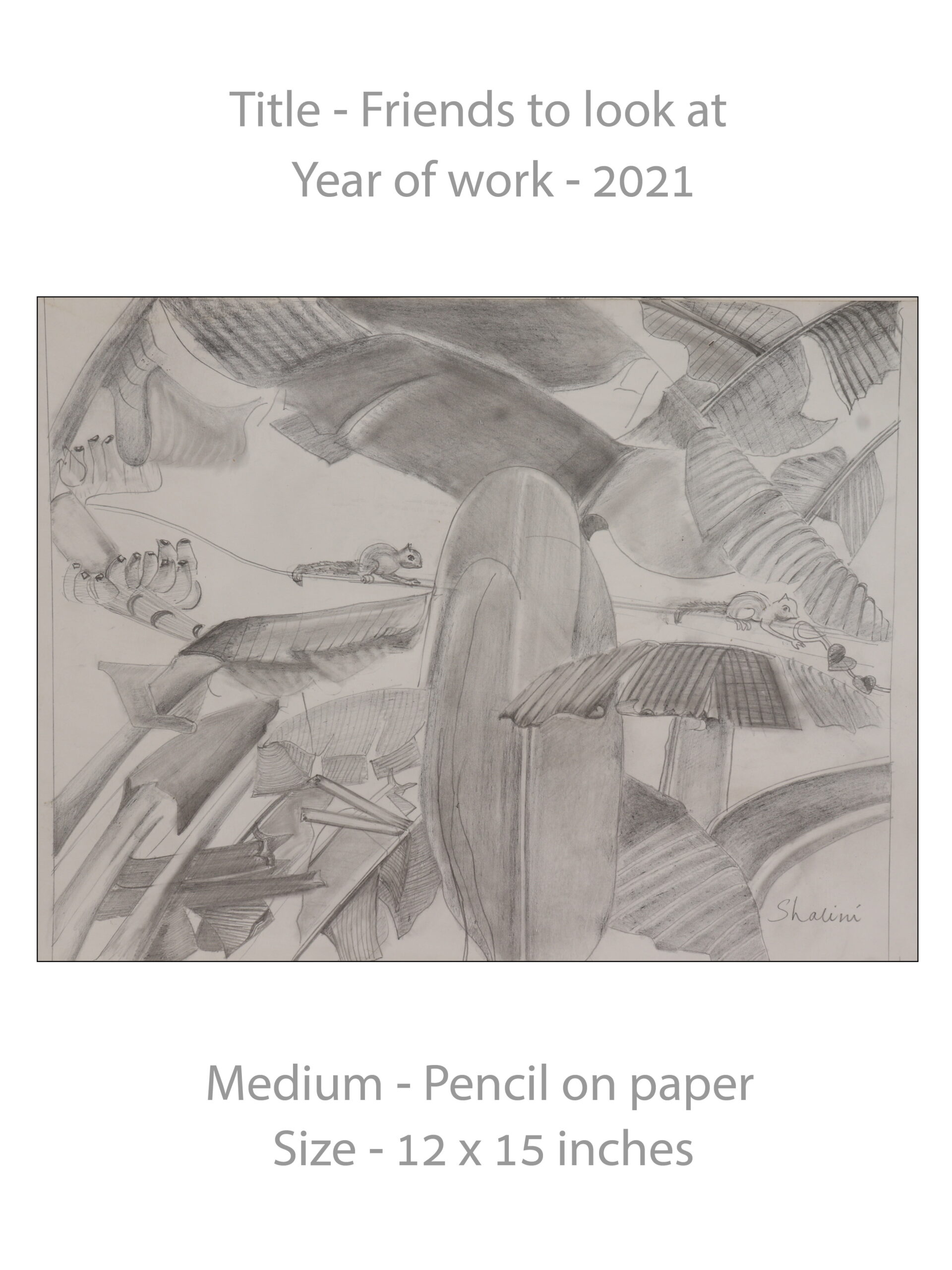
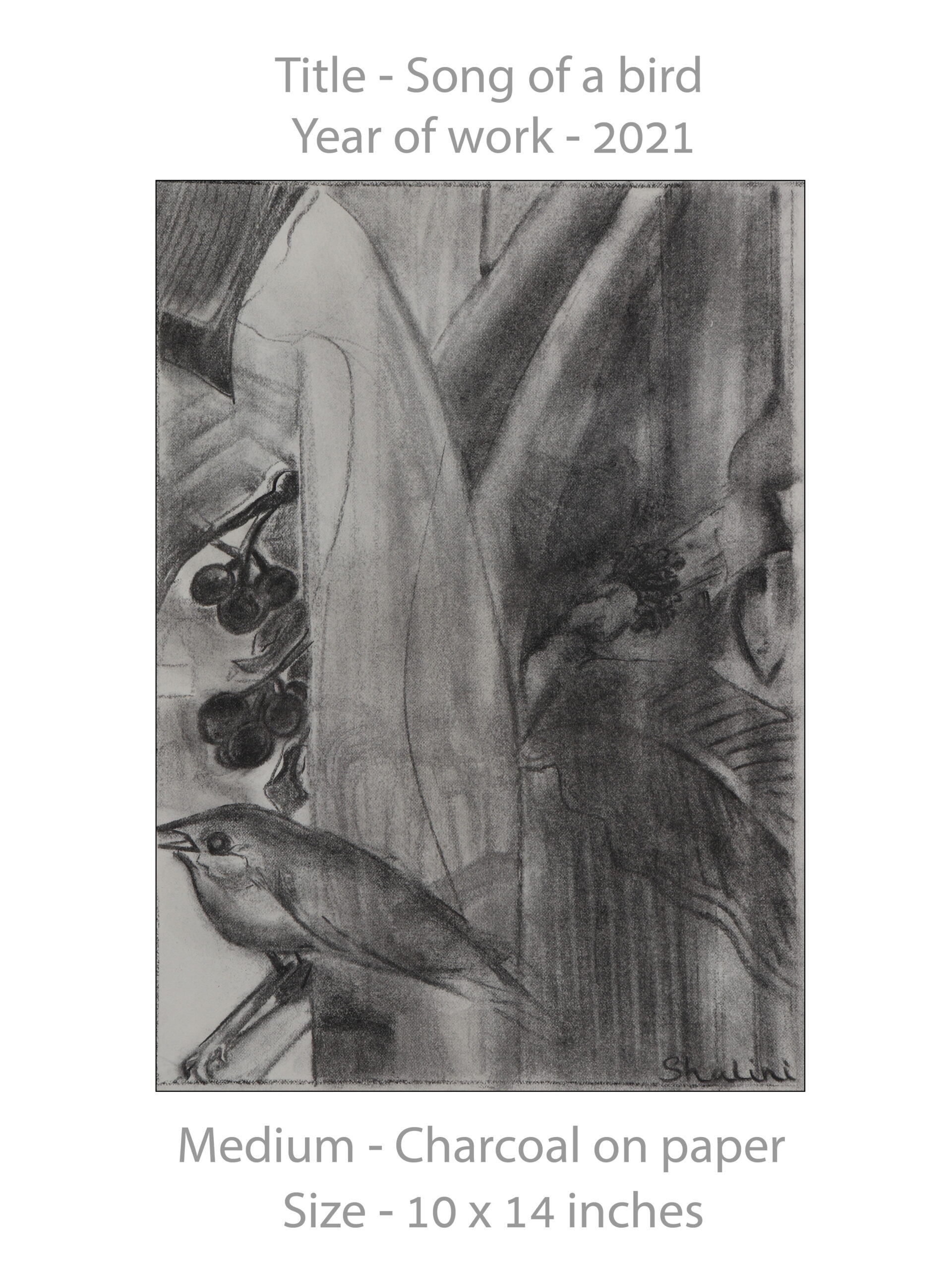
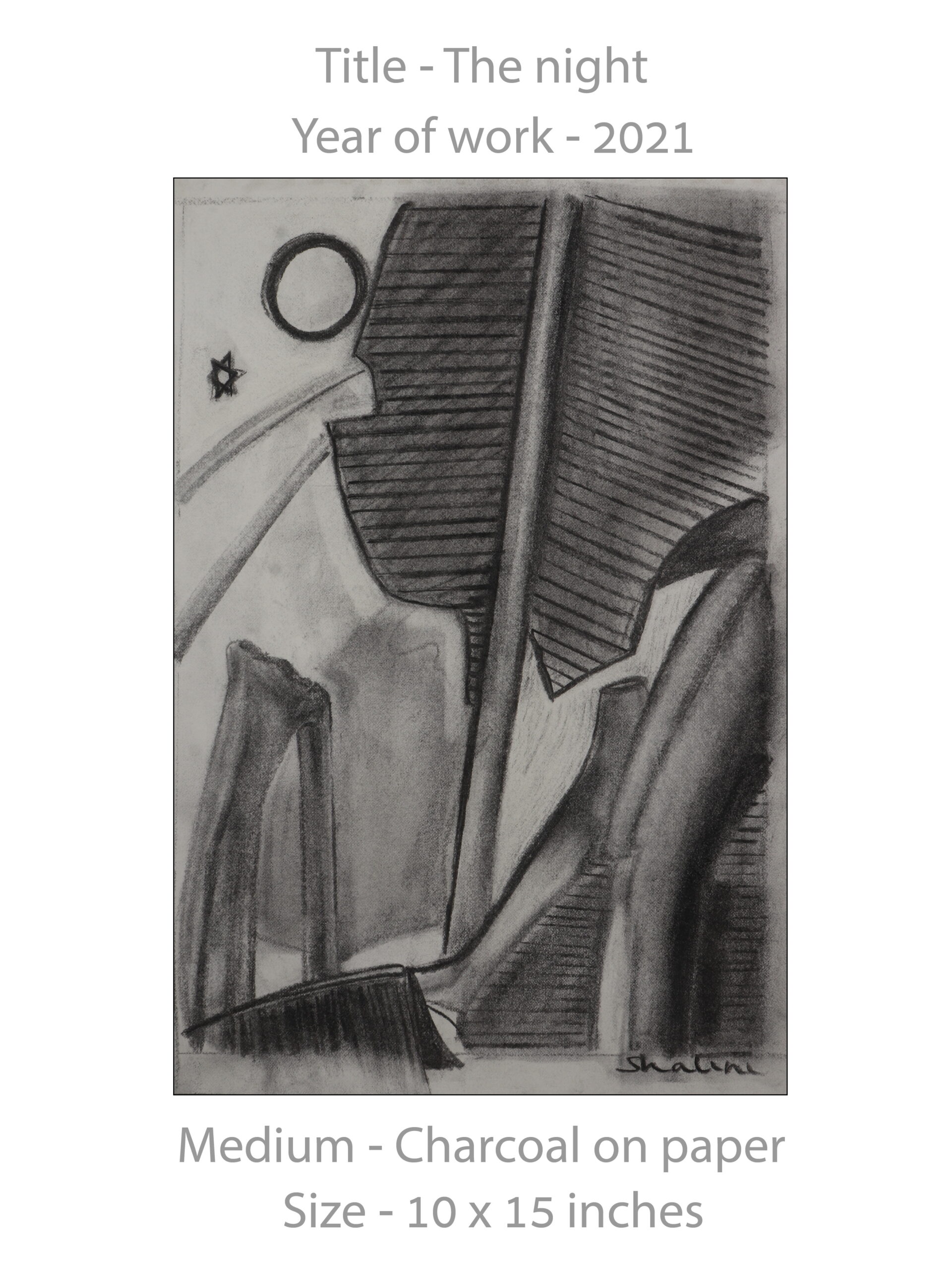
The drawings are variously titled “The Banana Tree,” “Composition from the Banana Tree,” “Friends to Look At,” “Song of a Bird,” “The Night,” etc. and “Composition,”
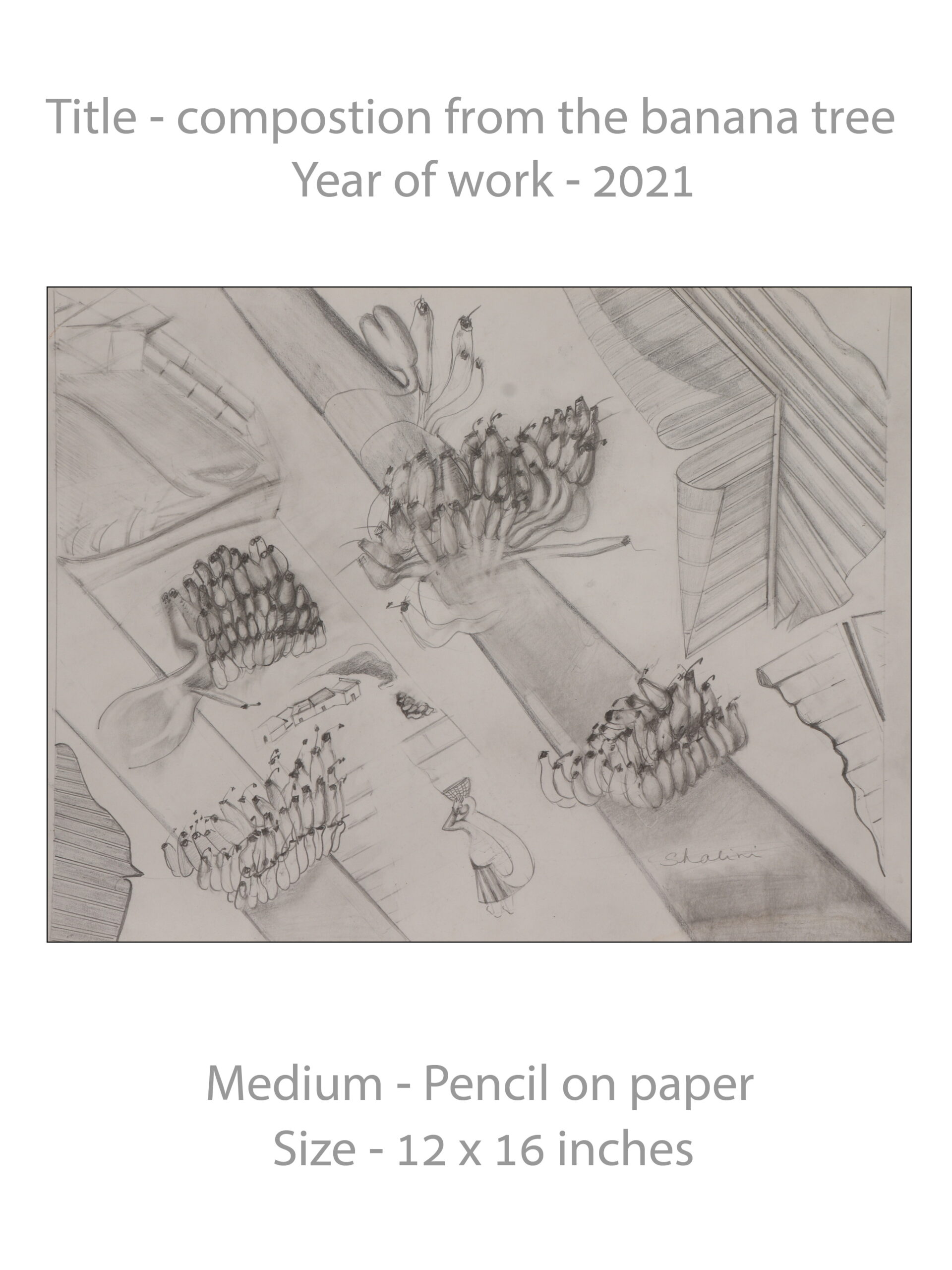
The works range from the depictive to the abstract. The earlier works in this group of drawings were more depictive such as those titled “Compositions from a Banana Tree” and progressively the drawings became more minimalist and abstract and simply titled “Composition.”
When an artist titles a work “Composition” or “Untitled” there is an immediate understanding on the part of the viewer that the subject matter or the formal reality of the work has been constructed as a design, bereft to a large extent of marks of identity as to what the work is about. The works titled “Composition” in Shalini’s banana tree drawings are arrangements of elements of a banana plant, such as a small section of a banana leaf, a portion of a stem or the trunk and other forms within the plant. Shalini devices ways to depict the forms and textures of a banana leaf such as the ridges that extend from the spine to the curvy edge of the leaf, which are a series of parallel lines, the leaf in the process of unfurling, and the natural splits that occur along the ridges in the leaf over time. We may presume that the various elements in any given drawing in this series are put together by breaking apart the view and arranging the elements into a composition drawn from the artist’s imagination.
However, in the case of these works the compositions are as they existed within the growth of the banana trees, which the artist observed and then drew without rearranging any of the elements. It was a matter of merely selecting a frame consisting of a pre-existing composition that appealed to the artist. Still, it is to be noted that many of the drawings have compositions made up of diagonals and radiating lines, which we may not associate with the vertical trunks and the characteristic curved forms of a banana plant.
The compositions have areas that are filled with textures drawn from the banana plant with negative spaces in-between, creating a play of dark and light forms. Despite the abstraction and given the non-descriptive title “Composition” of many of the works they leave no room for doubt as to the source of the subject, namely, that the forms and textures are clearly drawn from a banana plant, however fragmented, and no other plant or object.
The title “Compositions from a Banana Tree” that many of the works carry is telling. The preposition “from” denotes that the artist is not the all-powerful creator for whom subject matter is something to simply reach out to and grab and make it the very own property of the artist. Through the title the artist acknowledges that the “Banana Tree,” the protagonist of the works, is the giver and the artist the receiver.
Many of the drawings have representational elements and are simple narratives of fleeting activities of birds and squirrels among the banana trees. The work titled “Friends to look at” is one such drawing where the elements are drawn with a sensitivity and expressiveness that I wouldn’t hesitate to say are feminine in their impact. The drawing depicts squirrels running along a wire, which crosses through banana trees. The work is not merely charming, it has the pathos of a life lived during a prolonged period of a global lockdown – pitting freedom against incarceration.
Another work, a charcoal drawing titled “Song of a Bird “shows a bird in the left foreground with its beak open. The work evokes sound through visual representation and by the choice of words for the title.
In some of the works we see people on the ground but they are diminutive in the presence of the seemingly towering banana trees. Even the clusters of upturned bananas look like groups of people wearing shrouds, huddled together. These works give prominence to nature and raise the debate of man Vs nature.
The work in charcoal titled “The night” has many surprising features. The night is not dark; however, the large banana leaf, again only a fragment of a leaf- its lower half- occupying nearly three quarters of the space within the composition – along with other elements in the drawing is depicted in dark tones. Touching the edge of the leaf is the full moon surrounded by a dark circle and in the vicinity is a lone star, prominent because of its shape that of the Star of David. Shalini’s interpretation of a night-time view is unique/original.
Shalini’s set of drawings titled “Harmony” are being exhibited in Bhilwara, Rajasthan, at Akriti Art Gallery from 5th. to 9th. Sept., 2022. The exhibition is sponsored by the Gujarat State Lalit Kala Akademi.
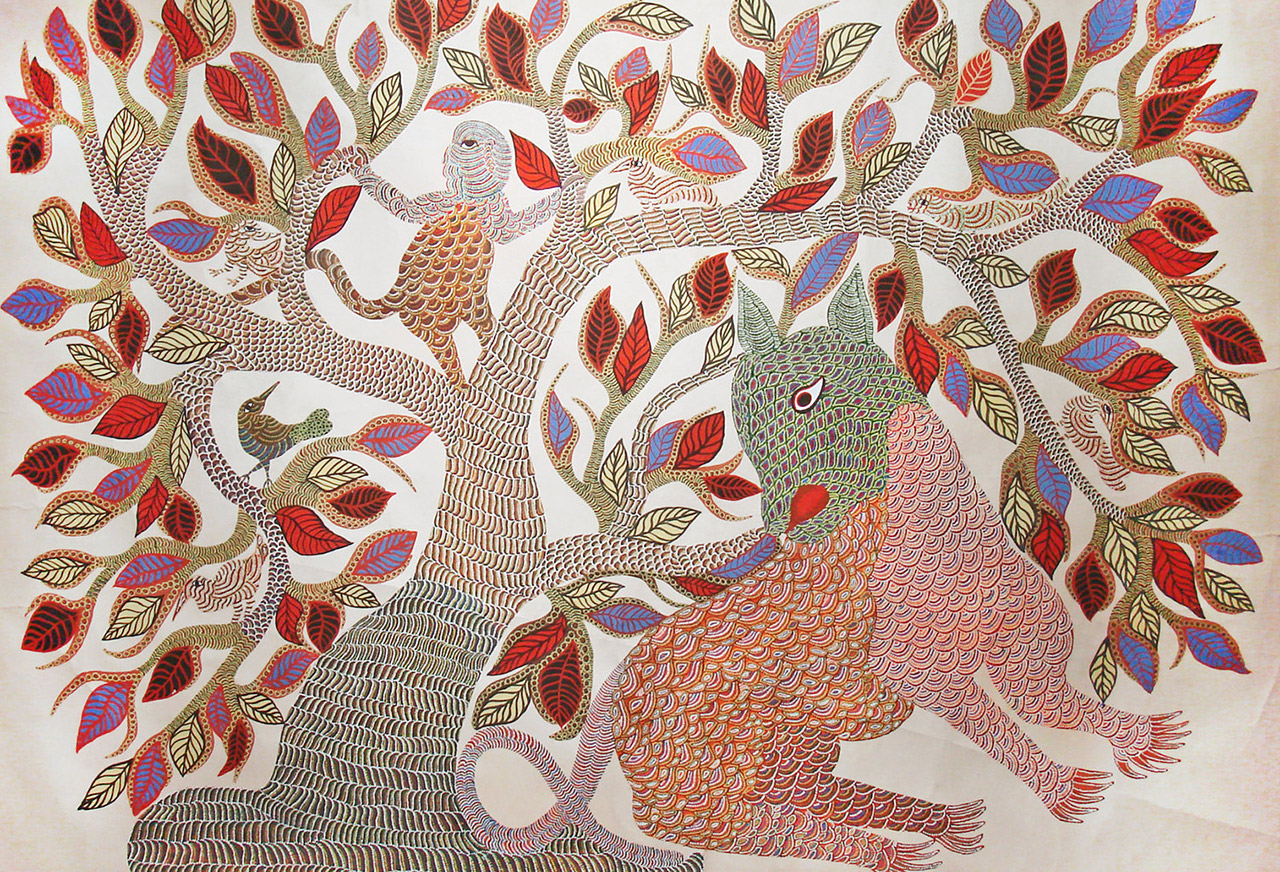
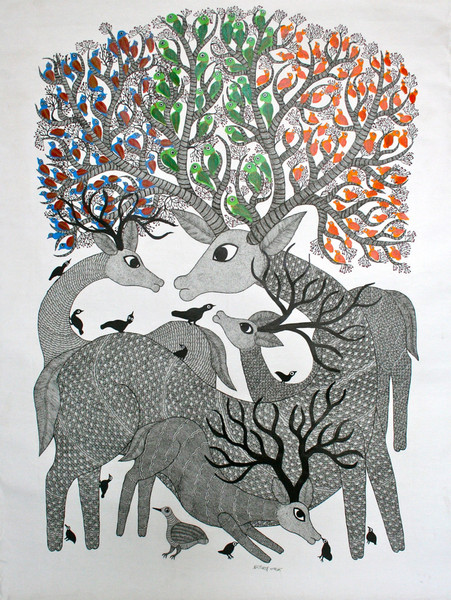
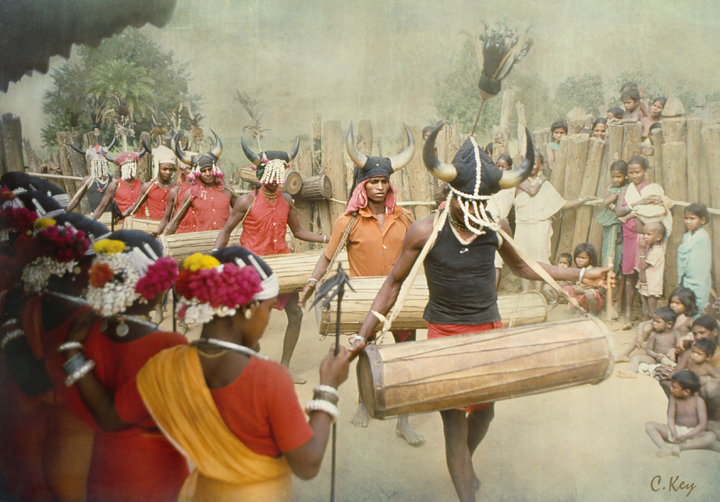
Gond art form, as the name suggests is the art form that is practised by the largest one of the largest tribe in India, i.e. the Gond tribe which is housed in central India in the states of Madhya Pradesh, Chattisgarh etc. The word Gond derives its roots from the Dravidian expression, Kond which implies ‘the green mountain’. In the recent times, the importance and the value of the Gond art form has gained such zeinth that the Indian government has stepped in to preserve and profess the art form.
In the central regions of India, paintings have been flourishing since the 1400s. Paintings are an integral part of the Gond traditional practices. The Gonds were of the opinion that viewing images and paintings brought in good luck for them and helped them gain prosperity. The tribe also used the art form to pass on the knowledge of history down the generations. It is due to this very reason that the Gonds traditionally have been creating motifs, tattoos etc. on the floors, walls of their homes.
For the Gonds, the art form is a means to illustrate the close connection the people share with the spirit of nature. The Gonds were of the strong faith that every natural element be it the mountains, the sun, the rivers had a spirit in them. For the people, recreating these acts in art was an act of worship and reverence to that spirit. The mighty Indian mythologies are some other sources of inspiration for the Gond art form.
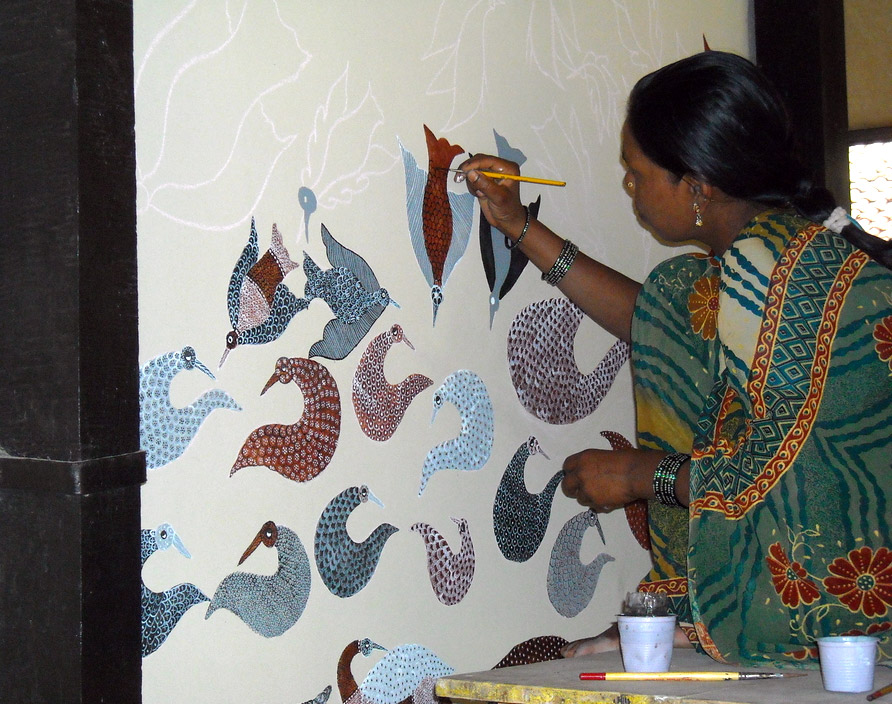
The Gond art form has striking features in the way the lines are drawn in them in such way that pique the curiosity of the viewer into the subject instantly. A sense of movement and flow was established by the use of waving lines and curvy strokes. The spread of the dots and the dashes in the Gond paintings complement the geometric shapes and patterns employed. The art form regularly employed the shapes like that of fish, water droplets to etch out an expressive value and weight to the painting.
The Gond art form employed sharp, defined colours in the paintings with the canvas being dominated by bright hues of red, yellow and white background to highlight the contrast. The sources of the colours were all natural ranging from plant sap, coloured soil to charcoal.
The Gond art form in contemporary times has reached the global scale with the efforts of modern artists and the steps of the government to preserve the art form.
The General having crossed a Torii boundary – Drawing with a Torii and a figure
The trajectory of my art practice takes on a zigzag path sometimes; and at other times a circuitous one or a U-turn that I didn’t expect to take. The work “The General” is one such. I started off with figure sculptures and then went on to study life drawing at Boston University.
Treasure Art Gallery opens with Prabhakar Kolte’s ‘The Mind’s Eye’
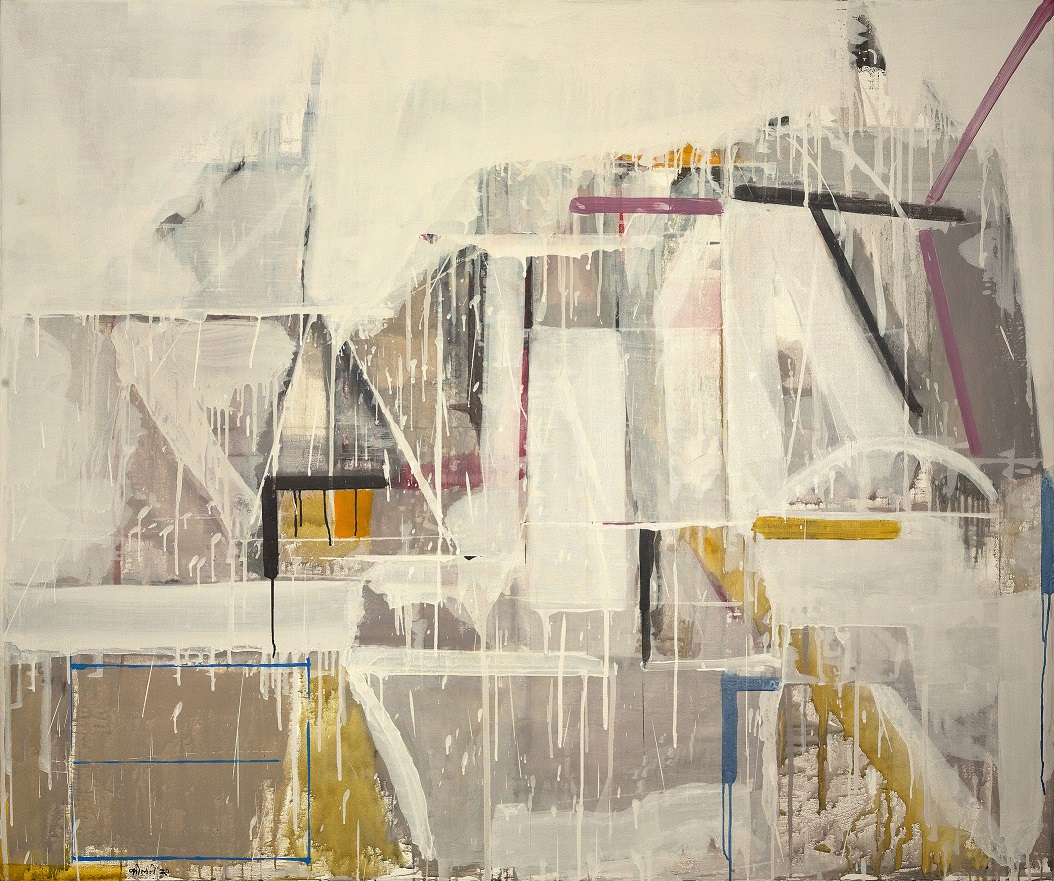
Prabhakar Kolte, Acrylic on Canvas, 60-72″
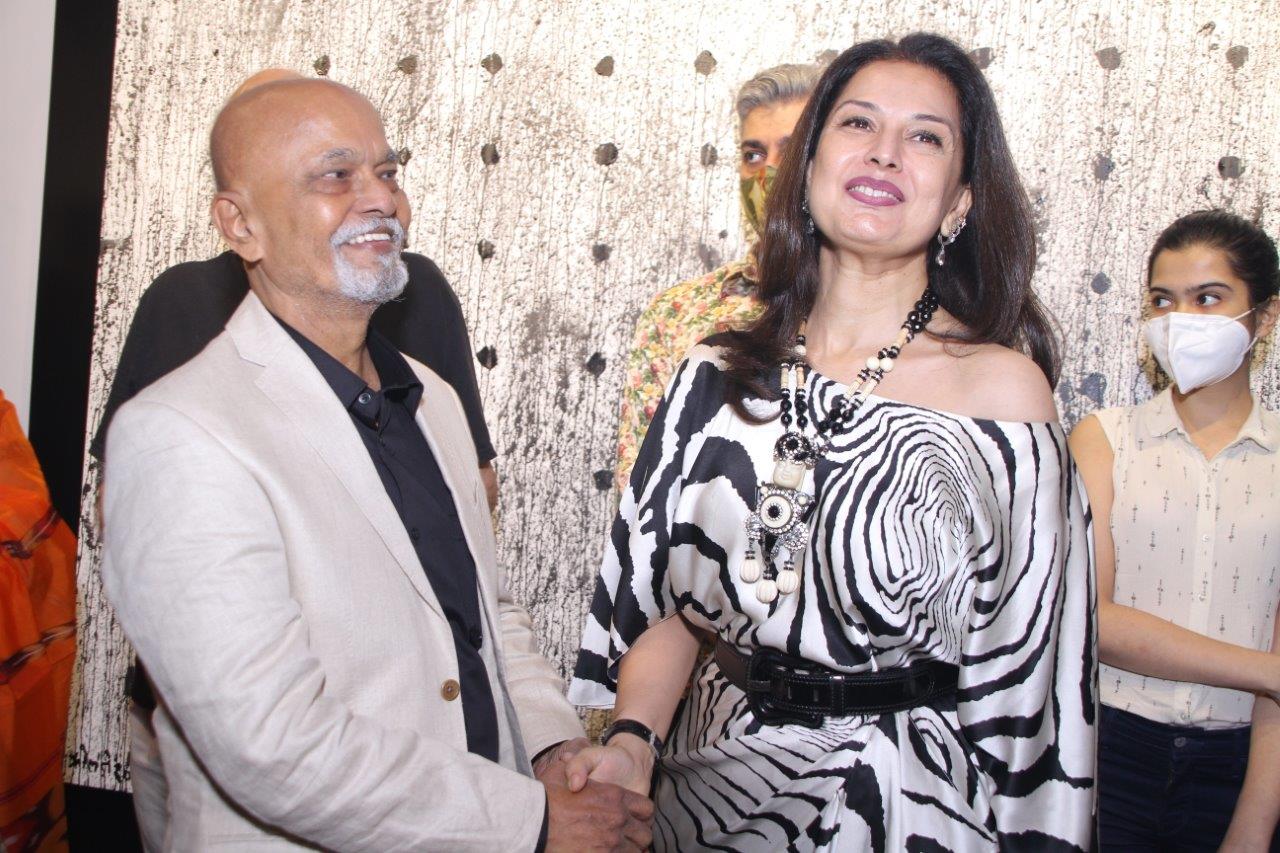
Prabhakar Kolte with Ritu Beri
`Ritu Beri inaugurates the exhibition, Kapil Dev sends a video message to the artist, who is back in the city after 15 years
The Mind’s Eye: a seminal exhibition of Prabhakar Kolte Curator: Uma Nair 9th October – 10th December 2021 11.00am -7.00pm, Monday to Saturday Treasure Art Gallery, D-24, Defence Colony, New Delhi- 110024
New Delhi, 9th October, 2021: Veteran Abstractionist Prabhakar Kolte’sseminal
exhibitionThe Mind’s Eye, curated by Uma Nair was inaugurated at Treasure Art Gallery in the city by renowned fashion designer Ritu Beri in the presence of CDirector General, ICCR; Adwaita Gadanayak, Director General, National Gallery of Modern Art; diplomats; eminent artists like Arpita Singh, Paramjeet Singh, Rameshwar Broota; prominent gallerist & art collectors.
Kapil Dev, former Indian Cricketer who could not be present at the event, said in a video message, “Looking forward to seeing Prabhakar Kolte’s beautiful abstract painting at Treasure Art Gallery in Delhi. This will add colour through everybody. To me definitely. All the best and hope I can have one painting in my house too. I wish everybody whoever is involved, good luck.”
Treasure Art Gallery is a contemporary art gallery owned by Tina Chandroji with two partners. The avant garde gallery located in the heart of Delhi’s upscale Defence Colony is made up of two exhibition spaces that makes it one of the biggest spaces for exhibitions in Delhi. TAG plans to work with emerging and established artists with the central aim of allowing their work to grow both in terms of production of new projects and the making of new exhibitions.
TAG launched officially on 9th Oct 2021 with debut solo exhibition of the abstract master Prabhakar Kolte one of the greatest mentors of the Sir J.J. School of Art Mumbai. For curator Uma Nair, “The most intrinsic quality of the gallery is the light filled window spaces and the fact that you can glimpse the masterpiece in the window as you pass by in your car.”
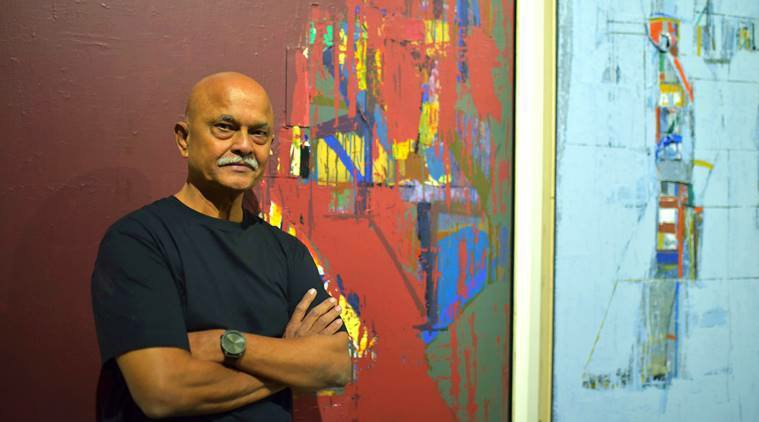
Kolte a famed Professor of J.J. School of Art and deeply loved by his students and collectors alike was present for the show. He ranks amongst India’s finest artists according to Nair who has followed his work for more than 3 decades. The seminal exhibition includes the portraits and still life works made during the early stages of his career, the paintings made during the formative years and the mature works made during and after realizing the hallmark art lingua that established his position in the modern art discourse.
One of the pioneers of Indian Abstract Expressionism, Kolte has been successfully carrying forward his unique abstract language for over five decades with timely innovations, experiments and changes within the same, in order to make the paintings fresh and alive. TAG houses the largest inventory of the artist’s works till now and has the ability to create a new collector base for the artist.
Uma Nair, Curator, The Mind’s Eye, said, “The Kolte solo show has stellar works of art and they range over a period of time while most belong to the past 10 years. Amongst canvases and works on paper and drawings are three intriguing installations that add to Kolte’s repertoire of creativity. The show is expected to run for a few months so that many art lovers and students of art have the opportunity to discover this great master from Mumbai.”
“I’m Delighted to inaugurate the Treasure Art Gallery, with an exhibit of Prabhakar Kolte, a personal favourite. I believe this show is going to be a visual delight for one and all. The Treasure art gallery is also going to add to the vibrant art scene of Delhi. We look forward to some unique collaborations between art and fashion to blur the lines between fashion and art. Congratulations Treasure Art Gallery and I wish you all the very best. You guys are going to rock.” said Ritu Beri, Fashion Designer and Founder Luxury League.
“We would like to add to the city’s character of art shows and hope to expand our reach with established artists as well as emerging contemporaries,” says Chandroji a second-generation art collector. “We hope to serve the arts in many ways and are looking forward to establishing new connections in Delhi which has a thriving art market.” Said Tina Chandorji, Director Treasure Art Gallery
“I have been practicing my way of painting and it will continue till my last breath. For me painting is my passion, it’s my breath and life. I am really glad to showcase my diverse practice with the official launch of Treasure Art Gallery in Delhi. I have full faith that Treasure Art Gallery will be a great treasure to the existing art ecosystem and will definitely add value to it. My best wishes and support are there with TAG in this new journey.” – Prabhakar Kolte, Artist
“Looking forward to viewing ‘Prabhakar Kolte’ – legendary abstract artist at the inauguration of Treasure art gallery” – Nupur Goenka, Director, GD Goenka Group
“We are delighted with the opening of Treasure Art Gallery which will be featuring the honourable Prabhakar Kolte. We fully embrace the beauty of Indian art and are looking forward to the opening.” said Mr. Ramesh Chauhan, Chairman Bisleri
“Treasure Art Gallery TAG launches itself in Delhi with a grand show of recent works of the master abstractionist Prabhakar Kolte of Mumbai. Impressive and gorgeous in range, size and depth, the show presents Kolte in his well-regarded essentials and yet discovering something new and unexpected.
Done largely during the pandemic, the art underlines a colourful zest for life. An intense spontaneity, well-tuned to the multiple rhythms of colours, runs across fiving you enough freedom to discover your own personal intimations of meaning and memory. A very well-appointed gallery, elegantly designed, with a magnificent show,” said Ashok Vajpeyi, Indian Poet, Noted cultural & Arts Administrator
About Treasure Art Gallery:
Located in the heart of New Delhi at Defence Colony, Treasure Art Gallery (TAG) is born out of a vision to build an institution dedicated to modern and contemporary Indian art. Treasure Art Gallery (TAG) is formally launching itself into the contemporary Indian art sector with a select retrospective exhibition of the veteran modernist Prabhakar Kolte from Mumbai.
TAG a gallery with a difference, is aimed primarily to offer a panoramic view of the arts they represent. We aim to encourage collaboration with institutions and artists by bringing in an active discourse around art and to create business partnerships. TAG also aims to support seminars, workshops, lectures, discussions, and talks that contextualise art within critical dialogue. We truly respect and value the modern masters and simultaneously encourage emerging, cutting-edge contemporary artists. Our objective is to provide a cohesive environment where younger artists are able to contextualise their work alongside the masters of Indian art and find avenues for their own journeys.
About Prabhakar Kolte:
Short Bio:
Prabhakar Kolte was born in 1946, in a village called Nerurpar of District Ratnagiri in Maharashtra. He received his Diploma from Sir J.J. School of Art, Mumbai in 1968. He also taught there between 1972 and 1974. The artist has a number of solo shows to his credit. He has participated in many important group exhibitions both nationally and internationally. He is the recipient of ‘Druga Bhagwat Award’ for his Book ‘From Art to Art’ – a compilation of various articles on art, in 2010. He has been writing about international and national artists for the Mauj publication (Marathi magazine).
About His Work
One of the pioneers of Indian Abstract Expressionism, Kolte has been successfully carrying forward his unique abstract language for over five decades with timely innovations, experiments and changes within the same, in order to make the paintings fresh and alive.
His early works show a strong influence of Paul Klee, the Swiss artist and teacher whose childlike figures belie the sophistication of his richly textured surfaces. Kolte’s abstract layering with paint echoes cityscapes where the signs and textures give a glimpse into his modernist consciousness. His early works are characterised by a single, dominant colour in the background, on which lighter and more complex geometric or organic forms are juxtaposed.
The operative system that Kolte found for his works was in a way colour field, but fundamentally different from that of the colour field abstractionists of his time like Marc Rothko, Robert Motherwell, Clyfford Still and so on. What he made was not even remotely similar to the paintings by KCS Paniker in the south or GR Santhosh or Biren De in the north. He was even different from his immediate predecessors like Raza, Gaitonde, Ram Kumar and Swaminathan. But the most interesting thing about Kolte is that, throughout his career he has been having the spirit of this international abstract movement that later condensed into a life philosophy rather than being just a mere art style or lingua. Kolte is a conversion of life into terms of colour. It occupied everything pertaining to life; from music to harsh mundaneness. Using an aesthetic alchemy, he turned them into pictorial expressions that opened up wider and narrower slits allowing entry to the viewer and sealing it the next moment, a sort of visual trapping for aesthetical engagement.
Abstractionist Prabhakar Kolte’s Exhibition,’The Mind’s Eye’ opens 9th Oct
Prabhakar Kolte was born in 1946 and received his Diploma from the Sir J.J. School of Art, Mumbai in 1968. He also taught there between 1972 and 1974. His early works show a strong influence of Paul Klee, the Swiss artist and teacher whose child like figures belie the sophistication of his richly textured surfaces.
Treasure Art Gallery cordially invites you to the Preview of this
Veteran Abstractionist, Prabhakar Kolte’s the seminal exhibition The Mind’s Eye
Curated by Uma Nair Inauguration by Ritu Beri
The other dignitaries who will be a part of the exhibition opening and inauguration are Shri. Adwaita Gadanayak, Director General, NGMA; Shri. Dinesh K Patnaik, Director General, ICCR; Diplomats; Eminent Artists; Prominent Gallerists & Art Collectors.
The Mind’s Eye by Prabhakar Kolte Treasure Art Gallery 9th October, 2021, 6pm onwards D/24, Defence Colony, New Delhi – 110024
The Preview will be followed by wine and cheese The exhibition will be on view until 10th December, 2021. Monday-Saturday, 11am-7pm
A Novel Solution – My First Sculpture/Archana Hebbar Colquhoun
Life to Art (and back to Life)
I saw the person walking backwards, moving with a rhythm well practised, as they would when facing forward and walking straight on. So far so good but within a split second the image of the person walking became clear.
I was amazed at the sheer simplicity of the innovation.
The problem resolution was ingenious. Footwear was cleverly adapted to be worn back to front, making the body of the man face the opposite direction to his feet.
A passing glance at this man walking on the street, comfortable in his skin, gave me little information as to whether his condition was congenital or was the result of an amputation (medically required or a deliberate act as in “Slumdog Millionaire”). Whatever the case may have been, it was certain that the pair of shoes he wore were of the same size.
The Making of the Sculpture
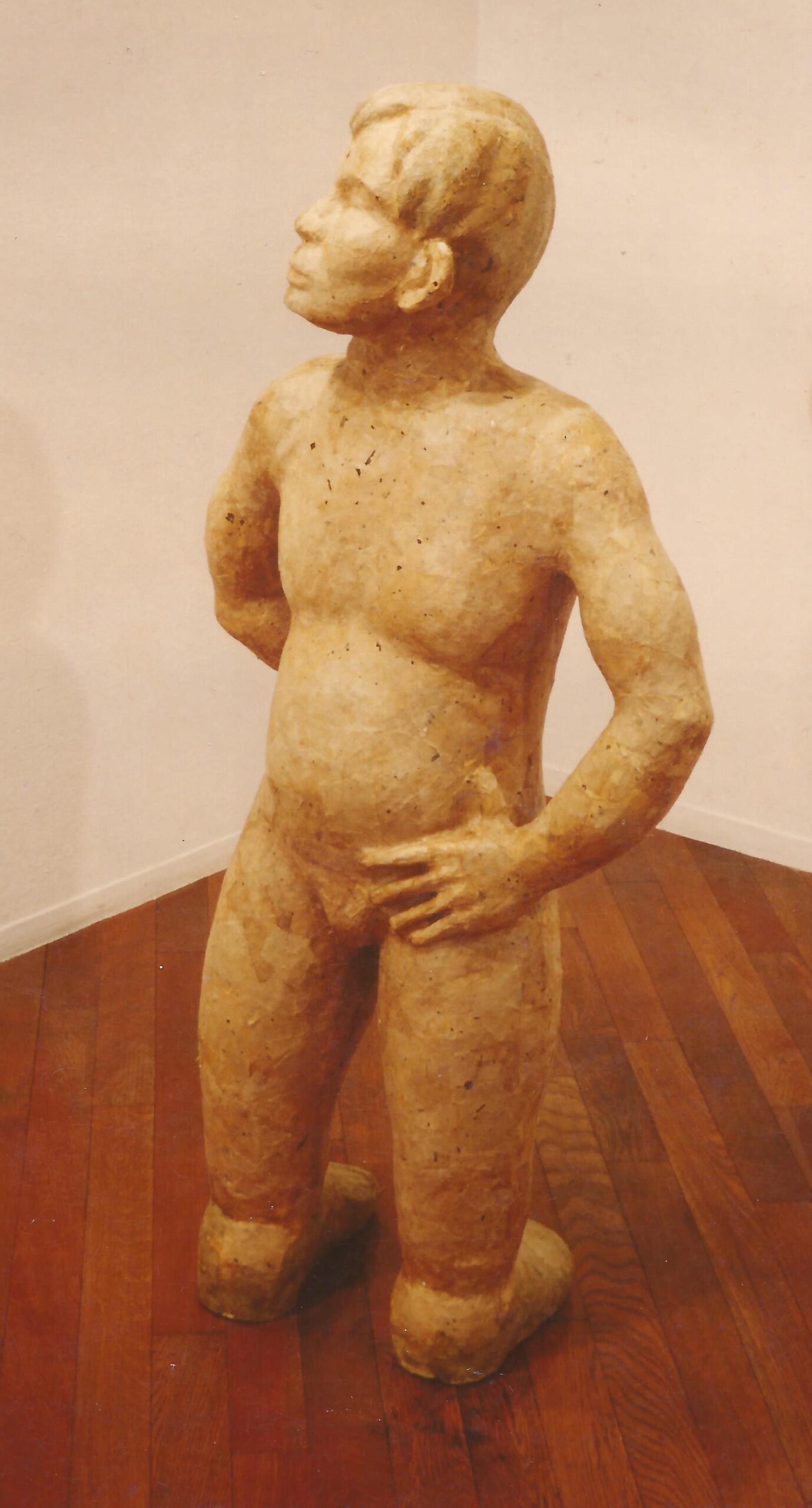
Carving a life-sized figure not only requires technical knowhow of how a form is to be sculpted and also the wherewithal (studio space, tools etc.) but most importantly a material that would lend itself to giving form and expression to the image you have in mind. I found a ready solution in the form of large blocks of polystyrene that were available in Tokyo outlets, easy to carve, lightweight for a person of my physical frame to move and manipulate as required.
When I made the sculpture and explained to friends and viewers that the concept of a man walking with his feet facing backwards was no allegory or a metaphor but something I had actually witnessed, few believed me – at least readily.
The sculpture shown below is a faithful depiction of my memory of the person I passed by in the street in as far as the main feature of “a man walking backwards” (seen from the point of view of the feet) is concerned. But there are other metaphorical features to the form of the body, all of which are hidden at the back. They are revealed only when the viewer goes around the sculpture to inspect the feet. (Refer to note below)
A Novel Solution – Sculpture carved from a polystyrene block, Tokyo late 1980s
NOTE: The Secret Weapons Hidden Behind
The man carries a bundle on his back which is integral to his body such that the bundle which could be a bag of tricks is also a part of his physiognomy.
The arm that he conceals behind is a formation of his extremity that can act as a tool that he could spring as a surprise weapon at an opponent who may pose a threat.
Art and Life are interrelated, one does not exist without the other and the two come together unexpectedly and at surprising intervals.
An example of this is a recent reference in digital media to the same issue that relates to my sculpture ….. (From Life to Art and back to Life)
On one of my many subconsciously motivated searches on Google, I one day came across the following photo article about Howie Desjarlais. It was now my turn to be taken by surprise.
I had witnessed a scene, I made a sculpture of the principal figure in the scene – the figure frozen in three dimensional form….and then, as if to reiterate the whole experience of me seeing and making of an image, I come across a document about Howie Desjarlias that indirectly pays homage to the life of the unnamed individual and to me an entirely anonymous person who I pass by on the street and who becomes the subject of my first life-size sculpture.
” …he landscapes yards around Regina to earn money for his family, despite losing both of his legs from the knee down. (Cory Coleman/CBC)”
Archana Hebbar Colquhoun
The General having crossed a Torii boundary/Archana Hebbar Colquhoun
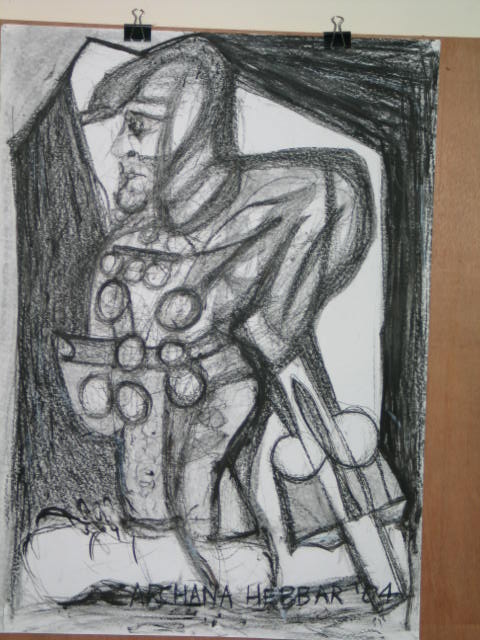
The General
The trajectory of my art practice takes on a zigzag path sometimes; and at other times a circuitous one or a U-turn that I didn’t expect to take.
The work “The General” is one such. I started off with figure sculptures and then went on to study life drawing at Boston University.
After returning to Tokyo, where I started my art practice, instead of going forward on the path of figurative works, I veered off into abstraction and minimalist expression – the Torii gateway being the most significant of them all.
Once I had done a body of work using that very simple form of a Torii as a sculpture, as drawings, in installations etc. using a range of medium and materials, I yet again changed direction and returned to figure drawing.
Here is an example of a drawing that came to me after a not very straightforward journey.
The Torii form is only alluded to in this work. Why the image of a General though?
The Context
One of the most magnificent set of Toriis in Japan is in the heart of Tokyo, all of those Toriis leading to the famous Yasukuni Jinja (a Shinto Shrine) founded by the Meiji emperor in June 1869. The shrine commemorates the death of Japanese soldiers and members of public in a number of wars starting from the civil war also known as the Japanese Revolution of the late 1860s through to the First Indo-China war.
The shrine also commemorates over a thousand convicted Japanese war criminals from World War II.
In any war, whether you consider the dead soldiers as war heroes or war criminals there is always a General. It is this figure of a General that is depicted in the drawing.
The Torii represents a boundary. Wars are waged to gain control over territories that lie beyond a nation’s boundary.
For more information on the Yasukuni Jinja follow the Wikipedia link provided below.
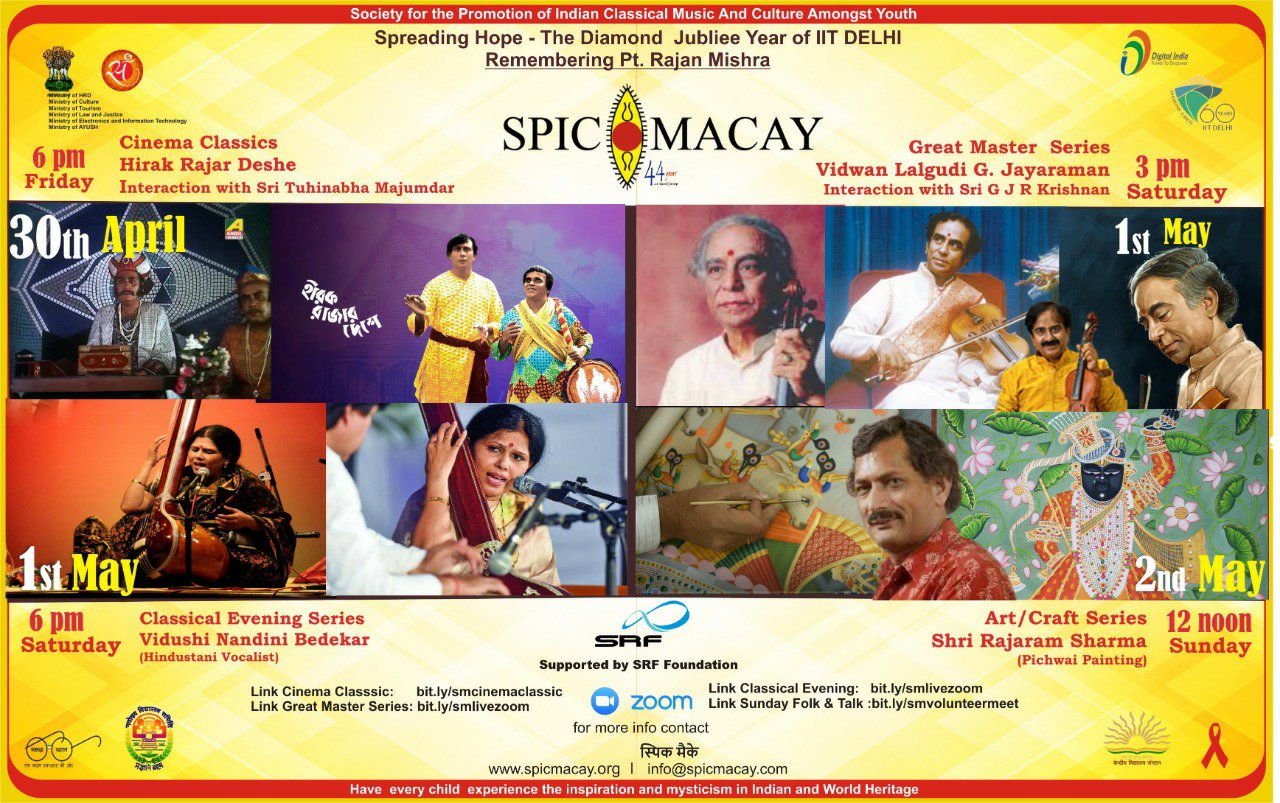
Spic Macay – Pt. Rajan Mishra – IIT Delhi Program
IIT Delhi, Diamond Jubilee Program 2021 April – May
The pandemic is growing rapidly all over the world. With aim of spreading hope and remembering Pandit Rajan Mishra ji (who passed away on the 25th of April), SPIC MACAY dedicates its online 3-day IIT Delhi Diamond Jubilee year program to him, the details of which are given in the link: https://spicmacay.org/rendezvousiitdelhidj
🎥🎬 April 30th, 6:00 pm, Friday: Cinema Classic “Hirak Rajar Deshe” by Shri Satyajit Ray, followed by an interaction with the expert, Tuhinabha Majumdar ji Link: bit.ly/smcinemaclassic
🙇♂️1st May, 3:00 pm, Saturday Afternoon : Great Masters Series- Vidwan Lalgudi G Jayaraman, followed by an interaction with G J R Krishnan ji Link: bit.ly/smlivezoom
🎤🎻🎼May 1st, 6:00 pm, Saturday Evening: Classical Evening Series with Vidushi Nandini Bedekar (Hindustani vocalist) Link: bit.ly/smlivezoom
🎨May 2nd, 12 noon, Sunday: Craft and Folk Series with Shri Rajaram Sharma (Pichwai Painting) Link: bit.ly/smvolunteermeet