Ayodhya Babu Sanak Gaye Hain— A Mirror to Modern Madness
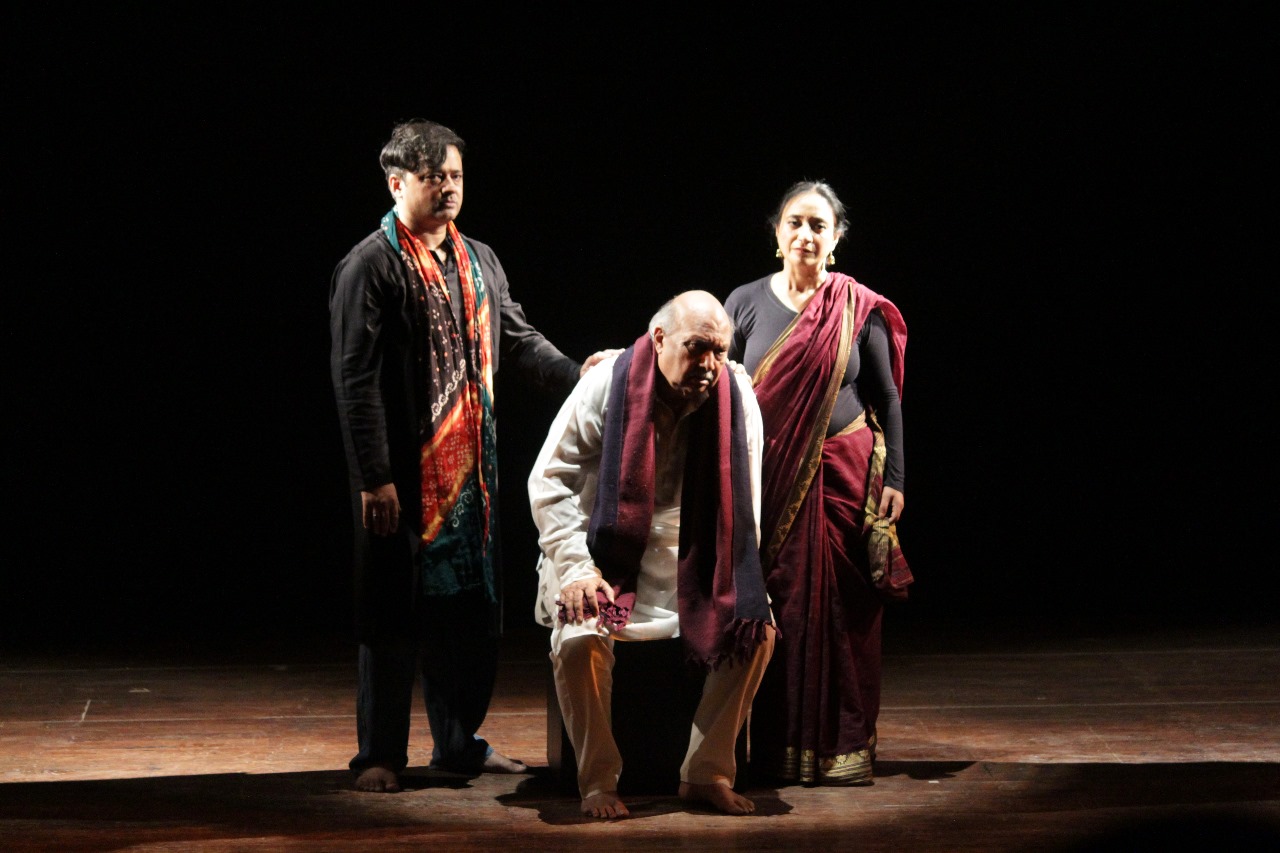
On April 29, 2025, the Sammukh auditorium of the National School of Drama, New Delhi, witnessed a deeply moving theatrical experience as part of the ‘Katharang’ series. The play “Ayodhya Babu Sanak Gaye Hain”, presented by Mailorang (Maithili Lok Rang) and staged by Sambhav Theatre Group, resonated profoundly with the audience. Based on a powerful short story of the same name by noted writer Umashankar Chaudhary, the production explored the contradictions and emotional fragmentation in contemporary society through an impactful dramatic interpretation.
Directed by Professor Devendra Raj Ankur, the play reflected a sharp eye for detail and a deep sense of social sensitivity. He intricately wove the essence of the original story into the dramatic structure, using characters as instruments to deliver a scathing commentary on present-day societal realities.
Amit Saxena delivered a layered and sensitive portrayal of the son. His internal conflict, the clash between duty and emotion, and the discomfort arising from Ayodhya Babu’s supposed madness were brought out with striking realism.
Hema Bisht, as the mother, left an unforgettable impression — especially in the final scene where her silent, broken presence on the deathbed conveyed volumes. Her performance evoked quiet grief and emotional depth.
Amitabh Srivastava brought the complex and multi-dimensional character of Ayodhya Babu alive on stage. His portrayal transcended mere eccentricity, revealing a soul tormented by truth and resistance against social hypocrisy. His ‘madness’ became a metaphor for the courage to speak truth in a world of convenient lies.
The lighting design by Raghav Prakash Mishra played a vital role in enhancing the emotional gravity of the scenes. Particularly in the strained moments between mother and son, the lighting subtly underlined the unspoken pain and tension.
With its naturalistic language, piercing dialogues, and emotionally resonant characters, the play captivated the audience from beginning to end. It was not merely a source of entertainment, but an invitation to introspect.
“Ayodhya Babu Sanak Gaye Hain” compels us to ask: who is truly mad — the one who dares to speak the truth, or the one who comfortably lives with lies? This remarkable production by Maithili Lok Rang and Sambhav Theatre Group stood out as a shining example of theatrical depth, creativity, and social commitment. By the final scene, the audience was not only emotionally moved but left with lingering questions and reflections.
‘Katharang’: A Stirring Theatrical Tribute to the Inner Worlds of Women
On April 28, 2025, the Sammukh Auditorium of the National School of Drama, New Delhi, transformed into a space of introspection and intensity as part of the Katharang series presented by Mailorang (Maithili Lok Rang). The evening featured two poignant theatrical presentations—“Ek Stree Ke Kaarname” by Suryabala and “Betiyaan Mannu Ki”, based on selected short stories of Mannu Bhandari. Both productions were helmed by acclaimed theatre director Prof. Devendra Raj Ankur, known for his ability to breathe theatrical life into literary works with sharp insight and emotional precision.
“Ek Stree Ke Kaarname” — A Satirical Soliloquy of the Self
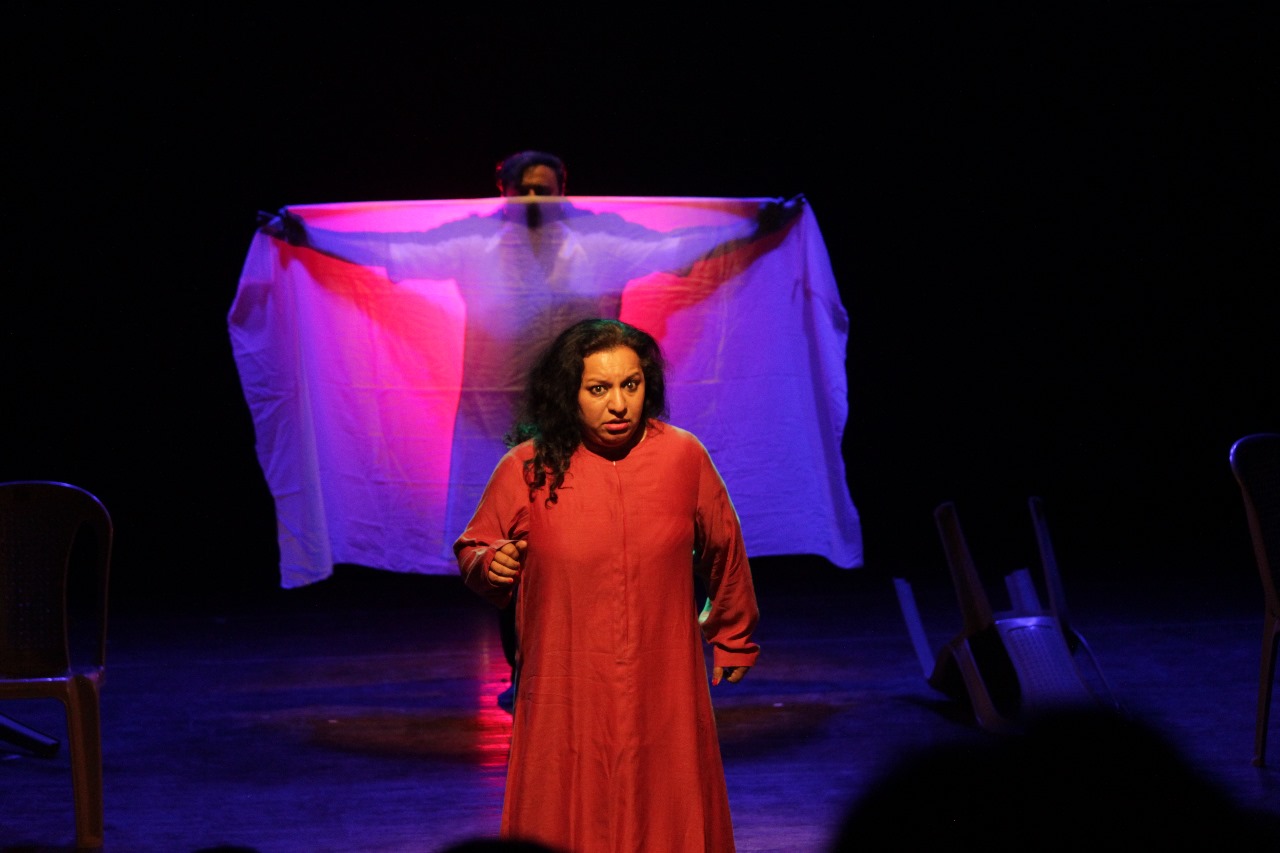
The first play, “Ek Stree Ke Kaarname”, dived deep into the psyche of a seemingly balanced and educated woman whose exterior composure masks an inner churning of suppressed emotions, quiet frustrations, and the desperate quest for identity. Suryabala’s acerbic wit and psychological depth were beautifully translated on stage through a tight script and layered performances. Durga Sharma, portraying the central character, delivered a finely tuned performance—her expressive control and emotional nuance navigating the character’s journey from repression to quiet self-awareness. Amitabh Srivastava lent strength to the performance with his presence, bringing balance and rhythm to the narrative’s unfolding. The interplay of speech, silence, and irony kept the audience deeply engaged, holding a mirror to the everyday contradictions of womanhood.
“Betiyaan Mannu Ki” — Fragments of Feminine Reality
The second presentation, “Betiyaan Mannu Ki”, was an ensemble performance based on several short stories by Mannu Bhandari, one of Hindi literature’s most powerful voices on gender and identity. The play explored multiple dimensions of womanhood across varied roles and stages of life, offering moments of tenderness, conflict, vulnerability, and resistance. The cast—Amit Saxena, Gauri Deval, Aditi, and Rachita Verma—brought these diverse female experiences to life with empathy and skill. Each transition between characters and narratives was handled with clarity and emotional depth. Whether as daughters, lovers, mothers, or rebels, the female characters emerged with raw honesty, making the stories resonate deeply with the audience.
The production’s lighting, designed by Raghav Prakash Mishra, subtly enhanced each scene’s emotional tone without overpowering the narrative. His use of soft transitions, warm shadows, and isolated highlights helped build the psychological landscapes of both plays. The minimalist set and gentle pacing allowed the performances and text to breathe, focusing the audience’s attention squarely on the characters and their journeys. The music selection, curated by Rajesh Singh, provided an evocative auditory backdrop, enhancing each emotional transition. Sahaj Harjai and Unis Yadav skillfully operated the music during the performances, ensuring smooth and expressive sonic flow that deepened audience immersion.
Katharang’s theatrical evening was a thoughtful confluence of literature and performance—a celebration of women’s stories told with dignity, irony, and emotional truth. Prof. Devendra Raj Ankur once again demonstrated his profound sensitivity as a director, translating literary narratives into stage experiences that speak directly to the conscience. The evening left the audience moved, provoked, and awakened reminding us that theatre, at its best, does more than entertain; it opens conversations and illuminates’ silences.
When Objects Spoke, and ‘Gareeb Nawaz’ Raised a Question: A Moving Theatrical Evening in Katharang
On 27th April 2025, at the Sammukh Auditorium of the National School of Drama, Delhi, the theatrical evening under the “Katharang” program—organized by Mailorang (Maithili Lok Rang), Delhi—featured Sambhav’s evocative presentation “Unke Hisse Ka Prem evam Gareeb Nawaz”. The performance offered an experience that touched audiences at their very core.
The direction was helmed by senior theatre practitioner Prof. Devendra Raj Ankur, whose theatrical finesse was evident in every scene and every emotion of the presentation.
The first story viewed love from an unusual yet striking perspective—where inanimate objects, rather than humans, become witnesses. Set in an office, the hidden layers of a boss’s romantic entanglements are brought to life through the voices of his desk, chair, diary, mirror, and pen. While the concept sounds extraordinary, it was executed on stage with remarkable ease and believability. These lifeless symbols transformed into living characters before the audience’s eyes, each one addressing the viewers—sometimes with sarcasm, at other times with compassion. The director’s choice to turn objects into “characters” was a daring experiment in theatre, and it proved to be a wholly rewarding one.
The second story depicted a contemporary conflict within society, rendered in a simple yet powerful form. The struggle between Vishwamohan—who returns from America to start a BPO—and Riyaz, who opens a modest “Gareeb Nawaz Chicken Shop” next door, is not merely a business rivalry. It becomes a clash of two worldviews. Beneath its humor and wit, the story makes a poignant commentary: in the blind race for development, how many truths are trampled, and how many “Gareeb Nawaz” figures are pushed to the margins?
On stage, Nidhi Mishra, Gauri Dewal, Rachita Verma, Amitabh Srivastava, Amit Saxena, Harikesh Maurya, Sahaj Harjai, and Prakash Jha brought their characters to life with such intensity and nuance that each scene appeared to unfold right before the audience’s eyes. Their performances added soul to the characters, going beyond mere dialogues. Behind the scenes, too, a dedicated creative team worked tirelessly.
Music selection was curated by Rajesh Singh, and technical operation during the performance managed by Unish Yadav and Sahaj Harjai, whose acoustic execution ensured precise alignment of sound with the emotional tone and rhythm of each scene.
Lighting was sensitively designed by Raghav Prakash Mishra, whose balance of light and shadow added both visual clarity and thematic depth. Every aspect of stage design, management, and visual aesthetics reflected a mature professional sensibility and deep theatrical insight, elevating the performance to a level of artistic completeness.
It would not be an exaggeration to say that this presentation offered more than just two stories—it offered two distinct philosophies of life. One, where love remains forever incomplete; and the other, where in the name of “success,” human relationships and grounded realities are blurred. Prof. Devendra Raj Ankur’s endeavor reaffirmed that theatre does not end at the stage—it becomes an extension of our consciousness.
Sambhav’s performance reminded us that when acting, direction, and thought move in unison, theatre becomes more than performance—it becomes a dialogue that resonates deeply within the viewer, long after the lights have dimmed.
Sanskar Bharti Kala Sankul Once Again became the Witness of a Mesmerizing Journey of Art, Devotion, and Dialogue
The monthly symposium began with a heartfelt tribute to the innocent civilians martyred in the recent terrorist attack in Pahalgam. All present members observed two minutes of silence, expressing their emotions in an unspeakable way. The entire atmosphere seemed to be immersed in a silent prayer.
On the auspicious occasion of the lighting of the lamp, all distinguished guests performed the lamp lighting ceremony, illuminating the stage.
Following this, a melodious stream of music began. The soulful singing by Mr. Vijay Rawal and Mr. Veer Mani Trivedi touched the hearts of everyone present. Their mastery of voice filled the atmosphere with unseen compassion and hope.
The main attraction of the symposium was the analytical discussion on the theatrical presentation ‘Arey Gadbadi Ho Gayi’, inspired by the Sanskrit play ‘Bhagavadjukkam’ by Bodhayan, directed by Raj Upadhyay, and performed by Navras Group.
In this discussion, the depth of the story, authenticity of the acting, the liveliness of the stage arrangement, and the artistic features of the entire presentation were examined in detail. Critics appreciated the dedication and effort of the Navras Group artists, stating that the presentation not only entertained but also sparked deep contemplation.
The Navras Group artists were deeply moved after hearing such a heartfelt and in-depth review of their performance. They expressed that such analytical discussions inspired them to further deepen their theatrical practice. They also expressed their gratitude to Sanskar Bharti for providing such a valuable platform.
To elevate the dignity of the event, the presence of several distinguished guests was noteworthy. Dr. Prashant Upadhyay, Delhi Province Minister, Senior NSD theater artist Mr. Pradeep Mohanty, Mrs. Shashi Prabha Tiwari, educationist Dr. Ruchika, and Mr. Manish Jha honored the event with their esteemed presence.
The success of the program was greatly aided by the contributions of Delhi Province’s stage art coordinator Mr. Raj Upadhyay, senior theater artist Shyam Kumar, Shraboni Saha, Garima Rani, Vishwadeep, Sneha Mukherjee, Raman Kumar, Saurav Tripathi, Pradeep Pathak, Mrityunjay, Brijesh, Shivam, Sushank, and Sakshi.
The event was skillfully and warmly conducted by Bharti Dag, and Mrs. Shruti Sinha concluded the art-filled evening with a heartfelt vote of thanks.
Jogiya Raag a Saga of Unwavering Faith and Silent Longing
On 26th April 2025, at the Sammukh Auditorium of the National School of Drama, New Delhi, the play “Jogiya Raag” was presented under the theatre festival “Katharang“, organized by the cultural organization Mailorang. Written by Vijay Pandit and directed by Prof. Devendra Raj Ankur, this production transformed a seemingly simple story into an extraordinary emotional experience on stage.
“Katharang” commenced on the same day with the stage being graced by the presence of senior theatre artist Mr. Amitabh Srivastava, who conducted the inaugural ceremony, and renowned literary figure Mr. Ashok Vajpeyi, who attended as the Chief Guest.
The story revolves around Savitri, a woman abandoned by her husband immediately after marriage as he renounces worldly life to become a hermit. Years pass as Savitri patiently waits for him, unwavering in her faith despite societal pressures. Eventually, in an act of poignant resignation, she accepts an unknown ascetic as her lost husband, surrendering herself to her destiny.
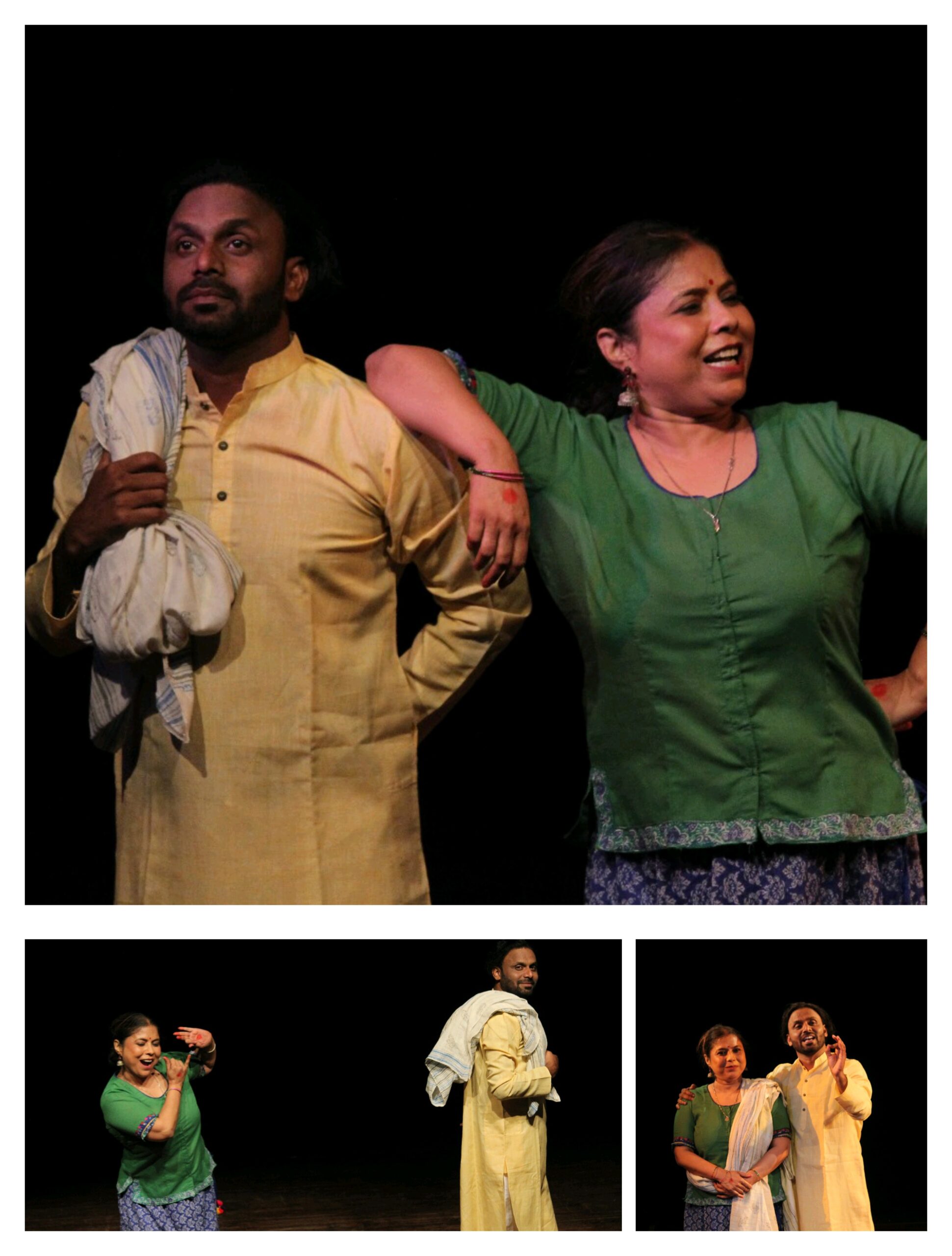
Nidhi Mishra, portraying the role of Savitri, delivered a truly exceptional performance. Her command over body movements, dialogue delivery, and the subtle expression of inner turmoil kept the audience deeply engrossed throughout the play. With remarkable ease and depth, she captured the complex emotions of hope, struggle, and despair dwelling within Savitri.
Mukti Das portrayed the character of Bal Mukund with great seriousness and authenticity. His restrained expression of internal conflict and the pain of renunciation, without falling into melodrama, added credibility and depth to his character. His dialogue delivery was composed and truthful, making his presence compelling on stage.
With only two actors on stage, multiple characters were seamlessly brought to life through masterful variations in posture, movement, and voice modulation. This technical challenge was executed with impressive smoothness, making the character transitions natural and believable.
The innovative use of a simple prop — a saree — deserves special mention. Throughout the play, the saree symbolically transformed — representing femininity, sorrow, or the complex dynamics of shifting relationships, enhancing the thematic layers of the production.
Selection of the music that was played in the play by Sneha Kumar, deepening its mood and emotional texture. Nitin Bharadwaj’s lighting design and its careful execution effectively elevated the story’s atmosphere, aligning each scene with its emotional tone.”
“Jogiya Raag” offered a profoundly moving theatrical experience. The balanced synergy of storytelling, direction, acting, and technical finesse elevated the performance to great artistic heights. The sensitive and sincere efforts of the team ensured that the audience remained deeply connected to the story from beginning to end.
This play is not merely the tale of Savitri’s endless waiting and loyalty; it is also a beautiful exploration of human emotions, faith, and the silent resilience embedded in life’s most difficult journeys.
Beyond Boundaries: The Artistic Splendor of Nritya Shikhar Mahotsav 2025
The “Nritya Shikhar Mahotsav 2025,” held at Triveni Kala Sangam in New Delhi, emerged as a grand celebration of the dignity and tradition of Indian classical dance. Organized by the Urvashi Dance Music Art & Culture Society, the festival introduced art enthusiasts to various classical dance styles while elevating Indian cultural heritage to new heights.
On this occasion, Shri Prabhat Kumar, President of Sanskar Bharti Delhi, graced the event as the chief guest. The festival also honored esteemed personalities from the arts world. Pandit Vijay Shankar Mishra, Shri Ashok Jamanani, and Shri Ashok Jain were presented with the Urvashi Kala Samman. Distinguished guests such as Shri Ashok Tiwari (Secretary, Sanskar Bharti), Padma Shri awardee and renowned Odissi dancer Smt. Madhavi Mudgal, and Shri Pradeep Kumar Pathak (Secretary, Kala Chaitanya) added further prestige to the event with their presence.
The festival featured mesmerizing performances in various classical dance styles like Kathak, Odissi, and Chhau. Among them, a standout performance was delivered by the dynamic young Kathak dancer Vishwadeep from the Jaipur Gharana.
Vishwadeep’s performance was among the most powerful and talked-about presentations of the event. Trained in the Jaipur Gharana tradition, this young artist brought to life the strength, emotion, and rhythmic excellence of Kathak. He began with Chaturbhuj, depicting the four-armed form of Lord Vishnu through expressive dance. His dynamic gestures, balanced movements, and fluid expressions made the performance truly memorable.
Following that, he presented a dance drama titled Ravan, which portrayed the complexities of Ravan’s personality and his inner psychological turmoil. This unique choreography blended traditional Kathak elements with deep emotional storytelling. Directed and choreographed by the acclaimed Kathak guru Shama Bhate, the piece preserved the purity of the dance form while offering a fresh perspective.
Vishwadeep’s performance was not limited to technical brilliance; through his expressions and body language, he powerfully conveyed the varied emotions within Ravan—pride, power, wisdom, and self-reflection. Especially gripping was his portrayal of Ravan’s internal struggle, which left the audience spellboun.
His mastery over footwork, rhythmic patterns (chakradhars and parans), and emotional depth made the performance unforgettable. The audience greatly appreciated his energy, technical finesse, and expressive storytelling. His presentation was not just a classical dance recital, but a dramatic narrative that showcased Kathak as a potent medium for storytelling. When he embodied Ravan on stage, it felt as though the entire auditorium was witnessing a pivotal moment from an epic, with Ravan in deep introspection. Vishwadeep performed with such natural ease that it didn’t feel like a traditional dance performance—it felt like a living, breathing theatrical experience.
The hall erupted in applause after his performance. It would not be an exaggeration to say that Vishwadeep’s presentation made “Nritya Shikhar Mahotsav 2025” a cultural milestone that will be remembered for years to come.
Other notable performances included Pune’s Ameera Patankar and Delhi’s Shobha Bisht. Shobha’s Odissi performance beautifully blended devotion, grace, and feminine dignity. The Chhau performance, directed by Guru Ajay Bhatt, was packed with energy and heroic expression (veer rasa).
The Kathak duet by Gaurav and Himani demonstrated the power of dialogue and harmony in dance. Their performance showcased a unique balance of creativity, technique, and synchronization.
Smt. Rekha Mehra, President of the Urvashi Dance Music Art & Culture Foundation, played a pivotal role in making the event a resounding success. Her dedication to dance and commitment to culture imbued the festival with both dignity and artistic excellence.
“Nritya Shikhar Mahotsav 2025” was more than just a cultural event—it was a living celebration of tradition, showcasing the continuity and creativity of Indian classical dance. For both performers and audiences, it was an inspiring experience that will be cherished for a long time.
Cultural Extravaganza Marks Hindu New Year at Kala Sankul
New Delhi, March 30, 2025- The central office of Sanskar Bharati, ‘Kala Sankul,’ witnessed a grand celebration on the auspicious occasion of the Hindu New Year with its Monthly Art Symposium. The event showcased an exquisite array of Indian cultural performances, leaving the audience spellbound.
The program commenced with the ceremonial lighting of the lamp, followed by a mesmerizing Kathak performance by the Alaknanda Cultural Group, which highlighted the grandeur of the Indian classical dance tradition. Subsequently, Kuleshwar Thakur and his group captivated the audience with an enthralling Chhau dance performance, characterized by its unique style and expressive gestures.
Renowned Odissi dancer Kavita Dwivedi, addressing the gathering, emphasized that the Indian New Year is not just a date but a significant representation of cultural identity, natural lifestyle, and deep-rooted traditions.
Vijay Kumar, North Zone Organization Minister of Sanskar Bharati, elaborated on the scientific significance of the Indian New Year, highlighting seasonal transitions, the commencement of new academic sessions, financial year changes, and the overall transformation in nature. He also underscored India’s pioneering role in developing an artistic system of timekeeping, which has influenced the world. Additionally, he detailed the importance of the Indian calendar, lunar dates, and festivals.
The event saw an impressive turnout of artists, culture enthusiasts, and distinguished guests. Among the notable attendees were senior playwright J.P. Singh, theater artist Rohit Tripathi, Chandrakanta Tripathi, dancer Ritu Shree, art critic Shashi Prabha Tiwari, NSD Secretary Pradeep Mohanty, and Kathak dancer Raksha Singh DeWitt, along with several other prominent figures.
Promoting environmental conservation, Mr. Joginder distributed flower seeds and Tulsi saplings, urging attendees to plant them as a symbolic gesture for the New Year and contribute to ecological preservation.
The success of the program was attributed to the collective efforts of Delhi Province Stage Art Coordinator Raj Upadhyay, senior theater artists Shyam Kumar, Shraboni Saha, Garima, Sneha Mukherjee, Raman Kumar, Vishwadeep, Pradeep Pathak, Mrityunjay, Brijesh, Shivam, Sushank, Nandini, Kathak dancer Sakshi Sharma, Priyanka, and Sakshi. The event was expertly hosted by Bharti Dag, while symposium coordinator Shruti Sinha delivered the vote of thanks.
Sanskar Bharati’s ‘Kala Sankul’ continues to host such events regularly, ensuring the preservation and promotion of Indian art, culture, and traditions.
The Intersection of Art and Constitution: A Republic Day Symposium at Kala Sankul
New Delhi, January 26: A special monthly symposium was organized at Sanskar Bharati’s central office, ‘Kala Sankul,’ on the eve of Republic Day. The theme of the symposium was “The Artist’s Vision of the Soul of the Indian Constitution,” with Shri Lakshmi Narayan Bhala Ji, a senior pracharak of the Rashtriya Swayamsevak Sangh and an expert on the Indian Constitution, as the keynote speaker.
The event began with floral tributes to the portrait of Bharat Mata and a ceremonial worship. During the session, Shri Bhala Ji shed light on the historical and cultural significance of the illustrations created by Nandalal Bose in the original manuscript of the Indian Constitution. He emphasized that these illustrations are not merely decorative but serve as a vivid reflection of Indian civilization, culture, and the soul of the Constitution. Through these artworks, the traditions, glorious history, and values of India’s freedom struggle have been effectively conveyed.
Shri Bhala Ji elaborated on the role of these illustrations in each chapter of the Constitution. He highlighted that great artist like Nandalal Bose dedicated their artistic expertise to give each page of the Constitution a unique identity. These illustrations incorporate significant elements from the Mahabharata, Ramayana, Buddhism, and key events of India’s freedom struggle, portraying the Indian Constitution as a living and inspiring document.
The symposium witnessed participation from a large number of art enthusiasts and thinkers, who regarded it as an inspiring opportunity to understand Indian art traditions. The officials of Sanskar Bharati expressed gratitude to everyone involved and resolved to continue organizing such motivational events in the future.
All India Organization Minister Shri Abhijit Gokhale and Area Organization Minister Shri Vijay Kumar were specially present on the occasion. The symposium was skillfully conducted by Garima Rani, while the vote of thanks was delivered by Shri Kuldeep Sharma, the convenor of the drama symposium. The success of the event was supported by significant contributions from Shri Vishwadeep, Pradeep Pathak, Ms. Anchal, Sushank, Shivam Mrityunjay, Saurabh, Harshit, Raman, and Kala Sankul’s administration head, Shri Digvijay Pandey.
This symposium was a commendable effort to unveil the depth of the Indian Constitution, and the unique aspects of Indian culture embedded within it. The illustrations by Nandalal Bose not only enhance the aesthetic appeal of the Constitution but also symbolize India’s soul and its rich historical heritage. Such events provide an opportunity to connect with Indian traditions and culture while deepening respect for the Constitution.
Gulammohammed Sheikh’s Kaarwaan and Other Works
Note: Previously published as Experiencing Gulammohammed Sheikh’s Kaarwaan and other works in the online version of Take on Art magazine with a change in format
Archana Hebbar Colquhoun
If I were to stitch together images, information, and narratives from memory, of the lectures delivered by Gulammohammed Sheikh for our art history courses in Baroda, and left them to grow and form into a display of artworks it would be Gulam’s Kaarwaan and Other Works shown by Vadehra Art Gallery at the Bikaner house, New Delhi, from 19, February 2024 to 12, March 2024, and subsequently at Gallery Chemould in Mumbai from April 5, 2024 until 15, May 15 2024.
The works in the Kaarwaan exhibition have come out of an atelier set up with a master artist (Gulammohammed Sheikh) conceiving, designing, and directing, the works to precise specifications, which atelier hands have contributed their labor and artistic talents to and help give the works physical forms of large, wall- mounted paintings; tall, painted screens stood on the floor; and small, architectural constructions painted and with movable parts – placed at eye-level on pedestals.
The works in this exhibition throw up many surprises of which we come to later.
It is interesting to note that the works in the exhibition were made over a period of four years or more including the two years when the Covid-19 pandemic raged. The pandemic restricted the one-on-one communication between Gulam and the artists assisting him in this large project.
In what way might the interference of Covid-19 have affected the production and the final outcome of the works is a question I asked myself.
The main work – Kaarwaan – a dream sequence
Only through a dream sequence can you conjure up a vision of known, unknown and historical characters from diverse regions and disciplines belonging to different time frames in a single cluster, seen all at once. The figures in Kaarwaan are not shown as walking and moving of their own volition towards a common destination but are propelled in a boat that bounces along on wavy waters.
A kaarwaan is a group of travelers along with their living and non-living accompaniments making their journey on footfrom here to there and from what is this to what maybe that in their life’s passage.
The boat in the painting, Kaarwaan, is not merely a vessel in which people are transported to a destination but it is a self-contained watercraft that also accommodates a large land mass of breathtaking landscapes with buildings, as if luring the people crowded together at the back of the boat to choose the boat itself as their final destination, in a way trapping their souls on the earthly plane of history – history written, and created by humans – although there are the angels and farishtas hovering just above the surface of the water and around the boat ready and waiting to take the souls on their onward journey to liberation. For anyone with a certain amount of knowledge and familiarity with art history the “chosen group” of people packed at the back of the boat are recognizable but Gulam is kind and he provides a map (displayed at the entrance to the gallery) of that area of the boat, which houses the figures from history, with a demarcated space for each figure on the map, spelling their name, so as to make the viewer’s journey through, into and across the painting a little bit easier and less intimidating.
Kaarawaan, Acrylic on canvas, 80 x 257 in., 2019 – 2023
Entering the gallery and viewing the works
Upon entering the gallery, I found that the arrangement of the works was in itself a creative act. Not all of the painted works could be hung on walls – as in a typical exhibition of paintings – in an array that is often monotonous.
In this exhibition are tall, double-sided recto verso painted screens, standing at strategic places that act as architectural devices, which divide the interior space of the gallery into fluid sections. Then there are the Kaavads.
At the exhibition opening when the gallery was full with visitors, and there was little room to move about, the experience was like that of negotiating movement between people and the works through shifting passages that had invisible walls. The movement of visitors was made even more complex and diversional when we were enticed to move around, sometimes in circles, to view the multiple painted doors of akaavad box shrinedisplayed atop a pedestal, once again the gallery space being broken up, by the kaavad-bearing pedestals, in a manner different to how the double-sided, free-standing painted panels divided up the gallery floor space, the arrangement creating a play of turns and many U-turns for the viewer.
The works seen in the exhibition and indeed how they were displayed engage the viewer such that their eyes flitter from one object to another in wonder and excitement with each work on display demanding the viewer’s attention in competition with the other works displayed; the experience akin to visiting a busy village fair with its many stalls and activities or grand Christmas or Diwali sales with their dazzling spread of objects and artefacts.
The varied collection of works and their display in a single exhibition creating unique paths of movement for viewers is a memorable feature of this exhibition since the same combination of works may not be presented at the same time, in a single presentation, very many times in the future. The reason is that the works belong to at least three distinct categories of structural constructions as described above. However, notwithstanding the fact that the show contained different groups of works which might prevent the works from being shown together in a single exhibition, there is the distinct possibility, even as this write-up is being prepared, that the works from the exhibition would be acquired by art collectors, removing them from public view and perhaps made irretrievable for a future show as one collective – the ownership of the works being spread out amongst many individuals and institutions.
[As a critic and a writer I am biased towards giving prominence to how artworks are presented in an exhibition space. This leaning comes from my own practice as an installation artist, where I present individual artworks with others as part of a family of inter-related works, the combinations and arrangements of which almost never repeated in another exhibition.]
Kaavads are complex, multi-paneled painted box works withdynamic moving shutters. They are sacred objects and are religious in nature.
Kaavads are portable box shrines the making of which involves the skills of a carpenter who constructs the box shrines with (light) wood and before the various parts of the kaavad are assembled into a shrine the individual parts are painted on both sides with ‘pre-planned’ narratives. The carpenter (Suthar) and the painter (Chitrakar) may or may not be the same artisan. It is a complex symbiotic relationship between the suthars/chitrakars – who are the creators of the painted kaavads – and the Kaavadiya Bhats who are the travelling storytellers who buy the ready-to-use kaavads from the suthars and narrate stories illustrated on the kaavads to their patrons (Jajmans) to whose houses they carry the kaavad and seated on the floor, placing the kaavad on their lap (tilting and moving the kaavad for better view) regale the small audience with stories from the epics, puranas and other literary texts illustrated on the kaavads while embellishing these well-known narratives with the genealogies of the patrons and extrapolating further the stories with “news clips” from contemporary happenings.
The kaavad is central to this tradition of storytelling prevalent in Rajasthan and while the kaavad is a prop, a device or an accompaniment to the performance of storytelling this embellished box shrine is way more than that; it is in fact the main actor, the protagonist that is central and indispensable to the kaavad presentation.
The kaavads in Gulam’s exhibition, I found, were completely novel structurally compared to the traditional kaavads. These fascinating kaavads that Gulam presents in his exhibition have even more multiple doors opening up in even more directions than the most complex of traditional kaavads I have seenand that I bought at craft fairs many years ago for my own small private collection. The paintings on the surfaces and the small door panels of the kaavads in the exhibition were certainly those by/of Gulam (’s). I assumed that the kaavad box structures were bought directly from artisans who make the kaavads, but prior to them being painted by a chitrakar, and the blank surfaces of the little folding doors and the walls of the small box-shrine being painted on by Gulam with narratives of his choice. But I was corrected by Gulam when I posed this question to him, in that these multidimensional structures were, in fact, designed by Gulam and not bought as ready-to-use objects (as do the storytelling kaavadia bhats). This fact was a revelation to me as I only knew Gulam as a teacher of art history, giving spell-binding lectures (a brilliant storyteller himself), and as a painter and a muralist
Gandhi, Acrylic on board 18 x 34 x 31 in., 2019 – 2024
Note:
I moved to Japan in the late 80s developing my own artistic idiom and was isolated from the goings on in Baroda and New Delhi, the two places where my mentors and artist-peers functioned as art professionals during which time many of whom grew greatly in stature.
The structure of the kaavads and the narratives they hold
Due to the many ways and directions in which Gulam’s kaavads can be opened, with each surface and each door depicting a scene or scenes – the totality of the many different tableaux adding up to a multitude of detailed narratives in one single kaavad,the viewer could consume the entire time planned to spend at the exhibition simply studying just one of the kaavads.
Another noticeable departure in Gulam’s kaavads, other than structural, from the traditional kaavads is the subject matter of the narratives painted on the surfaces of the boxes, making them no longer shrines but structures which house historical and contemporary narratives that are non-religious.
The kaavads in the exhibition are titled as follow:
City Blues, water colour, casein on wood 13 x 30 x 19 in., 2020
Gandhi, Acrylic on board 18 x 34 x 31 in., 2019 – 2024
Deluge, Water, Life, Casein, water colour on wood 10 x 35 x 28 in.,2019 – 2024
Having seen the kaavad box shrines in the exhibition, I could imagine Gulam creating a single kaavad, not as a miniature box-shrine displayed on a pedestal in a gallery but as a large architectural structure such as a kaavad room that accommodates people, who enter and exit the kaavad room from various doorways.This surmise of mine turned out to be a happy and unexpected synchronicity of reading an artwork as Gulam had already made such a kaavad room. I learnt this fact when I watched a YouTube video of Gulam’s – subsequent to including the above observation in this article – where he described a 7 to 8 ft. tall kaavad house he had created, not very many years ago.
Painting as Tapestry
The 21 ft. long painting – Kaarwaan – has large areas that are predominantly rendered with perfectly drawn parallel curved lines, denoting waves in the sea.
However, I viewed the painting as if it was an ancient tapestry that had undergone wear and tear, through extensive handling or neglect, whereby the tapestry retained many islands of its original woven rendering of narratives – the main image of a boat; the slope on the left hinting at a final destination for the people on the boat; and small, individual beings and animals scattered around the boat, the original weave being intact.
Conversely, the large areas of the painting occupied by waves I saw as those where the woven wefts of the tapestry had worn off and the fragile underlying warps being visible, creating a mystery and an opportunity for the viewer to fill up the near-blank spaces with a composition of narrative imagery through freewheeling imagination; each viewer recreating the entirety of the tapestry, in a manner uniquely their own.
Detail of Kaarawaan, Acrylic on canvas, 80 x 257 in., 2019 – 2023
The paintings displayed on the walls in the exhibition are as follow:
Kaarawaan, Acrylic on canvas, 80 x 257 in., 2019 – 2023
Simurgh aur Pariyaan, Acrylic on board, 84 x 15.5 in., 2019 – 2024
Hunted, Acrylic on Board, 84 x 15.5 in., 2018 – 2024
Francis and Kabir; Acrylic on canvas, 78.5 x 123.5 in., 2010 – 2023
Recto Verso panels or free-standing painted screens
The double-sided vertical panels in the exhibition with the sides defined distinctly as either Recto or Verso bear the following titles:
A. Majnun in the Forest (Recto) B. Tree of Sleep (Verso) Acrylic on board 84 x 48 in., 2019 – 2023
A. Conference of Birds (Recto)B. Lands Violated (Verso) Acrylic on board 84 x 48 in., 2023 – 2024
A. Dus Darwaze (Recto) B. Forest Fire (Verso) Casein on canvas mounted on board 84 x 30 in., 2019 – 2024
A. Rising (Recto) B. On the Prowl (Verso) Acrylic on board 84 x 18 in., 2019 – 2024
My earliest experience of dealing with recto verso pages in a notebook was when, as a child, I tore off the last page in my notebook, which was blank and to my astonishment found that the first page, perhaps the most important in the notebook, had become detached.
The fascinating aspect of recto and verso sides of a page is that the two sides could contain continuous text of a same narrative or texts that are not related to one another as in when a new chapter of a book or an entirely different essay begins on either the recto or the verso side of a page.
The aspect of un-relatedness between the contents printed on the front and those printed on the back of a page is undeniable and becomes obvious when the staples that hold together the pages of a notebook are removed and each folded sheet, now detached, previously forming four pages numbered for example, 1, 2, 15, and 16, containing distinct blocks of text on each of the four pages where the texts on the two recto and the two verso sides, i.e. the two sides of the sheet, are completely jumbled and apparently randomly selected for printing.
So, are the recto and verso sides of the painted panel, for example, the panel titled “Dus Darwaze” on one side and “Forest Fire” on the other, related or unrelated in their content?
The double-sided painted panels in the Kaarwaan exhibition contain another example of playful dialogue that the audience carries out with the work , which Gulam introduces in his works.
There is precedence in European art of the middle ages, depicting predominantly Christian subjects, to painting both sides of a panel with narrative scenes or iconic subjects. The double-sided painted panels may be an individual panel stood on its own or the panels could be doors of an altar of which the doors are an integral part with both sides of the doors bearing paintings, which when opened and shut reveal closely related narratives or individual episodes from the bible depicted on either side of the altar door.The architectural structures of the medieval Christian painted altars; the double-sided painted panels; the diptychs and triptychs etc. are all present as artistic ideas in the kaavads and the recto verso works of Gulam’s.However, the ideas drawn from the above sources are uniquely transformed by Gulam, leaving the viewer to either accidentally or through labored research find the sources and their connections to Gulam’s works.
The tree of life and a catalogue of birds – from the recto verso series
Content and Subject Matter – briefly viewed
The exhibition touches upon a range of issues, one among them being the degradation of the planet Earth and a very real possibility of extinction of many life forms, for example, of the birds in the painting, Conference of the Birds*, and referring through absence, in the painting, to the unfathomable range of species on earth that are dwindling in numbers rapidly, even the common ones.
The dense, dark greens of the tree and the background areas of the painting also rendered in greens, not allowing any daylight to filter through, invoke feelings that an end is near.
The Conference of the Birds (Recto); Lands Violated (Verso); Acrylic on board 84 x 48 in., 2023 – 2024
The painting, TheConference of the Birds, draws upon bestiary and aviary subjects depicted in medieval illuminated manuscripts and Indian miniature paintings, especially paintings produced at the ateliers of Mughal emperors.
The painting serves as a pictorial counterpart of the DNA data banks of life forms or refers to a modern day Noah’s Ark. The birds in the painting can be taken to be ones which are part of a selection of endangered birds that are under preservation orders, set by an expert committee, even many of the common ones.
[* The Conference of the Birds is a visual representation of the allegorical poem by the Persian Sufi poet Farid ud-Din Attar, 1177 A.D. In the poem the birds speak with each other about appointing a suitable sovereign. Each of the birds represents a human failing and to find the sovereign, the Simorgh, the seven valleys of vices have to be crossed. The poem symbolizes the intractable trials of being human. The motif of the tree of life is recurrent in Gulam’s works and he described in one of his interviews that a tree need not always be an independent entity in itself but can be an abode that houses other living beings. In addition to animals and birds, Gulam’s trees house portraits of his artist friends and other individuals, each portrait hanging somewhat like a large fruit in the tree.]
Style – Stylization and Realistic Rendering
Style in Gulam’s paintings has many identifiable roots; however, homogeneity in style is maintained through careful curation.
The elements within each composition in Gulam’s paintings are drawn in the styles of medieval illuminated manuscripts of Europe and the various schools of Indian miniature paintings; however, the scale of the works are large and by using a style/styles of figuration of what are traditionally intimate, hand-held works in a large-scale painting, he introduces other ways of looking at his works to that of an intimate viewing, that which requires distance.
A folio page of an album of miniature paintings can be studied without so much as moving the head, while in the case of the large paintings of Gulam’s the viewer is required to walk back and forth, forwards and backwards, and across from left to right and back to view a single painting – the figures and forms (greater in number) being painted in the various miniature styles and in varying sizes, on a large canvas.
Interestingly, the same “miniature” style of rendering figures and forms is applied to both large as well as small areas of painted surfaces – the large wall-mounted paintings; the recto verso panels; the surfaces of the small, shifting doors and the fixed walls of the kaavad box shrines.
Note: I am yet to have the opportunity to study the sizes of the figures in Gulam’s paintings and compare them with the ones in the miniature paintings to see what differences there are in the sizes of figures relative to the size of the works.
However, when “realism” is introduced into a painting, as in the work Kaarwaan, the rendering of figures and faces deviates, to a degree, so as to stubbornly retain a certain stylization that is personal and still drawn from the “miniature” style of painting.
Palette
The palette of the works in the Kaarwaan exhibition is distinctly sober compared to Gulam’s larger body of works dating from the earlier years of his figurative-narrative paintings.
The vibrant reds of Gulam’s earlier works are replaced in the present works with deep mustard yellows and dense olive greens in the larger areas and touches of titanium white made to shine forth luminously from small areas.
The hallmark of Gulam’s earlier works is the use of swathes of red, the pigment laid flat with no hint of textures from brush work or variations in hue from dilutions and mixing of paint, unless a colour gradation as in the edges of a flat surface is clearly intended.
While in the earlier works the large, flat areas of red connect self-contained locales of narratives, in the painting Kaarwaan, for example, and in other works in the exhibition the connecting areas are filled with delicate line work and other textured inclusions.
[This point I need to study further by viewing the actual paintings rather than their reproductions].
A large expanse of wavy lines surrounding jutting rocks of the Zen garden -Ryoan-ji – in Kyoto, Japan
The composition of the Zen garden in Kyoto with a sea of parallel, wavy lines raked in sand amongst which isolated, jutting rocks are arranged to perfection is a reference that I, as an observer, could not miss. It was from Gulam’s lectures on Japanese art that I first learnt of this extraordinary work of dry landscape art. Here colour is almost entirely absent and ephemeral lines drawn in sand act as rendition of a background to the rocks, which are found objects, not hewn and transformed in anyway, an example of the concept of wabi-sabi in Japanese aesthetics.
Colour and the meanings of colour
In yet another one of his YouTube videos (which, I also found subsequent to having written the first draft of this write-up) Gulam talks about the use of bold, flat, non-local colours, especially the reds in Mewar miniatures as drawing from senses other than the visual. The colours in the Indian miniature paintings are not only those that are seen but those which are sensed through edible items that have distinct tastes. This made me ponder the reason for the change in Gulam’s palette from the vibrant to the sober. Have the colours in Gulam’s paintings changed to a certain extent because of his repeated encounters with European and North American cuisine with the dull yellows and browns of say a burger, and his long(er) exposures to western cuisine, which is more weighted towards texture rather than strong flavors and colour?
Intertextuality
In addition to stylistic and compositional references – conscious, intended, or subliminal – to works in the history of art, Gulam also extracts images and figures from the works of other masters as well as his own and scatters these extracted images as pictorial quotations within the expansive compositions of his paintings, introducing new meanings to his works.
CONCLUSION
The exhibition contains other important works – Kabir and St. Francis in a mapa mundi work- that I have not discussed in this write-up. There is also the absence of a greater discussion and analysis of the extensive content and subject matter of the works in the exhibition, except for a brief discussion relating to the painting “Conference of Birds.”
As a concluding statement, I would say that the works in the exhibition Kaarwaan and Other Works are the product of a sophisticated, thinking mind that carries knowledge both expansive and of great depth, which is ever increasing.
Divine Evening of Music and Dance at ‘Shakti Mahapith’ Kamakshya’
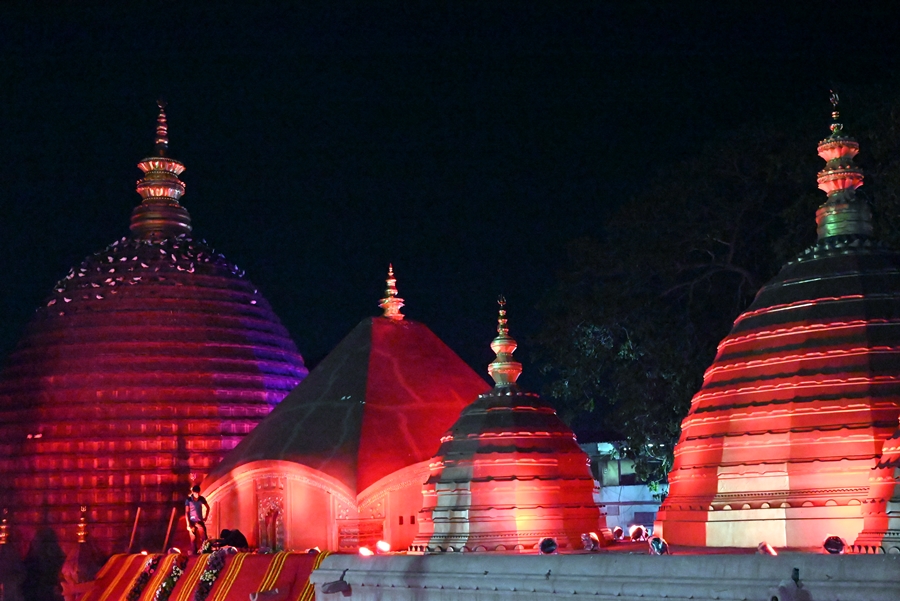
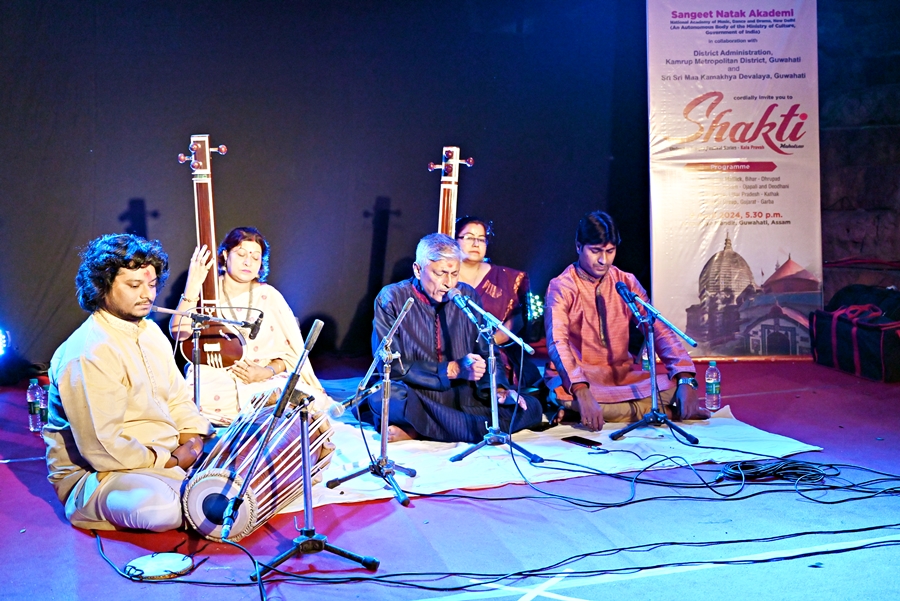
The time was just evening, the place was the courtyard of Shakti Mahapith Kamakshya, and the air was filled with the Shabda Brahma created by Pandit Ram Kumar Mallick and his team. Pandit Mallick ji, a Padmashree awardee for his contribution to the Darbhanga Gharana of Dhrupad, orchestrated the musical tapestry. The architect of that great moment was Sangeet Natak Akademi, which initiated a festival of Music and Dance titled ‘Shakti’, set to resonate across all the Shaktipiths of India. This was the inaugural event of this series.
Listening to Dhrupad by Mallick Ji live is a rare artistic experience, and Sangeet Natak Akademi receives heartfelt gratitude from the audience for curating such a program in Guwahati. Dhrupad, a genre of Indian classical music, is practiced by a select few artists, and public recitals are comparably infrequent. Pandit Ram Kumar Mallick, renowned in this field, is one of the prime representatives of the Darbhanga Gharana. In this concert, he was accompanied by Dr. Samit Kumar Mallick on vocal and Mr. Rishi Shankar Upadhay on Pakhwaj.
Pandit Ram Kumar Mallick
In this concert, Pandit Mallick performed Aalap and Chautal in Raag Yaman and a Durga Vandana ‘Jaya Mangala Sarba Mangal Kar Nihari’. His baritone voice, infused with the ritualistic sensitivity of prayer, transcended the earthly realm, captivating the audience. The melodious utilization of Gauhar Vani and Khandar Vani was evident in his singing. Alongside his gorgeous vocal delivery, the harmonious blend of detailed Aalap, Meed, Gamak, intricate rhythmic patterns, clear pronunciation of Bandish’s verses, and other layakari, made his recital an extraordinary auditory experience. His rendition of Durga Vandana paid homage to the Shaktipith, his voice echoing the strength and aesthetic beauty akin to a philosophical interpretation of a forceful waterfall on a hill, retaining its melodious appeal even after it falls on the ground. Pandit Ram Kumar Mallick’s performance elevated the recital into a spiritual pilgrimage through resonant melodies.
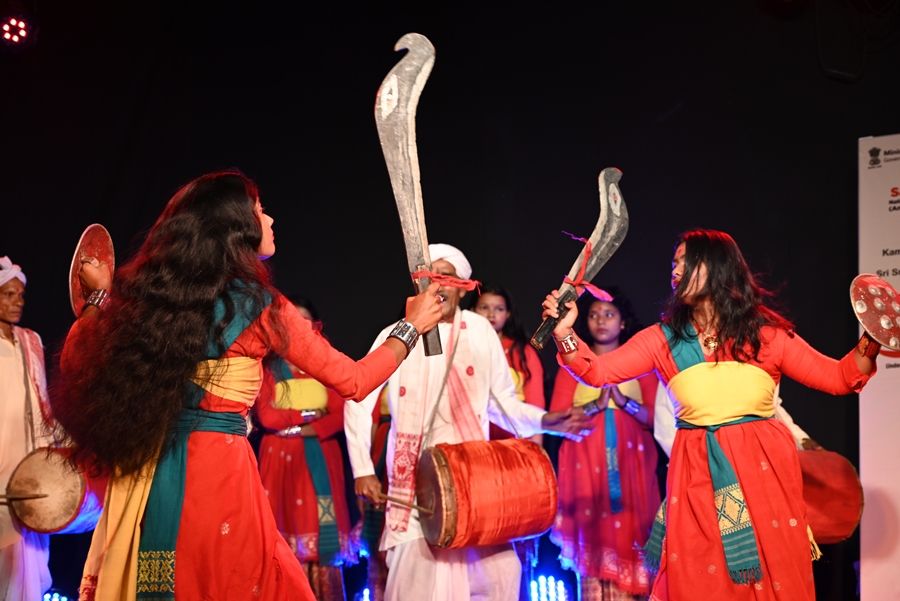
Another significant performance was Suknanni Ozapali (a traditional religious song from Assam with rhythmic body movements resembling dance) and Deodhani Nritya by Drona Bhuyan and his ensemble. Drona Bhuyan, a leading artist of Ozapali and Deodhani, was honoured with the Padmashree by Govt of India. The presentation comprised Ozapali, involving singing, and Deodhani Dance, with Bhuyan playing the lead role in both performances as a singer and drum player in the dance. The team’s performance paid tribute to Shakti through song and dance, resonating with the energetic beats of traditional drums, dynamic movements with war-fighting props, and spirited choreography, crafting a soul-stirring reverence to the Devipeeth, the eternal Shakti.
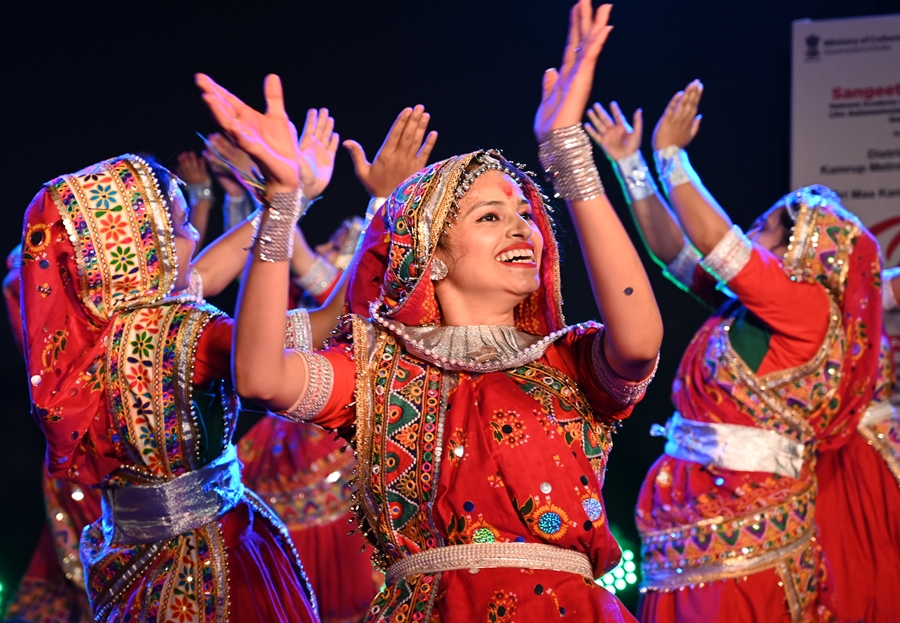
Two other performances in the evening included the Kathak Dance by Dr. Ruchi Khare and her team and Garva Dance by the Sanskar Group of Bhabnagar.
In closing, as an enthusiast of music and dance, I fervently urge Sangeet Natak Akademi to arrange another enchanting concert featuring Rudra Veena in this sacred Shaktipith.