Pratap Phad’s ANANYA

Playwright & Director: Pratap Phad

Group: Suyog Production, Mumbai

Language: Marathi

Duration: 2 hrs 30 mins

The Play

We often get inspired by various icons but seldom an ordinary person, who is just like one of us, steps out of all stereotypes, to do something unimaginable. This is a story of an ordinary girl, Ananya, who possesses the potential to do something extra – ordinary. Being a bright student, she was always showered by praise and her confidence never seemed to cease. She was a free girl with a lot of ambitions and had also got engaged to the person she saw a future with. Everything was pretty and full of sunshine until she meets with an accident. Things start turning upside down in no time and begin to change. But she doesn’t quit. What she does to overcome the obstacles becomes a story which is beyond one’s wildest imagination.

The Director & Playwright

Pratap M. Phad, born on 15th August 1980, has written & directed various one act plays and experimental plays in Marathi and Hindi. He has been awarded with the Best Play and Best Director at Malhar ’03, TESPO 2005-06, Parangat Sanman ’08 and various other competitions. For Ananyaa, he has been awarded Best Director Maharashtra Shasan Puraskar, 2018, Best Writer Sanskruti Kala Darpan Puraskar 2018, Shreshtha Natakakar Aacharya Atre Puraskar 2018. He has also worked and contributed in film industry.

The Group

Mr. Sudhir Bhat formed Suyog Production on 1st January 1985. In 32 years, around 80 plays were produced by Suyog production. Moruchi Mavashi, Gandhi Viruddha Gandhi, Vyaki aani Valli, Sandhyachaya, Char Divas Premache, Sunder Me Honar, Mitra, Lekure Udand Jhali are some of the best plays of Suyog Production. Dilip Prabhavalkar, Prashant Damale, Bharat Jadhav, Vijay Chavhan, Atul Parchure, Vandana Gupte, Bharati Aacharekar and Neena Kulkarni are amongst the known personalities who have performed under this production. Suyog Production is one of the best production houses in Marathi theater industry. Ananyaa is 85th presentation of Suyog Production and in 2018 Ananyaa received 34 awards in various competitions.

Cast & Credits

Baba: Pramod Pawar               

Ananyaa: Rutuja Bagwe               

Priyanka: Anagha Bhagare  

Dhananjay (Dada): Vishal More               

Shekhar Sarpotdar: Karan Bendre               

Jay Dikshit: Siddharth Bodke  

Setting: Pravin Gavali aani Mandali

Lights: Devidas Shivgan, Akshay Jadhav

Music and Projector: Prathamesh Bhuvad, Ruchir Chavhan, Sanjay Umbarkar

Make-up and Hair Dressers: Sharad Sawant, Jyotsna, Chhaya

Costume and Property: Pravin, Prashant, Nilesh

Manager: Santosh Mahadik

Producer: Rajesh Patil, Sandesh Bhat, Pratap Phad


G. Krishanan’s ABIMANYA SUNDARI THIRUKALYAM, Director: D. Elumalai

Playwright: G. Krishanan

Director: D. Elumalai

Group: Sri Thanthoni Amman Therukkuthu Nadaga Sabha, Thiruvannamalai

Language: Tamil

Duration: 1 hr 30 mins

The Play

Duryodhana’s son, Lakshmana Kumaran, is eligible to marriage and Sakuni suggests he may be married to the daughter of Dhurgapuri’s Lord  Krishna. Duryodhana agrees and goes to Dhurgapuri Darbar. Entering, Duryodhana asks Lord Krishna to marry his daughter to his son. But Krishna decided to first speak with his wife. Duryodhana agrees. Mangalakshmi, wife of Lord Krishna, listenes to Krishna, but reminds him that he has promised his daughter’s marriage to Arjun’s son. Lord Krishna says that as Arjun has lost almost all his land, we must reconsider the match. They finally decide to marry their daughter to Duryodhan’s son and announcement of the same intent is made. When their daughter, Sundari, hears this, she gets upset, and sends a message to Abhimanyu through Vayu Bhagvan that he should come immediately and marry her. Abhimanyu gets the message and straightaway sets out to stop the wedding.

Director’s Note

This play is dramatized from Mahabharata’s story of Abhimanya Sundari Thirukalyanam. It was performed in our rural villages. The audience would eagerly wait for Sundari’s entry. Whenever we performed this play, the Kattiya Karan (Narrator), makes jokes and adds humour to the whole play.

The Director

At the age of sixteen, after finishing his school, D. Elumalai underwent training with two Koothu teachers, Kishtappa Meshtri and Srinivasa Meshtri. He learnt Adavu and songs from them. Later he joined Purisai Kalaimamani Subramaniya Thambirar Therukoothu group as an actor. There he learnt Adavu from Kannappa Thambiran and Sambanthan in 1987-88. He founded the Sri Thanthoniamman Therukoothu Nadaga Sabha in the year 1997. He gave training to Thalai -K-kol, a modern theatre group in Pondichery and organised the performance of Nadu Koothan there. In 2006-2008, he got trained in Therukoothu at Pondichery University. He also conducted a 10 days’ workshop at National School of Drama’s Bangalore Centre. He is the chief trainer for Therukoothu. He got Kalai Nan Mani award from the Government of Tamil Nadu.

The Playwright

G. Krishnan has been writing for the last 30 years. His plays have been translated in German and French. He teaches Thabasu and Krishnan Doodhu to the village youths. Thakkayagam, Arjunan Thabasu, Lavakusha, Baratham, Sundari thirukalyam are some of his famous plays.

The Group

Sri Thanthoniamman Therukoothu Nadaga Sabha is the leading Tamil folk Theatre group that promotes the traditional folk art form of Therukoothu. It was established in 1985 by a Group of folk theatre enthusiasts who were involved in promoting Therukoothu in the districts of Thiruvannamalai, Kanchipuram, Chennai, Vellore, Dharumapuri, Pondicherry. They have performed in the National Theatre festival (19th BRM at New Delhi) and have also conducted a number of workshops with college students, foreign research scholars and school children.

Cast & Credits

On Stage: Ravichandran, Madhavan, Vijay, A. Ramakrishnan, M. Haridass, Ethiraj, E. Manikandan, Subramanian, Mukundan, Elavarasu, S. Rajesh, Venkatesan,

Harmonium: Seetharaman

Mirudangam: Krishnamoorthy

Mughaveenai: S. Chandiran

Lighting: E. Sukumar

Design & Props: E. Suresh

Translator & Coordinator: M. Manivanna


Ram Gopal Bajaj, the founder of Bharangam to be felicitated on the Inaugural


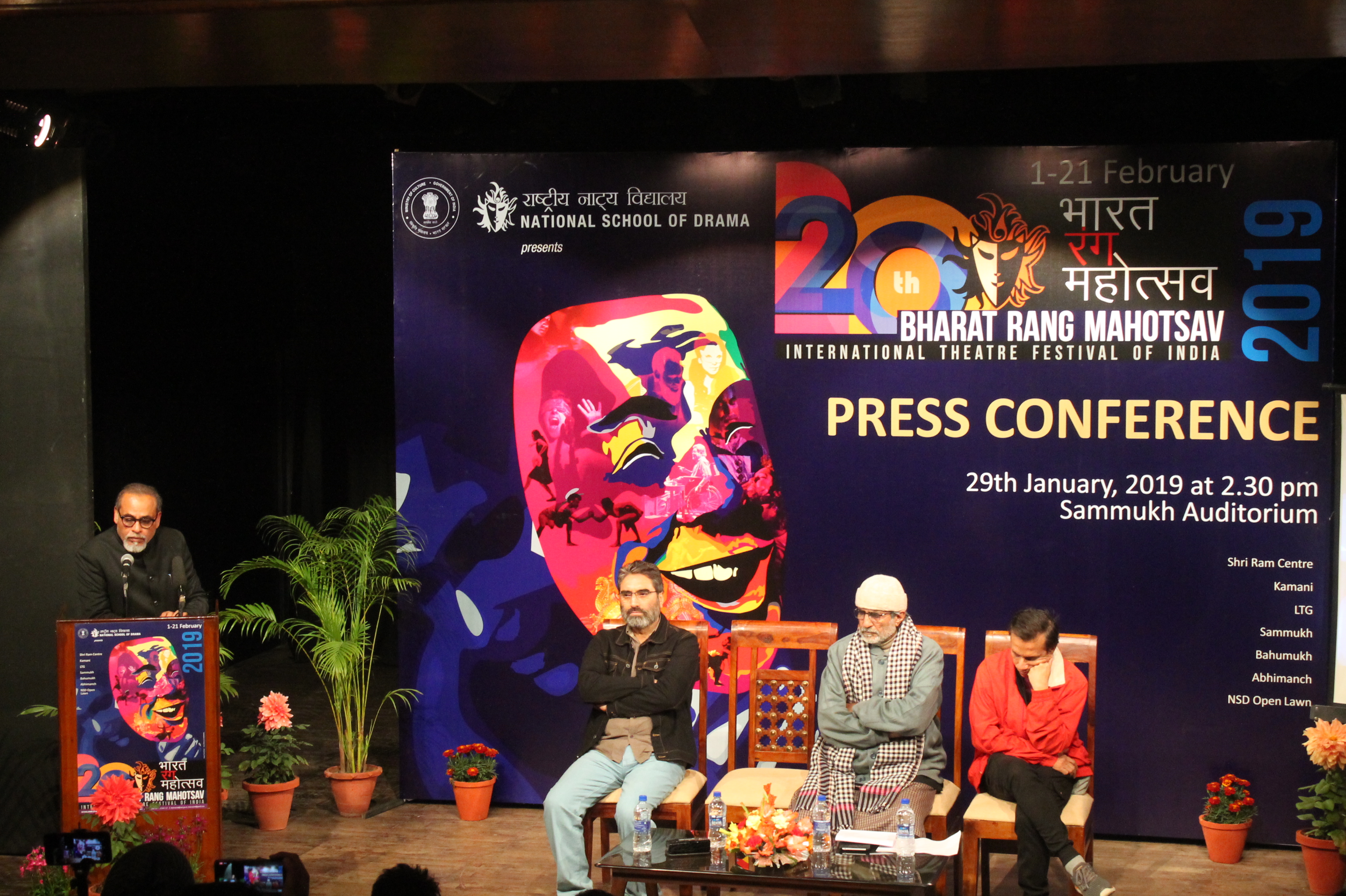
National School of Drama’s 20th Bharat Rang Mahotsav, the International Theatre Festival of India, is Back with a Bang; Gears Up to Dazzle India

The International theatre festival of India, Bharat Rang Mahotsav, BHARANGAM,  will kick off in New Delhi on 1st February, 2019 and culminate on 21st February, 2019 and will cover 6 cities in India with 111 shows and various allied events.

A key feature of the inaugural ceremony of the festival is the felicitation of its founder Ram Gopal Bajaj, who was the Director of National School of Drama. It was his visualisation of the idea of bringing best of theatre from India and later all over the world, to help the students of NSD to see the possibilities of theatre and also an experience for the audience to absorb and be enriched. 

Bharat Rang Mahotsav (BRM), the annual theatre festival is organized by the National School of Drama (NSD), was established two decades ago, by Ramgopal Bajaj to stimulate the growth and development of theatre across India. Originally a national festival showcasing the work of the most creative theatre workers in India, BRM has evolved to international scope, hosting theatre groups from around the world, and is now the largest theatre festival of Asia. Till date, BRM was celebrated in New Delhi and has travelled to several cities in India, presenting an overwhelming 1787 plays, and riveted thousands of audiences who basked in the glory of heart-winning stories and superior performances.

The 20th edition of BRM will include various national and international performances, and associated events such as, ‘Director’s Meet’, ‘Living Legends’, and ‘Master Class’. This year, the festival pays a tribute to Mahatma Gandhi, the ‘Father of the Nation’, on his 150th birth anniversary and will stage plays depicting the Gandhian philosophy and the dilemmas Bapu had as a person. The 20th Bharat Rang Mahotsav also hold parallel festival in other cities including Dibrugarh (Assam), Varanasi (Uttar Pradesh), Ranchi (Jharkhand), Mysore (Karnataka), and Rajkot (Gujarat).

The 21-day long festival will stage plays in Hindi, English, and other regional and international languages. International productions from Bangladesh, Poland, Russia, Sri Lanka, the Czech Republic, Italy, Nepal, Romania, and Singapore will also enthrall the audience during the festival.


Apart from plays, the festival will also host folk performances and other traditional performing art forms, street plays by around 50 dramatic societies of colleges in Delhi, and national and international seminars discussing the theatre scenario in India and abroad.BRM is organized by National School of Drama (NSD), an autonomous institution under the Ministry of Culture, Govt. of India and one of the foremost theatre training institutions in the world.

20th Bharat Rang Mahotsav (BRM), the largest theatre festival in Asia, organized by the National School of Drama (NSD), is all set to bring its bouquet of plays, interactive sessions, and other cultural events to cheer up the winter afternoons of theatre enthusiasts in the city.

The inaugural ceremony will be held at Kamani auditorium on 1st February, 2019 at 6:00 PM followed by the performance of ‘Karanth ke Rang’, directed by Amod Bhatt. The 50-minute long performance is a medley of songs composed by late Shri B V Karanth, a stalwart of Kannada and Hindi theatres. Shri Karanth was a prolific composer of songs and scripts for theatre and directed and acted in many productions.

The festival, which enters its 20th edition this year, is celebrating the 150th birth anniversary of Mahatma Gandhi – 4 of the plays to be staged on the life, philosophy, and principles of the ‘Father of the Nation’. The festival will host 69 Indian and 15 foreign plays across India, selected after screening. Additionally, 9 folk productions, 5 plays by NSD diploma students, 1 production from the Sikkim center of NSD, 3 plays by the NSD Repertory as well as 5 invitee plays by eminent theatre practitioners will captivate the theatregoers across India.

The national capital will host 89 plays: 25 plays in Hindi, 16 in Bengali, 5 in Kannada, 2 in Marathi, 2 in Odia, 2 in Gujarati, 2 in Manipuri, 3 in English, 2 in Assamese, 2 in Malayalam and 1 each in Maithili, Telugu, Nepali, and Sanskrit, in addition to 15 foreign plays, the festival also brings 8 folk performances to theatre aficionados in the city.

The 21-day long festival this year will include plays in Hindi, English, and other regional languages. International productions from countries such as Bangladesh, Poland, Russia, Sri Lanka, the Czech Republic, Italy, Nepal, Romania, and Singapore as well as non-verbal, folk, and multi-lingual performances will enthrall the audience during the theatrical spectacle.

The performances in New Delhi will be held at Bahumukh and Chahumukh (7:30 PM), Open Lawn (6:00 PM), and Abhimanch (8:30 PM) at the NSD’s Bahawalpur House campus as well as nearby Sri Ram Centre (4:00 PM), LTG (5:30 PM), and Kamani (7:00 PM) auditoriums.

Apart from the spellbinding performances and interaction with thespians and eminent personalities from the world of theatre, the festival in Delhi will also have 2 international and 2 national seminars on theatre. The national seminars to be held in New Delhi will attend to the topic ‘Is Modern Theatre Inclusive?’ and will hold sessions dedicated to ‘Notion of State and Representation’, ‘Unrepresented Form’, and ‘Non-Governmental Curating and Funding Policy’.

Besides, the NSD campus will be abuzz with street plays, ambience shows, and ‘Theatre Bazar’, a motley of stalls offering a range of products and culinary delights. The youth forum shows will comprise performances by dramatic societies of nearly 50 colleges in Delhi while ambience performances will bring folk dance and other traditional performing art forms.

In keeping with its concerted efforts to promote theatre among people and take select performances to other parts of the country, the NSD arranges parallel festivals in Dibrugarh (4th to 10th February, 2019), Varanasi (7th to 13th February, 2019), Ranchi (9th to 15th February, 2019), Mysore (11th to 17th February, 2019), and Rajkot (13th to 19th February, 2019).

“The art of theatre is the oldest and the strongest medium that conveys human emotions in a manner that defies temporal boundaries. We are delighted to usher in the Bharat Rang Mahotsav to its 20th year and have made all efforts to bring a selection of quality plays, choosing the best out of 960 submissions. There are 9 folk performances being presented in Delhi as well as invitee plays and productions in regional languages. We have tried to accommodate as many young theatre enthusiasts as we can, since the institution aim to foster the growth of young talents through the platform of BRM,” says Shri Suresh Sharma, Director In-charge, National School of Drama (NSD).

“Theatre is a celebrated art form across the world and I am happy that this festival gives us a chance to witness many of the plays which have received critical acclaim globally. BRM aims at bringing together people and hence, we have spread the festival across the country so that theatre reaches more and more people. BRM has been a very successful festival attracting a lot of audience, including first-timers and we hope a similar run this year too,” says Dr. Arjun Deo Charan, Acting Chairman, NSD Society.

About National School of Drama (NSD)

The National School of Drama is one of the foremost theatre training institution in the world and the only one of its kind in India. It was set up by the Sangeet Natak Akademi as one of its constituent units in 1959. In 1975, it became an independent entity and was registered as an autonomous organization under the Societies Registration Act XXI of 1860, fully financed by the Ministry of Culture, Government of India. It offers 3-years training program in every aspect of theatre with a special focus on the practical implementation of theories. The NSD has two performing wings – the Repertory Company and Theatre-in-Education Company (TiE) that started in 1964 and 1989, respectively.
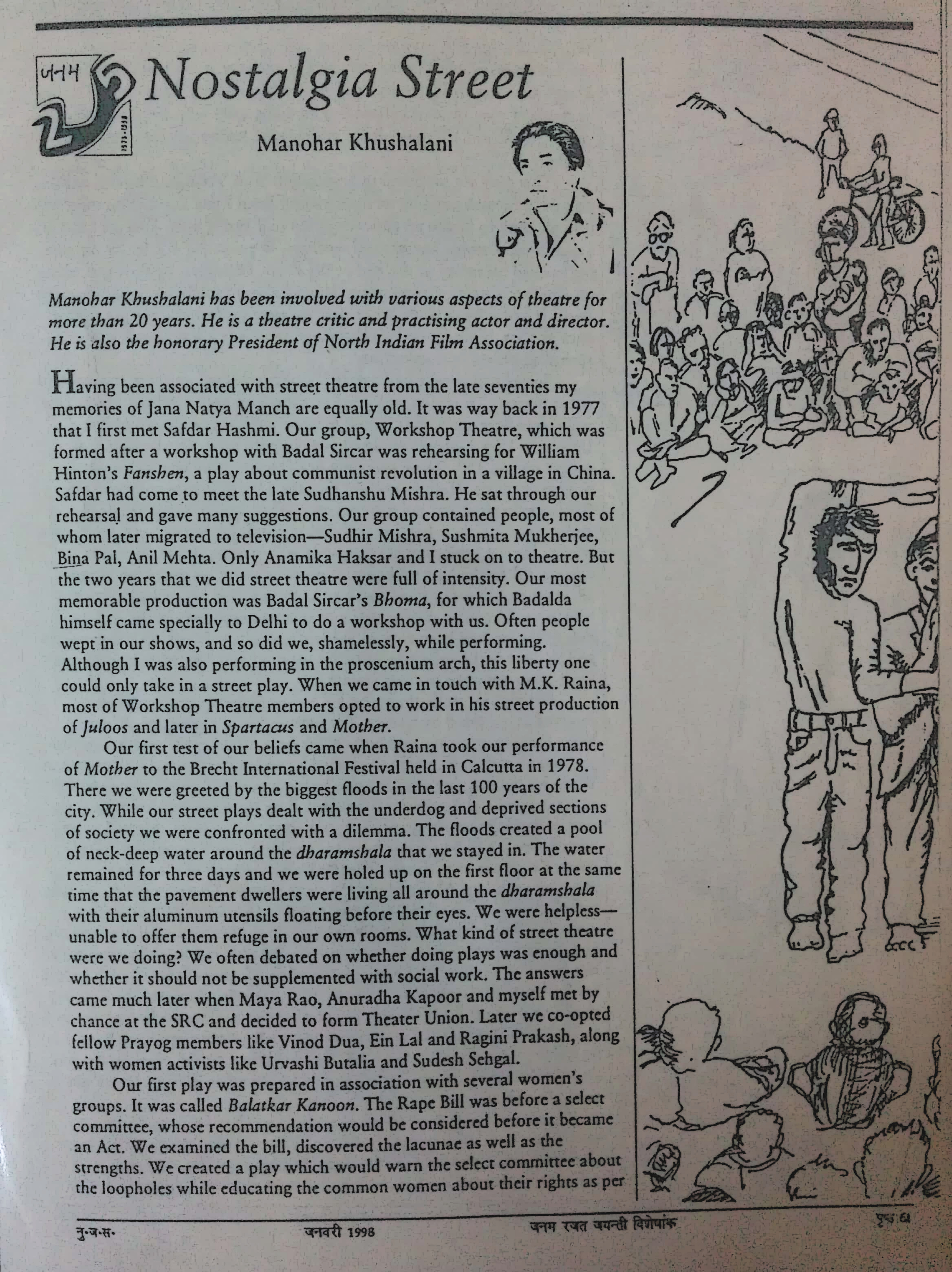
Nostalgia Street by Manohar Khushalani


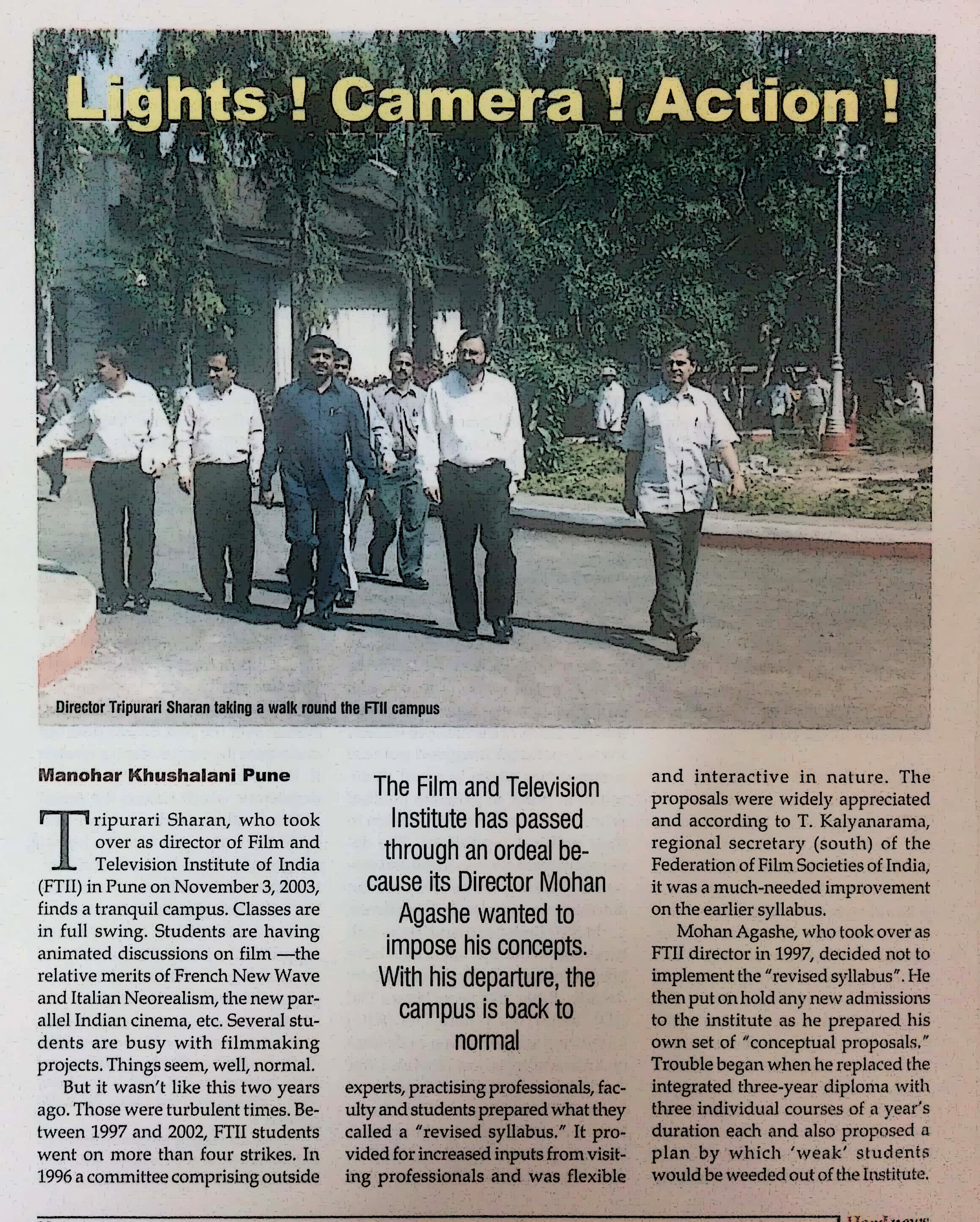
Lights ! Camera ! Action ! by Manohar Khushalani


Kartik

The Play & Director’s Note
This play has a storyline that could have been based on tomorrow morning's newspaper headlines. Using the wonderful theatrical device of three actors playing the central character of Kartik, we are able to enter his fractured world. We simultaneously see him as he was before the accident that changed his life; we also see him as he is immediately after the accident, recovering in hospital, at home and in school; as well as when he is an adult. The play brings together the present, past and uture in a seamless whole. It has been a fascinating journey with the actors and my own team. We have interviewed teenagers, their parents and teachers; watched their interactions in school, home and on the metro; created improvisations; spent hours mastering the intricate choreography; enjoyed the shopping for clothes that capture today's Delhi; and worked hard at creating over 36 characters,
played by just 14 actors!

The Director
Educationist, theatre director and activist, Feisal Alkazi lives and works in New Delhi. Over the past forty years he has carved his own niche with his group, Ruchika. He has directed over 200 plays with adults in Hindi, English and Urdu. Most recently, two plays, Noor and A Quiet Desire, written by him have been produced. In addition, he has directed over 100 productions for schools all over India. Ruchika also runs a training program in theatre for children since 1997. Feisal has written 24 books as well and is a counsellor with Sanjivani. In the field of disability, he has directed 30 films and produced several plays.

The Group
The Theatre-in-Education Company (Sanskaar Rang Toli) of the National School of Drama was established on October 16, 1989, and is one of the important educational resource centres in the  country. The TIE Co. consists of a group of actor-teachers working-with and performing-for children. The major focus of the company is to perform creative, curriculum based, and participatory plays in school, designed and prepared specially for children of different age groups. The company holds a one month long intensive Summer Theatre Workshop for Children organized in May-June every year. TIE Co. has participated in many international theatre festivals and symposia in countries including Poland, China, Philippines and Japan. Jashn-e-Bachpan and Bal Sangam are biannual festivals
organised by the company where it invites plays by and for the children from different parts of the country.

Cast & Credits
Sutradhar Kartik Manoj Kumar
Old Kartik, Gym Teacher, Shashank Manish Saini
New Kartik Mridul Anand
Mummy Aparna Kapoor
Papa, Changezi, Bhaiji Mahesh Kumar
Raghav Manoj Sharma
Himanshu, New Dancer Tasabber Ali
Nancy Jyoti Bala
Doctor Fatima, Rubina, Announcer Jyotsana
Inspector, Nurse1 Nidhi S Sasthri
Anshika, Nurse2, Vicky Soumita Kundu
Anthony, Shiny Piyush Verma
Drug Peddler, Teacher Kaleem Zafar

All Street Voices & Dancers Jyotsana , Aparna Kapoor, Soumita Kundu, Piyush Verma,

Mahesh Kumar, Manoj Sharma, Nidhi S Sasthri

Choreographer Vishwa Kant Singha
Assisted by Sandeep Kashyap
Costume Design Shaik Sheeba
Assisted by Jyotsana
Set, Poster & Brochure Design Jagan Shah
Assisted by Kamal Kumar
Light Design Mona Chawla
Assisted by Joginder Singh, Dhirender Kumar
Light Design Mona Chawla
Assisted by Joginder Singh, Dhirender Kumar
Music Operation Sheel/Vikram Jeet Singh
Stage Manager & Property Nidhi S. Sasthri
Tailor Saroj Silswal, Akhtar Ali
Sound S. Manoharn, Pratap Singh, Subhanjan
Photography & Videography Deepak Kumar
Assistant TIE Co. B.S Rawat
Administration Staff Pirat Singh Negi, Darmiyan Singh, Shailender Kumar,

Neha Bhatt

Attendant Md. Rashid, Pawan Kumar
Chief of TIE Co. Abdul Latif Khatana
Asst. Director Mona Chawla
Translation & Adaptation Kiran Deep Sharma
Design & Direction Feisal Alkazi


Sukhanshi Bhandato Amhi by Abhiram Bhadkamkar

The Play
Dr Shridhar is enjoying a successful, happy and rich lifestyle with his beautiful wife Mita and teenage son Akshay. He wants to build a multi-utility hospital as a future provision for Akshay. He eyes a central piece of land to build his dream hospital. But the land is reserved as children’s playground. He is prepared to use his political influence and monetary powers to acquire the land. And then enters Sada (Sadashiv) in Dr Shridhar’s life. Sada, a schizophrenic patient, was jailed for killing his own wife and son, in his schizophrenic state. Throughout the treatment period, Sada keeps on asking intriguing questions, and throws some challenging situations at Dr Shridhar and Mita. The play finishes on an interesting and unexpected turn.

The Director
Napolian Almeida was born in Vasai, Maharashtra, India in Christian family. Napolian’s father was a teacher in a Marathi medium school. His father always encouraged the children to read books. Napolian developed interest in reading books about drama and plays. He started performing at a very young age. The challenges and difficulties faced during the early years motivated Napolian to study more about acting and acquire formal training from workshops. Napolian’s theatre career then progressed by active participation in dramas for organizations like Nutan
Mandal, Jeevan Darshan, Jeevan Jyoti, St Xavier’s Club and currently in Australia with Marathi Association Sydney Incorporated. Though an engineer by profession, Napolian continued to follow his passion in acting and direction. He
has acted and directed many plays including one-act plays and has won awards.

The Playwright
Abhiram Bhadkamkar is an alumnus of National School of Drama. His acting in films has won him accolades. Abhiram has explored many possibilities of expression in various art forms, and created a niche for himself as a multidimensional artist. Abhiram is adroitly active in feature films, plays and literature. He has been successful in making a mark on the front of writing plays, novels and screen plays; conceiving films as a director; and expressing as an actor. His plays are performed in Hindi, Kannad and Guajarati in addition to Marathi theatre. His collection of stories and novels are published by publishers/ publications of repute. Some of his popular plays / production are Hasat Khelat, Pahuna, Jyacha Tyacha Prashna (Sawal Apna Apna), Ladi Najaria, Dehbhan, and Sukhanshi Bhandto Amhi.

The Group
The team of Sukhanshi Bhandato Amhi are members of the Marathi Association Sydney Incorporation (MASI). MASI is a non-profit community organisation established more than 27 years ago. MASI promotes Marathi language, culture and customs through Marathi Akashwani Sydney, Marathi school, and cultural events and drama activities. Theatre is one of the iconic interests of Marathi community. Members of Sukhanshi Bhandato Amhi are volunteers and come from various professions. Despite being busy with their professional career, they are passionate about Performing Arts and theatre activities. This passion and interest brings them together and keeps them energised and motivated even through the initial settlement challenges. Members of MASI have staged a drama activity almost every year. Few names to mention here are Ghashiram Kotwal, Mala Kahi Sangayachay, Durga Ban Gayi Gauri, etc.

Cast & Credits

Mrs Pradhan Apoorva Athawale
Dr Shridhar Napolian Almeida
Kamalabai and Suman Nilima Berde
Sadashiv Chinmay Abhyankar
Mita Manasi Gore
Akshay Mandar Pathak
Lights Makarand Bildikar
Background Music Nitin Kundap
Stage Ahirwad Athawale, Ganesh Gavde, Charudatta Bhadkamkar
Costumes Sanjyot Samudra, Olivia Almeida
Make-up Sanjyot Dongre
Playwright Abhiram Bhadkamkar
Direction Napolian Almeida


Macbeth Mirror by William Shakespeare

[ratings]
The Play
Macbeth is a play about evil that emanates from the dark power whose agents are the three weird sisters. The present interpretation does not visualize Macbeth externally as a historical record; but rather as a re- creation of the event as mirrored in the minds of the weird sisters. It is seen as a phenomenon transcending time and space: the incantations and rituals of the dark aspect of the Tantric cult used throughout the presentation represent this pervasive evil embodied in Shakespeare’s play. Evil is here invoked by, and its outcome experienced by, the three weird sisters. To concentrate on this emergence of evil, the original text has been edited so as to focus on the two central victims of the historical event who succumb to this evil due to their lust for power.
The text followed is the only Bengali translation which is faithful both to the rich poetry and the metric structure of Shakespeare’s original text, and runs in harmony with the Sanskrit incantations used in the production.

Director’s Note
In Hinduism, goddess Kali has two different powers; one positive and the other negative. Generally we worship the positive power. But some people worship the negative power to practice hypnotism, basikaran, maron etc. They start wearing all sorts of things in their hands, waist, neck etc. In our production three women worship the negative power of Goddess Kali. They start worshiping the negative power. As a result they turn into witches. We believe that witches exist only in the mind. Therefore in our production all the characters like Macbeth, Banquo, Lady Macbeth etc. continuously switch between witches and the original character. In this production three actresses perform all the characters.

Director
Santanu Das took the Diploma in Dramatics from National School of Drama, New Delhi. Presently he is working at Rabindra Bharati University as Assistant Professor in the Department of Drama. He started his career as director & designer in 1990 with the play Atha Dar Pal Katha. He has directed Power of Darkness, Ebom Indrajit, Romeo Jeannette, Raisin in the Sun, Manushi, Oedipus Turranus, Ghare Baire, and many more. In 2015 he jointly directed a production named ‘Crossing’ with Aude Marehsal, at Mondvil, France. He has presented papers at Rhodes University, South Africa & Elsinore Conference 2016, at Helsingor, Denmark. Recently his production Macbeth Mirror was invited to the Summer Shakespeare Festival, Ostrava, Czech Republic, and 21 st Gdansk International Shakespeare Festival, Gdansk, Poland.

Translator
Prof. Dutt was awarded D.Lit. in Drama for his pioneering multi-disciplinary work on the extra-rational roots of the Tragic Experience. He has written and directed children’s plays, translated and produced Shakespeare in Bengali, and also directed Tagore plays as well as improvised play-texts. In the international arena, he has collaborated with Gunter Grass, Hansgunther Heyme and Peter von Becker. He has also been invited to Italy and Poland, to deliver lectures.

The Group

Kalyani Kalamandalam was established in 1995 and in the last twenty-two years the group has produced fourteen major productions. Some of its previous productions are Ebong Indrajit, Romeo Jeannette, Manushi, Oedipus Turranus, Ghare Baire, Gollachut and Shakespeare’s Macbeth as ‘Macbeth Mirror’ directed by Sri Santanu Das. It has performed in countries like France, Poland, Czech Republic, Nepal and Bangladesh.

Cast & Credits
Actors Monalisa Chatterjee, Ananya Das, Jayeeta Das
Drums Chakra Pani Dev, Shovan Chakraborty, Prasenjit Halder
Set & Costume Santanu Das
Asst. Set Dipankar Halder
Asst. Costume Shipra Dey
Lettering Neelavo Chottpadhyay
Choreographer Deb Kumar Paul
Music Subhadeep Guha
Lights Arnab Kumar Ray
Properties Prasenjit Halder & Jayeeta Das
Subtitle Controller Anirban De
Production Manager Mahabub Biswas / Haradhan Ankureh
Playwright William Shakespeare
Translator Dattatreya Dutt
Design & Direction Santanu Das


Ruddhasangeet by Shri Bratya Basu

The Play
Shri Debabrata Biswas was a popular Rabindra Sangeet singer of Bengal. The artist’s involvement with, and severance from, Gananatya Sangha, his renunciation of the communist party, his differences with the music board of Biswabharati University and his inexorable rise to fame, his opposition against socially renowned institutions, all echoed through the many associations he shared, are some of the notable areas of focus within the many levels of this play. Apart from Debabrata Biswas, the other celebrated characters in the play are Hemanga Biswas, Salil
Chowdhury, Ritwik Ghatak, Shambhu Mitra, Bijon Bhattacharya, Tripti Mitra, Jyoti Basu, Pramod Dasgupta, Suchitra Mitra, Manjushree Chaki Sarkar, Santosh Kumar Ghosh. Ruddhasangeet bears a historic testimony to the lives of Bengalis in East India, to their social, economical and political ups and downs through almost half a century.

Director’s Note
Ruddhasangeet is a chronical, a saga, the flavour of mass music, the fashion – Ruddhasangeet, the spread of popular music, and the liaison with both, the singer and the person Debabrata Biswas, are all represented in this play. A journey of thirty years through the thick and thin of the artist’s life and limelight, are given the freedom of voice, the liberty of stage and a course of light. Providing and extra edge to the play is an original and rare treat involving both verbal and physical expertise.

The Director & Playwright
Bratya Basu, is an accomplished theatre artist, a playwright and director. Basu launched his career as a dramatist and director with the play Ashaleen (1996), described by theatre critics as the first post- modernist Bengali play. His noted plays (playwright, acting, direction) thereafter include Aranyadeb, Shahar Yaar, Virus-M, Winkle-Twinkle, 17th July, Chatushkon and many more. Basu has baggedmany awards and recognitions both in Theatre and Film. Some of them include Hyderabad Bengali Film Festival Award, Ritwik Ghatak Honorary Award, Kalakar Award, Shyamal Sen Memorial Award, Dishari Award, Satyen Mitra Award, Shilpayan Samman, Srestho Natya Nirman etc. Bratya
Basu, is currently Hon’ble Cabinet Minister and in charge of the Ministry of Information Technology & Electronics for the state of West Bengal. He has created his own space in contemporary theatre by moving beyond its existing boundaries. He formed his own theatre group Bratyajon in 2008.

The Group
Bratyajon was established by Bratya Basu in 2008. Apart from theatrical productions, the group is active in many associated fields. An important activity of the group is to organize an annual theatre festival. Bratyajon confers Bishnu Basu Smriti Puroskar in the loving memory of late Bishnu Basu and also organizes Bishnu Basu Memorial Lectures & Nitika Basu Memorial Lectures. Other activities include theatre publications comprising of a theatre journal and participation in the book fair. Bratyajon conducts theatre workshops for children that culminate in a stage performance.

Cast & Credits
Debabrata Biswas Debsankar Halder
Arun Debasish Roy
Bijan Bhattacharya Raktim Datta
Jyoti Basu Bishmoy Roy
Promod Dasgupta Prantik Choudhury
Nirmal Gosh Nabarun Barik
Binay Roy Prasenjit Chattopadhyay
Chorus Ranjan Dutta
Chorus Moloy Bera

Hemanga Biswas Samrat Ghatak
Rittwik Ghatak Krishnendu Dewanji
Salil Chowdhury Subrata Pathak
Subhas Mukhopadhyay Tanmay Sur
Police/Purnendu Chandranath Roy
Khokon Surojit Paul
Shambhu Mitra Billwatosh Chattopadhyay
Police/Angshu Abhijit Ghatak
Srikanta Prabir Basu
Gopesh Pradip Roy
Tushar Arindom Ghosh
Tripti Mitra Rumpi Paul
Lalita Ananya Roy
Manjusree Chaki Antara Bandopadhyay
Suchitra Mitra Sushmita Bandopadhyay
Dancer Sayeri Bhattacharya
Dancer Priyanka Chatterjee
Shila Poulami Basu
Santosh Kumar Ghosh Bratya Basu
Light Design Sudip Sanyal
Light Operation Prithiwis Rana
Set Design Soumik-Piyali
Set Making Tinku-Modon
Music Tapan Sinha
Make-up Alok Debnath
Background Score Swapan Bandopadhyay
Costume Amit Roy
Co-ordination Prithiwis Rana
Playwright & Director Shri Bratya Basu


Kinu Kaharer Thetar by Manoj Mitra

The Play & Director’s Note
The minister of state of Putna has abused a woman. The governor general says, ‘If it is not settled by law, the throne will be seized’. The king is now in trouble… the minister of state is his best friend, so how can he submit him to 14 slams of whip? He advises the minister to find out someone who will come to the court and state that he is the one who has committed the crime, not the minister, so that the punishment will be delivered to him. Jagadamba hands her lazy husband Ghontakarna to the minister, in exchange of four bags of money. Since then, all thieves, robbers, marked criminals gather in line at Ghontakarna’s yard, with bags of money; they do the evil, and punishment goes to ‘punishment receiving officer’ Ghontakarna. Jagadamba is happy that finally her husband has learnt to earn money…The king is happy for the throne is saved….The minister of state is happy, because there is no problem of law and order…Peace is everywhere…..But, it doesn’t continue as easily….The king suddenly gets accused of
murdering a goat. The intelligent governor general submits him to be hanged. The king says, ‘What to worry for? I have Ghontakarna. Go, Ghontakarna, stand up on the dice and get hanged.’ And then…?

The Director
Kazi Toufikul Islam is a creative, highly trained and confident actor with strong stage instincts and extensive formal training. He has the ability to work successfully as part of a team in cooperation with directors, designers, stage managers, fellow actors, camera operators, and a variety of backstage and production workers. He possesses a proven ability to learn lines and stage techniques quickly, as well as being punctual and prepared when attending rehearsals and auditions. He is committed to achieving the highest standard of performance and is always willing to listen and learn from others.

The Playwright
Manoj Mitra is the winner of Sangeet Natak Academy award for playwriting, Calcutta University Gold Medal and Calcutta University Best Bengali Stage Centenary Award, Asiatic Society’s Gold Medal, Munir Chowdhury Award from Bangladesh Theatre Society, Dinabandhu Puraskar, D Litt., Kalyani award, ABP Ananda Shera Bengali award for Theatre, Filmfare Award for Best Actor, Kalakar Award for legendary performance in cinema and many more.
Manoj Mitra, along with late Parthapratim Chaudhuri and some college friends, founded the theatre group Sundaram. He has till date written over a hundred plays. Many of his plays like Sajano Bagaan, Galpo
Hekim Saheb, Parabas, Ja Nei Bharatey etc. are considered classics of Bengali literature and included in school and college texts. His plays are performed in Bangladesh, America, Australia, England and other  places.

The Group
Established in 1997, Prachyanat is one of the leading theatre groups of Bangladesh. The group has many wings including Prachyanat School of Acting and Design, The Theatre in the Open, Prachyanat for Children, Theatre–lab Production, Prachyanat Research Cell, and the Musical Ensemble. In the last eighteen years Prachyanat has given eleven full-length productions.

Cast & Credits
Narrator Jaganmoy Paul
Clown Md Mizanurrahman

Kinukahar/Ghontakarna Mohammad Monirul Islam
Wazir Rontikbipu
Mouni Baba Mohammad Abu Bakar Siddiki
Lord Shahriarrana Jewel
Jagadamba Chetonarahmanvasha
Udashini Sanjida Anwar
King Shahriar Ferdous
Sentry Mohammad Rafiqul Islam
Police Officer Md Saiful Islam Jarnal
Musician 1/ Neighbour 1/Courtier 1/ Robber 1 Mohammad Fuadmian
Neighbour 2 /Courtier 2/Robber 2 Tanjim Imran Mahmood
Neighbour 3/Courtier 3/Robber 3 Been E Amin
Neighbour 4/Courtier 4/Robber 4 Al Amin Khandoker
Neighbour 5/Courtier 5/Robber 5 Mohammad Asad-Uz-Zaman
Musician 2/Neighbour 6 Parvin Akhter
Neighbour 7/Courtier 6/Robber 6 Md Faysalkabirsadi
Musician 3 Syed Rifatahammad Nobel
Musician 4 Kamrul Islam
Lights Mukhlesurrahman
Props Kamrunnahermony
Set Shafaat Khan
Make-up Mohammad Ali Babul
Playwright Manoj Mitra
Director Kazi Toufikul Islam