11th Bal Sangam begins in the Capital amidst much fanfare / Manohar Khushalani
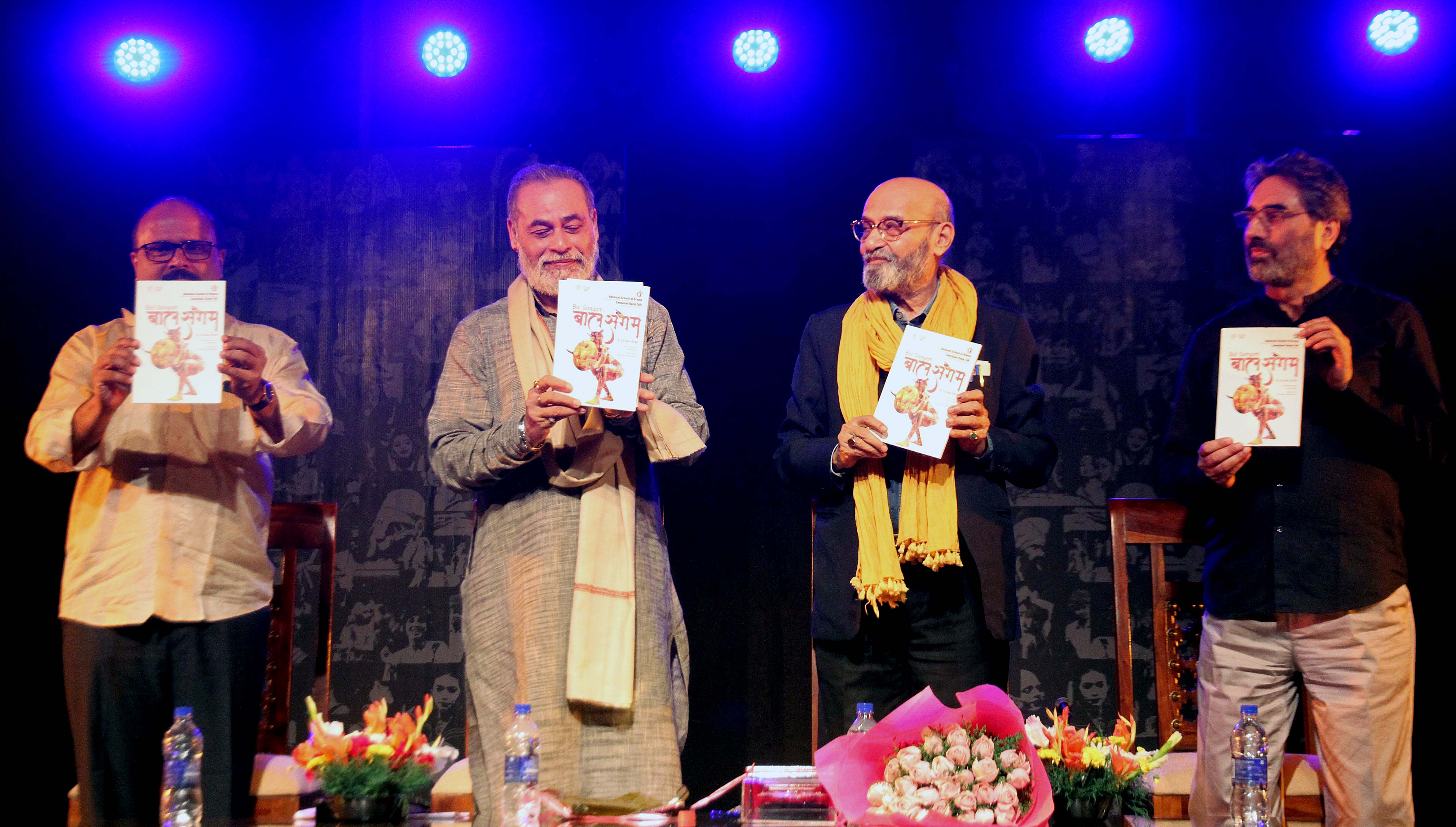
National School of Drama today inaugurated its, evergreen, much-awaited 11th Bal Sangam – a folk & traditional performing Arts & folk Theatre festival, at the lush green lawns of the campus amid much fanfare. Watch the film made on the occasion by my Digital Media students at IIITD: Sahil Yadav, Aseem Saini & Dilnawaz Ashraf

https://youtu.be/BtmyaJwBD2I

<iframe width=”560″ height=”315″ src=”https://www.youtube.com/embed/BtmyaJwBD2I” frameborder=”0″ allow=”accelerometer; autoplay; encrypted-media; gyroscope; picture-in-picture” allowfullscreen></iframe>

The opening ceremony of Bal Sangam witnessed the gracious presence of Renowned Theatre Actor & Director, Prof. Ram Gopal Bajaj, Prof. Suresh Sharma, Director-in-Charge, NSD, Abdul Latif Khatana, Chief, TIE Co., and Prof. (Dr.) Abhilash Pillai, Dean-Academic.


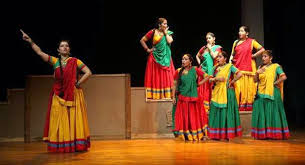
The opening ceremony was followed by Rangoli – a stage performance by Folk & Traditional child artistes of India, choreographed by renowned choreographer Shri Bharat Sharma, who has an illustrious career spanning over three decades.

Renowned Theatre Actor & Director, Prof. Ram Gopal Bajaj said, “Without relation and communication there is no world. Festival like Bal Sangam help building relationship among the children of different culture. Strong relationship and bonding lead to form a strong nation.”

Prof. Suresh SharmaDirector-in-ChargeNational School of Drama said, “I’d like to thank everyone who managed to take out their valuable time to come here and give their blessing to the participating kids. I welcome all the participants and audience to this festival. We are proud that the TIE Company has been working hard to make children know about their own culture, traditions, and values. NSD will continue taking such initiatives in the future as well.”

Mr. Abdul Latif Khatana, Chief, Theatre-in-Education said, “Theatre-in-Education has been continuously trying to reach and touch the lives of children across the country in last three decades. Apart from folk & traditional performing arts and folk theatre, we conduct interactive workshops among participant children from different parts of the country.  The experience and exposure they get at such a young age, will definitely inspire them to do something in the field of folk and traditional performing arts and folk theatre in the future.”

Prof. (Dr.) Abhilash Pillai, Dean-Academic, extended the vote of thanks to chief guest, children and the audience for taking out their time and being a part of Bal Sangam.

Bal Sangam provides the platform for young talent who have never got chance to show their talent and whose performances have never been witnessed at national level. Long Man, Rajasthani Puppet, Behroopiya, and Magician etc. are the special attraction of the festival. Various types of art and craft workshops are also being conducted during the festival.

This year around 15 productions from 12 states are participating in the festival. Bhavesh Chau Nritye Kala Kendra Jharkhand will perform Kharsama Chaun Sholi, likewise Manipuri Folk by Thang-Ta Cultural Association Manipur, Rajasthani Lok Kala by Manganiar Group Rajasthan Rajasthan, Gotipua Dance by Aradhana Dance Academy Odisha, Bodo Folk by Sifung Harium Afad Assam, Oggudolu by Kunta Sadaiah Oggudolu Group Telangana, Kalarippayat by Hindustan Kalari Sangam Kerala, Punjabi Folk by Punjabi Folk Art Centre Punjab, Malvi Lok Nritye by Pratikalpa Sanskrit Sansthan Madhya Pradesh, Gujarati Folk Dance by Kalrav Sewa Trust Gujarat, Pasumukha (Animal Mask Dance), Kandhei Nata (Puppet Dance) Kothishala by Bichitra Barnali Natya Sansada Odisha, Tiwa by Tiwa Bhakha – Sanskriti Charcha Somittee Assam and Folk & Traditional Theatre performances will be Ram Vijay by Manjula Kalakendra Assam, “Gosian Pather” by National Bhand Theatre J & K, and Yakshagana Dance Drama by Yakshagana Kendra Karnataka.

 The Bal Sangam festival is an ensemble of various performing traditional art forms presented by children, with the objective of encouraging children to continue traditional performances so as to preserve our cultural heritage in this rapidly changing world. The fanfare and hub of Bal Sangam 2019 start from 9th November and goes on till 12th November 2019 at the New Delhi Campus of NSD at Bhagwandas Road. Timing- 4:00PM to 8:00PM. Entry to the event is free.
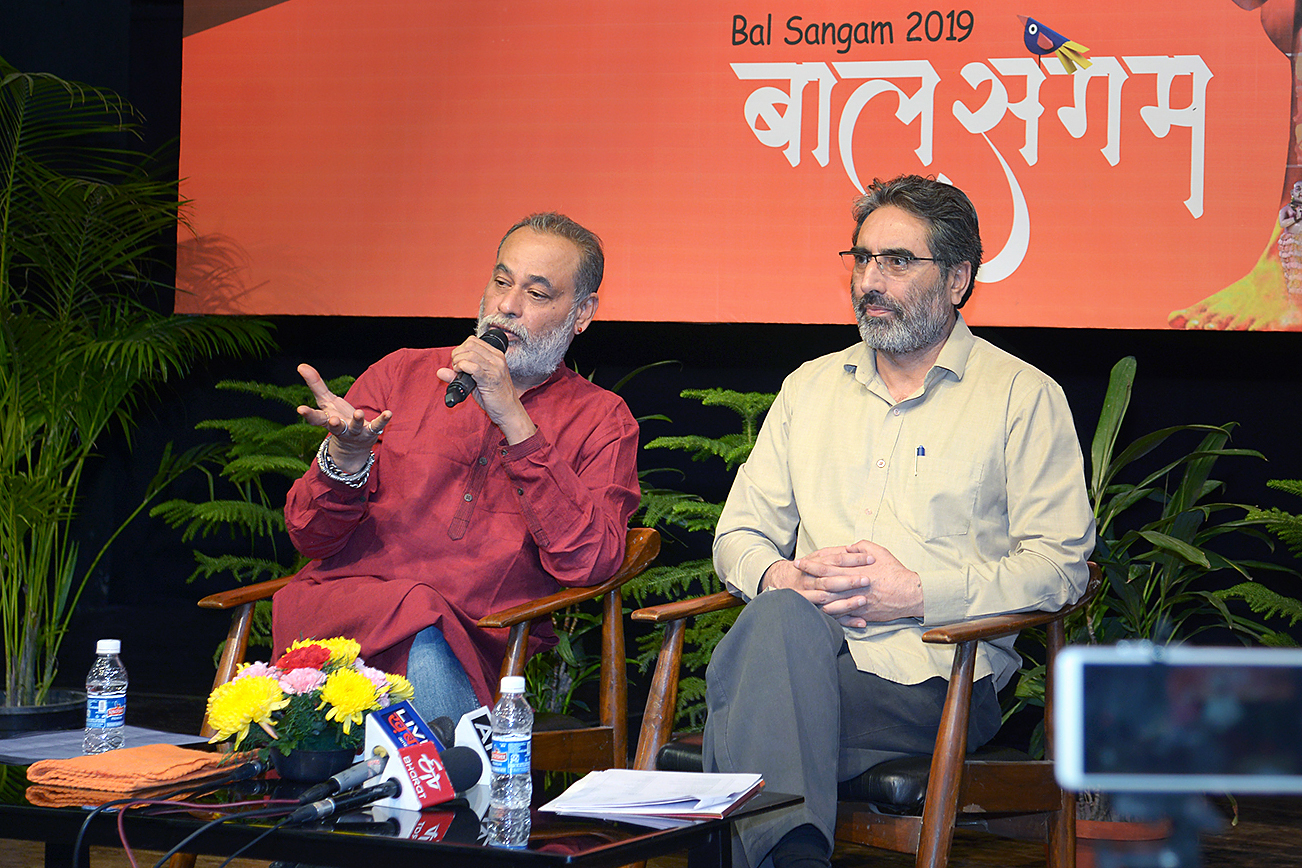
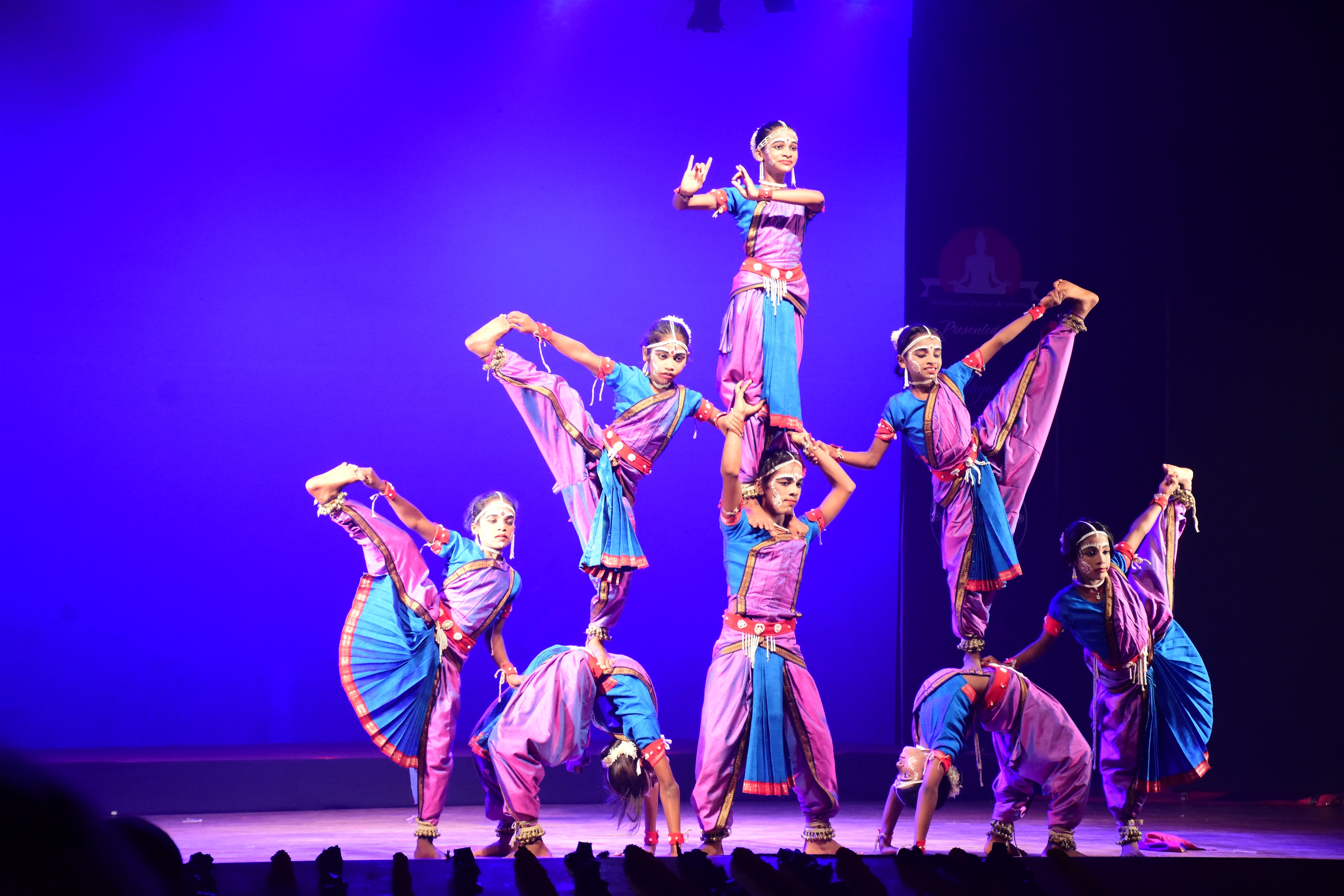
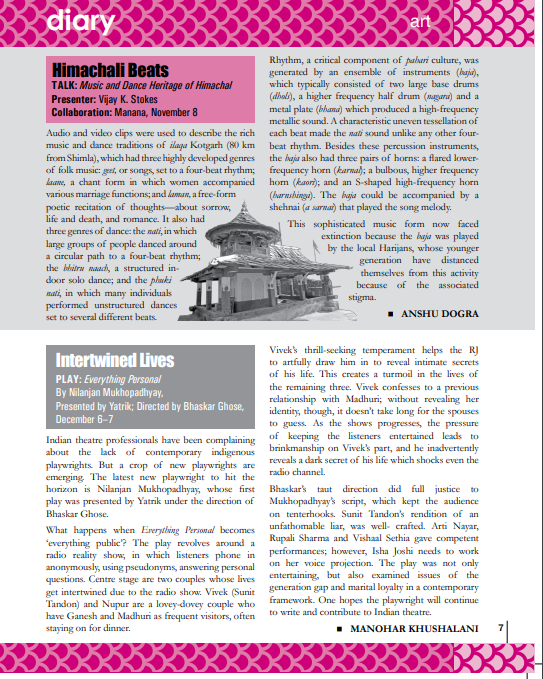
National School of Drama’s 11th Bal Sangam to begin from 9th November

National School of  Drama, the foremost theatre training institutions in the world and the only one of its kind in India today announced the commencement of its much awaited 11th edition of Bal Sangam from 9th-12th November 2019, in its premises. The 11th edition of the festival will showcase enthralling folk & traditional performing Arts & folk Theatre from 12 states of India dedicated to children.

Bal Sangam, an outreach programme of Sanskaar Rang Toli (Theatre-in-Education Company), in every alternate year brings forth both the heritage and legacy of traditional art forms and performances that are presented by children belonging to traditional performing families, guru-paramparas, and institutions across the country.

The four-day cultural mela will begin on November 9th, five days ahead of the Children’s Day with an inaugural performance ‘Rangoli’ by folk and traditional child artistes of India, choreographed by renowned choreographer Shri Bharat Sharma, who has an illustrious career spanning over three decades. The Festival also includes folk dance, martial arts, acrobatics, street play performances and also acts like juggling, puppetry and magic shows.

To encourage eagerness in children for traditional performances, states like Assam, Odisha, Rajasthan, Manipur, Jammu and Kashmir, Karnataka, Telangana, Kerela, Gujarat, Punjab, Jharkhand, and Madhya Pradesh will bring to the fore the magic of folk performances and plays so that Indian cultural heritage will be preserved in this rapidly changing world.

Dr. Arjun Deo Charan, Acting Chairman, National School of Drama said, “The festival is an ensemble of various performing traditional art forms that are presented by children. We are proud that the TIE Company has been working hard to make children know about their own culture, traditions and values,”

Highlighting the importance of theatre and folk performances, Shri Suresh Sharma, Director-in-Charge, National School of Drama said “Theatre and folk performances are a great learning medium for exploring and sensitizing children towards issues. Such activities and festivals are a wonderful platform to not just perform, but learn, travel, and share. NSD believes that theatre makes a person sensitive towards issues and an active participant of society as it boosts powers of communication. Theatre brings in all these qualities and if children are introduced to this wonderful, they become better human beings”.

Mr. Abdul Latif Khatana, Chief, Theatre-in-Education, said, “Bal Sangam is a confluence of folk and traditional art forms performed by children. When the child artistes imbibe these folk and traditional art forms with the mastery of their art and their innocence then the performance becomes magic.”


NSD authorities will be making special arrangements through various NGOs working with underprivileged children and social organisations, to reach out and invite children from not so privileged class so as to give them the due privilege to experience and be enriched by this long awaited festival of National School of Drama for children.

There will also be various types of art and craft workshops during the festival from 9th12th November.

About National School of Drama

National School of Drama is one of the foremost theatre training institutions in the world and the only one of its kind in India. It’s an autonomous organization, fully financed by the Ministry of Culture, Government of India. Training in the School is highly intensive and is based on a thorough, comprehensive, carefully planned syllabus which covers every aspect of theatre and in which theory is related to practice.

About T.I.E. Co.

Sanskaar Rang Toli (T.I.E. Co.) of NSD was established on October 16, 1989, and completed 30 years of its existence. Sanskaar Rang Toli is the only theatre education resource centers in the country and has worked with around 20 thousand children till date in various workshops. It consists of a group of actor-teachers working with and performing for children. The major focus of the TIE Company is to perform creative, curriculum-based and participatory plays in schools, specially designed and prepared for children of different age groups.

The TIE Company has done more than 2000 performances in various parts of the country. More than 10 lakh children, apart from college students, teachers, parents and theatre lovers, have witnessed these plays in approximately all the states in the country as well as internationally such as Poland, China, Philippines and Japan.

The Toli began with an objective of bridging the gap between passive education and an active method of learning by doing through its performances of varied plays, Summer Theatre Workshops on self-development and social integration, Sunday Club for devising original performances with children, workshops with teachers on effective teaching-learning process. All these activities are practiced round the year as per the children’s annual school calendar in Delhi and other parts of the country.


Everything Personal – a taut and gripping play | Manohar Khushalani

A Review by Prof. Manohar Khushalani
Published earlier as ‘Intertwined Lives’ in IIC Diary
Nov-Dec 2010 Issue

Indian theatre professionals have been complaining about lack of contemporary indigenous playwrights. But a crop of new playwrights is emerging. Abhishek Bhattacharya’s ‘Nothing Will Happen Between Us’ and Anushka Ravi Shankar’s ‘Phoenix’ come to one’s mind. The latest new playwright to hit the horizon is Nilanjan Mukhopadhyay, a seasoned journalist; whose first play, ‘Everything Personal’, was presented by Yatrik under the direction of Bhaskar Ghosh. Incidentally, all the three plays were produced by the India International Center, though the first two were presented by Ruchika Theatre Group at IIC earlier.

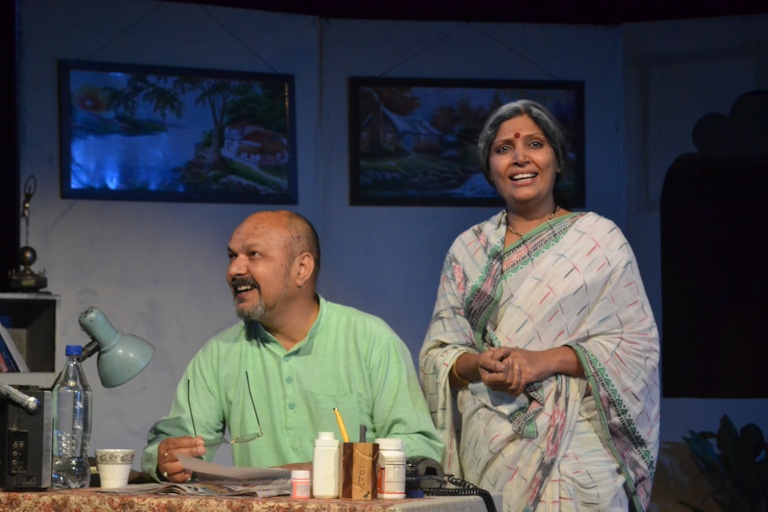
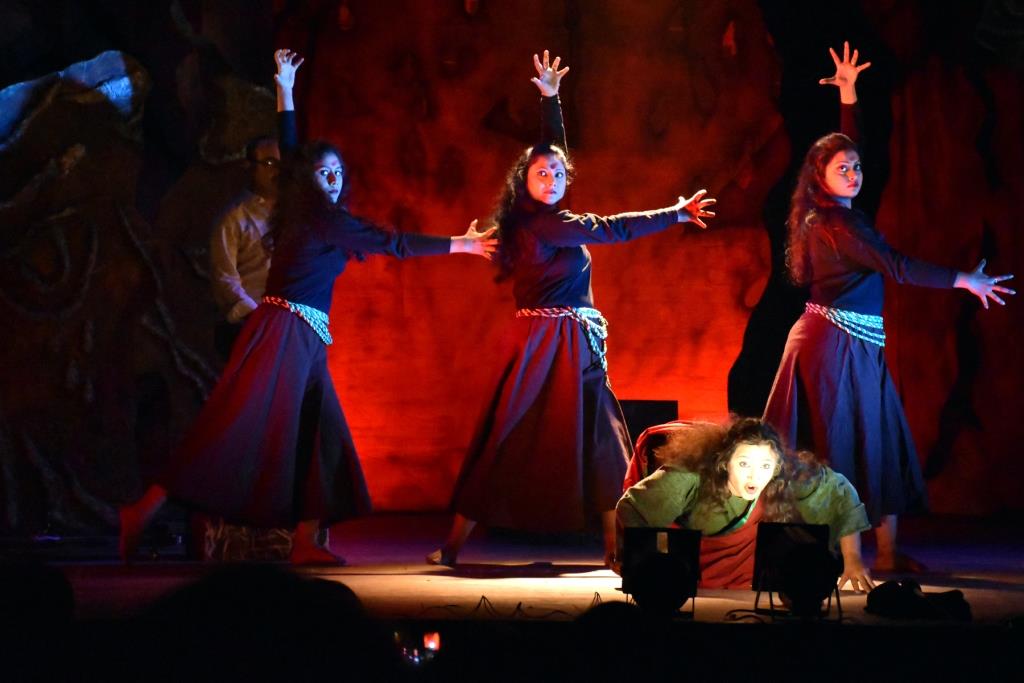
Mukhopadhyay’s precisely written script is about what happens when Everything Personal leaks into the public domain.  The play revolves around a radio reality show. The show has listeners phoning in, and, using made-up names, answering very personal questions, hopefully truthfully – since they are promised by the Radio Channel that their identities will be kept concealed. The story revolves around two couples whose lives get intertwined due to the radio show. Vivek (Sunit Tandon) and Nupur (Rupali Sharma) are a lovey-dovey couple who have Ganesh, (Vishaal Sethia) and Madhuri (Isha Joshi) as frequent visitors, often coming over for dinner. Vivek is intrigued by the show and is uncontrollably attracted to it with his thrill-seeking temperament. As Vivek is artfully drawn in by the Radio Jockey (Aarti Nayar) to reveal intimate secrets of his life, it creates a turmoil in the lives of the remaining three. For one, Vivek had a previous relationship with Madhuri, which he confessed about on the radio show, without revealing her identity – though, it didn’t take long for the spouses to guess. As the shows progressed, the pressure of keeping the listeners entertained led to unprecedented brinkmanship on Vivek’s part. So much so, that he inadvertently revealed a deep dark secret of his life which shocked even the radio channel.


Bhaskar’s taught direction did full justice to Mukhopadhyay’s script which kept the audience on tenterhooks. Sunit Tandon’s rendition of an unfathomable liar, who keeps others guessing as to whether he was lying or not, was well crafted. Arti Nayar, Rupali Sharma and Vishaal Sethia gave competent performances. Sinia Dugal and Ramesh Thakur as Vivek’s parents provided the appropriate support, however, Isha Joshi needs to work on her voice projection. The play was not just entertaining, but it also examined some issues regarding the high expectations of the younger generation and marital loyalty in a contemporary framework. One hopes that the Playwright will continue to write and contribute to the Indian theatre scene.

Published earlier as ‘Intertwined Lives’ in IIC Diary Nov-Dec 2010 Issue


Rajendranath’s Play on Stories of Premchand | Manohar Khushalani

A Review by Prof. Manohar Khushalani

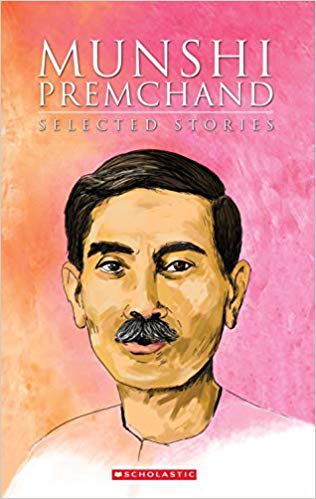
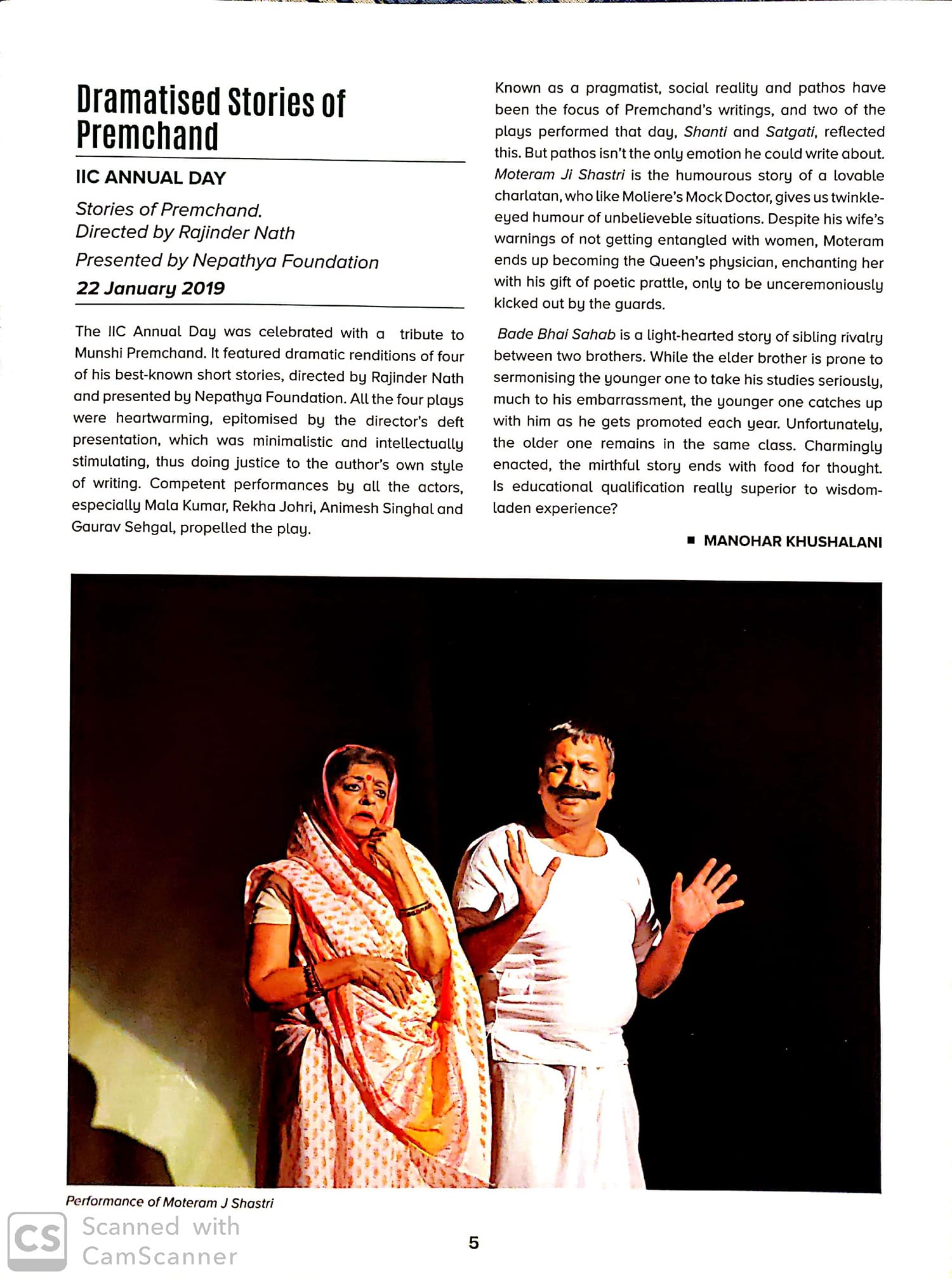
IICs  Annual Day was celebrated with a fitting tribute to Munshi Premchand by dramatic renditions of four of his most well known short stories directed by Rajinder Nath and presented by Nepathya Foundation. All the four plays were really heartwarming epitomized by the Director’s deft presentation, which was minimalistic and intellectually stimulating, thus doing justice to the author’s own style of writing. Competent performances by all the actors, especially Mala Kumar, Rekha Johri,  Animesh Singhal and Gaurav Sehgal propelled the play.

Known as a pragmatist, social reality and pathos has been the focus of Premchan’s writings, which was also emulated by two of the plays performed that day; Shanti and Satgati. But, pathos isn’t the only emotion he could write about. In ‘Moteram Ji Shastri’, the story of a lovable charlatan, who, like Molier’s Mock Doctor, gives us twinkle-eyed humour of unbelievable situations. But, despite his wife’s warnings, of not getting entangled with women, Moteram ends up becoming the Queen’s physician, enchanting her with his gift of poetic gab, only to be kicked unceremoniously out by the guards.

Bade Bhai Sahab, a light-hearted story of sibling rivalry between two brothers, one of whom is five years elder to the other. While the elder brother is prone to sermonize the younger one; on the need to take studies seriously, much to his own embarrassment, the younger one catches up with him as he gets promoted each year. Unfortunately, the older one stays put in the same class. Charmingly enacted, the mirthful story ends with food for thought. Is educational qualification really superior to wisdom laden experience?

Published earlier in IIC Diary

Prechand Review

Review as published in IIC Diary


Women Against War | Manohar Khushalani

NSD Play Directed by Waman Kendre

A review by Manohar Khushalani

First Published in IIC Diary

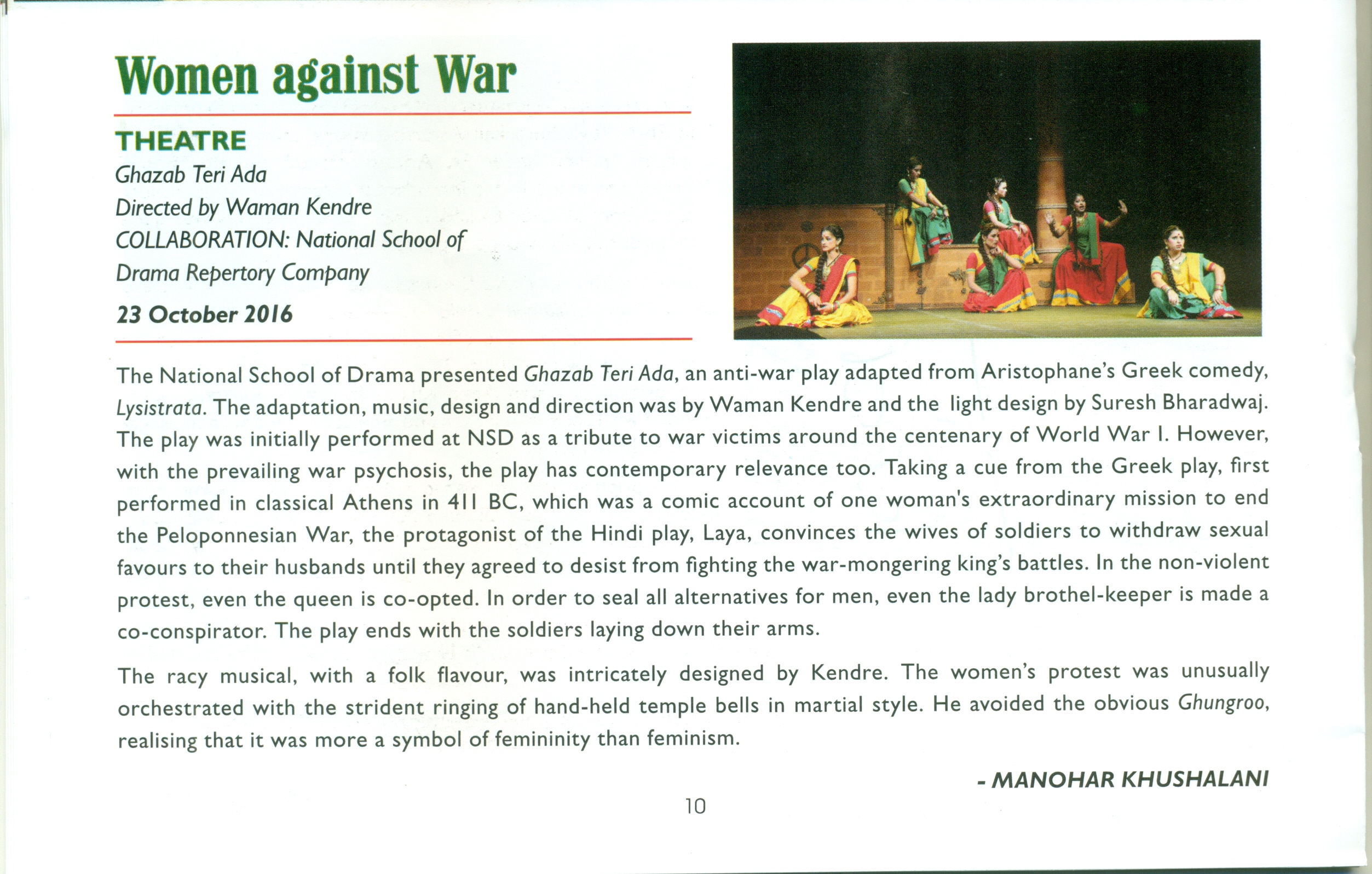
National School of Drama’s “Ghazab Teri Ada”, an anti-war play, adapted from Aristophane’s Greek comedy, Lysistrata, was staged at IIC. Adaptation, music design and direction is by Waman Kendre and light design by Suresh Bharadwaj. The play was initially performed at NSD as a tribute to war victims around the centenary of World War I. However, with the prevailing war psychosis, the play has contemporary relevance too. Taking a cue from the Greek play, first performed in classical Athens in 411 BC, which was a comic account of one woman’s extraordinary mission to end the Peloponnesian War, the protagonist of the Hindi play, Laya, convinces the wives of soldiers, to withdraw sexual favours to their husbands, until  they agree to desist from fighting the War Mongering King’s battles. In the non-violent protest, even the Queen is co-opted. In order to seal all alternatives for men, even the lady brothel-keeper is made a co-conspirator. There are hilarious scenes of desperate men trying to win favours first from their wives and later, in futility, from the women in the brothel. Even the King is brought on his knees by the Queen. The play ends with the soldiers laying down their arms.


The racy musical, with a folk flavor, has been intricately designed by Kendre. The women’s protest, was unusually orchestrated with strident ringing of hand held temple bells, in a martial style. He avoided the obvious Ghungroo, realizing that it was more a symbol of femininity than feminism.


The Review Published in IIC Diary


Epic Narrative in Regional Theatre Traditions of South India | Manohar Khushalani

 
Event: A Talk by Prof. Paula Richman
Learning from Performance: Epic Narrative in Regional Theatre Traditions of South India
Venue: Seminar Rooms I & II, Kamaladevi Complex at IIC
Date: Sept. 7  2013
First Published in IIC Diary Sept-Oct 2013 Issue
 

Paula Richman, Danforth Professor of South Asian Religions at Oberlin
College in Ohio, USA, gave a talk on Learning from Performance using Epic
Narrative in Regional Theatre Traditions of South India. Supporting her as
the moderator was Prof. Rustom Bharucha, from the School of Arts and
Aesthetics, JNU, where Paula is also doing a short term Fellowship.
Richman’s passion for Ramayana is well known, so much so, that her name
has become synonymous with the topic. Paula has travelled to many parts of
the world in hot pursuit of the ‘Many Ramayanas ‘, which is also the title of
one of her books. According to her, people for whom Ramayana is central
now live throughout the globe in countries as diverse as South Africa,
Trinidad, Surinam United Kingdom, Australia, USA, Canada, parts of Europe,
besides South East Asia, “it has indeed become a global text as well as a
global piece of theatre” she added. But the subject of her current research
was South India.

She began her talk with a Tamil ‘Morning Sickness Song’, relating to Queen
Kausalya’s condition when she was pregnant with her son Rama.   The song
describes rituals that King Dasharatha and other women performed to
support her during her pregnancy, and her food cravings too. One day she
wants murukku, then idli, as another woman wants dosas! Idlis in Ayodhya?
Sounds weird, but, Tamilians can relate more easily to pregnant women who
crave for local dishes. Indian folklore believes in anthropomorphism. It bring
Gods closer by imagining that they behave like humans.

Paula also discussed a Kattaikkuttu play called RamaRavana.  It expressed
the yearning for virtuous governance.  One of its songs talks about how
people are still waiting to have an ideal, fair, and compassionate leader rule
– somewhat reminiscent of Ram Rajya.

Richman hopped from one topic to another as she gushed about Yakshagana
dance-dramas of coastal Karnataka and finally, about how the legendary
actress Usha Nangiar enacted the role of Mandodari in one of her
performances.

Her underlining thrust was that live performances offer new ways of
understanding the experiences of Ramayana characters.

 
IIC Diary Sep-Oct 2013 Issue


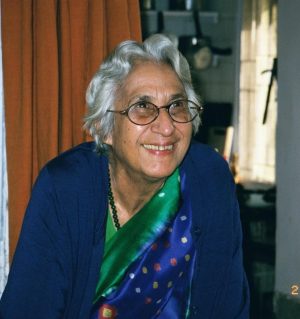
DU Professor and Thespian Lola Chatterji Passes Away

Lola Chatterji (26 July 1924 – 5 June 2019)

Lola Chatterji, who died peacefully on 5th June 2019 was a well-recognized figure in theatre circles in the capital. As a member of the English Department at Miranda House for over two decades, she was involved in many theatre productions in Delhi University in the sixties and seventies. Among the plays she directed or co-directed at Miranda House were: Easter (Strindberg), The Rape of the Belt (Levy), The Member of the Wedding (McCullers), Ring Round the Moon (Anouilh), Mourning Becomes Electra (O’Neill), and The Importance of Being Earnest (Wilde). She was also closely involved as staff advisor and mentor in three plays put up by DUMADS (Delhi University Music And Drama Society): Rhinoceros (Ionesco), A Man for All Seasons (Robert Bolt), and Rosencrantz and Guildenstern Are Dead (Stoppard).

Lola’s life-long interest in the theatre continued for many years after her retirement. She served for many years as Vice President of the Shakespeare Society of India and as a board member of Yatrik. She was particularly known for her make-up skills. There would e few actors in Delhi University theatre or in Yatrik who did not have their make-up doen by her.

A memorial event for Lola Chatterji will be held on 4th July 2019 at 6:30 pm in the Multipurpose Hall, Kamladevi Wing, India International Centre, New Delhi. All are cordially invited to the event


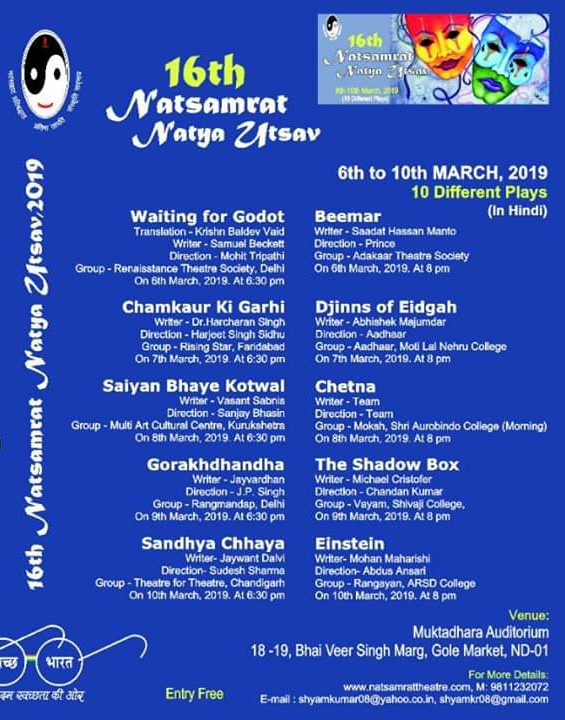
16th Natsamrat Natya Utsav opens in the Capital 6th March ’19

Natsamrat is one of Delhi’s oldest and most consistent theatre groups. Since its inception in 1998, Natsamrat has presented 1265 shows of 35 renowned plays. Ably led by Actor, Director and Visionary Shyam Kumar, whose philosophy has really been not only to evolve his own group but also to create space for all other theatre groups which are battling heavy odds to survive in theatre. Thus 16 years ago, when Natsamrat was barely four years old, he started the Natsamrat Natya Utsav so that other theatre groups also get a platform to perform. Three years ago, again Natsamrat widened its landscape by starting a Natsamrat Mahavidyalaya Natya Utsav, a student theatre festival, providing a parallel platform for the upcoming theatre generation to evolve and grow. Thus despite limited resources such a grand festival has evolved and grown. Natsamrat theatre festival thus begins with a bang on 6th March 2019 at 6.30 pm with the first performance of Waiting for Godot. The schedule is given above and the synopsis of the plays are given below.
On 9th March, at the same venue, Natsamrat will award the Thespians  who have been supporting Theatre as Practitioners, on Stage, off stage and as promoters and critics. Read more about elsewhere
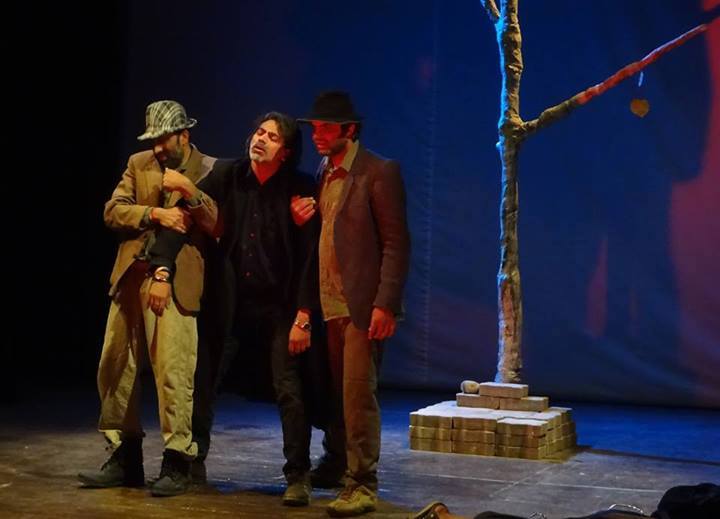
1.    WAITING FOR GODOT
Translation by Krishna Baldev, Witten by Samuel Beckett and Directed by Mohit Tripathi
On 6th March, 2019 at 6:30 p.m.
The plot of Samuel Beckett’s Waiting for Godot is simple to relate. Two men, Vladimir and Estragon, meet near a tree. They converse on various topics and reveal that they are waiting there for a man named Godot. While they wait, two other men enter. Pozzo is on his way to the market to sell his slave, Lucky. He pauses for a while to converse with Vladimir and Estragon. Lucky entertains them by dancing and thinking, and Pozzo and Lucky leave. After Pozzo and Lucky leave, a boy enters and tells Vladimir that he is a messenger from Godot. He tells Vladimir that Godot will not be coming tonight, but that he will surely come tomorrow. Vladimir asks him some questions about Godot and the boy departs. After his departure, Vladimir and Estragon decide to leave, but they do not move as the curtain falls. The next night, Vladimir and Estragon again meet near the tree to wait for Godot. Lucky and Pozzo enter again, but this time Pozzo is blind and Lucky is dumb. Pozzo does not remember meeting the two men the night before. They leave and Vladimir and Estragon continue to wait. Shortly after, the boy enters and once again tells Vladimir that Godot will not be coming. He insists that he did not speak to Vladimir yesterday. After he leaves, Estragon and Vladimir decide to leave, but again they do not move as the curtain falls, ending the play.
2.    CHAMKOUR KI GARHI
Wriiten by Dr. Harcharan Singh and Directed by Harjeet Singh Sidhu
On 7th March, 2019 at 6:30 p.m.
‘Chamkour di Gadi’ play Regarded as one of the most important battle of the Sikh history. It was against the Mughal army led by Nahar Khan; the Muslim commander was killed, while on Sikh side the remaining two elder sons of the Guru – Ajit Singh and Jujhar Singh, along with other Sikh soldiers were killed in this battle.
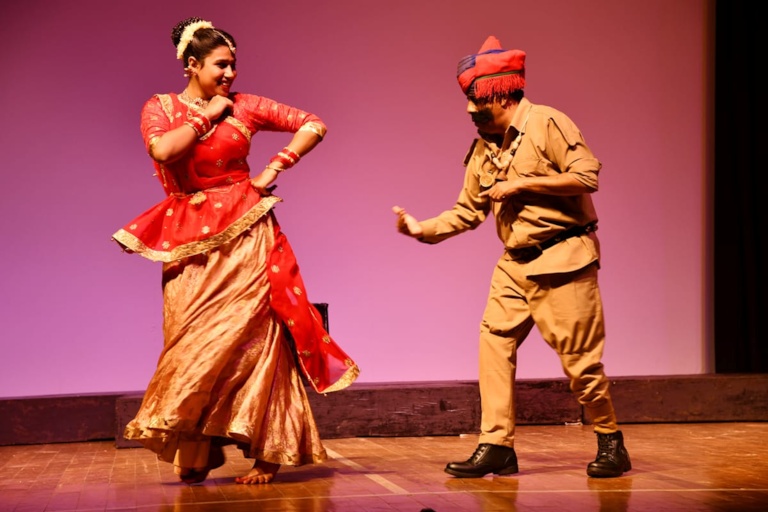
3. SAIYAN BHAYE KOTWAL
Wriiten by Vasant Sabnis and Directed by Sanjay Bhasin
On 8th March, 2019 at 6:30 p.m.
Saiyan Bhaye Kotwal is a translation of famous Marathi folk play Vichha Majhi Puri Kara, which was written by Vasant Sabnis. The story of the play is focused on the king and his scheming prime minister. As per the hierarchy, the present Havaldar have to be promoted to that post. However, the wronged Havaldar and hi girl Mainavati, a dancer, plans to frame the new Kotwal. The play is based on traditional tamasha and is a slapstick comedy which brings out the political undercurrents of nepotism.
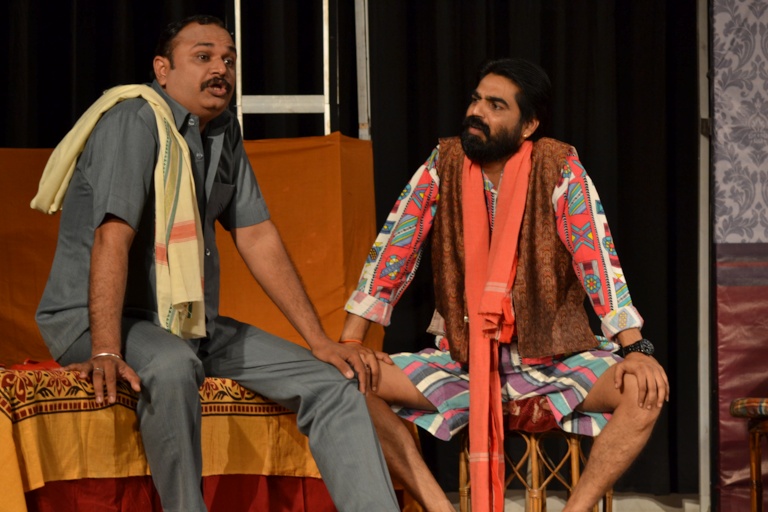
4. GORAKHDHANDHA
Wriiten by Jayvardhan and Directed by J.P.Singh
On 9th March, 2019 at 6:30 p.m.
When money becomes the be all and end all of one’s existence, when money becomes one’s religion then all relations, all ethics and morals are rendered meaningless. When one’s sole aim is to accumulate wealth then the person’s conniving mind keeps on scheming towards that end. There are some people who are adept at extracting something out of nothing. The protagonist of this play is such a character who will resort to any means to hoodwink people out of their money. While seemingly he is being helpful and charitable towards others, however, all he is doing is helping himself in the guise of helping others. He believes that there is a certain honesty to his dishonesty. In his games of deceit, he is forced to tell lies after lies till in the end he is so caught up in his web of untruths that he is neither able to give up nor get out. Gorakhdhandha is a fictional play based on true stories. Its dialogues and anecdotes don’t just tickle our funny bone but rather force us to break out into bouts of laughter.
5. SANDHYA CHHAYA
Wriiten by Jaywant Dalvi and Directed by Sudesh Sharma
On 10th March, 2019 at 6:30 p.m.
Sandhya Chhaya is a story about an old couple, an aged couple who spent their lives in the upbringing of their children and they are the ones who live alone and long for the love, affection and togetherness of their children. It is a story about a man and woman fondly called Nana, Nani respectively and it deals with the emotional turmoil the parents have to go through. In spite of having being deprived of love from their children, they still have the courage to fight the melancholy and pathos of their lives. They support and love each other and as the play unfolds, the audience also falls in love with them. Older people who are not so useful in today’s materialistic age bear the brunt of the changing values. They get lonelier and lonelier. This play is entertaining and simultaneously it tells us about old age and Loneliness. It is a great play, which can be very easily called a classic of Modern times. They have two sons, Deenu (the elder one) and Nandu (the younger one). Deenu is settled in USA and Nandi is in the Air Force. Deenu very rarely comes to meet his parents. He just sends money at regular intervals, meanwhile as the play progresses, they get to know that Nandu has been killed in the war. The whole play revolves on the nuclear families’ concept where in the parents are left alone and their children are settled somewhere else. The whole play is poignant collective mixture of emotions portrayed by an old couple, be it happiness, loneliness, love for kids, their childhood etc. On the whole, the play stresses on the fact and asks the society a very straightforward question that parents who have been there for us the whole life, do they deserve such a lonely old age? Do they really?
3rd Mahavidyala Natya Utsav
 
1.    BEEMAR
Wriiten by Saadat Hassan Manto and Directed by Prince
On 6th March, 2019 at 8 p.m.
2.    DJINNS OF EIDGAH
Wriiten by Abhishek Majumdar and Directed by Aadhar
On 7th March, 2019 at 8 p.m.
3.    CHETNA
Wriiten and Directed by Team
On 8th March, 2019 at 8 p.m.
4.    THE SHADOW BOX
Wriiten by Michael Christopher and Directed by Chandan Kumar
On 9th March, 2019 at 8 p.m.
5.    EINSTEIN
Wriiten by Mohan Maharishi and Directed by Abdus Ansari
On 10th March, 2019 at 8 p.m.


James Graham’s PRIVACY Director: Ajay Khatri

Playwright: James Graham

Director: Ajay Khatri

Group: N.S.D. Diploma Production, New Delhi

Language: Hindi

Duration: 1 hr

The Play

The play Privacy is a story of a writer who is hiding all these years in her shell. She’s afraid of coming out in public and the social media. Heartbroken and after having a deep interaction with a psychoanalyst, she is determined to take on the world. She wants to write a play, meet new people, interact and experience their lives. Through the process of meeting she is introduced to the social media and technologies and learns how they are involved in surveillance. She unveils and reveals herself to society and ends up meeting someone similar.

Director’s Note

During my training in Direction at National School of Drama I tried exploring a new language of theatre in the contemporary world. Since past few years, I have been fascinated with technology, media and re-invention in theatre. In this era of globalization, I strive to locate a language that is mutually complementary to masses – as viewers and we as artists.

My interest in privacy and surveillance dates back to graduation days. Initially, social media always intrigued me instigating thoughts to question the way it interfered with our lives. I have extracted the recollections of collective impressions made on me in all these years in the play – Privacy.

This adaptation of the play involves gender inequality and how our society reacts to privacy and surveillance predominantly, of females begins from birth, continue into her teens till she matures. Then her next ‘milestone’ is when she belongs to the watchful eyes of her husband’s family. The unstated social activities and other social elements intrude and lay claim on her life. Through this narrative / performance, we try to express and understand how a hitherto unknown woman protects her privacy from being waylaid by agents of society. Though it is strange and difficult for anybody to firstly realize and then accept that there are now new weapons and systems being engaged to trap, track and control targets especially those considered disruptive by society which is also the State.  Our social, economic and political leanings are trapped by and handcuffed in a technologically – driven society. Surveillance is meant to intrude upon and deny privacy- a person struggles for his personal expression and existence amidst it’s, all pervasive and overpowering presence in our lives.

Violence erupts and flourishes to stop or counter state sponsored hostility. The State wields a powerful backup or ‘in the wings’, weapon of sophisticated technology-driven surveillance; destroying and disrupting natural human passages of vent: behavior, emotions, social, work, family or relationships. When an individual’s surveillance is used unopposed against his/ her/ or their own will.

The Director

Ajay Khatri is a graduate from National School of Drama. He is instrumental in guiding theater workshops and instilling these with creative energy befitting young independent theatre aspirants and groups, school, colleges and NGOs. Starting his journey in 2005 as director he presented: Surya Ki Antim Kiran Se Surya Ki Pehli Kiran Tak, Yayati, Illa, Komal Gandhar. He has worked and designed lights in national projects such as Othello, Comedy of Terrors, and Arjun Partigya among other experimental exploratory pieces include: Saturday Night and Privacy.

The Playwright

James Graham (born 1982) is a British playwright, television writer and actor. His work has been staged throughout the UK, at theatres including the Bush, Soho Theatre, Clwyd Theatr Cymru and the National Theatre. He was discovered by, and has been a playwright – in – residence at, the Finborough Theatre.

He wrote the script for the film X+Y, which premiered in 2015. He has written The Culture, This House, Labour of Love, Little Madam,  The Whiskey Taster, The Vote, Finding Neverland, The Men and Sixty – Six Books among several others. His play Privacy had its world premiere at the Donmar Warehouse, London.

The Group

This play is being presented as a part of National School of Drama’s graduate showcase (class of 2018), which aims to provide a platform for emerging theatre practitioners, allowing them to share their work with a wider audience.

Cast & Credits

On Stage: Meenakshi Thapa, Sanjeev Jaiswal, Rachna Gupta, Debashree Chakrabarty, Bhagyashree Tarke Rahul Kumar, Jayanta Rabha, Parag Barouah, Sayan, Shruti

Technical Team: Vishala Mahale, Saras

Lights: Sarthak

Animation: Priyansh

Music: Daood Husain, Vikesh Bisth, Sachin Rohilla, Mahadev Singh Lakhawat, Devika

Story: James Graham

Dramaturge: Ajay Khatri

Translation: Meenakshi Thapa

Adaptation, Design & Direction: Ajay Khatri


Hara Bhattacharya’s MEDEARA Director: Goutam Mukherjee

Playwright: Hara Bhattacharya

Director: Goutam Mukherjee

Group: Chhandam, West Bengal

Language: Bengali

Duration: 1 hr 40 mins

The Play

After 15 years of absence, veteran theatre actress Kamini returns to stage as the protagonist of  Euripides’ play Medea, directed by her ex-fiancé and famous theatre director Purushottam Dasgupta who had used Kamini’s acting ability and charm to make his plays successful, but had later married Ipshita, the daughter of an influential Minister. Kamini’s friend Kanchan is serving life-imprisonment for killing her new born male child out of vengeance towards her husband, who had got her previous pregnancies aborted since she was carrying a female foetus in her womb. For Kamini, Kanchan is the Medea of our time. Gradually Ipshita also starts identifying herself with Medea, Kanchan and Kamini. Kamini’s interview by a famous theatre critic Tonumoy, in Kolkata’s leading newspaper, reveals the present day story of several Medeas.

Director’s Note

I have tried my best to give the complex fabric of gender politics a modern stage-language by designing the play with the austerity that it deserves. It was a challenging and thrilling project for me as a director, to bring out the essence of the concept of an intricate and intense subject brilliantly depicted by the playwright. Ultimately, I can humbly say, with chiaroscuro light design, absorbing sounds and a relatable set-design, Medeara has become a brilliant play to watch.

The Director

Goutam Mukherjee started his theatre journey as an actor in 1985. He directed the play Moinuddiner Bhoot for the group Samay in 1993 which was awarded District’s Best Production by Paschimbanga Natya Academy. In 1994, Goutam joined Chhandam and started acting in many remarkable plays by the troupe under the direction of Late Sudhangsu Dey, the pioneer director of the troupe. In 2015, at Chhandam, Goutam directed the play Lajja written and compiled by him. The play Medeara is his second directorial work for the troupe Chhandam.

The Playwright

Hara Bhattacharya is an eminent playwright of West Bengal who has been active in Bengali theatre since 1987. Most of his plays have been produced by eminent directors like Bibhas Chakraborty, Biplab Bandopadhyay, Chandan Sen, Anirban Bhattacharya and others. Some of his remarkable plays are Nashta Asim, Noti o Ghorachor, Adbhut Andhar, Aguner Barnamala, Ashtitwer Akaar, Oedipus, Medeara. He was awarded with Sundaram Puraskar in 1990, and West Bengal Journalists Association’s Dishari Award for Best Playwright in 1996. His play Aguner Barnamala was staged in Bharat Rang Mahotsav in 2007.

The Group

Chhandam was founded by a few young theatre enthusiasts of Raiganj in 1962. Since then it has been traversing the path of theatre uncompromisingly. It celebrated its golden jubilee in 2012 and has almost 60 outstanding plays to its credit, one of which has been crowned with presidential award and some of which have been honoured with several other awards. It has established its own theatre auditorium where most of the theatre groups across the state regularly stage their productions. Besides producing plays, the group frequently arranges seminars and conducts intimate discussions and workshops to develop the physical skills as well as the mental capabilities of the theatre aspirants of the group.  

Cast & Credits

Kamini / Medea: Srabani Dey

Kanchan: Barnali Nandi

Jason: Koushik Das

Tonumoy: Santanu Chatterjee

Purushottam Dasgupta / Creon: Goutam Mukherjee

Reporter: Sumitra Bhowmick

Ipshita: Ratna Basu

Tapan: Subrata Talapatra

Satyada:  Satyabrata Deb

Suman / Photo Journalist: Suvra Ghosh,

Medearas / Group of girls:   Sangita Ghosh, Shilpa Deb, Ritwika Biswas, Debolina Paul

Stage & Costume Design:  Neel Koushik

Stage Designing Assistance:  Koushik Saha, Goutam Basak

Light Design & Application:  Soumen Chakraborty

Choreography & Music:  Deb Kumar Pal

Music Application:  Anirban Mandal

Make-up:  Bhanu Mitra

Production Design:  Shubhabrata Sinha Roy

Playwright:  Hara Bhattacharya

Director:  Goutam Mukherjee