Tarali’s musical experiment with Anup Baruah
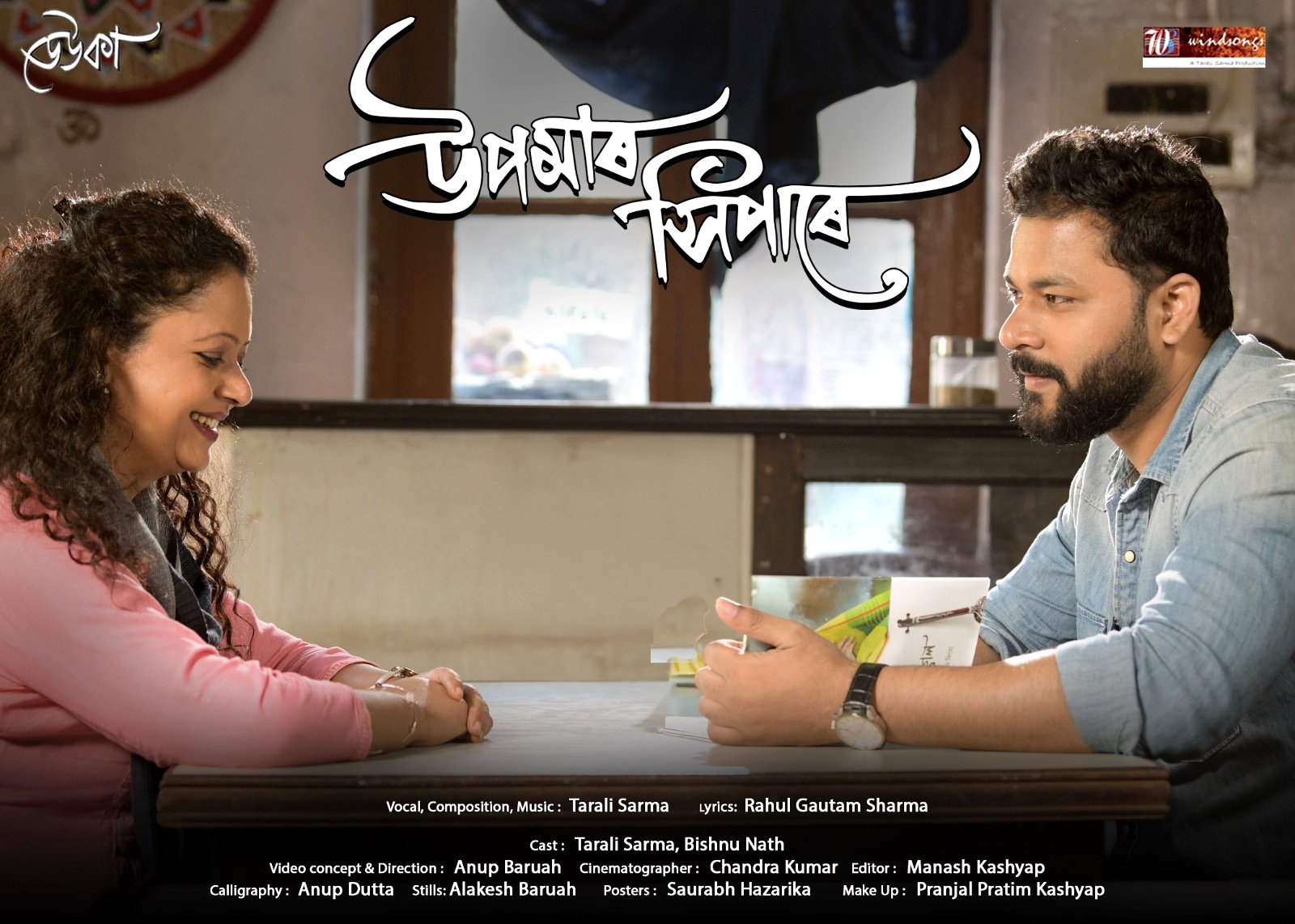
Tarali Sharma’s cinematic song, ‘Upomar Sipare,’ is her latest contribution to the industry. She earned the National Film Award for Best Female Singer for the Assamese film ‘Akashitorar Kathare,’ a well-deserved recognition that thrust her into the national spotlight. Before receiving this accolade, her talent had been confined to the regional sphere. Once she transcended those boundaries, she faced the challenge of maintaining her prowess on a national scale. Working in a remote place like Assam, within a small film world with limited resources, it was difficult for her to maintain a national level in all her work.

Yet, through dedication and hard work, she sustained her capabilities and showcased her multifaceted talents as a singer, lyricist, music composer, and director for both stage and film productions. She also served as a jury member in the National Film Award, enriching her with a wide variety of cinematic experiences. Her diverse experiences in these interconnected fields enhanced her creative pursuits, exemplified by her latest song ‘Upomar Sipare.’

Presented in a visual format, this song defies prevailing norms in music videos. Rahul Gautam Sharma, an upcoming lyricist-singer, penned the song, showcasing his praiseworthy command over the Assamese language. The song takes the form of a short film (duration 8 minutes), depicting emotional moments between a singer and her fan during a brief encounter. Tarali herself portrays the singer, staying true to her character.

The narrative unfolds as she encounters a young boy at a homestay near her house. Their gradual acquaintance reveals him as a devoted fan. The young boy purchases a biography of Tarali Sharma and asks her to sign the book. The book, written by Alex Figo, portrays the musical journey of Tarali Sharma. In the film, director Anup Baruah establishes her as she is and includes the fictional character of the photographer. Anup establishes her residence ‘Puwati’ (early morning), known to most culturally inclined people of Assam. Again, the homestay he shows is a fictional entity. This interesting mix of a real character with a fictional makes the narrative intriguing, diminishing the thin line between fact and fiction. When the photographer leaves, he gifts her a beautiful portrait, prompting Tarali to reflect on the unexplained bond they shared.

Anup Baruah, a renowned still photographer, crafts this sweet and concise film. Each frame is meticulously composed to convey the adjacent emotions of the narrative. Despite being dialogue-free, Baruah skilfully captures expressive moments.

As the central character, Tarali shoulders the responsibility of conveying all emotional nuances through the journey. The film may be short in length, but it exhibits the growth of a drama feature film. Tarali effortlessly breathes life into the visuals, portraying subtle expressions with rapid transitions—a testament to her acting competence.

Bishnu Nath, portraying the young photographer, complements Tarali’s performance by doing justice to his character. Cinematography by Chandra Kumar Das supports the simple yet underplayed dramatic narrative.

Integral to this creation is the song, serving as practical background music. It enhances the visual moods, with melody and instrumental sounds playing pivotal roles while the lyrics align with powerful visuals. The composition weaves the vocal part seamlessly into the entire musical narrative. As a busy music director in Assam, Tarali’s vast experience prompted her to experiment with a different musical pattern for this song, combining instrumental and vocal elements to create a unique musical experience.

This experimental approach served as a crucial test for both the director and the music director. In the end, they have delivered a meaningful and out-of-the-box experience

—- Utpal Datta.

First published in The Daily Eye (www.thedailyeye.info)


Story of a Lonely Artist

Film Criticism | Behrupiya

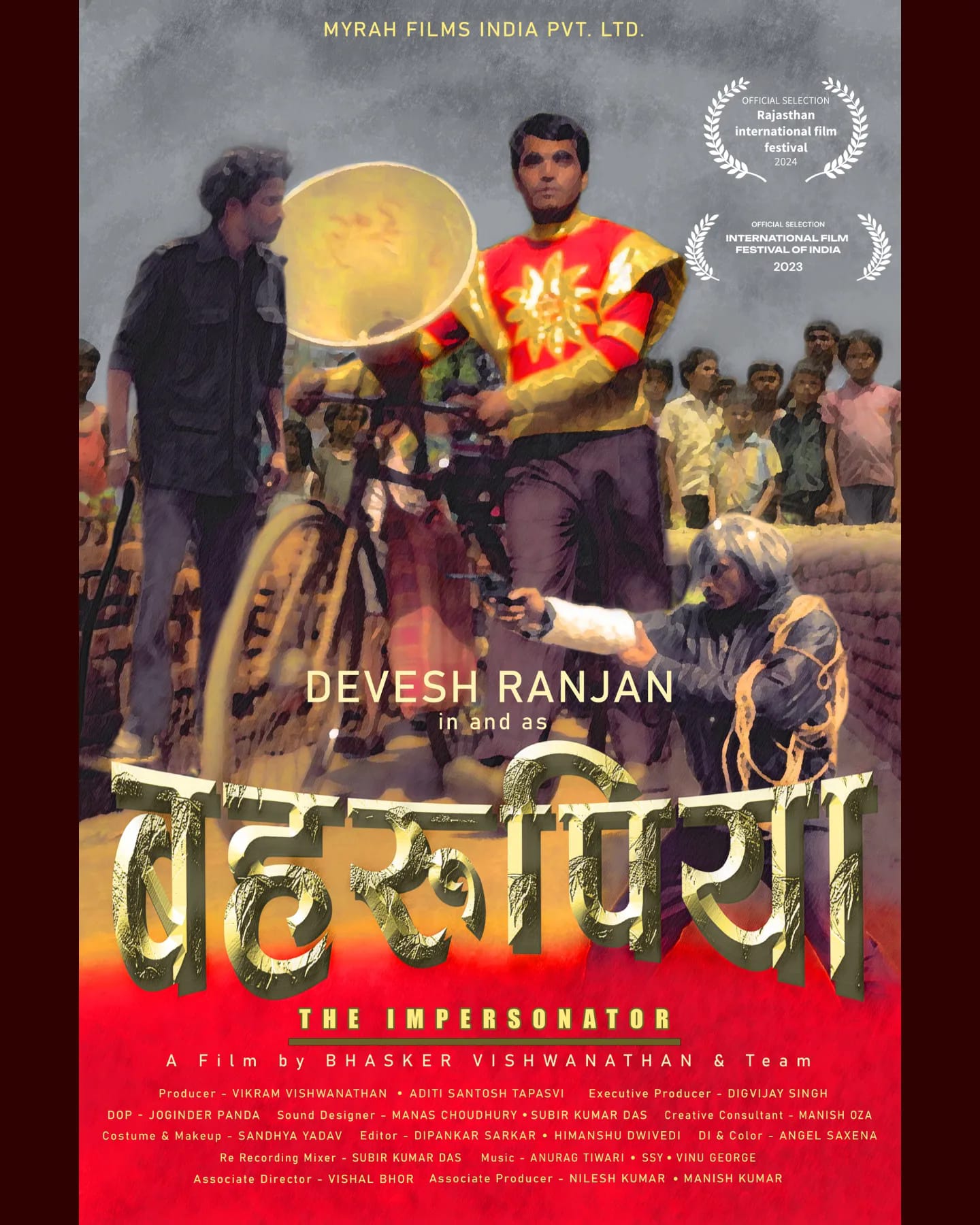
It sounds pathetic, but the reality is that a huge number of folk art forms are on the verge of vanishing from the world. There may be many reasons for this disappearing state within our society. Several Indian films have been made on this existential crisis of folk art forms and the void it has created. Bhaskar Biswanathan’s short film ‘Behrupia,’ based on a similar theme, has been selected for this year’s Indian Panorama.

‘Behrupia’ is a familiar character in rural areas of India, mainly in the Hindi belts. Currently, these multifaceted ‘Behrupiyas’ are mainly confined to Hanuman, Shiva, and Kali forms. These three characters are immensely respected and worshipped by the common public. There are also stories about how kings and emperors used such ‘Behrupiyas’ for spying.

The film’s ‘Behrupiya’ is a member of the present day’s world. He carries a small sound system on his bicycle. He travels from place to place, performing his art of being a ‘Behrupiya,’ enacting popular dialogues from Hindi films and television serials. He also uses costumes to enhance the look of the character he plays. Most of his audience is comprised of children, with a small number being women. No matter how happy the children are, they cannot afford to support him financially. The village women also lack financial capacity, so some of them give rice and other food items. Incidentally, once his foot gets hurt, he cannot work. One day, while fetching water and returning home, he finds that his costumes are gone. Despite his unimaginable injuries, he wanders the village in search of his stolen costumes.The story is simple, and the audience is often familiar with the expected sadness and pain of the ending of such stories. The extinction of folk art is sad for connoisseurs, yet there is no way but to accept it as part of the evolution of time. The film is about the life of a modern-day Behrupiya. This modern Behrupiya is a creation of the story-writer. Such modifications will certainly hurt the traditional character of folk art, but they will also reveal a picture of the recent trend of folk life in a society where the influence of cinema and TV serials is unimaginable. The story writer-director may have thought that some modernization could give a new life to this endangered folk art form. In support of this, he shows that the costumes and dialogues of the characters attracted the children’s community, and some children have even expressed their desire to become a ‘Behrupiya.’ This positive attitude distinguishes the film from other films on the same subject. In Buddhadev Dasgupta’s ‘Bagh Bahadur,’ the folk artist died of exhaustion in the struggle for survival, announcing the tragic end of an art form. In contrast, Bhaskar Biswanathan’s film is a message of hope that the younger generation is showing interest in the multifaceted and going along with it, distinguishing the film from similar films.

The film’s lead actor, Devesh Ranjan, makes the character believable. His expressions were explosive, especially in the silent parts. Earlier, he successfully played the central role in Kamakhya Narayan Singh’s ‘Bhor.’

A calm and lively picture of a village in Bihar is beautifully captured by the camera, creating the necessary local setting for the story. The camera plays a significant role in capturing the subtle expressions of the main character. Director of Photography Yogendra Panda has helped the director realize the vision of the director. The film is edited by Himanshu Dwivedi and Deepankar Sarkar. The editor’s skill is particularly noticeable in the scenes where the devastated ‘Behrupiya’ goes around looking for the clothes after they are stolen. In terms of the story, the character’s mind was restless and fast at that moment, but the injury to his leg prevented him from walking fast. The editor has balanced the pace of the film by properly controlling these two opposing motions. The music of the film also keeps the plot moving. The film is produced by Aditi Santosh Tapasvi and Bikram Viswanathan.

Two Assamese technicians were associated with the film in editing and BGM, and they are Dipankar Sarkar and Arnab Deka, respectively.

—- Utpal Datta


Star Fades, Brilliance Shines On

The departure of Ustad Rashid Khan leaves a void in the realm of Indian classical music, casting a shadow of sorrow and emptiness that will endure for a considerable time. Rashid Khan, synonymous with the ethereal world of ‘Anya Ek Bhuban,’ crafted by his resonant and masculine voice, embarked on an enchanting musical journey, seamlessly navigating from one note to another—a phenomenon known in the musical lexicon.

The mere mention of Rashid Khan conjures up a nostalgic image. Thirty-two years ago, on a chilly January evening, I left Tollyganj’s studio and found solace on a roadside tea shop bench, accompanied by cinematographer Kamal Nayak and film director Arun Guhathakurta. At the other end of the bench, a young man joined us. Kamal Nayak inquired, ‘Have you heard of Rashid Khan?’ Back then, he wasn’t yet ‘Ustad Rashid Khan,’ but his fame was burgeoning. Though I had encountered his name in Desh magazine’s music reviews, I did not get an opportunity to experience his highly lauded singing. We struck up a conversation, and over a cup of tea, we acquainted ourselves. Politeness adorned his demeanour, and after a brief encounter, we each resumed our places. Later, I discovered that he studied music at the Music Research Academy, residing with the renowned Ustad Nisar Hussain Khan across the street.

Months after our meeting, Rashid Khan’s vocal performance in an audio cassette, featuring Raag Bageshri and Desh, hit the shelves. In response to our encounter, I purchased the cassette—a delightful experience. His voice, youthful, humble, and enchanting, resonated with a subtle echo of Pandit Bhimsen Joshi’s energy, Ustad Aamir Khan’s solemnity, and Ustad Nisar Khan’s Tarana’s rapid pace. Yet, amidst these influences, Rashid Khan’s voice possessed a distinct identity, brimming with new energy.

In a concise span, Rashid Khan left an indelible mark on the music industry—successive gramophone records, and live concerts domestically and internationally—thrusting him into the limelight among his generation’s talented musicians. Pandit Bhimsen Joshi heralded him as the future of Indian classical music. His desire to break free from the traditional ‘Gharana’ constraints set him on a journey to explore the expansive world of music, incorporating Sufi influences. He ventured into creating new melodies, even lending his voice to classical songs in films, such as ‘Kahe Ujari Mori Nind’ and ‘Tore Bina Mohe Chen Nahi.’

Rashid Khan’s enthusiasm extended beyond film songs; he collaborated with popular Bengali singer Nachiketa to experimentally sing Rabindra Sangeet. Their rendition, based on Raags, with interludes featuring Ustad’s ‘bandis,’ showcased a unique approach, distinct from previous interpretations by Pandit Ajay Chakraborty and Swagatalakshmi Dasgupta. Among his notable achievements was his Krishna Bhajan for Times Music. He often performed in duets with Pandit Bhimsen Joshi, including Bhajans. These bhajans not only reflected the influence of Joshi but also showcased the positive effects of that association.

Recognized by the government with the Padma Shri and Padma Bhushan awards, Rashid Khan achieved success, and honours, and, tragically, departed at a relatively young age—a reality difficult to accept.

Having witnessed several live performances, I regret not having had the chance to meet him except once at the Kolkata airport. A brief interaction revealed his affability, especially upon noticing ‘Aakashbani’ on my visiting card. Classical musicians, it seemed, felt a closer connection when reminded of Aakashbani.

Rashid Khan, initially disinterested in music as a child, imparted his musical knowledge to his son Armaan from a young age. Armaan, emerging as a talented singer and accomplished guitarist, undoubtedly carries the influence of his father.

As the stars extinguish, their brilliance magnifies in the darkness.


Is anarchy acceptable in the name of artistic freedom? The magic of OTT.

Anant OTT

Book Review by
Utpal Datta

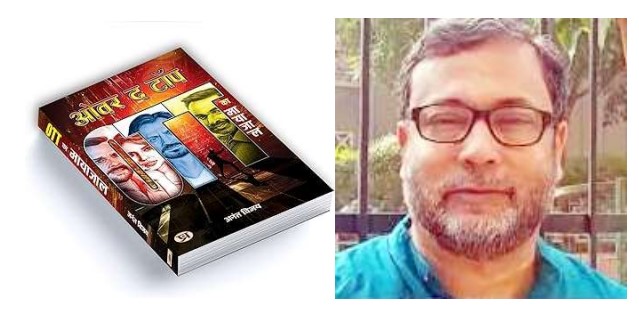
OTT platforms, a new addition to the media, have become competitors to cinema and television programs, raising a few uncomfortable questions. Does OTT concern discern viewers? Is the tasteless and obscene content on OTT platforms a result of the absence of a censor board? Is this the beginning of a dangerous practice for society and culture? Journalist and author Anant Vijay seeks answers to these questions through his Hindi book ‘OTT Ka Mayajal.’ This is his latest book and probably the first Indian book on OTT. Anant Vijay, a national award-winning film critic, journalist, literary critic, and political analyst, reveals all these identities through this book. The writing style reflects more of his journalistic mentality than a writer’s, making the book easy to read, even for non-Hindi-speaking readers familiar with Hindi.

OTT is a platform primarily for movies and similar content. This book mainly discusses programs aired in Hindi. During the pandemic, cinemas were closed, people were under house arrest, and television became the sole means of entertainment for cinema lovers. At the same time, OTT platforms became well-established in the minds of the audience, and OTT directors started planning to provide the audience with a new taste. OTT had old popular movies replaced by new ones, especially those that failed in theatres. At one point, cinemas opened, but due to the limited audience and the popularity of OTT, new Hindi films were released on this platform. Filmmaking for OTT started, and web series in the style of a TV series also began.

Most web series used elements like obscene abuse, violent scenes, and explicit sexual content to attract a larger audience. While censor boards for movies monitor such scenes, many producers took unimaginable liberties due to the lack of controls for OTT, resulting in chaos in the world of creation.

Some directors are notably aggressive, using verbal abuse to grab the audience’s attention. The unhindered and uncontrolled environment of OTT platforms is reflected in his encouragement in the series ‘Sacred Games.’ Anant Vijay rightly comments, ‘When there is no bondage and no need to apologize, freedom turns into anarchy.’ He also wrote, ‘In fact, such people use abuse, violence, and sexual scenes to cover up their incompetence.’

Not only have movies or series been created for the OTT platform with sexually violent elements, but also series with wholesome entertainment and reality. The author balances the subject with detailed discussions of several such series and maintains his responsibilities as an author.

Author Anant Vijay carefully observes and explains the clever construction of a ‘fake narrative’ through OTT programs. The same narrative of anti-Hindu and Muslim praise created in Hindi films is seen differently in OTT. The brains of political power control agendas and promotion tactics under the guise of entertainment. It involves either the creator’s political beliefs or profit motives or the goal of obtaining the blessings of an influential force. When analysing the present from a political perspective, two things are needed – political knowledge of the past and the ability to predict the future in light of it. The author rightly considers the political background while discussing the web series ‘Leila’ by the once-famous filmmaker Deepa Mehta. “Art was turned into a rehearsal ground for politics”. He further elaborates by explaining that this was done after the last two Lok Sabha elections. There are many reasons why a distorted image was created of the political dispensation and promoted by portraying some organizations as radical. It can be assumed that a part of that agenda was Deepa Mehta’s ‘Leila.’ Although ‘Leila’ is told as a fictional story, it combines the, so-called grim future it depicts with the image of the agenda. Anant Vijay has informatively analysed many other such agendas. The web series ‘Jubilee’ also beautifully describes how the Russian Communist Party used Indian films as part of their agenda. The author also refers to Dev Ananda’s autobiography ‘Romancing with Life’ in support of this.

Overall, this book analyses both the artistic work and the process of agenda-building through the latest entertainment medium in depth and can provide the reader with thought. In India, the relationship between art and politics has been judged in a one-sided manner. This book has broken down that wall of limitations. This is the real power of the book.

The book is published by Prabhat Prakashan, and the price is Rs 300. The book must be translated into regional languages.

It is worth mentioning that the author dedicated the book to the Maa Kamakhya Temple and released it for sale.


Tora’s Husband: Honest and rooted

Tora’s Husband,’ the latest film by Rima Das, is simple in content and production. The film revolves around the transformation of the mindset of Jaan, an alcoholic young businessman and husband of Tora. Tora, a responsible village daughter-in-law with two children, loves her family, husband, and flowers, although she is not comfortable with her mother-in-law. In crafting the story of this couple, Rima Das has remarkably succeeded in portraying the lives, hopes, aspirations, frustrations, joys, imaginations, realities, problems, and other issues faced by the lead characters. The major characters are integral to society, and certain societal sequences also become part of the film. Rima Das seamlessly integrates the environment and people as a part of reality without imposing any constructed characters or locations, thereby enhancing the film’s authenticity.

The film’s narrative is thin and straightforward. Tora’s husband, Jaan, is a young enthusiast who engages in football, runs a successful business, drives a Bolero, and spends quality time with his children. However, his habit of drinking with friends late into the night, causing him to be absent at home, becomes a source of frustration for Tora. Set in a village close to an emerging business hub with an urban framework, the story unfolds just after the post-COVID period. As Jaan’s restaurant faces financial challenges, he grapples with the stress while also supporting the village football team financially. The film captures Jaan’s realization that his nightly drinking habits are taking a toll on his family, especially when Tora has to search for him at night. Tora’s hospitalization for COVID-19 infection becomes a pivotal moment, prompting Jaan to recognize Tora’s significance in his life.

The film progresses with two compelling assets: the vivid portrayal of village life and its inseparable connection with the characters, complemented by a balanced dose of normal humour. The narrative begins with Jaan taking his son to the cremation place of his deceased father, creating initial curiosity that, unfortunately, doesn’t contribute significantly to the main storyline. Instead, the film cleverly weaves in Tora’s purchase of flower seedlings from a small nursery, linking it symbolically to the climax and providing a meaningful reference to the earlier scene. The film skillfully uses the flower as a metaphor for the gap between Tora and Jaan, enhancing the emotional depth of the story.

While the film contains scenes that add instant appeal through natural acting and simple visualization, it lacks a well-structured screenplay. The scattered sequences, although interesting, often do not contribute to the central theme’s development. The film’s pacing issues raise questions about the necessity of a well-defined screenplay, as the story lacks a cohesive rhythm.

The film primarily explores the strained relationship between Tora and Jaan. However, crucial information, such as Jaan’s mother leaving due to Tora’s alleged misbehaviours, lacks convincing evidence, making it a less dominant aspect of their troubled relationship.

Towards the film’s conclusion, Tora’s return from the hospital is marked by a family walk on a narrow bridge in the rain, emphasizing the spiritual bonds, responsibilities, and reliance within the family. The film uses elements like rain, narrow bridges, and umbrellas as metaphors, elevating the scene’s aesthetic appeal and conveying deeper meanings.

The film’s visuals maintain simplicity to align with the narrative and production technique. The fixed camera frame offers opportunities for beautiful composition, yet cinematographer Rima Das doesn’t fully capitalize on this potential. The film’s visual simplicity contradicts its central message, as it fails to express the complex emotions inherent in the story through strong cinematic language. Despite the challenges of capturing busy outdoor scenes with a limited crew, Das maintains a balance in preserving the simplicity of the camera work.

The major characters, Jaan and Tora, are well-portrayed by the writers and director. Tarali Kalita Das delivers a convincing performance as Tora, while Abhijit Das effectively embodies the multifaceted character of Jaan. However, the characters of Jaan’s mother and sister, crucial to the story, are not proportionately presented. The two child characters are believable, adding depth to Jaan’s relationship with them. Though not closely connected to the main plot, other characters contribute to the film’s credibility.

While the film tells a compelling story, the necessary rigour and technical skills to seamlessly propel the narrative forward are somewhat lacking. Both the editor and director are responsible for ensuring a clean and cohesive film, but ‘Tora’s Husband’ falls short in this regard. The film’s timeline, set in the declining stage of the pandemic, handles COVID-related elements with sensitivity, focusing on the courage to embrace a new life. The protagonists embody the spirit of overcoming challenges, making the film a globally recognized work of art in the post-COVID era.

___Utpal Datta


“Malti”: Like a Flower, it spreads Fragrance

Film Criticism | Utpal Datta

In Hindi, ‘Malti’ is the name of a little flower, distinguished by its delicate fragrance.

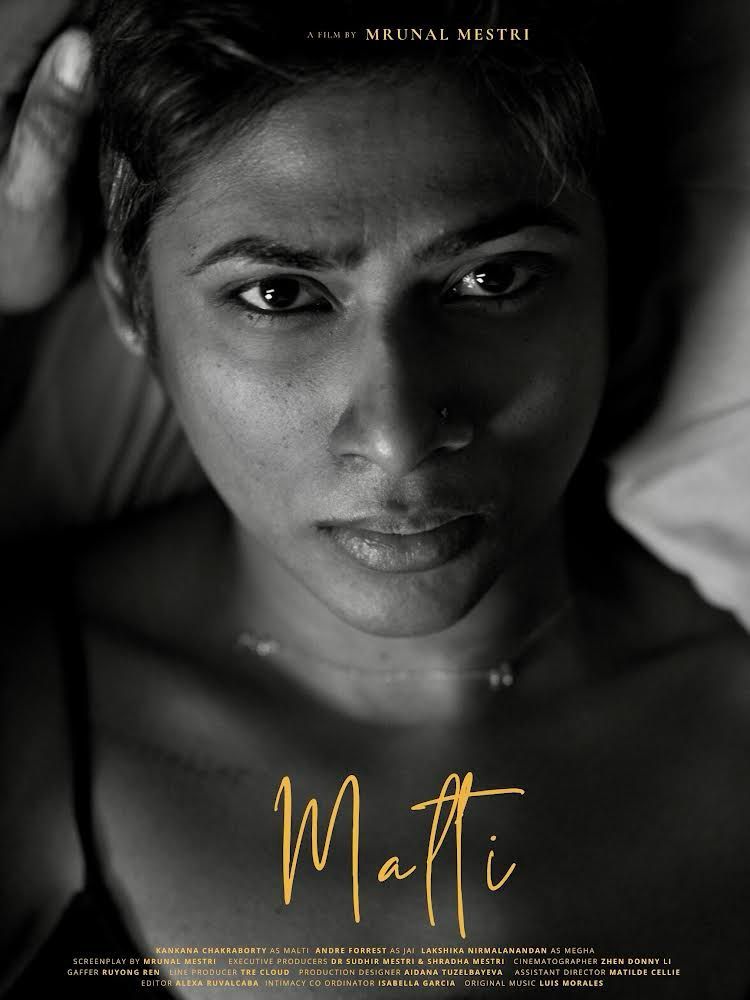
The film “Malti” opens with a woman in her thirties entering a house. Two framed photographs adorn the walls: one capturing a girl receiving a ring (a marriage proposal), the other depicting her embracing a man (indicative of marriage). Limited information about the woman is provided. She returns home, takes a bath, and searches for clothes in the closet. As she touches a man’s robe, her expression reveals a desire not for the fabric but for the man within. The emotion is palpable, deepened by a melodic accompaniment. It becomes apparent that the robe belongs to her beloved, and through it, she senses his presence. Selecting another robe, she detects a scent, halting her humming; the joyous closeness on her face dissipates, replaced by a pained question mark.

This sets the tone for the film. Mrunal Mestri, the writer-director of the sixteen-minute film ‘Malti,’ explores the emotions of a newly married woman discovering her husband’s proximity to another woman. While such narratives are not novel in cinema, the film’s real strength lies in the innovative approach taken by the writers and directors in visual storytelling.

The heroine sings at the film’s outset, offering no linguistic cues. Once the humming ceases, the film remains entirely devoid of audible sounds and dialogue—a dialogue-free cinematic experience. The director adeptly compensates for the absence of dialogue by strengthening the visuals to convey the narrative effectively. The primary crisis of the story is introduced within the first two minutes, a testament to the director’s skill. By isolating the woman inside the house, the director successfully immerses the audience in the protagonist’s emotional turmoil. The actress’s gestures convey her anticipation of her husband, evidenced by a smoky candle lit at night. While intimacy is shared in bed, her face betrays no interest, with only the presence of the other woman reflected in her eyes.

The film, presented in black and white, employs shadows and lights aesthetically to complicate scenes. Zhen ‘Donny’ Li’s camera work contributes to the film’s allure, with certain long shots effectively expressing the emptiness within the woman’s mind. Luis Morales’s background music enhances the film’s appeal, while Alexa Ruvalcaba’s editing skillfully balances the mood and pace of the story.

The director’s choice of a talented actress, Kankana Chakraborty, proves pivotal to the film’s success. Without any dialogue, Chakraborty eloquently communicates the subtle emotions of disbelief, surprise, distrust, and pain through facial and body expressions. Two standout moments include her poignant reaction while smelling the shirt and her solitary contemplation at the dining table. The actress seamlessly embodies the character, and a lion’s share of this credit is due to the director for this achievement.

The film tackles a complex theme, utilizing all elements of filmmaking proficiently to achieve its intended impact. Maintaining the delicate balance among numerous aspects is challenging, yet director Mrunal Mestri succeeds admirably. Although the name ‘Malti’ is presumed to refer to the film’s heroine, the film itself, devoid of dialogue, refrains from explicitly naming her. After viewing the film, one might ponder the choice of the name Malti. Perhaps, like the flower, the film ‘Malti’ is diminutive yet leaves an enduring appeal, akin to the fragrance of the flower.

Key words #utpal_datta #Kankana_chakrabarty, #Malti, #Mrunal, #short film


The story of an ice-cold relationship

Film review | Utpal Datta

It’s approaching evening, and a woman in her forties is seated in her house, engrossed in a video conference on her laptop. The phone rings, prompting her to step out of the conference to take the call. Her facial expressions and tone shift to a mundane and unwanted conversation. After the call concludes, she re-enters the conference, restoring a smile to her face. This marks the beginning of the film, subtly expressing that the woman inhabits two distinct worlds. An evocative entrance unfolds, inviting viewers into the film.

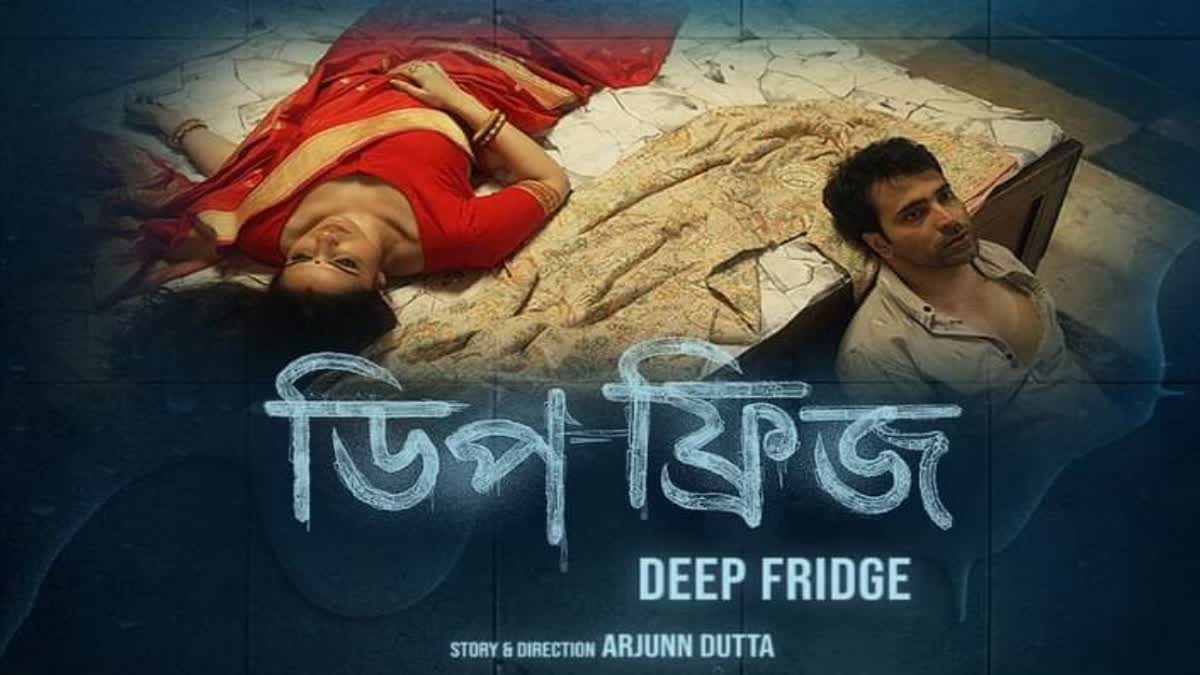
Titled ‘Deep-Fridge,’ this Bengali film hints at a section of the refrigerator where ice quickly forms. The name unmistakably suggests an urban theme. The narrative revolves around the relationship between two individuals – Mili, the woman introduced first in the film, and her husband Swarnava, both divorced. They share a child named Tatai, who resides with his mother. Tatai’s father has remarried and is anticipating another child. When the father visits, and Tatai reciprocates, his father’s second wife, Ronja, establishes a warm bond with him.

The initial scene’s conversation unveils Mili’s assumption of full responsibility for Tatai, with Swarnava equally invested. On that stormy evening, Swarnava visits to inquire about the child’s health. Reluctantly, both individuals engage in conversation, focusing on the child’s well-being. The child persuades his father to stay the night, and with no alternative, they hesitantly begin talking, gradually revealing the thoughts concealed in their hearts. The accumulated ice between them, preserved in the deep freeze for so long, begins to thaw.

Their marital happiness is disrupted when a third party enters, altering the course of their lives. While such narratives are commonplace in films, Arjun Dutta’s approach is distinctive. Swarnava marries a close acquaintance and is expecting children, while Mili falls in love with a younger man. Despite their intimate relationship being acknowledged by the boy’s family, Mili is hesitant to formalize it. She confides in her male friend, describing this intimacy as a form of escape. The film explores why Mili, who voluntarily embraces a free life, perceives this connection as an escape. As the daughter of a broken relationship, Mili harbours disdain for her mother, preventing her entry into her home. Despite Swarnava’s repeated apologies, Mili remains dissatisfied.

Lead Actors Abir Chatterjee and Tanushree Chakraborti

The film unravels the complexities on that rainy night, delving into various aspects such as questions, pride, conflict, sense of rights, responsibilities, and more, providing Mili with answers. It’s a portrayal of the ice in the mind, needing to melt and flow like water for life to progress.

While the film primarily addresses personal issues, the director’s adept storytelling elevates it to a profound exploration of the human psyche. Presented against the backdrop of a rainy night, the film captures the gloomy mood of the protagonist living in a confined space. Events unfold indoors, often in low light or even complete darkness, while flashback scenes bask in bright light, indoors and outdoors. Cinematographer Supratim Bhol skilfully utilises light and shadow to intensify the prevailing sense of claustrophobia. Capturing facial expressions in low-light situations is challenging, yet Supratim adeptly manages, maintaining the scene’s mood. The blue colour effect harmonises indoor scenes with the prevailing mood. The flashback scenes, featuring Mili in a bright red saree, visually symbolize her strength. In a morning scene following a troubled night, the sunlight delicately highlights the actor’s body and the room’s interior, showcasing the filmmaker’s sensitivity.

In this 100-minute film, Tanushree Chakraborty, portraying Mili, seizes the opportunity to express diverse emotions, perceptions, and reactions. Her nuanced performance, marked by restraint and avoidance of exaggeration, positions her as a potential contender for film awards. Abir Chatterjee, in the role of Swarnava, delivers a natural performance. The complexity of the principal character’s emotional journey is navigated with skill, given Abir’s experience. However, the kissing scene between Abir and Tanushree feels mechanical and hesitant, contrary to its narrative demand. Anuradha, playing Ronja, impresses with evident improvement as an actress.

The film alternates between the present and the past, with the present progressing chronologically and past scenes interjecting sporadically. Editor Sujay Dutta Roy adeptly manages this intricate pace transition.
The Western music used as background music complements the film’s urban setting. Music director Soumya Rit seamlessly incorporates Indian Classical and Folk music as per scene and mood requirements. The sweet songs, especially the one composed with a blend of Mallar and Bhairavi ragas (Gagne Garaj Barse), stand out for their unique fusion and ability to enhance visuals. The singer Mekhla Dasgupta deserves special mention. However, the inclusion of Kaviguru Rabindra Nath Tagore’s name as a lyricist in the film’s credit title seems unjustified. Tagore did not write songs for Arjun Dutta’s films; Dutta used uncopyrighted songs for his work. Tagore’s name should be mentioned with proper dignity and respect, a practice observed in many Bengali films.

The screenplay (Arjunn Dutta and Ashirbad Maitra) could have benefited from greater attention to character development with visual details. While Swarnava’s profession is labelled as an economist, this alone falls short in establishing his credibility. Characters visiting Mili’s home needed more contextual references to firmly establish their identities. A brief verbal introduction proves insufficient for character identity establishment.

In his gentle and nuanced narrative, Arjunn Dutta gracefully unfolds the story of a divorced couple. As a suggestion for future endeavours, expanding creative horizons beyond the confines of upper-middle-class society could add a layer of richness to cinematic encounters.

Tags #Utpal Datta #Arjunn Dutta #Deep Fridge #Film criticism #Bangla Film