“Gandhari: Beyond the Blindfold” — A Powerful Theatrical Experience of Pain, Resistance and Inner Turmoil
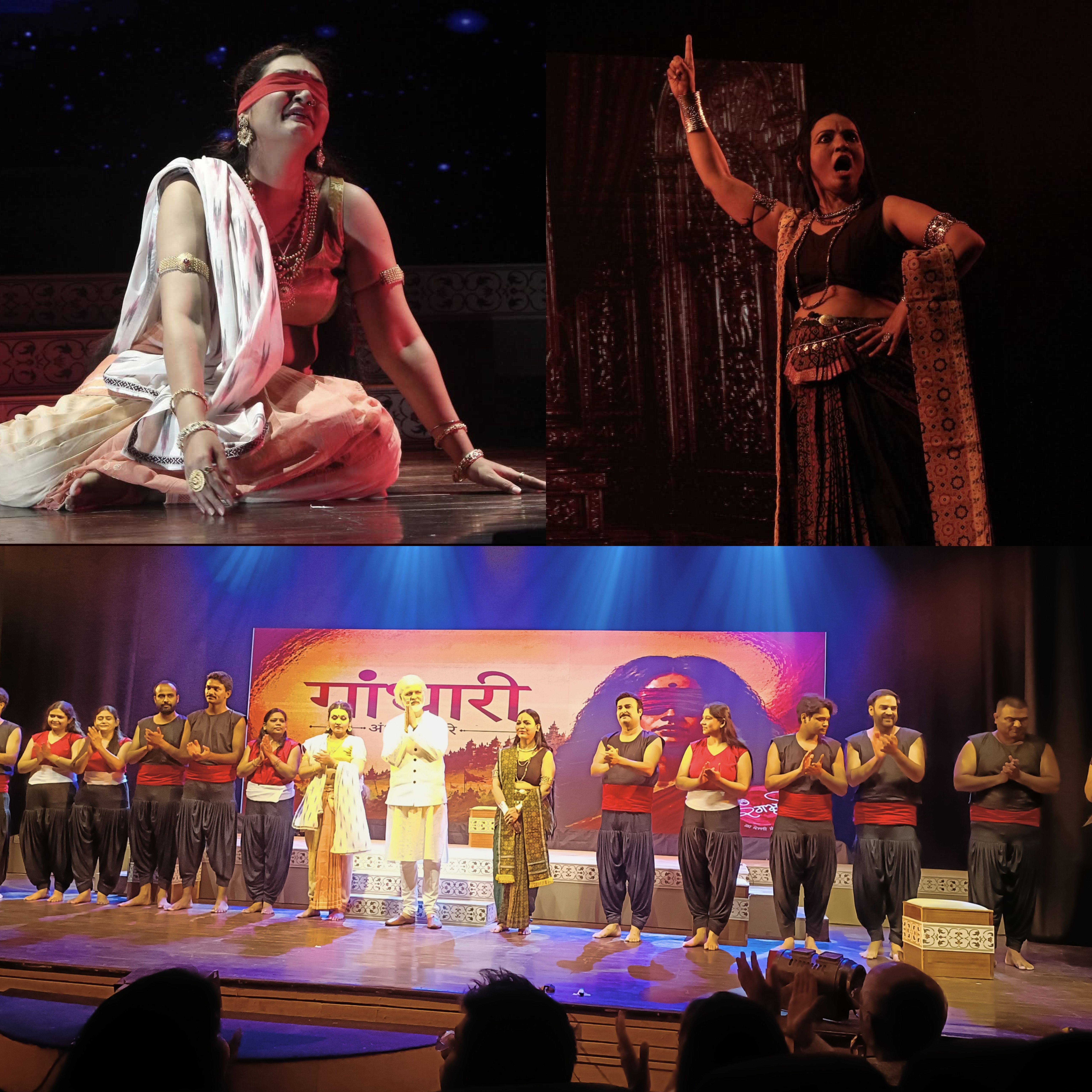
On 22 May 2026, at the iconic in Mandi House, Delhi, Rangbhoomi Delhi presented “Gandhari: Beyond the Blindfold”, a deeply moving theatrical production that transformed the epic narrative of the Mahabharata into a profound exploration of womanhood, grief, motherhood, silence, and resistance.
The auditorium was completely packed, and from the very first moment, the performance created an atmosphere of intense engagement and emotional anticipation. The audience remained immersed throughout the production, experiencing every moment with complete stillness and attention.
A Beautiful and Immersive Opening
The play opened with a visually mesmerizing scene. Gandhari sits on the stage holding a Veena, and as the soft, soothing notes of the instrument slowly begin to resonate through the auditorium, a serene and emotionally rich atmosphere takes shape. The delicate melody beautifully reflects Gandhari’s pure, graceful, and compassionate inner world.
The music does not simply introduce the play — it gently draws the audience into Gandhari’s emotional universe. Soon after, the Sutradhar enters, and the narrative begins unfolding layer by layer. It was an opening filled with poetic beauty and theatrical sensitivity.
The Vision of J.P. Singh / Jayvardhan
The greatest strength of the production lies in its writing and direction. J.P. Singh, who writes under the pen name Jayvardhan, deserves immense appreciation for creating and directing such an emotionally layered and symbolically rich theatrical experience.
His direction proves that meaningful theatre is not dependent on elaborate sets or spectacle, but on emotional truth, rhythm, symbolism, and sensitivity. Every movement on stage, every silence, every pause, and every transition appears carefully crafted.
The symbolic treatment of characters, the restrained performances, the use of masks, music, lighting, and stage movement together create a theatrical language that feels both poetic and deeply human. The actors are able to perform with such emotional depth because of the clarity and precision of the director’s vision.
Rather than presenting the Mahabharata as a grand mythological spectacle, J.P. Singh focuses on the emotional and psychological suffering hidden within its characters — especially Gandhari. This approach gives the production contemporary relevance and emotional intensity.
Anamika Sagar as Gandhari — The Soul of the Production
If the production has a heartbeat, it is undoubtedly Anamika Sagar’s portrayal of Gandhari. Her performance is deeply internal, emotionally restrained, and extraordinarily powerful. She transforms Gandhari from a mythological figure into a living, breathing woman filled with pain, dignity, helplessness, anger, and maternal grief.
Her body language, vocal depth, expressions, and even her silences communicate volumes. There are moments when she says nothing, yet the audience can feel the emotional storm raging within her.
The most unforgettable sequence comes after the war, when Gandhari mourns the death of her hundred sons and her suppressed anger toward Krishna finally erupts. The scene is emotionally devastating.
Anamika Sagar portrays the unbearable pain of a mother shattered by loss with such honesty and intensity that the entire auditorium falls silent. Her grief feels real, raw, and deeply human. The emotional impact of the scene sends chills through the audience, while many viewers are left visibly teary-eyed.
What makes her performance exceptional is that she balances Gandhari’s tenderness and rage with remarkable control. She never overacts; instead, she allows the pain to emerge gradually from within, making the character unforgettable.
Tripti Johri’s Transformative Performance
As the Sutradhar, Tripti Johri delivers a remarkable and highly versatile performance. She not only narrates the story but also embodies multiple characters from the Mahabharata, including Kunti, Sanjay, Draupadi, and the maidservant.
Without relying on elaborate costume changes, she differentiates each character through voice modulation, body movement, rhythm, and expression. Her transitions between characters are smooth, convincing, and emotionally engaging.
Her portrayal of Draupadi is particularly striking. The emotional intensity in those scenes is so powerful that it repeatedly sends shivers through the audience. The pain, humiliation, anger, and emotional vulnerability expressed through her performance leave a deep impact, and several moments visibly move the audience to tears.
Masks, Symbolism and Visual Language
Another remarkable aspect of the production is its symbolic visual design. Several characters appear wearing masks, transforming them into representations of power, violence, emotional blindness, and the dehumanizing effects of war.
The symbolic staging gives the play a haunting philosophical depth and creates striking visual imagery without relying on excessive theatrical decoration.
In the play Gandhari, The Female Visual Group included Poonam Singh, Mansi Brar, Shreeya Kumar, Sangeeta Suyal, and Jyotsna Chakrabarty, while the Male Visual Group comprised Arun Sode, Ravi Parcha, Jitender Chauhan, Pawan Chauhan, Bhanu Sethi, Kaustubh Pandey, Anurag Malik, Atul Dhingra, and Prithviraj Chauhan.
Lighting and Music as Emotional Forces
The lighting design was exceptionally beautiful and atmospheric. The interaction between darkness and focused light reflected the psychological states of the characters with remarkable precision.
Music by Bharati Dang was truly remarkable. From the very beginning, the soft and soothing notes of the Veena created an atmosphere of serenity and emotional depth inside the auditorium. The gentle melody beautifully reflected Gandhari’s graceful and compassionate inner self.
As the narrative progressed, the music evolved alongside Gandhari’s emotional journey — carrying her silence, sorrow, motherhood, helplessness, and inner conflict with extraordinary sensitivity. Rather than functioning merely as background sound, the music became an emotional extension of the characters themselves.
In several moments, the music seemed to breathe with the actors, enhancing the emotional depth of every scene and enriching the poetic texture of the production.
The backstage team featured Akhya Jaywardhan for Design & Publicity, Costume Design, and Visual Concept, while Ved Phoja managed Set Execution, Harish Kholia was responsible for Makeup, and Atul Mishra handled Light Execution. Costumes were managed by Dalchand, and Visual Projection was created by Sanobar Bari. Videography was handled by Noor Khan, Photography by Ansh Jaywardhan, and Props by Jitender Chauhan and Akhya.
The Production Assistants were Pawan Chauhan and Ravi Parcha, Public Relation was managed by Amar Saha, and the Box Office team included Gaurav Verma, Vashisth Upadhyay, Jatin Joshi, Rakesh Sharma, Naman Bharadwaj, and Jyoti Upadhyay. The Stage Manager was Arun Sode, while Jitender Chauhan served as the Assistant Director. Together, the entire cast and backstage team made Gandhari a memorable theatrical presentation.
A Theatre Experience That Stays With You
“Gandhari: Beyond the Blindfold” is far more than a retelling of the Mahabharata. It is a deeply human story about motherhood, trauma, silence, feminine resistance, and emotional survival.
Through the combined brilliance of Jayvardhan’s writing, J.P. Singh’s direction, Anamika Sagar’s hauntingly powerful performance, Tripti Johri’s transformative acting, and Bharati Dang’s emotionally resonant music, the production becomes an unforgettable theatrical experience.
This is the kind of theatre that does not end when the curtain falls — it remains alive within the audience long after they leave the auditorium.